
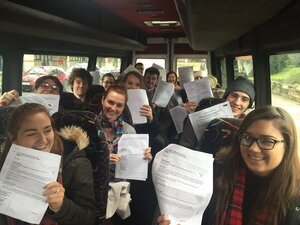
This afternoon.
Students from Maynooth Students’ Union on a bus to Leixlip in order to register ahead of the general election.
Democracy.
Mmf.
Previously: Home To Vote (Part 2)
Via Síona



This afternoon.
Students from Maynooth Students’ Union on a bus to Leixlip in order to register ahead of the general election.
Democracy.
Mmf.
Previously: Home To Vote (Part 2)
Via Síona
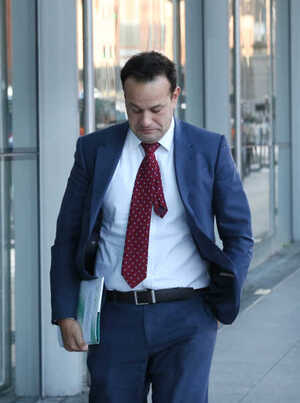
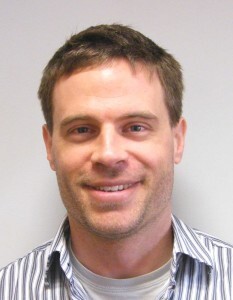
From top: Minister for Health Leo Varadkar; Dr Julien Mercille
Leo Varadkar’s views on hospital overcrowding and abortion shows he is not fit to be Minister for Health.
Dr Julien Mercille writes:
This weekend, Niamh Horan in the Sunday Independent had a great interview with Minister for Health Leo Varadkar (see also the related article here).
Ms Horan seems to have a knack for extracting nuggets of information from politicians, having done the same last week with macho-man Alan Kelly from Labour, who boasted that “Power is a drug… it suits me”.
Leo made a number of astonishing claims that cast serious doubts about his understanding of health and health care. In other words, the interview proved that it’s not because you’re Minister for Health that you know anything about health.
First, he stated bluntly that cutting resources to hospitals was a good thing.
You would have expected that a pro-austerity Minister well-trained by public relations advisers would have said something like “Listen, I know cutting funding to hospitals is not good, but we don’t have a choice”.
But no, he said he does like the policy of cutting funding to hospitals because he thinks it makes nurses and doctors work more efficiently when they’re under pressure. Leo said:
“What can happen in some hospitals is sometimes, when they have more beds and more resources, that’s what kind of slows it down.”
Really? And why is that?
“Because they [hospital staff] don’t feel as much under pressure. So when a hospital is very crowded, there will be a real push to make sure people get their X-rays, get their tests and, you know, “let’s get them out in four days”.”
Nevermind if they need more than four days, they get out in four, and we push the problems down the line as usual, when those people will come back to the hospital because they were discharged too quickly and they haven’t healed properly, and their condition may even have worsened.
What Leo said is simply not true, as anybody working in a hospital will tell you. When you’re under pressure, you speed up, and you make mistakes and you cut corners. Medical staff work with people’s lives and they need to take the time needed to do what needs to be done.
I can hardly imagine Leo himself on the operation table telling the surgeon and his assistants: “hurry up you don’t have time to do it 100% because you need to go meet other patients”.
Nevertheless, Leo made the incredible and wrong claim that “more beds and more resources do not relieve overcrowding” in hospitals.
Well, yes: more beds do relieve overcrowding, by definition.
It is true, however, that more funding is not the only solution to the health care system. The main problem is the type of system we have.
Anybody working on health care needs to know something: a tax-funded public health system like the NHS in the UK is the best system that exists and it is what we should aspire to. It is both cheaper and it is better for health.
The reason is that in privatised systems, there is a lot of bureaucracy involved and that’s very expensive. Armies of clerks and office workers need to compute the price of every treatment, process claim forms, reject claim forms to try to save money for the insurance company, send glossy letters to insurance policy holders, etc. All that costs a lot of money and this is why private for-profit systems are more expensive than public ones. It’s very well-established through health policy research.
There is therefore no reason for Leo not to know that. Why is he privatising our system then? It’s not because people want that.
Indeed, the one issue that is the most important to Irish people, poll after poll, is health care. Therefore, the government is completely at odds with the population in that it acts to worsen the trolley crisis, cut funding to our hospitals, increase crowding in our hospitals, and privatise the system even if this is amounts to a waste of money.
The second point Leo made in the interview is about abortion. Niamh Horan pushed him but he simply refused to give any answer that would mean that he wants to liberalise abortion laws significantly.
Leo has stated that he is “pro-life”—that means, cutting through the spin, “anti-choice” or “pro-the government deciding for women and their partners what’s best for them”.
This means that the Minister of Health does not want health care in this country to provide an important service for women’s health.
In fact, it appears that Leo doesn’t even understand the issue of abortion. Here is the exchange with Niamh Horan:
Niamh Horan: “Do you believe abortion in Ireland is a class issue?”
Leo Varadkar: “No [laughs]. I don’t know what that question means.”
Horan: [I explain that a woman who is wealthy and can afford to travel to the UK has greater access to a safe abortion and medical care than a woman who has no access to similar funds]
Varadkar: “No, I don’t think it’s a class issue.”
In sum, what the above reveals is not so much ideological differences as a failure to know and understand the basic facts about health and health care. If we agreed on the basic facts but had an ideological argument, at least, we’d all be living in the real world. But here we have a more fundamental problem with getting the facts straight.
It reveals incompetence of the highest order.
A Minister for Health who believes that overcrowding is a good thing and that refuses to provide abortion services like everywhere else in the Western world is not a Minister of Health.
Julien Mercille is a lecturer at University College Dublin. Follow him on Twitter: @JulienMercille
But interesting nonetheless.
Rocky writes:
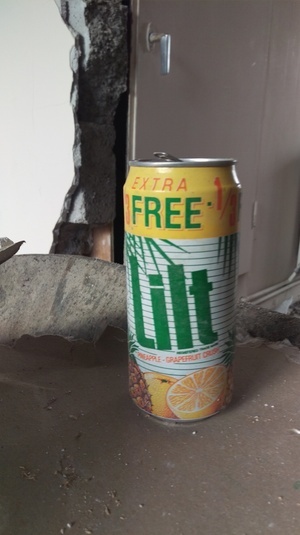
A Lilt-le bit of renovation unearthed this (from 1994). It has the 1/3 extra free which you don’t see on Lilt cans these days. 440ml total for the price of 330ml. But definitely a narrower can.


Labour canvassers in Meath
The Crack Site writes:
“Here is our guide to dealing with canvassing career politicians during the election… It may be absolutely futile, but if we want politics to change we need to try something new…”
1. Whenever your doorbell rings between now and the election take a big deep breath before answering it.
2. If it is a career politician remind yourself that beneath their politician exterior there is a human being in there somewhere.
3. Avoid discussing their party’s proposals for the future. (Experience tells us these are nothing more than a hastily put together list of things that their team of marketers thinks you want to hear, and will more than likely never be acted on)
4. Ask about when they first ran for office and what drove them to it.
5. Sympathise with them as a person who is in a horrible job that would wear anyone down.
6. Encourage them to ask themselves whether the passion that drove them to start as a politician is still there, and whether or not there could be someone more suited to the job.
FIGHT!
A guide to dealing with canvassing politicians (The Crack Site)
Sam Boal/Rollingnews

 The
The
From top: Regency Hotel in Drumcondra, Dublin, after last Friday’s shooting; Manager John Glynn
In a statement to the BBC this morning, a man alleging to speak on behalf of Continuity IRA said its members were responsible for the shooting in The Regency Hotel last Friday which left David Byrne dead and two men seriously injured.
The statement claimed Mr Byrne was shot because he had been involved in the killing of Alan Ryan in Dublin four years ago.
Further to this…
In a pre-recorded interview for RTÉ’s News At One, Áine Lawlor spoke with the managing director of The Regency Hotel, James McGettigan, who witnessed the shooting.
James McGettigan: “I was in the hotel bar with the general manager of the hotel, running through the business of the weekend. We had a very busy weekend, the hotel was full. We had a lot of Welsh rugby supporters over and we had Brendan Grace, who was playing for two nights so that was all booked out and the next thing is, there was commotion out in the reception area. There was sort of a panic. And within then maybe 15 seconds, three uniformed gardaí came in to the bar area and told everyone that this was the gardaí, to lie down on the floor and put your hands behind your heads.”
Áine Lawlor: “And you’d no reason to believe they weren’t gardaí at that stage?”
McGettigan: “Absolutely no. I mean these, they had the full Garda uniform. I mean they were very calm, very collected. I thought there was either an imminent robbery about to take place and the gardaí were about to thwart it or there was somebody in the bar that had done something somewhere else and the gardaí were about to, you know, arrest the person or something like that.”
Lawlor: “So they told people to lie down, they seemed very calm and collected. What happened then?”
McGettigan: “What happened then was there was a couple of shots fired. And then I saw a man just through a window in the bar basically getting assassinated. And that was just very, very shocking to watch. Because it happened so quickly and at this point, I really didn’t believe these guys were guards because the man beside me, who had a massive rifle – I don’t know what type it was – he basically, you know, he was basically looking at me and I was looking at him a little bit and, you know, I didn’t know if this was the real guards or not. But I started to believe that they weren’t and I started to panic. So then he disappeared and I went to the front door of the hotel to see if there was squad cars out there because I didn’t believe they were guards and this man is lying on the ground with blood pouring out of his head and I wanted to try and help him or save him or something. And when I went to the front door and opened it, I got a bit of a sinking feeling when I saw there was no cars out there at all, there was nothing.”
Lawlor: “So at this stage you know the real guards aren’t on your premises. You have these gunmen on your premises, presumably you want to contact the Garda Síochána?”
McGettigan: “Yes, that’s correct, yeah. And I ran down then, well ran, I walked down to the residents’ lounge of the hotel, I closed the door, I told this girl I met on the way who was an employee, I told her to immediately ring the guards and she said, the guards were already here. And I said, they’re not the guards. Went into the room and I slammed, closed the door and I locked it. There was a banging on the door afterwards, I don’t know who it was but I wasn’t going to open it to find out who it was and then I did try and contact the guards. Well when I rang 999, it was just a busy tone or it was a voice saying it was busy or something like that, I can’t remember exactly but I couldn’t get through. Now there may have been other people trying to ring at that point, I don’t know. But, look, you know, it was just very worrying not to get through you know? And, you know, I wanted to try and get these guys apprehended immediately. But I did eventually get through and…”
Lawlor: “How long did it take?”
McGettigan: “It took the third phone call so maybe, I don’t know, maybe 30/40 seconds?”
Lawlor: “So you got through and that stage. And what was the response from the garda when you finally got through?”
McGettigan: “Well the person I spoke to on the phone, I explained what happened, and he then said, ‘I’ll put you through to the Dublin division’. Then I could just hear the phone ringing and ringing and ringing out for, I don’t know, maybe 20/25 seconds. And twice he came on and said, ‘look they’ll answer, they will answer eventually,’ or ‘they’re about to answer’ or something like that. So, like 25 seconds seemed like an eternity for me now. I don’t know why that was.”
Lawlor: “Was all of this, I mean, you know, these aren’t huge delays but equally there’s a you know, there’s murder on your premises, there’s gunmen roaming around the place dressed as gardaí, did you have any sense in that time that you were able to get the help you needed from the security forces as quickly as you needed?”
McGettigan: “I don’t know what was happening. I just, there was a man outside, in the lobby, on the ground, with blood coming out of his head and all I wanted to do was try to help that person, that was all I was trying to do and I thought that we could probably try and maybe get these guys arrested. But I did then ring a detective I know on his mobile and he, he answered straight away and said he would get somebody out and I think, within, I stayed in that room then, I don’t know, within about two, two and a half minutes, the police had arrived.”
Lawlor: “And as you say, it’s a couple of days later and it was an horrific experience for everyone who was there and so many people in the country, even if they’re not Dubliners, they all know the Regency Hotel, it’s such a landmark, it’s so ordinary and what happened was so extraordinary.”
McGettigan: “Absolutely yes, you know, and the real worry was, I mean I didn’t know, I mean, how many people could have been, you know, certainly shot at – least of all myself for being pretty stupid. But, you know, I thought the person who was shot, I didn’t know who he was but he was just a guest in our premises so we were trying to just, you know, take care of him.”
Lawlor: “As one human being to another.”
McGettigan: “Correct.”
Listen back in full here
Previously: Getting The Shot
Sasko Lazarov/Rollingnews
Update:
Senior Irish republican source insisted @Channel4News the Dublin shooing is criminal, not genuine IRA in any form
— alex thomson (@alextomo) February 8, 2016
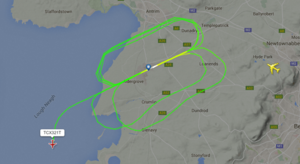
Tadhg Ryan tweetz:
Something strange going on around Belfast International Airport #flightradar.
Anyone?

Earlier today.
At Dogpatch Labs in the CHQ Building in Dublin where Fine Gael launched its Better Services whatsit.
Taoiseach Enda Kenny listens to Black Eyed Peas apparently.
It’s not a caption competition until…
Mark Stedman/Rollingnews
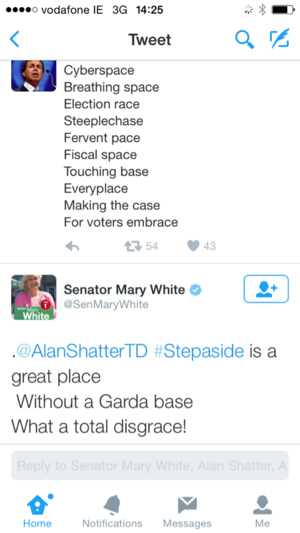
Elfordo writes:
“Senator Mary White ‘OWNS’ Alan shatter in rap off #stepaside”
FIGHT!

Sinéad writes:
“I left my phone – a black Sony Z3 (like the one pictured above) – in a taxi on Thursday evening. I got the taxi from Donnybrook to Harcourt Street in Dublin and realised I didn’t have it five minutes after I got out of the taxi, and immediately began ringing it. It’s still ringing so it must have been charged as its battery should have died by now. I have been able to track it to its approximate location but I’m at a loss as to what to do. Other readers must have had this issue – seems a waste to cancel and replace as it’s somewhere!!”
Anyone?
