

Two chainsaws either side of a barbed sword.
*shudder*



Two chainsaws either side of a barbed sword.
*shudder*


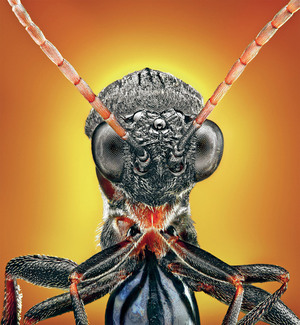

 Animal Earth is a 320 page book featuring extraordinary photographs of some of the world’s most obscure and eye-candiful species compiled by a panel of animal specialists and researchers.
The book, published by Thames and Hudson will be released mid November.
Above: the ‘sea angel’, Clione limacine (pic: Alexander Semenov); a toxic nudibranch sea slug Chromodoris annulata (pic: Arthur Anker); a Bougainvillia superciliris jellyfish with a hitchhiking Hyperia galba amphipod (pic: Alexander Semenov); the compound eyes of a cynipid wasp (pic: Tomas Rak); the colourful tentacles of a tube-dwelling serpulid polychaete and a segmented annelid (both pix: Alexander Semenov).
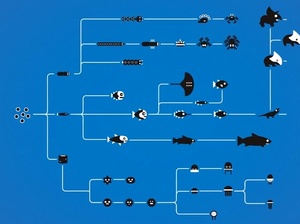

All the complex mechanics of evolution adorably summed up in under 12 minutes – designed by Phillip Dettmer and animated by Jacques Alomo.


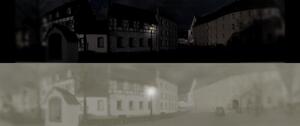
 Artist Nickolay Lamm (he of Average Guys) consulted with animal eye specialists and ophthalmologists at the University of Pennsylvania’s veterinary school to visualise how cats (lower pix) see the world compared to humans (upper pix).
The blurry edges of the vistas represent cats’ enhanced peripheral vision. Elliptical pupils and greater concentration of rods in the retina means that their night sight is also superior, but cats have poor distance vision and can see blue and yellow colors, but not red, orange or brown.
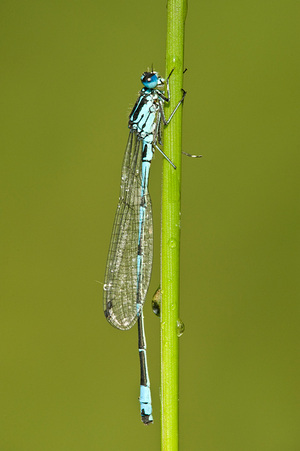
 A Blue Damselfly climbing up a stem, captured by wildlife photographer Tony Flashman in 2011.

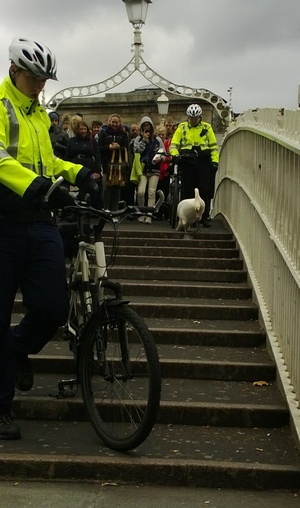
Sara Murphy writes:
A disorientated swan got an escort across the [Ha’penny] bridge [Dublin, yesterday] from two slightly nervous looking guards and drawing a gaggle of paparazzi behind them.


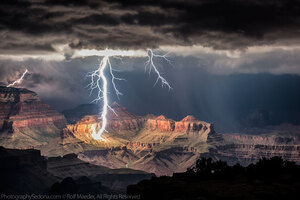 Incredible 25 second exposures of a lightning storm at the east end of Arizona’s Grand Canyon captured last month by photographer Rolf Maeder.
Here’s how he edited the print.
 Port cats awaiting the return of fishing boats somewhere in Japan (photographer, date and exact location unknown).

Conservation scientist Luke Dollar from National Geographic’s Big Cats Initiative narrates a decisive predator versus predator encounter in Brazil’s Pantanal wetlands.
