Category Archives: News

news as it is happening-ish

0006fb66-642


In 2004, Karl McCaughley was employed as an agent of Cork City Council to distribute parking discs and bin tags and to collect payments from retailers.

Within a year, he came to the attention of the internal audit department of Cork City Council.

This eventually lead to an audit by Pricewaterhouse Cooper in 2009 and a garda investigation.

During a search of Mr McCaughley’s home, Gardai gave evidence of the accused having six luxury cars at his address (including two Porsches, two Mercedes SUVs and a Land Rover).

In March 2012, McCaughley appeared in Stubbs Gazette as the council registered a separate judgement against him for €925,000.

According to The Phoenix magazine, the council agreed to an installment scheme of €25 a week which would mean it would be 2721 before the bill was settled.

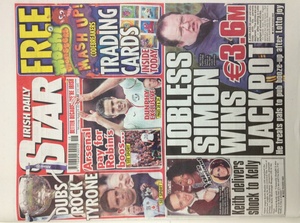
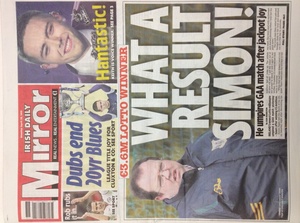
Mr McCaughley pleaded guilty to 28 charges of theft, deception and fraud totalling €124,000 in October 2012 and was sentenced to three years today.

In evidence, McCaughley said he “100% apologised” and he wanted to repay the council, but to date just €26,000 has been repaid.

And thanks to the guilty plea, Cork City Council is not required to give evidence in court of its auditing practices.

Result.

City council scammer had several luxury cars (Liam Heylin, Irish Examiner)

Businessman pleads guilty to deception, forgery and theft (RTE News)

(RTE)

pbbk

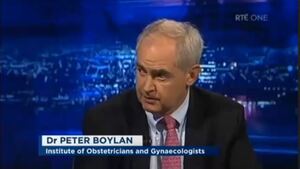
Dr Peter Boylan’s encounter with Breda O’Brien on Radio One last week wasn’t his first time spreading his blasted ‘facts’.

He was also involved in this merciless exchange on ‘Prime Time’ in November with Dr Berry Kiely, medical advisor to  the Pro-Life Campaign. (Scroll to 12:10)

Dr Berry Kiely: “Sorry. Can I just clarify there, Peter? Because I was looking at the Institute of Obstetricians and Gynaecologists website today and they have guidelines for the management of miscarriage em..in pregnancy…”

Dr Peter Boylan: “Not threatened miscarriage though. That’s different you see. There’s an awful lot of confusion about this. Miscarriage, threatened miscarriage, abortion, mixed abortion and so on.”

Kiely: “But they do talk about incomplete miscarriages which we are told is what happened in this case.”

Boylan: “That’s where the baby has died and the tissues have been passed and there’s remaining tissue. That’s what an incomplete abortion is and you should know that, Berry.”

Kiely: “Yeah, no but what they’re what they’re talking about in these guidelines is that they say you have conservative management you have medical induction of labour and you have..”

Boylan: “This is talking about really really early miscarriages, six or seven weeks which is completely different. This is muddying the waters here.”

Kiely: “Imagine, Peter. I think perhaps that’s not being fair here.”

Boylan: “No.”

Kiely: “I don’t think there is anything from any of the other obstetricians I have talked to. None of them seem to make that tremendous distinction you’re making. They’ve all agreed…that yes…”

Boylan: “Well you’re not talking to the right people.”

Kiely: “Oh.”

Previously: Dr Peter Boylan and Breda O’Brien: The Transcript

BI73O2rCUAAzhSvOr ‘trendy’ bottled water (as is often the case on these occasions).

To coincide with the EU conference on Gender Equality taking place in Dublin Castle today.

Therese Caherty writes:

Action on X will be at the City Hall Plaza from 6pm to demand that the government legislates to ensure women get equal medical treatment to men: the right to any treatment needed to protect their lives. Speakers include Clare Daly TD; Ailbhe Smyth, Action on X; Rachel Doyle, National Women’s Council of Ireland; Maire Mulcahy, ICTU Women’s Committee; Rhonda Donaghy of SIPTU; Peadar O’Grady of Doctors for Choice and others from AkiDwA, Terminations for Medical Reasons and Abortion Rights Campaign.


Thanks Niamh Puirseil

Juliendavid_on_primetime_2003KellyFor the rest of YOU.

No Mercille!

You might recall last week’s post concerning Dr Julien Mercille (top), of University College Dublin and his report into the Irish media and the property bubble.

His academic paper claims that organisations such as the Irish Times, The Independent group and RTE helped stoke, sustain – and ultimately fail to warn people about the dangers of – the bubble.

Having now read  the report.

It wasn’t all bad news..

Dr Mercille (who has given us permission to quote from his findings), writes:

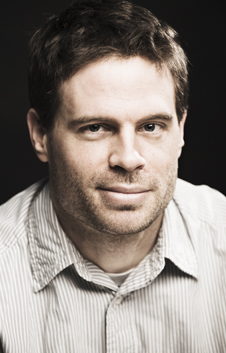
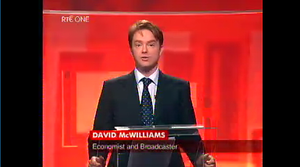
“In Ireland, economist David McWilliams (centre) warned unambiguously about the unsustainability of the boom as early as January 1998, when he wrote that ‘fundamentals count for nothing if your house is built on a bubble’ and pointed to the fact that mortgage lending in Ireland ‘has been growing at 15 per cent per annum for the past four years. This cash has been funnelled with the help of significant fiscal incentives, into bricks and mortar, pushing, as we all know, prices through the roof. On top of this, general credit in the economy is up more than 20 per cent in 1997 alone. A quick glance at property prices suggests that we are definitely entering asset-price bubble territory’. Until the crash, McWilliams has been one of the few analysts in Ireland to warn publicly and explicitly about the growing housing bubble and its eventual collapse. Another Irish analyst to have done so is Morgan Kelly (above). He looked at nearly 40 property booms and busts in OECD economies since 1970 and showed that there is a strong relationship between the size of the boom and ensuing bust: typically, ‘real house prices give up 70 per cent of what they gained in a boom during the bust that follows.”

“Kelly observed that, between 2000 and 2006,house prices in Ireland had doubled relative to rents, while the price-to-income ratio had also significantly outpaced its historical level. This showed that Irish property prices were no longer sustained by fundamentals such as rising employment, immigration or rising income. He predicted a fall in real house prices of ‘40 to 60 per cent over a period of 8 to 9 years’, which seems relatively accurate as of this writing.”

But.

The prevailing mood was such that:

“Marc Coleman, the Irish Times economics editor, wrote as late as September 2007 that: ‘Far from an economic storm – or a property shock – Ireland’s economy is set to rock and roll into the century’. In fact, ‘Ireland enters the 21st Century in a position of awesome power’.

[Of Brendan O’Connor’s June, 2007 Sunday Independent column: ‘The Smart, Ballsy Guys Are Buying Up Property Right Now’] “(The article was) urging Ireland’s readers to buy property, saying himself: ‘Tell you what, I think I know what I’d be doing if I had money, and if I wasn’t already massively over-exposed to the property market by virtue of owning a reasonable home. I’d be buying property. In fact, I might do it anyway…anyone who is out there in the jungle will tell you that it is a buyer’s market big time’

Dr Mercille gives four reasons why the media may have sought to downplay the bubble and its dangers.

1) The news organisations have multiple links with political and corporate establishment, of which they are part, thus sharing similar interests and viewpoints.

2) Just ‘like elite circles’, they hold a ‘neo-liberal ideology’, dominant during the boom years.

3) They feel pressures from advertisers, in particular, real estate companies.

4) They rely heavily on ‘experts’ from ‘elite institutions’ in reporting events.

He writes

Irish news organisations are large private or government-owned institutions, and as such are themselves part of the corporate and political establishment…”

“…The overall point is that news content reflects economic and political elites’ interests and views. The Irish media can be seen as neoliberalised, in line with Ireland’s political economy. Over the last several decades, mergers have reduced the number of smaller, independent regional news organisations and increased the concentration of ownership, while the liberalisation of the industry has allowed a number of foreign companies to take stakes in the Irish media. It has been argued that increased commercialisation has contributed to a shift away from investigative journalism and toward a ‘tabloidisation’ of the news.”

Dr Mercille says because the property boom helped key sectors of the Irish corporate and political establishment, “it was never seriously challenged”.

“Government-owned media are by definition controlled by the government to a greater or lesser extent, through funding and appointments of principal officers. In theory, state-owned media could be more representative of popular concerns than private media since they are part of the democratic structure of government. However, this only goes so far as the government is democratic and, in Ireland as elsewhere, national politics are largely dominated by a few parties representing various factions of the establishment.” 

“In 2008, PricewaterhouseCoopers conducted a detailed study offering a comprehensive look at the ownership, size and concentration of the media in Ireland that illustrates the above statements. Independent News & Media (INM) is arguably the dominant media conglomerate and is listed on the Irish and London stock exchanges. During the housing bubble years, it generated annual revenues of €1.67 billion (2007 data), owned 200 newspapers and magazines, 130 radio stations and 100 online sites in Ireland, the UK, South Africa, India, Australia and New Zealand. In Ireland, it owns seven national and 17 local newspapers and 27 websites. Some of those are leading titles, such as the Irish Independent, Sunday Independent, Sunday World and Irish Daily Star.

“Its main bankers are Bank of Ireland, AIB and Ulster Bank Ireland, which were all deeply involved in the housing bubble. Its board members and directors are establishment figures, including the financial sector. For example, board members have included Brian Hillery, a Director of the Central Bank of Ireland and former Fianna Fail member of parliament, Dermot Gleeson, the chairman of AIB during the housing bubble years, and B.E. Summers, a director of AIB.”

“The Irish media even acquired a direct financial interest in the sustenance of the real estate bubble by acquiring property websites. For example, in 2006, INM bought PropertyNews.com (along with the PropertyNews monthly newspaper), the ‘largest internet property site on the island of Ireland’ listing ‘nearly 20,000 properties for sale’. In 2006, the Irish Times, Ireland’s newspaper of record, also bought the property website MyHome.ie for €50 million, along with the website newaddress.ie which aims to make it easier for home owners to move residences. The Irish Times’ board has also been replete with individuals linked to the corporate and political establishment. For example, during the bubble years, the board included David Went, CEO of Irish Life & Permanent, an Irish bank deeply involved in the housing boom.”

“RTÉ is Ireland’s state-owned media organisation and dominates the television sector. It is funded through advertising revenues, indicating an important commercial dimension, and also by the government through license fees collected from the public. The government appoints RTÉ’s board, giving it additional influence on the organisation.”

During the boom years, RTÉ had as chairman Patrick J. Wright, who was at the same time a director of Anglo Irish Bank, which epitomised more than any other bank the excesses of the Celtic Tiger and property lending. In 2006, Mary Finan took over as chair, with a resume including positions such as director of the ICS Building Society, a Bank of Ireland subsidiary mortgage lender that offered 100 per cent mortgages from 2005 onwards and was eventually covered by the 2008 government guarantee.”

In relation to advertising, Dr Mercille writes:

“The Irish media received a large amount of funding from property advertising during the housing boom (and, as seen above, they even became owners of property websites). Most newspapers published weekly supplements for commercial and residential property, ‘glamorizing the whole sector’, while ‘Glowing editorial pieces about a new housing estate were often miraculously accompanied by a large advertisement plugging the same estate’, in the words of Shane Ross, former Sunday Independent business editor.

“Ross also shows the power of advertisers’ in influencing news content when he states that: ‘Unfavorable coverage of developers and auctioneers in other parts of the newspapers was regularly met by implied threats from property interests that advertising could go elsewhere’.

“Moreover, a journalist working for the Irish media stated that journalists ‘were leaned on by their organisations not to talk down the banks [and the] property market because those organisations have a heavy reliance on property advertising’. As Irish Times columnist Fintan O’Toole remarked: ‘There is no question that almost all of the Irish media for the last 10–15 years has had a crucial economic stake in a rising property market. Because property advertising is very lucrative and is a very important part of what makes the Irish media tick’.

Continue reading →

pm

pm3

Less than 24 hours after his controversial remarks on ‘Late Debate’, Fine Gael TD Peter Mathews spoke to RTE’s Fergal Keane on Friday’s ‘Drivetime’.

Here’s what he had to say on the Fine Gael party meeting during the week:

Listen here (scroll to 45:00)

Peter Mathews: “I wouldn’t call it a stormy affair, Fergal. It was a concentrated affair where people were anxious that the full expression of the individual members of the party would be available for all to hear at some stage. So it was concentrated.”

Fergal Keane: “You’re reported as having words with the Taoiseach on the issue.”

Mathews: “No. I asked the Taoiseach a question at the invitation of the chairman. I just wanted to know if there would be a party whip, if there was legislation brought forward because I don’t believe that legislation is actually necessary. Em..and the answer to that is and I’m just short circuiting it a little bit was that there would be a party whip. That he didn’t want the division that occurred in the past. Now I wasn’t a member of the party until a month before the elections. But seemingly in the distant past there were times when ah party when when em party whip wasn’t imposed and sort of divisions occurred within the party in terms of ah lobbyists and others targeted members of the party to try and exert pressure or whatever on them. But you know after I heard there was going to be a party whip that unity of expression by the party will be required. I just said “Well it’s clear to me that you know your mind and I know my mind.”

Keane: “And you’re against legislating for suicidal intent as being a reason for abortion?”

Mathews: “Fergal, it’s very simple. As John Bruton said in a letter actually, the constitution is very clear and it’s in plain English. The Supreme Court were shoehorned into dealing with a specific case which by the way and in the strictest terms of logic will never occur again. So when I hear the phrase ‘legislating for the X case’, actually it’s irrelevant, it’s illogical and doesn’t stand up to scrutiny. You can’t legislate for something that was a once-off event and is never going to happen again. As regards suicide, we now know from modern em professional expression that it is,does not, that that suicide intent is not addressed properly by allowing an abortion. We know that.”

Keane: “If this legislation includes suicide as grounds for abortion, will you in conscience vote against it?”

Mathews: “The likelihood is yes. I’m not going to say definitely because if, if ah legislation comes forward and I don’t think it’s necessary. I think that the expression by the Supreme Court judges which by the way was a majority decision. Each of those judges answers their conscience in respect of the constitution and the case at hand that they have to give ah ah judgement on.”

Keane: “You can see yourself as voting against this in a question of conscience, if it comes to that?”

Mathews: “I have to answer my conscience. I have to do what’s right. And by the way, in the United States, in France. People haven’t even mentioned France. In 1975 ah, you know very strict legislation was introduced for the first time on the grounds for lawful abortions. Today in France, a ch..a girl who isn’t even at the age of consent without the knowledge of her parents can go to a GP and have an abortion. That’s how legislation gets amended. Unfortunately, every sort of legislation, history shows, legislation gets amended.”

Fergal Keane to Marie Wilson: “And Peter Mathews when he was speaking to me did make the point, people who are suicidal intent need treatment for the suicidal intent rather than an abortion.”

Pics: (TV3)

Previously: “If She Can’t Do It Maybe She Should Decide To Retire.”

breda

Iona Institute’s Breda O’Brien (above).

She’s no fundamentalist.

“Christians and other believers are often derided for believing in a God or gods on faith alone.
However, thoughtful believers say they make a leap of faith based on a reasonable, though not definitive, level of proof. They don’t endorse blind faith or dogma that flies in the face of evidence, a stance they consider to be fideism, not faith. Those who operate on faith alone are what most of us call fundamentalists.
Scientists and rationalists pride themselves on avoiding faith-based dogma by strenuously adhering only to empirical evidence.
Yet we have the extraordinary situation where people who believe that abortion should be available in Ireland are ignoring the best available scientific evidence, in favour of a faith-based dogma that abortion is somehow good for women when they are in crisis.”


Evidence showing ‘no mental health benefit to abortion’ cannot be ignored (Breda O’Brien, Irish Times)

Previously: Dr Peter Boylan and Breda O’Brien: The Transcript

A Little Light Reading

Iona Lot Of Airtime

Pic: (ABCandX / YouTube)

casey


Patricia Casey of the Iona Institute spoke on ‘Morning Ireland’ earlier with Cathal Mac Coille about a survey carried out to gauge psychiatrists’ views on abortion as a treatment for suicidal women.

This, despite Dr Anthony McCarthy’s assertion on Wednesday that psychiatrists from the College of Psychiatry in Ireland would not participate in compulsory assessment of pregnant women with suicidal ideation who are seeking an abortion.

He said said compelling psychiatrists to take part in such a system was abusing their profession, which is supposed to offer comfort, compassion and support to people in vulnerable situations.

Dr McCarthy said the Government has to deal with the abortion issue and legislate adequately for it, and should not pass the social control of a situation onto psychiatrists.

He said asking psychiatrists to test the truth of women’s stories was extremely abusive.

Listen  here.

Reilly meeting Labour junior ministers to agree heads of bill in abortion issue (RTE News)

More than 100 psychiatrists disagree with abortion proposal (Eilish O’Regan, Irish Independent)