Category Archives: Science

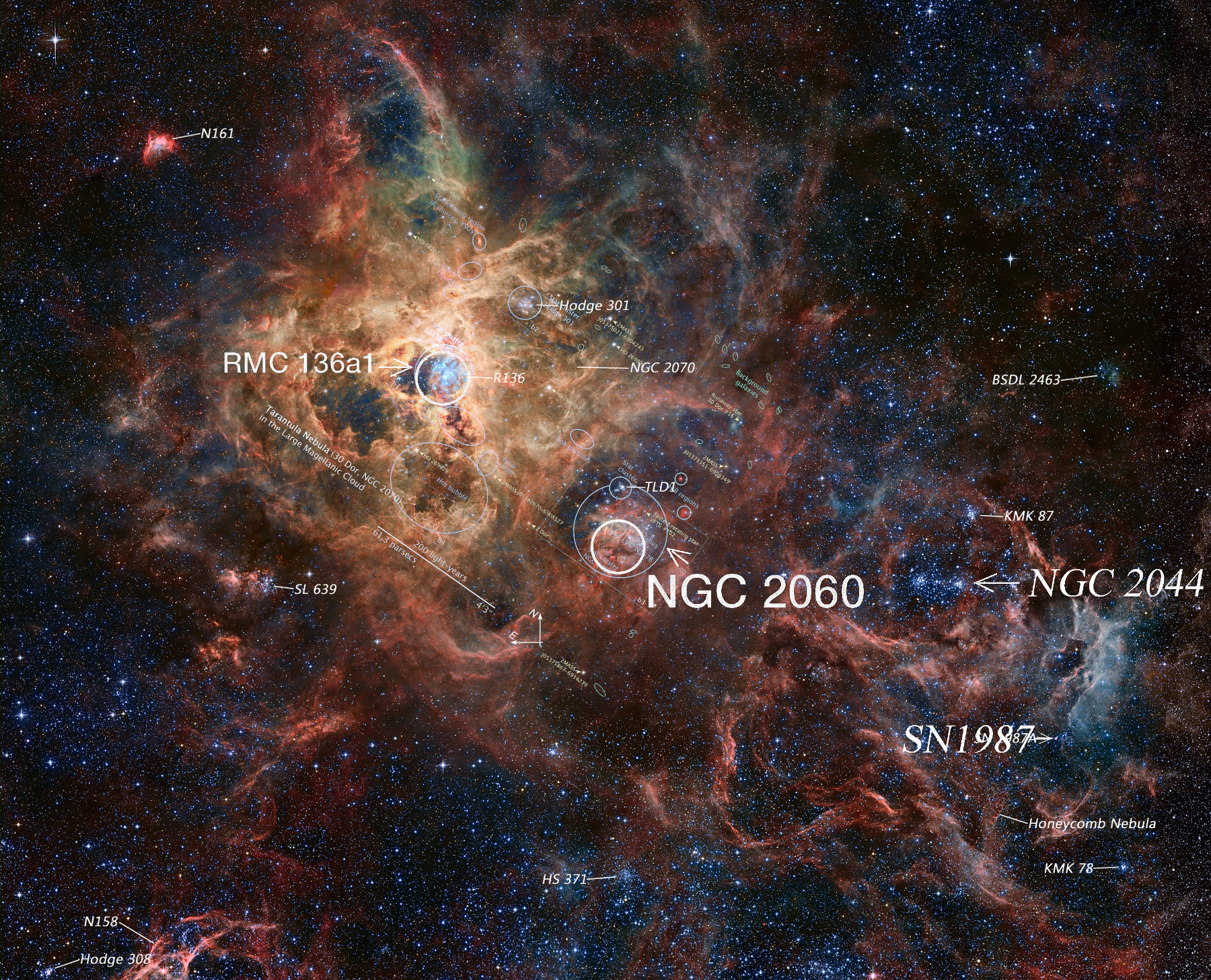
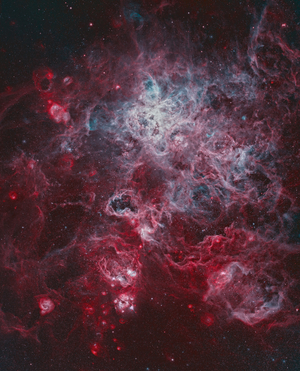
Behold: NGC 2070, aka 30 Doradus, aka, the Tarantula nebula – a giant star forming region within the Large Megellanic Cloud near 1000 light years from side to side. You don’t want to accidentally stray in there. To wit:

About 180 thousand light-years away, it’s the largest, most violent star forming region known in the whole Local Group of galaxies. The cosmic arachnid sprawls across the top of this spectacular view, composed with narrowband filter data centered on emission from ionized hydrogen and oxygen atoms. Within the Tarantula (NGC 2070), intense radiation, stellar winds and supernova shocks from the central young cluster of massive stars, cataloged as R136, energize the nebular glow and shape the spidery filaments. Around the Tarantula are other star forming regions with young star clusters, filaments, and blown-out bubble-shaped clouds. In fact, the frame includes the site of the closest supernova in modern times, SN 1987A, right of centre. The rich field of view spans about 2 degrees or 4 full moons, in the southern constellation Dorado. But were the Tarantula Nebula closer, say 1,500 light-years distant like the local star forming Orion Nebula, it would take up half the sky.

(Image: Ignacio Diaz Bobillo)

apod

Behold: NGC 5866, aka, M102, aka, ‘the Spindle’ – not the thinnest  galactic disk in the Universe but, seen edge-on from the perspective of our own Milky Way, pretty damn svelte all the same. to wit:

Classified as a lenticular galaxy, NGC 5866 has numerous and complex dust lanes appearing dark and red, while many of the bright stars in the disk give it a more blue underlying hue. The blue disk of young stars can be seen extending past the dust in the extremely thin galactic plane, while the bulge in the disk center appears tinged more orange from the older and redder stars that likely exist there. Although similar in mass to our Milky Way Galaxy, light takes about 60,000 years to cross NGC 5866, about 30 percent less than light takes to cross our own Galaxy. In general, many disk galaxies are very thin because the gas that formed them collided with itself as it rotated about the gravitational center. Galaxy NGC 5866 lies about 44 million light years distant toward the constellation of the Dragon (Draco).

(Image: NASA, ESA, and The Hubble Heritage Team (STScI/AURA); Acknowledgment: W. Keel (U. Alabama)

apod

What colour does the Moon appear to be? Well, that all depends. To wit:

Outside of the Earth’s atmosphere, the dark Moon, which shines by reflected sunlight, appears a magnificently brown-tinged grey. Viewed from inside the Earth’s atmosphere, though, the moon can appear quite different. The featured image highlights a collection of apparent colours of the full moon documented by one astrophotographer over 10 years from different locations across Italy. A red or yellow coloured moon usually indicates a moon seen near the horizon. There, some of the blue light has been scattered away by a long path through the Earth’s atmosphere, sometimes laden with fine dust. A blue-coloured moon is more rare and can indicate a moon seen through an atmosphere carrying larger dust particles. What created the purple moon is unclear — it may be a combination of several effects. The last image captures the total lunar eclipse of 2018 July — where the moon, in Earth’s shadow, appeared a faint red — due to light refracted through air around the Earth. The next full moon will occur at the end of this month (moon-th) and is known in some cultures as the Beaver Moon.

*drops monocle*

(Image: Marcella Giulia Pace)

apod

Behold: Westerhout 5, aka, the Soul Nebula, but not as it’s normally seen. To wit:

The dark and brooding dust clouds near the top, outlined by bright ridges of glowing gas, are cataloged as IC 1871. About 25 light-years across, the telescopic field of view spans only a small part of the much larger Heart and Soul nebulae. At an estimated distance of 6,500 light-years the star-forming complex lies within the Perseus spiral arm of our Milky Way Galaxy, seen in planet Earth’s skies toward the constellation Cassiopeia. An example of triggered star formation, the dense star-forming clouds in the Soul Nebula are themselves sculpted by the intense winds and radiation of the region’s massive young stars. In the featured image, stars have been digitally removed to highlight the commotion in the gas and dust.

(Image: Jason Guenzel)

apod

Behold: Phobos – the largest and innermost of Mars’ two moons. Also the darkest one in the entire solar system. Why? To wit:

Its unusual orbit and colour indicate that it may be a captured asteroid composed of a mixture of ice and dark rock. The featured picture of Phobos near the limb of Mars was captured in 2010 by the robot spacecraft Mars Express currently orbiting Mars. Phobos is a heavily cratered and barren moon, with its largest crater located on the far side. From images like this, Phobos has been determined to be covered by perhaps a meter of loose dust. Phobos orbits so close to Mars that from some places it would appear to rise and set twice a day, but from other places it would not be visible at all. Phobos‘ orbit around Mars is continually decaying — it will likely break up with pieces crashing to the Martian surface in about 50 million years.

(Image: G. Neukum (FU Berlin) et al., Mars Express, DLR, ESA; Acknowledgement: Peter Masek)

apod

Clouds blocking the sun: a common sight. But that’s not all. To wit:

Averaging over the entire Earth, clouds block the Sun about 2/3rds of the time, although much less over many land locations. On the Sun’s upper right is a prominence of magnetically levitating hot gas. The prominence might seem small but it could easily envelop our Earth and persist for over a month. The featured image is a combination of two exposures, one optimising the cloud and prominence, and the other optimising the Sun‘s texture. Both were taken about an hour apart with the same camera and from the same location in Lynnwood, Washington, USA. The shaggy texture derives from the Sun’s chromosphere, an atmospheric layer that stands out in the specifically exposed colour. The uniformity of the texture shows the surface to be relatively calm, indicative of a Sun just past the solar minimum in its 11-year cycle. In the years ahead, the Sun will progress toward a more active epoch where sunspots, prominences, and ultimately auroras on Earth will be more common: solar maximum.

(Image: Rainee Colacurcio)

apod

Behold: the centre of NGC 6514, aka, Messier 20, aka the Trifid nebula. To wit:

Three prominent dust lanes that give the Trifid its name all come together. Mountains of opaque dust appear near the bottom, while other dark filaments of dust are visible threaded throughout the nebula. A single massive star visible near the center causes much of the Trifid’s glow. The Trifid, cataloged as M20, is only about 300,000 years old, making it among the youngest emission nebulas known. The star forming nebula lies about 9,000 light years away toward the constellation of the Archer (Sagittarius). The region pictured here spans about 10 light years. The featured image is a composite with luminance taken from an image by the 8.2-m ground-based Subaru Telescope, detail provided by the 2.4-m orbiting Hubble Space Telescope, color data provided by Martin Pugh and image assembly and processing provided by Robert Gendler.

Previously: Spitzer’s Trifid

(Image: Subaru Telescope (NAOJ), Hubble Space Telescope, Martin Pugh; Processing: Robert Gendler)

apod

Behold: the stars at the centre of our Milky Way galaxy imaged by the Dark Energy Camera at the Cerro Tololo observatory in Chile.

The first image, while vast, shows a mere 10 million of the estimated 100-400 billion stars of the Milky Way, which is only one one of an estimated 2 trillion galaxies in the Universe.

Have your melon properly twisted by the full sized zoomable version here.

kottke