
Another elucidating short from German educational design studio Kurzgesagt. This time – vast interventions of the future that might save us from the mess we’ve made of the planet or, equally, doom us.
Previously: Doom And Ploom



Another elucidating short from German educational design studio Kurzgesagt. This time – vast interventions of the future that might save us from the mess we’ve made of the planet or, equally, doom us.
Previously: Doom And Ploom

Behold: Sh2-136, otherwise known as the Ghost nebula, for obvious reasons. To wit:
The jewelled expanse, filled with faint, starlight-reflecting clouds, drifts through the night in the royal constellation of Cepheus. Far from your own neighborhood on planet Earth, these ghostly apparitions lurk along the plane of the Milky Way at the edge of the Cepheus Flare molecular cloud complex some 1,200 light-years away. Over two light-years across and brighter than the other spooky chimeras, VdB 141 or Sh2-136 is also known as the Ghost Nebula, seen at toward the bottom of the featured image. Within the reflection nebula are the telltale signs of dense cores collapsing in the early stages of star formation.
(Image: Bogdan Jarzyna)

Behold: the full 24 light year wide expanse of the Orion nebula.
And yet, as spectacular as this image appears, it’s a mere thumbnail of the real thing – a giant 2.5 gigapixel photomosaic composed of 12,816 individual photos created over the past five years by amateur astronomer Matt Harbison.
Explore the mahoossive full sized zoomable mosaic here.
MORE: This Insane 2.5 Gigapixel Image of the Orion Constellation Took Five Years To Complete (Petapixel)
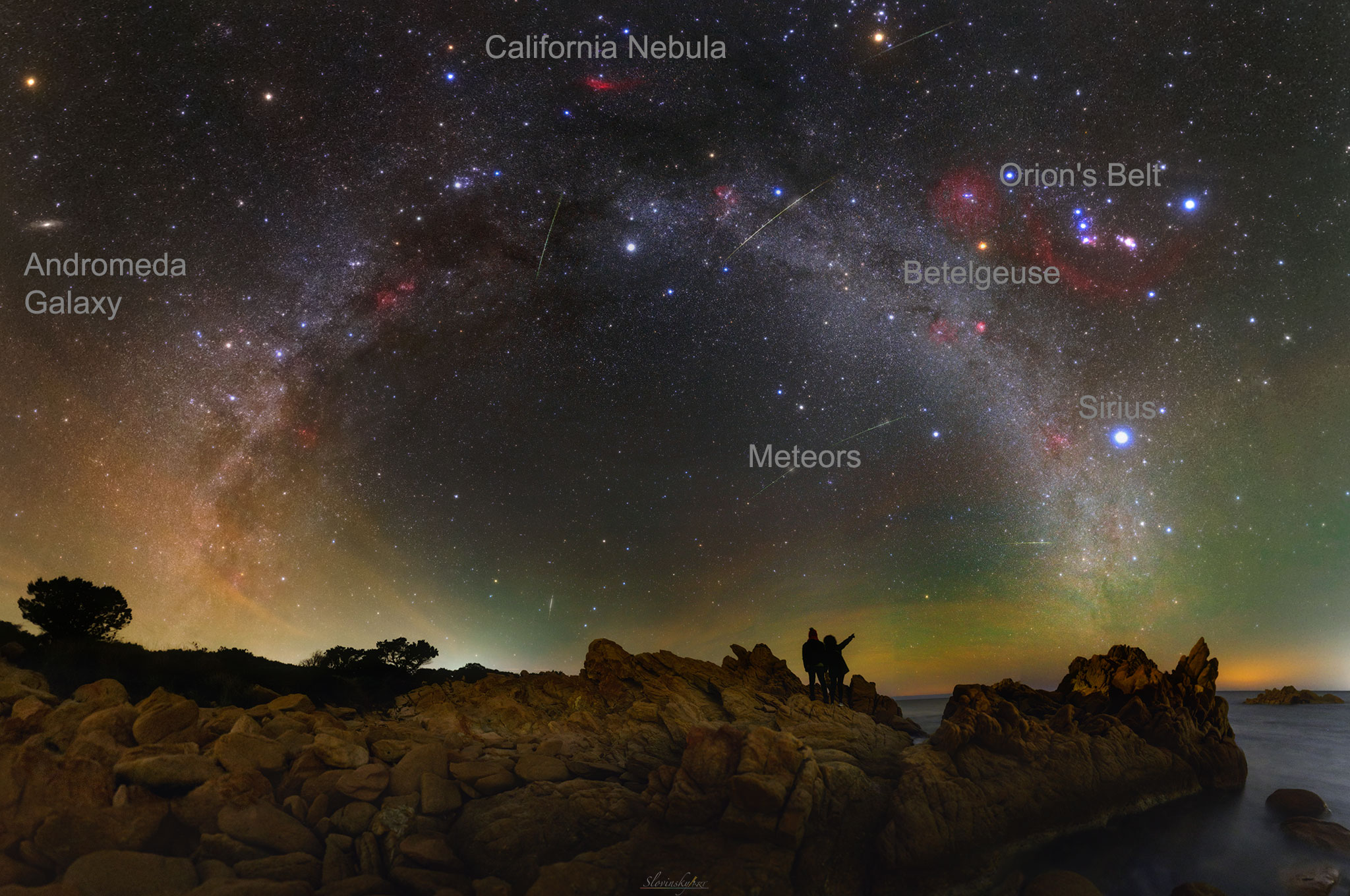
So much detail. Far too much for one photograph, that’s for sure. To wit:
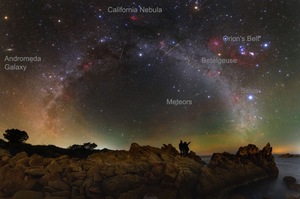
The featured dark sky composite combines over 60 exposures spanning over 220 degrees to create a veritable menagerie of night sky wonders. Visible celestial icons include the Belt of Orion, the Orion Nebula, the Andromeda Galaxy, the California Nebula, and bright stars Sirius and Betelgeuse. You can verify that you found these, if you did, by checking an annotated version of the image. A bit harder, though, is finding Polaris and the Big Dipper. Also discernible are several meteors from the Quandrantids meteor shower, red and green airglow, and two friends of the astrophotographer. The picture was captured in January from Sardinia, Italy. You can see sky wonders in your own night sky tonight — including more meteors than usual — because tonight is near peak of the yearly Orionids meteor shower.
(Image: Tomáš Slovinský)

The approach of Mars is so over.
For the next two months, Saturn and Jupiter will take centre stage in the night sky, drawing closer to earth and appearing closer together. To wit:
…in mid-December, a Great Conjunction will occur — when the two planets will appear only 0.1 degrees apart — just one fifth the angular diameter of the full Moon. And this isn’t just any Great Conjunction — Saturn (left) and Jupiter (right) haven’t been this close since 1623, and won’t be nearly this close again until 2080. This celestial event is quite easy to see — already the two planets are easily visible toward the southwest just after sunset — and already they are remarkably close. Pictured, the astrophotographer and partner eyed the planetary duo above the Tre Cime di Lavaredo (Three Peaks of Lavaredo) in the Italian Alps about two weeks ago.
(Image: Giorgia Hofer)

No, but it sure does look like that.
Behold: the Crescent nebula (the aforementioned pulsating brain) and the Soap Bubble nebula (that ‘orb’ [what are the chances?] at bottom left) – two globular clouds of dust and gas drifting through the star field between our Milky Way and the constellation of Cygnus. To wit:
Both were formed at a final phase in the life of a star. Also known as NGC 6888, the Crescent was shaped as its bright, central massive Wolf-Rayet star, WR 136, shed its outer envelope in a strong stellar wind. Burning through fuel at a prodigious rate, WR 136 is near the end of a short life that should finish in a spectacular supernova explosion. Discovered in 2013, the Soap Bubble Nebula is likely a planetary nebula, the final shroud of a lower mass, long-lived, sun-like star destined to become a slowly cooling white dwarf. Both stellar shrouds are 5,000 light-years or so distant. The larger Crescent Nebula is around 25 light-years across.
(Image: Michael Miller, Jimmy Walker)

Behold: a tumultuous cosmic conflict – a Star War, if you will – in the region of spiral galaxy UGC 1810. To wit:
The featured galaxy is labelled UGC 1810 by itself, but together with its collisional partner is known as Arp 273. The overall shape of UGC 1810 — in particular its blue outer ring — is likely a result of wild and violent gravitational interactions. This ring’s blue colour is caused by massive stars that are blue hot and have formed only in the past few million years. The inner galaxy appears older, redder, and threaded with cool filamentary dust. A few bright stars appear well in the foreground, unrelated to UGC 1810, while several galaxies are visible well in the background. Arp 273 lies about 300 million light years away toward the constellation of Andromeda. Quite likely, UGC 1810 will devour its galactic sidekick over the next billion years and settle into a classic spiral form.
Related: You Weren’t There Man, You Don’t Know…
(Image: NASA, ESA, Hubble, HLA; Processing & Copyright: Domingo Pestana)

Behold: a sharp telescopic view of galaxies toward the constellation of Pegasus, far beyond the stars of our own Milky Way. To wit:
Prominent at the upper right is NGC 7331. A mere 50 million light-years away, the large spiral is one of the brighter galaxies not included in Charles Messier’s famous 18th century catalog. The disturbed looking group of galaxies at the lower left is well-known as Stephan’s Quintet. About 300 million light-years distant, the quintet dramatically illustrates a multiple galaxy collision, its powerful, ongoing interactions posed for a brief cosmic snapshot. On the sky, the quintet and NGC 7331 are separated by about half a degree.
(Image: Robert Eder)
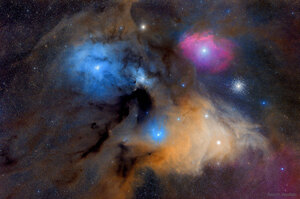
The many processes of the Rho Ophiuchi ‘dark nebula’ highlighted by the colour of its clouds. To wit:
The blue regions shine primarily by reflected light. Blue light from the Rho Ophiuchi star system and nearby stars reflects more efficiently off this portion of the nebula than red light. The Earth’s daytime sky appears blue for the same reason. The red and yellow regions shine primarily because of emission from the nebula’s atomic and molecular gas. Light from nearby blue stars – more energetic than the bright star Antares – knocks electrons away from the gas, which then shines when the electrons recombine with the gas. The dark brown regions are caused by dust grains – born in young stellar atmospheres – which effectively block light emitted behind them. The Rho Ophiuchi star clouds, well in front of the globular cluster M4 visible here on the upper right, are even more colorful than humans can see – the clouds emits light in every wavelength band from the radio to the gamma-ray.
(Image: Amir H. Abolfath)


One shot containing three very famous, very different celestial objects captured last month over Turkey. To wit:
On the upper left is the bright blue Pleiades, perhaps the most famous cluster of stars on the night sky. The Pleiades (M45) is about 450 light years away and easily found a few degrees from Orion. On the upper right is the expansive Andromeda Galaxy, perhaps the most famous galaxy — external to our own — on the night sky. Andromeda (M31) is one of few objects visible to the unaided eye where you can see light that is millions of years old. In the middle is bright red Mars, perhaps the most famous planet on the night sky. [On Tuesday] Mars [was] at opposition, meaning that [was] is opposite the Sun, with the result that it [was] visible all night long. In the foreground is an ancient tomb in the Phygrian Valley in Turkey. The tomb, featuring two stone lions, is an impressive remnant of a powerful civilization that lived thousands of years ago. Mars, currently [just past] its brightest, can be easily found toward the east just after sunset.
(Image: Cem Özkeser)