

An interesting size and spin comparison of various bodies in our solar system by astronomer Dr James O’Donaghue: from the dwarf planet Ceres to mighty Sol itself.



An interesting size and spin comparison of various bodies in our solar system by astronomer Dr James O’Donaghue: from the dwarf planet Ceres to mighty Sol itself.


 Behold: the galaxies of the Virgo Cluster (there could be up to 2000 of them) scattered across a deep telescopic field of view, spanning about three full moons, captured in dark skies near Jalisco, Mexico. To wit:
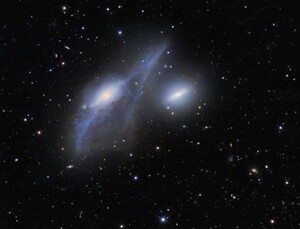
About 50 million light-years distant, the Virgo Cluster is the closest large galaxy cluster to our own local galaxy group. Prominent here are Virgo’s bright elliptical galaxies from the Messier catalog, M87 at the top left [pic 2], and M84 and M86 seen (bottom to top) below and right of centre [pic 3]. M84 and M86 are recognised as part of Markarian’s Chain, a visually striking line-up of galaxies vertically on the right side of [the top] frame. Near the middle of the chain lies an intriguing interacting pair of galaxies, NGC 4438 and NGC 4435, known to some as Markarian’s Eyes [pic 4]. Of course giant elliptical galaxy M87 dominates the Virgo cluster. It’s the home of a super massive black hole, the first black hole ever imaged by planet Earth’s Event Horizon Telescope.
(Image 1, detail 2,3: Fernando Pena; Image 4: Ken Crawford (Rancho Del Sol Observatory))
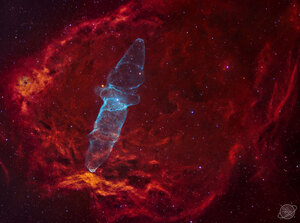
Behold: Ou4 (in blue), and Sh2-129 (in red), aka the Giant Squid Nebula enclosed by the downward flapping wings of the Flying Bat Nebula as seen against the backdrop of the constellation of Cepheus. Quite a shot. To wit:
Composed with 55 hours of narrowband image data, the telescopic field of view is 3 degrees or 6 Full Moons across. Discovered in 2011 by French astro-imager Nicolas Outters, the Squid Nebula’s alluring bipolar shape is distinguished here by the telltale blue-green emission from doubly ionized oxygen atoms. Though apparently completely surrounded by the reddish hydrogen emission region Sh2-129, the true distance and nature of the Squid Nebula have been difficult to determine. Still, a more recent investigation suggests Ou4 really does lie within Sh2-129 some 2,300 light-years away. Consistent with that scenario, Ou4 would represent a spectacular outflow driven by HR8119, a triple system of hot, massive stars seen near the center of the nebula. The truly giant Squid Nebula would physically be nearly 50 light-years across.
(Image: Yannick Akar)
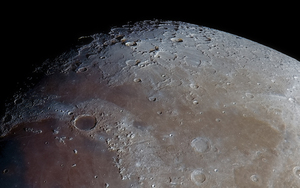
Behold: the (figuratively) frosty expanse of Mare Frigoris in the far north of the Moon. To wit:
Also known as the Sea of Cold, it stretches across the familiar lunar nearside in this close up of the waxing gibbous Moon’s north polar region. Dark-floored, 95 kilometre wide crater Plato is just left of the centre. Sunlit peaks of the lunar Alps (Montes Alpes) are highlighted below and right of Plato, between the more southern Mare Imbrium (Sea of Rains) and Mare Frigoris. The prominent straight feature cutting through the mountains is the lunar Alpine Valley (Vallis Alpes). Joining the Mare Imbrium and Mare Frigoris, the lunar valley is about 160 kilometres long and up to 10 kilometres wide.
Yes, it does look a bit like Mike Pence’s head with a fly on it.
(Image: Matt Smith)

If you were looking up at the sky last evening, you’ll have seen the Red Planet as bright and close as it’s been to the Earth for two years. To wit:
In a week, Mars will be almost as bright — but at opposition, meaning that it will be directly opposite the Sun. Due to the slightly oval shape of the orbits of Mars and Earth, closest approach and opposition occur on slightly different days. The featured image sequence shows how the angular size of Mars has grown during its approach over the past few months. Noticeably orange, Mars is now visible nearly all night long, reflecting more sunlight toward Earth than either Saturn or Jupiter. Even at its closest and largest, though, Mars will still appear about 100 times smaller, in diameter, than a full moon.
(Image: Jonathan T. Grayson)

Behold: spiral galaxy NGC 5643. But what the hell is going on inside? To wit:
A swirling disk of stars and gas, NGC 5643‘s appearance is dominated by blue spiral arms and brown dust, as shown in the featured image taken by the Hubble Space Telescope. The core of this active galaxy glows brightly in radio waves and X-rays where twin jets have been found. An unusual central glow makes NGC 5643 one of the closest examples of the Seyfert class of galaxies, where vast amounts of glowing gas are thought to be falling into a central massive black hole. NGC 5643, is a relatively close 55 million light years away, spans about 100 thousand light years across, and can be seen with a small telescope towards the constellation of the Wolf (Lupus).
Alright, just keep it down.
(Image: ESA/Hubble & NASA, A. Riess et al.; Acknowledgement: Mahdi Zamani)

Behold: the glowing gas of the Orion nebula as it envelopes hot young stars at the edge of an immense interstellar molecular cloud. Like the Oscars in space or something. To wit:
Many of the filamentary structures visible in the featured image are actually shock waves – fronts where fast moving material encounters slow moving gas. The Orion Nebula spans about 40 light years and is located about 1500 light years away in the same spiral arm of our Galaxy as the Sun. The Great Nebula in Orion can be found with the unaided eye just below and to the left of the easily identifiable belt of three stars in the popular constellation Orion. The image shows the nebula in three colors specifically emitted by hydrogen, oxygen, and sulfur gas. The whole Orion Nebula cloud complex, which includes the Horsehead Nebula, will slowly disperse over the next 100,000 years.
(Image: César Blanco González)
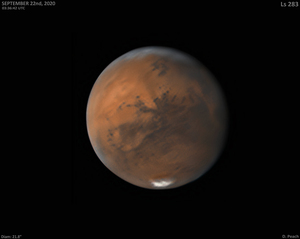
As astronomers gaze up at Mars growing brighter in the night sky, approaching its 2020 opposition on October 13th, the Red Planet has been looking right back. Hey. Cut that out. To wit.
September 22: Mars’ disk is already near its maximum apparent size for earthbound telescopes, less than 1/80th the apparent diameter of a Full Moon. The seasonally shrinking south polar cap is at the bottom and hazy northern clouds are at the top. A circular, dark albedo feature, Solis Lacus (Lake of the Sun), is just below and left of disk center. Surrounded by a light area south of Valles Marineris, Solis Lacus looks like a planet-sized pupil, famously known as The Eye of Mars . Near the turn of the 20th century, astronomer and avid Mars watcher Percival Lowell associated the Eye of Mars with a conjunction of canals he charted in his drawings of the Red Planet. Broad, visible changes in the size and shape of the Eye of Mars are now understood from high resolution surface images to be due to dust transported by winds in the thin Martian atmosphere.
(Image: Damian Peach)


Of the most terrifying, relentless and seemingly intractable man-made problem faced by the world today, German educational design studio Kurzgesagt sez:
We have known for decades that rapid Climate Change is being caused by the release of Greenhouse Gases. But instead of reducing them, in 2019 the world was emitting 50% more CO2 than in the year 2000. And emissions are still rising. Why is that? Why is it so hard to just stop emitting these gases?
Previously: The Biggest Star In The Universe

Behold: ribbons of shocked interstellar gas at the outer edge of an expanding stellar explosion that would have been clearly visible to our ancestors during the late Stone Age 20,000 years ago. To wit:
The featured image was recorded by the Hubble Space Telescope and is a closeup of the outer edge of a supernova remnant known as the Cygnus Loop or Veil Nebula. The filamentary shock front is moving toward the top of the frame at about 170 kilometres per second, while glowing in light emitted by atoms of excited hydrogen gas. The distances to stars thought to be interacting with the Cygnus Loop have recently been found by the Gaia mission to be about 2,400 light years distant. The whole Cygnus Loop spans six full Moons across the sky, corresponding to about 130 light years, and parts can be seen with a small telescope toward the constellation of the Swan (Cygnus).
(Image: ESA/Hubble & NASA, W. Blair; Acknowledgement: Leo Shatz)


.jpg)