
Category Archives: Science

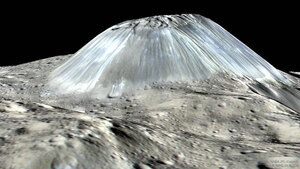
Behold: Ahuna Mons – the largest mountain on the dwarf planet Ceres – part of the asteroid belt that lies between the orbits of Mars and Jupiter. To wit:

Ahuna Mons is like nothing that humanity has ever seen before. For one thing, its slopes are garnished not with old craters but young vertical streaks. The new hypothesis, based on numerous gravity measurements, holds that a bubble of mud rose from deep within the dwarf planet and pushed through the icy surface at a weak point rich in reflective salt — and then froze. The bright streaks are thought to be similar to other recently surfaced material such as visible in Ceres’ famous bright spots. The featured double-height digital image was constructed from surface maps taken of Ceres in 2016 by the robotic Dawn mission. Successfully completing its mission in 2018, Dawn continues to orbit Ceres even though it has exhausted the fuel needed to keep its antennas pointed toward Earth.

(ImageDawn MissionNASAJPL-CaltechUCLA, MPS/DLR/IDA)

apod

If you have a pair of those red-blue 3D specs, now’s the time to fish them out and float along beside Helene. To wit:

Appropriately named, Helene is one of four known Trojan moons, so called because it orbits at a Lagrange point. A Lagrange point is a gravitationally stable position near two massive bodies, in this case Saturn and larger moon Dione. In fact, irregularly shaped ( about 36 by 32 by 30 kilometers) Helene orbits at Dione’s leading Lagrange point while brotherly ice moon Polydeuces follows at Dione’s trailing Lagrange point. The sharp stereo anaglyph was constructed from two Cassini images captured during a close flyby in 2011. It shows part of the Saturn-facing hemisphere of Helene mottled with craters and gully-like features.

(Image: Cassini Imaging TeamISSJPLESANASA; Stereo Image by Roberto Beltramini)

apod

Behold: the immense spiral galaxy of Messier 96 – 31 million light years distant in the Constellation of Leo. To wit:

…it spans 100 thousand light-years or so, making it about the size of our own Milky Way. M96, also known as NGC 3368, is known to be about 35 million light-years distant and a dominant member of the Leo I galaxy group. The featured image was taken by the Hubble Space Telescope. The reason for M96‘s asymmetry is unclear — it could have arisen from gravitational interactions with other Leo I group galaxies, but the lack of an intra-group diffuse glow seems to indicate few recent interactions. Galaxies far in the background can be found by examining the edges of the picture.

(Image: NASAESAHubble; Processing & Copyright: Leo (what are the chances?) Shatz)

apod

What the heck is going on in and around the optically dark star-forming region of the Cave Nebula, sez you. Easy now. NASA’s orbiting Spitzer Space Telescope reveals the scene in four colours of infrared light. To wit:

The Cave Nebula, catalogued as Sh2-155, is quite bright in infrared, revealing details not only of internal pillars of gas and dust, but of the illuminating star cluster too – all near the top of the image. The red glow around the Cave’s entrance is created by dust heated by bright young stars. To the right is Cepheus B, a star cluster that formed previously from the same cloud of gas and dust. Other interesting stars of Cepheus come to light in infrared as well, including those illuminating an even younger nebula toward the image bottom, and a runaway star pushing a bow shock, tinged in red near the image centre. This region spans about 50 light years and lies about 2,500 light years toward the constellation of the King of Aethiopia (Cepheus).

(Image: NASAJPL-CaltachSpitzer Space Telescope)

apod

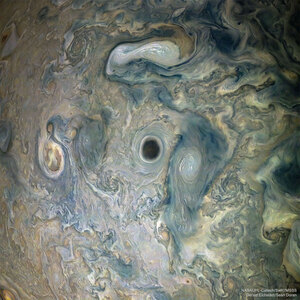
The Abyss – that’s what NASA is calling this unusually dark cloud feature observed by the Juno probe during its latest pass over Jupiter. To wit:

Surrounding cloud patterns show the Abyss to be at the center of a vortex. Since dark features on Jupiter’s atmosphere tend to run deeper than light features, the Abyss may really be the deep hole that it appears — but without more evidence that remains conjecture. The Abyss is surrounded by a complex of meandering clouds and other swirling storm systems, some of which are topped by light coloured, high-altitude clouds. The featured image was captured last month while Juno passed only about 15,000 kilometres above Jupiter’s cloud tops. The next close pass of Juno near Jupiter will be in July.

(Image: NASAJunoSwRIMSSSProcessing & LicenseGerald Eichstädt & Sean Doran)

apod

German educational design studio Kurzgesagt applies its no-nonsense balanced approach to matters carnivorous. To wit:

Over the last few years eating meat has increasingly been associated with health risks, like heart disease, cancer and an early death. How unhealthy is meat really?

Previously: Does Your EU Vote Matter?

Behold: a long exposure (taken over several nights earlier this year) of the constellation of Orion – not just three stars in a row, rather, a direction in space rich with impressive nebulae. To wit:

 Of the many interesting details that have become visible, one that particularly draws the eye is Barnard’s Loop, the bright red orange arc just to the right of the image center. The Rosette Nebula is not the giant orange nebula just to the left of the image center — that is larger but lesser known nebula known as the Meissa Ring. The Rosette Nebula is visible, though: it is the bright orange, blue and white nebula near the image bottom. The bright orange star just left of the frame center is Betelgeuse, while the bright blue star on the upper right is Rigel. About those famous three stars that cross the belt of Orion the Hunter — in this busy frame they can be hard to locate, but a discerning eye will find them just to the right of the image center.

(Image: Andrew Klinger)

apod

An image taken by the Hubble telescope showing four of the five adjacent galaxies of Stephan’s Quintet in the Pegasus constellation – the first compact galaxy group ever invited to compete on Strictly discovered. To wit:

Really only four of the five of Stephan’s Quintet are locked in a cosmic tango of repeated close encounters taking place some 300 million light-years away. The odd galaxy out is easy to spot in this recently reprocessed image by the Hubble Space Telescope — the interacting galaxies, NGC 7319, 7318B, 7318A, and 7317 (left to right), have a more dominant yellowish cast. They also tend to have distorted loops and tails, grown under the influence of disruptive gravitational tides. The mostly bluish galaxy, large NGC 7320 on the lower left, is in the foreground at about 40 million light-years distant, and so is not part of the interacting group. Data and modeling indicate that NGC 7318B is a relatively new intruder. A recently-discovered halo of old red stars surrounding Stephan’s Quintet indicate that at least some of these galaxies started tangling over a billion years. Stephan’s Quintet is visible with a moderate sized-telescope toward the constellation of Winged Horse (Pegasus).

(Image: NASAESAHubble; Processing: Daniel Nobre)

apod

Behold: stars forming in Lynd’s Dark Nebula (LDN 1251). To wit:

About 1,000 light-years away and drifting above the plane of our Milky Way galaxy, the dusty molecular cloud is part of a complex of dark nebulae mapped toward theCepheus flare region. Across the spectrum, astronomical explorations of the obscuring interstellar clouds reveal energetic shocks and outflows associated with newborn stars, including the telltale reddish glow from scattered Herbig-Haro objects seen in this sharp image. Distant background galaxies also lurk on the scene, visually buried behind the dusty expanse. The deep telescopic field of view imaged with broadband filters spans about two full moons on the sky, or 17 light-years at the estimated distance of LDN 1251.

(Image: Francesco Sferlazza, Franco Sgueglia, Astro Brallo)

apod