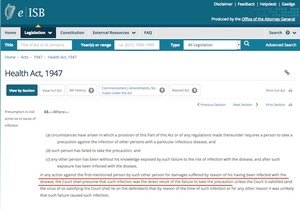

From top: Section 43 of the Health Act 1947; Barrister Tony McGillicuddy
Yesterday.
On RTÉ’s This Week.
Barrister Tony McGillicuddy spoke to Carol Coleman about gardai receiving powers to enter people’s homes.
It followed the Cabinet last Friday rejecting proposals for criminal penalties for people organising gatherings of more than six people but Tanaiste Leo Varadkar later saying a ‘civil offence’ may be introduced.
Carole Coleman: “Could you explain for us briefly what a civil offence is? And how it is investigated or prosecuted?”
Tony McGillicuddy: “Yeah, there is no such thing as a civil offence, Carole. It’s a contradiction in terms. I mean, under our Constitution and our laws, we have statute laws and then regulations which fill in the details of those and they can be enforced either through civil orders that are made in the courts or else by a criminal sanction if those provisions are made criminal law offences.
“So there’s two streams. And we have that at the moment with our regulations on, for instance, wearing a facemask in shops or shopping centres. So that is a provision. The power to make that order is in the Health Act 1947. The minister made the relevant regulations to make that a requirement of all persons. And if a person is in a shop today and they’re not wearing a facemask, a garda can approach that person and give them a direction that they must wear a facemask.
“If that person doesn’t wear a facemask after getting that direction from a garda, that is a criminal offence and the garda can arrest that person and can prosecute that person. So it’s the failure to comply with a direction of a garda to wear a facemask in a shop that would then be a criminal offence.”
Coleman: “They’re now planning to involve gardai in the house parties or the house gatherings. So what you’re saying is that it would become the law of the land but not a crime. What use would this be in say a flagrant breach of the house gathering rules?”
McGillicuddy: “Yeah, I mean, it is possible, that there could be a requirements set out in regulations or in a primary piece of statute law, whereby a person would be prohibited from having a gathering of six people in their household from three or more households. And they could then decide not to make it a criminal offence, they could just say it’s in statute, it’s in the law of the land and it doesn’t have any criminal sanction.
“I think the only thing that I can see that might have an importance at the present time is that there’s a very interesting provision in the Health Act 1947 which has not received public commentary up to now.
“It’s Section 43 of the act and that outlines that if a person, if there are requirements for a person to take certain precautions to avoid Covid or other infectious diseases, and if they don’t do so, and if a person then, in their household, becomes infected with Covid, that person who has attended, as an invitee at their house, could sue them for damages. And it would be presumed in law that they obtained the infection from attending at their house unless the householder can prove otherwise.
“So you could have a situation whereby the Government will say ‘well, we’re gonna make this the law of the land, we’re not going to impose a criminal sanction but if you invite more than six people into your house of a night and if one of them subsequently finds out that they have Covid, they could sue you for damages’. And it would be up to the householder to show that they hadn’t been infected at their house that night.
“And I think if members of the public knew that that presumption in law could act against them, in such a scenario, that might have its own coercive effect on people organising house gatherings.”
Coleman: “OK, well that’s very complicated and lots to be discussed there, barrister Tony McGillicuddy, thank you very much for joining us.”
Anyone?
Listen back in full here
RollingNews