



Hic.
Ruadhain writes:
As listed in Brannigan’s bar on Cathedral Street [off O’Connell Street, Dublin 1]
Long neck rather than hard neck?


Oh.
This afternoon.
Ely Place, Dublin 2.
Among a convoy of tractors which have converged on Dublin city centre carrying farmers protesting the EU-Mercosur free trade agreement and baiting vegans.
More as we get it.
Thanks Seán Doyle
Update:


This afternoon.
Merrion Street, Dublin 2.
Farmers and their families congregate near Government Buildings.
Clampers not outside.

Why is the leader of the country opening a shopping centre? Does nobody else find this mortifying? https://t.co/jJtzvaPr1v
— HeLikedTurner (@HeLikedTurner) November 25, 2019
Anyone?
Also: Vans or Skechers, anyone?
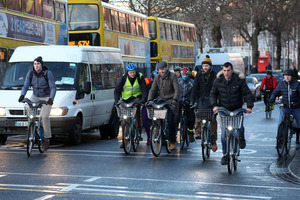
 From top: Morning commuters in Dublin city; Michael Taft
The EU Commission makes an interesting observation on in-work poverty:
‘ . . . in-work poverty is certainly becoming more prominent in policy discourse and action . . . However, the concept of “in-work poverty” is often not used as such, and discourse focuses on alleviating poverty in general.’
That’s not surprising. It is difficult for many policy-makers and commentators to discuss in-work poverty for the simple reason that employment is portrayed as way out of poverty.
When it is shown not to be for significant sections of the population, the pathway argument collapses.
Similarly, in Ireland: ‘in-work poverty’ is not generally discussed (though there has been considerable discussion of the Living Wage). Hopefully, the Nevin Economic Research Institute’s latest findings will contribute to changing that.
There are a number of ways to measure in-work poverty. The main statistical measurement is relative, or ‘at-risk’, poverty. This measures the percentage of workers whose income is 60 percent below the national median income.
The national median income is the midway point (50 percent above, 50 percent below) for all people in society, not just those in work. On this measurement Ireland looks good when compared with our EU peer group.

However, when comparing median incomes we’re not on the same pitch. This means that in Ireland, work income would have to be significantly lower than the other countries to be classified as ‘at-risk of poverty’, or 60 percent of median incomes.
That’s because Irish median income is significantly poorer.
That is why when using relative measures we have to look at not only the rate but the denominator (median income) as well. This is not to dismiss relative measures; only that we need to be aware of what we are measuring.
There are other measurements – soft measurements. These are not statistically based like ‘at-risk of in-work poverty’. These measurements, collected by the CSO and Eurostat, are based on asking people about their living standard.
This is what NERI presented last week, using two measurements: deprivation and inability to afford an unexpected expense.
(a) Deprivation
The CSO defines deprivation as experiencing two or more deprivation experiences ranging from an inability to keep house warm, affording two pair of strong shoes or a warm waterproof coat, to affording a substantial meal every two days, or a morning/evening out in the last fortnight.
NERI’s findings are concerning:
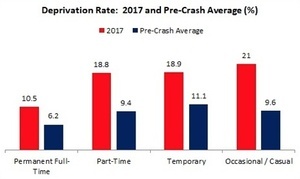
Over 10 percent of permanent full-time employees are officially classified as living in deprivation conditions while part-time, temporary (fixed-term) and occasional employees come in at approximately 20 percent. These are dismal numbers.
Deprivation rates are still well above pre-crash averages (the average for 2002 – 2008) despite significant increases in national income. They have, at least, declined from recession highs. For instance, deprivation among full-time employees was 16.7 percent in 2014.
However, between 2016 and 2017, the rate barely fell by 0.2 percentage points. In fact, in 2017 the deprivation rate for two-income households actually rose over the previous year – from 9.2 percent to 10.7 percent.
(b) Inability to Afford an Unexpected Expense

Nearly 30 percent of permanent full-time employees are unable to afford an unexpected expense. This rises to nearly 40 percent for part-time employee and even higher for temporary employees.
Occasional and casual workers fare the worst with over half unable to afford an unexpected expense. The numbers are significantly higher than pre-crash numbers.
Unfortunately, we don’t have European comparisons for either deprivation or unexpected expenses for those in work. The following looks at deprivation rates among all 18-65 year olds.
This, at least, captures the working age population. The unexpected expenses data relates to those above the relative poverty threshold so, again, this is likely to be largely made up of people in work.
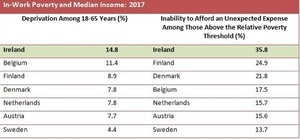
While indicative, the data shows Ireland topping the deprivation and unexpected expenses tables.
There is no magic bullet that can bring down rates of deprivation and precarious living conditions. One thinks of increasing the minimum wage – and there’s nothing wrong with that.
However, we shouldn’t assume that all the households affected are on the minimum wage.
Much depends on circumstances. If you’re paying €1,500 a month in rent, a few extra Euros in the pocket isn’t going to make much of a difference.
However, cutting rent by a couple of hundreds of Euros would be a significant gain in living standards.
Similarly, with families facing childcare costs, school costs, etc. – reducing these costs would go much further than a wage increase.
Getting a few extra hours of work would have significant benefit for those on low-hour precarious contracts.
Addressing these issues requires a number of inter-locking strategies:
Reduction in living costs
Collective bargaining
Reduction in precarious work contracts
Stronger statutory or sectoral wage floors
If we truly want employment to be a route to prosperity, if we want to reduce poverty in the economy, we need to take in-work poverty seriously. The first step is to start actually naming it so we can start debating it. These are the first steps to eventually abolishing it.
Michael Taft is a researcher for SIPTU and author of the political economy blog, Notes on the Front. His column appears here every Tuesday.


This afternoon.
St. Kevin’s College, Crumlin, Dublin.
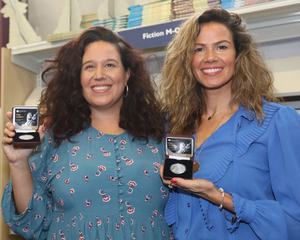
President Michael D. Higgins (top and above right) with singer Brush Shiels (above) and, pic 2 from left, sisters Sarah and Cathleen Lynott, daughters of Phil Lynott, in the library which bears his name at his former school for the launch of the Central Bank’s new Phil Lynott Commemorative Coin.
Earlier...

This morning.
The Central Bank of Ireland has launched a €15 silver commemorative coin to mark 70 years since the year of birth of Phil Lynott.
The coin will be officially launched by President Michael D. Higgins at St. Kevin’s College, Crumlin, Dublin – Phil’s former school – today.
Any excuse
Central Bank via Rollingnews
No Patrol
at
So sorry to announce, due to illness, we have to cancel tonight’s show at the @olympiatheatre dublin. Information on refunds will follow shortly. We are gutted & were so looking forward to Dublin but it’s just not possible to do the show tonight. See you all soon we promise. SP.x
— Snow Patrol (@snowpatrol) November 26, 2019
⌁ BREAKING: @SnowPatrol have been forced to cancel their @OlympiaTheatre show tonight due to illness. Statement from the band below. pic.twitter.com/tNGl5EYKAZ
— MCD Productions (@mcd_productions) November 26, 2019
Unfortunately @snowpatrol performance in the @olympiatheatre this evening has been cancelled due to illness including their exclusive performance for us.
More info to follow. https://t.co/sQhl2lMv3H
— Tower Records Dublin (@TowerDublin) November 26, 2019
This afternoon.

The Darkling Air – Octogenarian Mermaid
Fancy a swim?
Then dive in to the new video by Northern Irish duo Rachel McCarthy (top left) and Michael Keeney (top right) aka The Darkling Air.
Based in Bangor, County Down, the Darkling Air have teamed up with the Arco String Quartet to produce lyrical chamber pop par excellence.
Rachel, who filmed and edited the video, was inspired by the healing power of swimming in Belfast Lough and her convivial chats with fellow waders.
Their second album Ancestor is out this month.
Nick says: The craic was 80.


Mary Harney “If this bill passes, it would make survivors of the industrial schools invisible once more.” #Stand4Truth #RetentionofRecords @maeveorourke @IrishCentreHR pic.twitter.com/1Ry7NDl2fl
— Kelly Ledoux (@mkledoux1) November 26, 2019
From top: Carmel McDonnell-Byrne, Dr Mary Lodato, Eileen Molloy, Catriona Crowe, and Dr Fred Logue, from FP Logue Solicitors
Further to a post this morning about today’s meeting of the Oireachtas Joint Committee on Education and Skills…
During which survivors, lawyers, historians and archivists spoke against a bill which proposes to seal millions of abuse records from survivors and the public for at least 75 years…
Lawyer Cassie Roddy Mullineaux, who followed the proceedings, noted:
Eileen Molloy’s powerful opening statement: “I don’t think our personal information can be used as history in the future, it’s our history now, and should be made available to us while we’re still alive”.
Mary Ledato: “If we don’t confront our past we are condemned to repeat it”
Mary Ledato: “Survivors still live with shame and secrecy imposed on them. They need a process of healing and reconciliation.”
Maeve O’Rourke: “Without records, accountability is denied.”
Fred Logue: One thing is certain – the Retention of Records Bill will delay access to personal data and this will have a significant effect on survivors!
Maeve O’Rourke: “Everyone has a right to their personal data – unredacted!”
Mary Harney: “When I first held my birth certificate in my hand, I jumped up and down and said ‘I am someone, I am.. !'”
Maeve O’Rourke: “Redress means accountability, ideally in court, but also truth telling at a national level. The Right to Truth is not just an individual right but also a societal right. There must be a guarantee of non-repetition!”
Eileen Molloy: “I’m going to die before the 75 years are up – so will my children and grandchildren. Just tell me why you are doing this to me?”
Carmel McDonnell-Byrne: “I get the feeling I’ve been heard for the first time in my life, but I hope this doesn’t fall on deaf ears.”
Earlier: “They Don’t Want The Files And Testimonies To Be Kept Secret”
UPDATE:
After the meeting, the committee released the following statement:
“The Joint Committee on Education and Skills heard evidence this morning from wide range of witnesses – including perspectives from legal, historical and human rights backgrounds – on a Bill that would seal records of redress bodies for 75 years.
However, particularly poignant evidence given was from survivors who outlined, in a deeply moving way, the impact this Bill would have on them personally.
The Select Committee on Education and Skills was due to consider the Retention of Records Bill (2019) at a meeting next week.
But Deputies have now agreed to defer consideration of the Bill and are now seeking a response from the Minister for Education and Skills on concerns raised by survivors of institutions and legal experts about the legislation.
Chair of the Committee on Education and Skills, Deputy Fiona O’Loughlin said: “We had excellent engagement with survivors and legal experts on the proposed legislation at a meeting of the Joint Committee earlier today.
“We will be forwarding the Minister a summary of what we heard and we will be seeking a response from him addressing a number of the key issues raised.”
The Bill provides for records from the work of the Commission to Inquire into Child Abuse (Cica), the Residential Institutions Redress Board, and the Residential Institutions Redress Review Committee to be in the National Archives of Ireland (NAI) and sealed for a minimum of 75 years.

The National Museum of Ireland writes:
NMI regrets that heavy rainfall has resulted in the temporary closure of the first floor of the Natural History Museum.
It is our aim to reopen the first floor as soon as possible and we will post updates as available. We apologise for any inconvenience caused.
First Floor of the National Museum of Ireland-Natural History is temporarily closed (Museum)