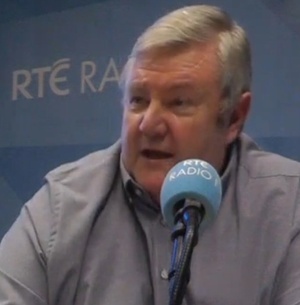
Trinity College Dublin tweetz:

Happening now. See the transit of Mercury [top pic] across the sun today at the Campanile [at Trinity College Dublin].

Those who wish can take a look between 12.40pm and 3.30pm today.

Or watch here live.

Related: Astrophysicists to bring Mercury Transit to Irish public (Trinity College Dublin)

Behold: the glowing gas and dust clouds of NGC 3572 – a beautiful emission nebula and star cluster of the Southern skies. So much to see. To wit:

…the region is often overlooked by astro-imagers in favour of its brighter neighbour, the nearby Carina Nebula. Stars from NGC 3572 are toward the upper left in the telescopic frame that would measure about 100 light-years across at the cluster’s estimated distant of 9,000 light-years. The visible interstellar gas and dust is part of the star cluster’s natal molecular cloud. Dense streamers of material within the nebula, eroded by stellar winds and radiation, clearly trail away from the energetic young stars. They are likely sites of ongoing star formation with shapes reminiscent of the cosmic Tadpoles of IC 410 better known to northern skygazers. In the coming tens to hundreds of millions of years, gas and stars in the cluster will be dispersed though, by gravitational tides and by violent supernova explosions that end the short lives of the massive cluster stars.

(Image: Josep Drudis)

apod

Um.

Shane writes:

Bees were taken very seriously in early medieval Ireland, an entire law tract dedicated to legal intricacies of bee-keeping and even providing for trespass by bees (‘Early Medieval Ireland 400-1200′ by Dáibhí Ó Cróinín, p 124)…

From top: Ireland under sea in 2050 as imagined for tonight’s show presented ; Gerard Fleming

Gulp.

In a stark message to be delivered tonight, former RTÉ weather presenter Gerard Fleming is set to warn “the sea will come and take them back”.

There is a set of circumstances adding up to such a threat that has every chance of happening before 2050, he says. Galway, Limerick, Waterford, Drogheda and Wexford are also vulnerable, Fleming points out, but Dublin and Cork “are where most of the assets are concentrated”.

Right so.

Will Ireland Survive 2050? at 9.30pm on RTÉ1.

Can Ireland survive events of chaotic climate change? (Kevin O’Sullivan, irish Times)

What impact will climate change have on Ireland in 2050? (RTÉ)

Montages: Eddie Sheanon/Midas Productions

From top: Chair of the RTÉ Board Moya Doherty (right) and RTÉ Director General Dee Forbes; Marian Finucance

On Saturday.

Chairwoman of the RTÉ Board Moya Doherty was interviewed by Marian Finucane in regards to the financial situation facing the State broadcaster.

Ms Doherty spoke about “transformation”, “strategy” and “being nimble”.

She also raised the water charges protests.

During the interview Ms Finucane informed Ms Doherty that she had attempted to watch an item on the RTÉ Player three times on Friday night before giving up – because, after playing a stream of ad, it cut out.

It follows the Director-General of RTÉ Dee Forbes telling Mary Wilson on RTÉ’s Drivetime on Thursday night that the RTÉ Player is going to be a “huge part” of RTÉ’s future and that, in five years’ time, the player will be “more important to a certain generation of people than RTÉ One or RTÉ Two”.

From Ms Doherty’s interview…

Marian Finucane: “I’m joined this morning by Moya Doherty who’s chairwoman of the RTÉ Board. Now you wrote an opinion piece Moya, in the paper [The Irish Times] about the licence fee. And you’re talking about the responsibility of the Government.

“But what about, ultimately, the responsibility of the executive board and the authority.”

Moya Doherty: “Good morning, good afternoon actually, Marian and thank you for inviting me in this morning. I think it’s important to contextualise what has happened in the last week and what has been happening for months and years within public service media globally.

“There is contestant change and it will be in a constant state of reform. It is impossible to predict where public crevice media will exist in five years let alone 10 years. What our job is, as a board, and as an executive is to ensure that the infrastructure is right, the funding is right, the skills are contemporary and flexible to meet the rapid change.”

Finucane: “But with the kindest will in the world, there’s little evidence of that. I mean, obviously, as the authority and the chair, it is your responsibility to support the executive but I’ve, we hear people talking about public service broadcasting, public service broadcasting, where’s our destination?”

Doherty: “Well, I mean, I think Marian nobody has a crystal ball around destination. The cataclysmic change in the industry globally is quite frightening. Right across the media, people are losing jobs. It is painful, it is incredibly difficult but we cannot not change. You stand still and you are history.

“So, just let me clarify firstly the role of the board. It used to be called the authority, it’s now the board.”

Finucane: “Yeah.”

Doherty: “The board is nominated and appointed by Government. It is not the job of the board to do the role of the RTE Executive. It is the job of the board to represent Government, to stand over the Broadcasting Act of 2009, which is a dinosaur piece of legislation at this time, which cripples the organisation…”

Finucane: “In what way?”

Doherty: “In terms of the commitments it puts on to the organisation when the funding isn’t there to meet those commitments. So that indeed needs to be looked at. So I think that, and also our most important person in the room are the people you are speaking to out there. The audience.”

Finucane: “Absolutely. Yeah.”

Doherty: “They ultimately own public service media. They are ultimately the ones who need to know in five years’ time where their solid, truthful sense of news and current affairs will come from. That is the most important thing.”

Finucane: “Well I want to go into a lot of individual detail but let’s stick with the broad brush for the moment. If you say that there is no crystal ball, the truth is that the internet is not new anymore.

“And if you take youngsters – we had a group in on one of our Sunday programmes and I think to a man or a woman, none of their children watch television in the way, in the old-fashioned way that people sat down to watch The Late Late Show years ago. It just doesn’t happen. And they choose different ways to find their media.

Continue reading →

From top: Taoiseach Leo Varadkar (Left) and Fianna Fáil Leader Micheál Martin; Derek Mooney

Looking back at speechwriting commissions received over the last few years (leaving aside requests for best man speeches) I see that most have had leadership as a central theme.

While the scripts have ranged from looking at the role of leadership in building communities through to the importance of leadership in delivering commercial change, they have each asked the same question: what makes a leader?

It is not an easy question to answer. As Leadership guru Warren Bennis puts it:

 “To an extent, leadership is like beauty: It’s hard to define, but you know it when you see it.”

We appreciate leadership when we see it but, more importantly, we quickly recognise its absence.

This is certainly the case across the water. One week into the British general election campaign and the absence of leadership from either of the two main parties is already much in evidence.

While Boris Johnson is offering his best impression of leadership with, perhaps, a nod to Napoleon’s dictum that a leader is a dealer in hope, the Tory leader’s constant reliance on upbeat, though deceitful, rhetoric in place of demonstrable fact suggests that he has no notion of offering leadership by example.

Meanwhile the Labour Party offers a mirror image of the Johnson vacuum.

Whereas Johnson talks and acts like a charlatan, Corbyn appears sincere and genuine, almost to the point of insipid vagueness.  But, while Corbyn may offer a vision of a kinder, gentler Britain, his record as party leader is one of ambivalence on the bullying and anti-Semitism of his supporters.

This absence of leadership in British politics is not something new. It was obvious at the Brexit referendum. As I remarked at the time:

“it is no coincidence that the most significant and impactful interventions… have come from those who are no longer active on the main political stage, such as John Major, Gordon Brown or Ken Clarke…. the current crop of Conservative, Labour and Lib Dem political leaders have failed to impress… The few bright points from the current political generation have come from the likes of Nicola Sturgeon.”

The departure of senior political figures, most notably Ken Clarke, points to a less than bright political future for the UK. How could anyone treat any polity seriously that mistakes Priti Patel for a senior political figure?

So, what about us? Do we have a better standard of political leadership on offer here than they have in the UK?

In a word: yes.

Though our current crop of political leaders have failings and flaws, they still compare favourably with their British… sorry, English… counterparts.

Continue reading →

The MIT Biomimetics Robotics department unleashes its pack of frisky miniature cheetah quadruped robots – each weighing about 9kg and capable of all manner of not-yet-killing-all-humans-but-let’s-face-it-its-just-a-matter-of-time shenanigans.

awesomer

Broadsheet.ie