



This afternoon.
Terminal 1, Dublin Airport.
Some of the 91 members of Team Ireland arrive home from the Special Olympic World Games after winning 86 medals in Abu Dhabi, including 30 gold, 29 silver, and 27 bronze.
From top: Katie Dillon (4th place: shot putt) Emma Barrett (gold, freestyle relay swimming); Mark Claffey (gold, golf); unidentified; Sarah Kilmartin (gold: basketball).
Hot Wheels
at


Behold: the 1987 BMW Alpina B7 Turbo Coupe – an ultra rare variant of the E24 6-series and one of only 17 equipped with a catalytic converter resulting in slightly less horsepower (320bhp) but more torque ( 520 nm at 2,400 rpm as opposed to 512 nm at 3,000 rpm).
This B7, which had its interior reupholstered in red leather with sport seats shortly after leaving the factory, can be yours for €160,000.
интернет
at

Donald Tusk is happy with #Brexit developments but admits up until 11 April “anything is possible”
Read more on this story here: https://t.co/neSqJF5sR6 pic.twitter.com/LaAM63pawR
— Sky News (@SkyNews) March 22, 2019
European Council president Donald Tusk speaking at a press conference in Brussels today.
It follows the EU last night agreeing to postpone Brexit until May 22 – as long as MPs in Westminster approve British Prime Minister Theresa May’s Brexit deal next week.
If MPs don’t approve her deal, Britain will leave on April 12.
Ms May had sought an extension until June 30.
‘Hope dies last’ – Europe reflects on Brexit shambles after Brussels summit (The Irish Times)
Previously: Tusk Tusk
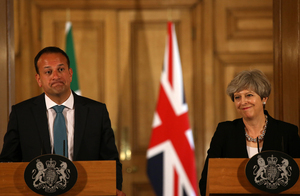

From top: Taoiseach Leo Varadkar and British Prime Minister Theresa May MP at No. 10 Downing Street on Mr Varadkar’s first official engagement outside of Ireland after becoming Taoiseach in June, 2017: Anthony Sheridan
It is grotesquely hilarious to witness Irish journalists, commentators and politicians condemning the British political system over its handling of the Brexit crisis. Here, for example, is Irish establishment journalist Alison O’Connor:
‘Who are these people who have risen through the ranks of British politics who don’t know their history, their geography or their arse from their elbow?’
The suggestion here is that Irish politicians, unlike their British counterparts, do know their arse from their elbow. There are millions of Irish citizens with ruined lives who would beg to differ.
And here’s Michael McDowell ignorantly suggesting that British politicians should adopt the same dishonest, anti-democratic strategy favoured by the corrupt Irish ruling elite when the people don’t do as they’re told – hold a second referendum:
‘Obviously our government has to pay lip service to accepting the outcome of the first British referendum, but others in Ireland should, in a friendly and decent way, publicly encourage the people’s vote cause. It would be honourable and honest to do so – provided it was not done in a counterproductive way.’
This sly, manipulative, patronising and dishonest attitude to how politics should be done is the norm in our dysfunctional democracy and therefore the likes of McDowell, in his ignorance, thinks it’s the norm in real democracies.
There is no doubt that the whole Brexit episode is a complete disaster for the United Kingdom. There is no doubt that stupidity, extreme nationalism, selfish party politics and cowardly political leadership are the main ingredients that led to the catastrophe.
But there is one element of the crisis that no mainstream Irish politician could possibly recognise or understand – British democracy is alive.
British democracy is a living, breathing, dramatic, often toxic, always passionate, sometimes uplifting, sometimes disastrous, but most importantly, always, always alive to the awareness that democracy belongs to the people, that in the end it is the people, for better or worse, who will decide the fate of the nation.
Ireland, on the other hand, is a dead democracy and has been since independence. Irish democracy is a rotten corpse that goes nowhere.
It performs just one function – it feeds and fattens the political maggots of the main political parties that have been crawling all over its putrid body since independence.
The principal difference between so-called Irish democracy and that of genuine democracies is evident in how ordinary citizens interact with their political systems.
Citizens of functional democracies such as the UK, France and Germany are aware that ultimate power rests with them, with the people.
They are aware that elected representatives are servants of the people, servants of democracy. In other words, in functional democracies, power flows from the bottom up and when that power is abused there is accountability and consequences.
That’s why there’s a virtual revolution going on in France. That’s why British politicians are extremely wary of dismissing the will of the people as expressed in the Brexit referendum.
In Ireland, the complete opposite is the case.
Unique among Western democracies, Irish citizens, for the most part, see power as residing in their elected representatives and government officials. They see power as coming from the top down and are forever grateful when the powerful throw them a few crumbs from the table.
There are historical reasons for this mindset that are too complex to go into at this time. Sufficient to say that this attitude, that the citizen is powerless and dependent on favours doled out by public representatives, has morphed into a system of political gangsterism that has destroyed the lives, wealth and hopes of millions of Irish citizens over the decades turning Ireland into a virtual banana republic.
History is the key to understanding how all this came about.
Prior to the English civil war of 1642 Parliament had very little power. At the time the divine right of kings to rule was absolute. But that all changed when King Charles I attempted to force Parliament to do his bidding.
When Parliament refused the king entered the House of Commons [the House of the People] with 400 soldiers and attempted to arrest five members. Charles Lenthall, the Speaker of the House, displaying great courage, told the king that he stood by [the people’s] Parliament and not the monarchy.
Not only did the king lose the ensuing civil war, he also lost his head when he refused to accept that power resided in the people and not in his person. The English monarchy never regained absolute power and the English people, to this day, are very aware that they are the real power of the land.
Just the other day, nearly 400 years after people power first challenged royal power, the current Speaker of the House, John Bercow, told those who sought to abuse the people’s parliament, to take a hike.
The evolution of Irish ‘democracy’ could not be more different.
When independence was achieved in 1922 power was usurped by an extremely conservative political class that created a fake democratic system based on parish pump politics and gombeenism.
Hughe swathes of power and influence were handed over to the Catholic Church that led directly to a holocaust of abuse and criminality that continues to this day.
Ireland has never had a functional democracy. Instead we have a political ruling class made up principally of Fine Gael, Fianna Fail and the near extinct Labour Party.
This is why there has never been a Right/Left wing political divide in Ireland as there is in almost all functional democracies. You cannot have such democratic balance in a country where there is, effectively, just one ruling class [party] masquerading as three political parties.
In Ireland we have a political system that is nothing more than a diseased corpse where the stench of corruption, lies, secrecy, cynical political manipulation and outright state criminality daily chokes the lungs of any hope of a genuine democracy emerging into the light of day.
Yes, British democracy is in crisis. Yes, total catastrophe is a distinct possibility, even the possibility of revolution. But that has happened before, it has happened in many countries over many centuries.
But the very fact that such chaos exists is testament that British democracy is a living, breathing entity where the people are fully engaged and ultimately supreme.
Only in countries like Ireland do we witness politicians and their toadying supporters in mainstream media say:
‘Look at the chaos that reigns in the UK in comparison to our stable political system here in Ireland.’
They little realise that apart from the stench and rot a [political] corpse is always stable.
Anthony Sheridan is freelance journalists and blogs at PublicEnquiry.
 The votes are in.
Following last week’s controversial St Patrick’s MAGA hat competition.
‘Spaghetti Hoop‘ wins the ‘cap of shame‘ – following a tense electoral college run off – with the following verse:
Trumpsters wear red,
But my cap is green,
Would ye send it to Fermanagh,
As a gift to Arlene?
Meanwhile…

Trumpsters wear red,
But my cap is green,
Groper they said
But Bill ain’t clean
A bonus Trump ‘Make Low Orbit Great Again’ Space Force cap to Angela Broderick for the above ditty.
Thanks all.
Thank you to Johnny-NY for purchasing the caps.
Last week: Our Cap Overfloweth

This afternoon.
Saint Patrick’s Church, Donaghmore, Co Tyrone.
School friends and clubmates of Lauren Bullock, one of three people killed during an apparent crush at the Greenvale Hotel, Cookstown, Co Tyrone, wait for her coffin following a funeral service.
Meanwhile…

Edendork, Dungannon, County Tyrone
Edendork gaelic club team mates link arms around the coffin of Greenvale Hotel victim Conor Currie before it is carried into Saint Malachy’s Church for a funeral service.
Earlier, a third victim Morgan Barnard’s funeral took place St Patrick’s Church in Dungannon.


From top: Former Taoiseach Enda Kenny in the Dáil in February 2013 when he apologised to women who had been incarcerated in Magdalene homes; Irish Examiner journalist Conall Ó Fátharta
Yesterday.
Journalist with The Irish Examiner Conall Ó Fátharta tweeted his thoughts on the Magdalene redress scheme.
His sobering account follows separate previous reports by him detailing how 14 women who were sent from An Grianán training centre to work in Dublin’s High Park Magdalene laundry in the 1980s have yet to receive an offer of redress from the Department of Justice.
This delay, he reported, is on account of the department saying that the order which ran the laundry, the Sisters of Our Lady of Charity of Refuge, claims it stopped sending women from An Ghrianán to the laundry in 1980.
But, Mr Ó Fátharta has pointed out, among other matters, that the department’s legal team has refused on three occasions to given the women’s legal team any evidence to support this claim and the High Court accepted, in 2017, that children worked at High Park into the 1980s.
Mr Ó Fátharta tweeted:
Related: Magdalene women seek minister’s help on redress (Conall Ó Fátharta, The Irish Examiner)

What you may need to know
1. After years of false starts and broken promises, the long-hoped-for return of HBO’s masterful western drama is really real.
2. Deadwood, set in the eponymous frontier town in the late 19th century South Dakota, initially ran for three seasons from 2004-2006. It didn’t find much of an audience at the time but has since been consistently hailed as one of the all-time greats due to its realism, complex characterisation, production value and blending of actual events with fiction.
3. Ever since its rather undignified cancellation, creator David Milch and much of the cast kept a candle lit for its eventual return. That has taken more than a decade, but fans are currently punching the air in ecstasy.
4. A healthy portion of Deadwood’s acclaim is for Ian McShane (top) in the role of saloon owner and local crime boss Al Swearengen, whose penchant for soliloquies and getting his hands dirty for what he believed to be the greater good gave him the air of a dusty Shakespearean king.
5. Beyond that, there are actually too many good things to say about Deadwood, other than there’s plenty of time to catch up between now and the end of May.
Doug’s verdict: Yer darn’ tootin’
Release: May 31 (Sky Atlantic TBA)