


A short by Mark Fuller and Stephen Ing of UK studio Make It Move, that ‘peers into the mundane, rarely heroic life of an office fire extinguisher’.



A short by Mark Fuller and Stephen Ing of UK studio Make It Move, that ‘peers into the mundane, rarely heroic life of an office fire extinguisher’.

Yesterday.
Shannonwatch released a statement, following the arrest of two US veterans, aged 77 and 82, at Shannon Airport on Sunday.
The two men were charged with causing €2,500 worth of criminal damage to the airport perimeter fence at Shannon Airport and unlawful trespass into a taxi-way at the airport.
Shannonwatch wrote:
“Two US veterans were arrested at Shannon Airport on 17 March for entering the airfield to inspect and investigate an OMNI Air International plane on contract to the U.S. military. The two, Tarak Kauff and Ken Mayers, were refused bail at Ennis District Court today.
The plane, tail number N351AX, arrived at Shannon Airport about 8.30am from Eielson US air force base in Faribanks Alaska, believed to be on its way to the Middle East with up to 300 armed US troops.
At about 10am Mayers, a former Marine Corps Major and Kauff, a former Army paratrooper, both members of US Veterans For Peace, entered the airfield carrying a large banner that said:
U.S. Veterans say
Respect Irish Neutrality
U.S. War Machine out of Shannon Airport
Veterans For Peace
The two walked across the air field with the intent of inspecting the plane for weapons or munitions, but were apprehended by airport security and gardai.
There were detained and interviewed at Shannon Garda station and held overnight for arraignment on charges of trespass and criminal damage.
At Ennis District Court [yesterday] morning Mayers and Kauff were represented by solicitor Darragh Hassett.
The prosecution outlined the charges against them and indicated that they were opposed to bail.
Garda Sergeant Noel Carroll gave evidence of arrest on Taxiway 12 at Shannon airport. He also stated that there was a US military aircraft at the airport, most likely referring to OMNI Air N351AX.
He also confirmed that the defendants were both veterans of the US military.
The prosecutor, Inspector Thomas Kennedy, said there had been substantial damage to the airport perimeter fence.
When the bail issue was being discussed solicitor Hassett initially stated that the defendants were prepared to agree to bail conditions that involved surrendering their passports, and remaining in Ireland for the duration of the legal processes.
This was an unacceptable condition as it would mean that the defendants would have to remain in Ireland at their own expense for up to two years before the trial would occur, and this restriction amounts to punishment without trial.
The defendants then requested an adjournment to discuss matters with their solicitor.
After the court resumed, Hassett emphasised that the defendants needed to return home to the USA and would sign a sworn undertaking to return for trial.
The prosecution opposed this and continued to oppose the granting of any bail.
Judge Maire Keane then ruled that she was denying bail to the accused and remanded them in custody to Limerick Prison, where they are to appear for a further court mention hearing by video from the prison on Wednesday, 20 March.
Further discussions were then held with solicitor Hassett.
He raised the option of appealing the bail refusal to the High Court in Dublin and he was told to lodge such an appeal.
He indicated that it would likely be Thursday, 28 March, before this High Court appeal would be heard.”
Two US Veterans For Peace Refused Bail at Ennis District Court (Shannonwatch)
Previously: Cleared for Takeoff

The tale of Nancy the orb-weaver as told by zefrank. To wit:
She can make rope with her butt, and what she chooses to do wit that butt rope is nobody’s business.
Previously: True Facts About The Lemur

We got our High Court ruling dismissing John Delaney’s injunction application at 9.35pm last night. That’s about 20 mins before The Sunday Times print deadline. I was out of there like this (except wearing a blue hoody instead of a blue dress!). pic.twitter.com/vHPJx1rrbW
— Mark Tighe (@marktigheST) March 17, 2019
CEO of the Football Association of Ireland John Delaney
On Saturday night, The Sunday Times journalist Mark Tighe tweeted that he had just spent three hours in the High Court.
The CEO of the Football Association of Ireland John Delaney had, from 6pm, tried to secure an emergency injunction to prevent Mr Tighe reporting that Mr Delaney had given the FAI a cheque for €100,000 in 2017.
Mr Tighe subsequently told RTÉ’s Morning Ireland that, at the High Court, Mr Delaney also sought damages from the newspaper for breach of privacy and swore an affidavit – which was opened to the court – claiming that he believed the only place The Sunday Times could have got information about the cheque was from his divorce proceedings.
The High Court appearance followed the newspaper starting correspondence with Mr Delaney about the cheque on March 1.
On Saturday night, Judge Anthony Barr ruled in the newspaper’s favour and ordered Mr Delaney to pay the newspaper’s legal costs.
In his judgement, the judge said there was no proof that The Sunday Times’ source was Mr Delaney’s divorce proceedings.
The judge reportedly said: “…the finances of the FAI and any payment and repayment to its chief executive are matters of significant public interest.”
Mr Tighe tweeted that the judge found in their favour at 9.35pm – 20 minutes before the newspaper’s print deadline.
An article about the cheque subsequently appeared in the newspaper on Sunday, explaining that the €100,000 was drawn from Mr Delaney’s account at Bank of Ireland in Waterford and subsequently lodged at Bank of Ireland in Blanchardstown, near the FAI headquarters in Abbotstown.
The FAI has since issued three statements on the matter, saying that the cheque was a “bridging loan” from Mr Delaney to the FAI.
Yesterday, Niamh Lyons and Sean McCarthaigh, in The Times Ireland edition, reported that – since news of the cheque emerged – a whistleblower has contacted a member of the Oireachtas sport committee about a number of allegations concerning governance at the FAI.
They reported that the whistleblower is preparing to make a formal complaint to the Office of the Director of Corporate Enforcement, while the politician who has received the information is going to see if the allegations can be put to FAI representatives when they go before the committee on Wednesday, April 10.
The FAI’s first statement was released around 11.40pm on Saturday night – after The Sunday Times went to print – with the FAI stating “the short-term loan [in April 2017] was required to aid cash glow on that occasion and was repaid in full” to Mr Delaney by the FAI in June 2017.
Mr Delaney was quoted in the statement saying: “This is the only occasion on which I provided the association with a short-term loan.”
On Sunday, the FAI released a second, longer, statement – about the FAI’s governance – which also included reference to the cheque.
In it, Mr Delaney was quoted as saying:
“I have already commented on the reasons behind the loan. I acted in the best interests of the association at a time when immediate funding was needed.
“This loan had no impact on the full financial position or performance of the association for the year. It was a matter of timing.
“The monies received from EURO 2016 were utilised in that year’s budgets as outlined in the financial report to the 2017 AGM.
“As CEO I hold regular meeting with our Director of Finance regarding the state of our finances and all items arising are conveyed to our board at our monthly meetings.
“This was the case in 2017 when I acted in good faith for the benefit of the FAI and will continue to do so.”
The statement added that a “full media conference will be held in early April”.
The third statement was released yesterday in which the association reiterated that “the bridging loan was made in the best interests of the FAI in 2017 when it experienced a short-term cash-flow issue”.
In further coverage about the FAI, Neil Cotter and Craig Farrell, in The Irish Sun, yesterday reported that out of Ireland’s three main sports — football, GAA and rugby — the FAI alone needs to beg for early drawdown of State funding.
And this morning, John Hand, also in The Irish Sun, reported that Mr Delaney likely faces a €50,000 legal bill after failing in his bid to secure an injunction.
Meanwhile, in late January, it was announced that the former Sports Editor at The Irish Sun Cathal Dervan had been appointed as the FAI’s new director of public relations and communications.
He’s to take up the position in April after seven years at The Irish Sun.
Delaney’s unexplained €100,000 cheque to FAI (Mark Tighe, The Sunday Times, March 17, 2019)

Ah here.
on shelves tomorrow.
Thanks Bernard

Oh my.
Sunday morning.
Miss Thea writes:
My pal sure knew how to dress for the day that was in it…
Any excuse.

The suspected mob boss killer and his ‘doodles of hate’
Where we go one, we go ‘ah here’.
Man Suspected of Killing Gambino Mob Boss Drew QAnon Symbols on Hands in Court (New York Magazine)
Pics: AP
Meanwhile…
Sad day for internet yesterday, AU and NZ ban a dozens of websites including voat, 4chan, 8ch, liveleak, archive, Bitchute, zerohedge, kiwifarms the beginning of the end.
— Skywalk (@skywalk819) March 19, 2019
Hmm.
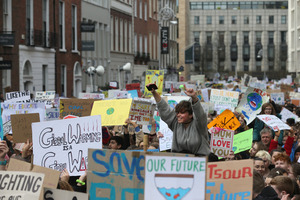

From top: Schoolchildren strike for climate action in Dublin city centre last week: Bryan Wall
The students striking for action on climate change represent probably our last and best hope for any meaningful change. In Dublin over 11,000 students took part in the protest while in Cork around 5,000 took to the streets.
Worldwide, over 1 million students went on strike in over 100 countries. Nonetheless, the question remains, is it too late to do anything? Unfortunately, the answer appears to be yes. The best we can hope for now, barring some kind of technological miracle, is mitigation.
Nothing has been done decades to create more sustainable societies and industries. Instead, businesses and their friends in government continued to extract and pollute as much as they wanted. The science has been known for more than a generation.
As far back as 1968 there were warnings about the damage CO2 could do to the environment. The American Petroleum Institute at the time had received a report which clearly stated that CO2 “may be the cause of serious world-wide environmental change”.
What’s more, the report detailed that “man is now engaged in a vast geophysical experiment with his environment”. Even in 1968 the authors could write that “There seems to be no doubt that the potential damage to our environment could be severe”.
Melting ice caps, rising sea levels, and warming oceans were some of the consequences they predicted. And here we are, 51 years later and we are still not adequately prepared for the damage that has already been done, let alone the damage that awaits us in the coming years.
Nick Cowern, an emeritus professor of atmospheric science, energy, and climate change has some stark truths for us. He pointed out that if all of our emissions stopped now, it would still take hundreds of years for the biosphere to absorb all of the CO2 that has already been emitted.
And even then, the global temperature would still go above 3 degrees of warming. So we on our well on our way to hurtling past 3 degrees of warming given that emissions are not going to simply stop overnight and all at once. What will that mean for us?
David Wallace-Wells describes this scenario in his new book, The Uninhabitable Earth: A Story of the Future. He writes:
“Warming of 3 or 3.5 degrees would unleash suffering beyond anything that humans have ever experienced.”
On our way to that level of warming we will have made survival for millions, if not billions, of people uncertain.
Wallace-Wells says:
“it’s possible as soon as 2050, when we will be at about 2°C of warming or a little bit warmer than that, that many of the major cities in India and the Middle East will be lethally hot in summer.”
This means people “won’t be able to reliably go outside, work outside during the summer months without incurring some lethal risk”.
Then there are other side-effects. In a paper prepared for the UN Global Sustainable Development Report, the authors pointed out that “Meeting current or growing levels of energy need in the next few decades with low-carbon solutions will be extremely difficult, if not impossible”.
What’s more, “economies have used up the capacity of planetary ecosystems to handle the waste generated by energy and material use”.
Essentially, then, we’re caught in a vicious cycle. Renewable energy isn’t reliable or common enough — at least that’s the argument — to provide for growing levels of energy use right now. We’ll have to rely on fossil fuels for the next few decades instead.
But at the same time we’ve already burdened the planet with so much waste that even the permafrost in the Artic and Siberia is starting to melt.
And given that “1.8 trillion tons of carbon, more than twice as much as is currently suspended in the Earth’s atmosphere” is contained in that permafrost, the future looks even more apocalyptic. So, we must turn to renewables. But we can’t. Instead we rely on fossils fuels, and on and on. Ireland, as you’d expect, is not immune from any of this.
A new report issued by the Sustainable Energy Authority of Ireland (SEAI) found that Ireland is doing miserably compared to its neighbours in doing something about climate change. Ireland has a binding agreement with the EU to have 16% of its energy provided by renewable sources by 2020.
Instead only 10.6% comes from renewables. Ireland is not going to meet these or other 2020 targets according to the SEAI. In fact, at the moment Ireland is 26th out of 28 countries in terms of its progress towards meeting its targets.
Ireland is not the only one that is failing. Every country and corporation is. It’s just that some are failing more than others. Some don’t even care if they fail. According to the Guardian, a study found that 100 companies were responsible for 71% of greenhouse gas emissions.
Such an abhorrent figure should have people calling for revolution, be it green or otherwise. This, as Greta Thunberg pointed out, has been left to the younger generations; to the children of those doing most of the polluting.
She also rightly said that “change is coming, whether you like it or not”. The idea that people will continue to wait for their governments to do something while they are starting to die from the effects of climate change is laughable. People have their limits. We are quickly approaching them.
And we have already seen that climate change can have a role in provoking long and deadly wars. The Syrian civil war, for example, has been partly blamed on the effects of an unusual drought which struck the country in 2006.
Farmers were forced to migrate to the cities in order to survive, where their unhappiness with the government response turned into rage. Of course, there were other internal and external reasons for the civil war but climate change was one of them.
Syria could be a portent of what we can look forward to around the world over the next few decades. An economic and social revolution is needed. There have been calls to mobilise on the level of World War II in order to, at the very least, mitigate the damage that has already been done.
This is a laudable tactic but it is one doomed to failure unless we topple the corporations doing most of the damage. If we want a viable planet and ecosphere for ourselves and our children, revolutionary action of this kind is the only way forward.
Bryan Wall is an independent journalist based in Cork. His column usually appears here every Monday but owing to the Bank Holiday… Read more of Bryan’s work here


