This morning.

Dublin Cycling Campaign is launching a poetry competition on the theme of the beloved bicycle.

Mike McKillen writes:

Joyce-cycle is a pageant of over one hundred participants of all ages on bicycles on the theme of Irish writers, who will be participating in the St. Patrick’s Parade on behalf of Dublin Cycling Campaign.

As we joyfully celebrate the many Irish writers who incorporated the bicycle in their literature, Dublin Cycling Campaign is today launching a poetry competition in collaboration with Poetry Ireland on the theme of bicycles.

There will be a junior under 16 and senior category, with cash prizes ranging between €200 and €500.

It would be preferable if poems were no more than 40 lines, but can be as few lines as you wish.

The final date for submitting your poem is midnight on the 1st March and winners will be announced on the 7th of March.

Joyce-Cycle: Love Your Bike Poetry Competition (Dublin Cycling Campaign)

This morning.

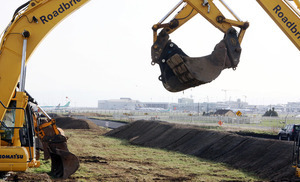
Dublin Airport.

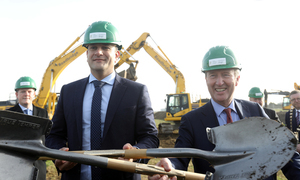
The Official Sod-Turning for Dublin Airport’s €320m North Runway by Taoiseach Leo Varadkar with Minister for Transport Shane Ross.

Meanwhile…

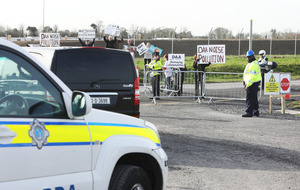
A protest by local residents and members of nearby St Margaret’s GAA club.

Previously: Residents To Protest Runway

Rollingnews

From top: Sunday Business Post; Tom Lyons and Denis O’brien; the Banking Inquiry’s core book of evidence related to PwC 

This morning Paul O’Higgins SC, for businessman Denis O’Brien, continues his cross examination of former editor of the Sunday Business Post about his articles on March 15, 2015, pertaining to a 2008 PricewaterhouseCoopers report.

Mr O’Brien claims the articles were defamatory of him.

The Sunday Business Post denies this.

The confidential PwC report was a Government-commissioned report in which PwC listed the top 22 borrowers of Ireland’s six banks in 2008. The Sunday Business Post reported that PwC recorded Mr O’Brien as No.10 on the list.

In November 2008, after getting the PwC report, the then Taoiseach Brian Cowen told the Dail that Ireland was right to guarantee the banks in September 2008.

He also told the Dáil that there was enough money in Ireland’s banks for the next three years.

The Sunday Business Post reported that the PwC report showed it believed – in its worst case scenario – Ireland’s banks would lose €10.6billion.

Ireland would eventually go on to get a EU/IMF bailout for €64billion in 2010.

The jury in the High Court, before Justice Bernard Barton, has heard that the Sunday Business Post reported in one of the articles:

“[Denis] O’Brien he went on to repay all his debts to Anglo. He is one of AIB and Bank of Ireland’s best clients.”

It’s also heard, on a number of occasions this week, how Mr Lyons destroyed his copy of the PwC report on St Patrick’s Day 2015 by putting it through a shredder in the offices of the Sunday Business Post.

He said he did this to protect his source as he believed the document was traceable.

Mr O’Higgins SC, for Mr O’Brien, quipped yesterday that this was like the “St Patrick’s Day massacre” – a reference to St Patrick’s Day in 2008 when €3.5 billion was wiped off the value of stocks on the Irish Stock Exchange.

A common refrain from Mr O’Brien’s legal team is that they have not seen the PwC report.

When it was put to Mr Lyons by his own counsel Michael McDowell SC that it was Mr O’Brien’s case that he was “the odd man out”, that he should never have been put in the articles with the other 21 men – and that to do so was “defamatory, gratuitous, unnecessary” and done of out of “malice” – Mr Lyons said: “Jesus, that’s nonsense.”

Mr Lyons also said he found it “shocking” that Mr O’Brien said he wouldn’t put it past Mr Lyons to just stick Mr O’Brien into the articles.

Mr Lyons rubbished the suggestion that Mr O’Brien was the victim of some kind of “crazy conspiracy” cooked up by him and the former editor of the Sunday Business Post Ian Kehoe.

The jury has also heard that at the time that the articles were published – in March 2015 – the Banking Inquiry was under way.

It heard that the inquiry contacted Mr Lyons for a copy of the PwC report.

But, at this point, Mr Lyons said he had already destroyed it.

Asked earlier this week if he was surprised when the inquiry asked him for the report, Mr Lyons said:

“It did surprise me. I had this suspicion they hadn’t got it. It was a gut instinct. But when it came out that they hadn’t got it, I was very surprised.”

Further to this…

In PwC’s core book of evidence for the Banking Inquiry – which is publicly available online – one section of it’s evidence appears to match the headline figures reported by the Sunday Business Post on March 15, 2015.

The item is headlined:

The top 22 exposures across the six institutions we have reviewed total 25.5 billion of which 13.7 billion (53%) is in Anglo and 8.1 billion (32%) in AIB.

Although redacted, the list of the amount owed by the 22 borrowers in the Banking Inquiry’s PwC summary (page 155) matches the amount owed reported by the Sunday Business Post here

The PwC core booklet can be viewed here in full

The case continues.

Update: Meanwhile, in the High Court

Yesterday: “He Thinks It’s All About Him”

Meanwhile, In The High Court

This morning.

Capel Street, Dublin 1

Queueing for €13 tattoos.

John Gallen writes:

I thought this thread both horrific – queueing for cheap tattoos – and hilarious…

From top: Members of the Fingal Battalion Direct Action group outside Minister for Health Simon Harris’s County Wicklow home last Sunday; Dan Boyle

They looked a sorry lot. The half worn balaclavas combined with sunglasses was not the most de rigueur look.

The self styled Fingal Battalion gave the impression they had arrived in Wicklow after a 21st century attempt at the Jarrow March, hiking from Balbriggan to Greystones but frustratingly failling to pick up any support between Howth and Bray.

After 40 minutes on the M50 they finally found soulmates in the form of Wicklow Says No, undoubted second cousins of Ian Paisley and the DUP.

Being angry for anger’s sake must be one useless and pathetic responses in modern politics. Anger, as John Lydon has warbled, is an energy, but a particularly empty one if not effectively harnessed or directed. Anger to be acted on needs to have a strategic purpose.

There is plenty airing these days of who and what most people are against. There is very little exposition on what most people are for.

It is very easy to be reactionary, to create then point at a panoply of hate figures who are there to be blamed; never to recognise responsibility as something that needs to be shared.

Maybe I’m wrong in being bothered about the politics of hate. It’s more of a religion really. Its rites and rituals now fairly commonplace. Its liturgy seems to write itself.

Its demonology affixed to the misplaced great and good, for whom a special place in hell has been bought and paid for several times over.

Like any mainstream religion there isn’t any need for theological consistency either. Followers of GOD on Earth (Gemma O’Doherty) seem to see no irony in demanding a platform, for her and them from the malign, nay evil, Empire of Google

The ultimate irony is that this type of politics of the playground often achieves the opposite of its intentions. It evokes an undeserved sympathy for the inept, the incompetent, the evasive and the incomprehensible.

The many failures of traditional politics lay not in not exposing the intricacies of conspiracies, but in the persistent inability to avoid cock ups.

It isn’t George Soros who’s having meetings about bringing about an end of the World as we know it, it’s the conspiratorialist who believe he is.

One of the sadder and more pathetic aspects of the religion/politics of hate is that anyone who questions these inconsistencies, who challenges these basic tenets, immediately becomes part of the demonology, a conspirator inter pares.

This type of buffoonery not only insults successful protest movements of the past, they also help undermine the credible vehicles of today and their near future counterparts.

That’s the frustrating thing about democracy, built into its modus operandi is the right, even the need, to be wrong.

I’ve been wrong before. I will be wrong again. I’d like to think that I have and will learn from my mistakes. The scary thing about the religion/politics of hate is an ingrained inability to admit they can be wrong.

Their messianic view of the World does not allow for the right to be wrong. To be wrong is to be as bad as they are. If you can’t be moralistic, in this solipsistic World they inhabit, how is it possible to be moral?

Like economics, political thought and actions are subject to cycles. It has been our collective tragedy that a dark phase of these cycles has co-incided over the past decade.

But these things too shall pass. We can choose to let these times overcome us, we can be the change we want to be, or we can live our lives in a state of perpetual bemusement.

Dan Boyle is a former Green Party TD and Senator. He is running in the local elections in Cork in May  for the Greren Party.  His column appears here every Thursday. Follow Dan on Twitter: @sendboyle

Previously: Meanwhile, In Wicklow

Broadsheet.ie