


 Stacked and suspended assemblages of the human form by fashion photographer Rob Woodcox.



Clockwise from top left: Niall O’Connor, Chris Donoghue, Paul Melia and Catherine O’Halloran
Gatekeepers.
Turned.
Gatekeepers!
Via The Sunday Business Post
More than half a dozen journalists have been hired as special advisers by Fine Gael ministers since Leo Varadkar became Taoiseach just over 18 months ago.
The latest recruit was announced last week, with Irish Independent environment editor Paul Melia leaving his role to become policy adviser to Minister for Housing Eoghan Murphy.
….Tánaiste Simon Coveney hired former Newstalk presenter and political correspondent Chris Donoghue as his media adviser in November 2017.
Defence minister Paul Kehoe hired Niall O’Connor, an ex-Independent News and Media political correspondent, as his media adviser at the start of last year, while Minister for Health Simon Harris recruited the former Irish Times political reporter Sarah Bardon as his media adviser last summer.
Three other journalists were recruited from the media world over the last year: former RTÉ broadcaster Caroline Murphy, who is media adviser to Minister for Justice Charlie Flanagan; former Newstalk news editor John Kehoe, who advises Minister for Culture Josepha Madigan; and former Press Association reporter Ed Carty, who is media adviser to Minister for Education Joe McHugh.
In addition to Fine Gael, Independent Alliance ministers recruited former Daily Star political correspondent Catherine Halloran as deputy government press secretary in 2016, while Minister for Transport Shane Ross hired former Sunday Independent writer Carol Hunt as his media adviser.

Ah here.
John Gallen writes:
BuzzFeed let go a load of staff writers… but they kept the best they had!
More than 2,100 people lost their jobs in a media landslide so far this year (Business Insider)
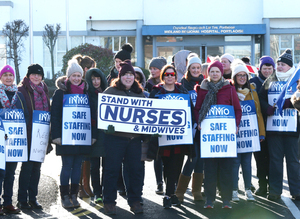

 From top: INMO members outside the Midlands Regional Hospital, Portlaoise; Irish media coverage of the dispute last week; Bryan Wall
With nurses set to strike again later this month, the government finds itself in a difficult position.
Does it acquiesce to the wishes of the nurses and their idea that decent pay and conditions be a prerequisite for being such an integral part of healthcare?
Or does it continue down the well-worn road of ignoring the wishes and needs of the wider population in service of the greater needs of profit and market discipline?
Given the stridency of the government thus far, the latter is the likely outcome.
The status quo must hold. Workers simply asking for a fair income and decent conditions is too much. To give in now might give other workers ideas about their role in society. It might also give them ideas about the value assigned to them by the government and its lackeys.
The media of course has played its own role in all of this. Yes, the strikes are reported on. But often they have been reported on in the context of the effects on patients.
Headlines across the Irish media reflected this adherence to the government’s stance.
This playing to the emotions of people, trying to pit them against nurses is a tactic commonly used. During the water charge protests we had “sinister fringes” who would unleash anarchy. And now we have nurses who are putting the lives of patients at risk by striking.
In the Irish Independent one article led with the headline, “Hundreds of people with an intellectual disability to be affected as nurses escalate strike threat”. This “escalation” would “mean many more vulnerable people will be hit by the strike”.
RTÉ followed suit, and reported in- and out-patient surgeries would be cancelled alongside the closing of injury units and other services.
In the Irish Examiner one could find the same warnings. Not only did they report that services across the board be cancelled but that there would be other unforeseen consequences well into the future.
Opening with the point of view of a Health Service Executive (HSE) representative, the following was reported:
“The knock-on effect of cancelled procedures and appointments due to the nurses’ strike will be felt for some time, the HSE says.”
Further down the article we find out what was actually said by the HSE representative. He warned “There will be a cumulative effect which would be quite significant” if there are further strikes.
The Irish Times was also no exception. Only the disruption to patients was worthy of attention. Of note is the mention of the government’s wish to “re-engage in talks to find a resolution to the current nurses’ dispute.” No word of the sanctions mentioned by Simon Harris or SIPTU.
That honour was left to the Irish Independent who, quoting the Health Minister, wrote that “financial penalties against nurses will be considered”.
According to Harris although the government “‘isn’t in that space today’”, nonetheless, “‘The Department of Public Expenditure and Reform will legally consider that in the coming days and weeks’”.
In the same piece the government line that a raise is unaffordable and beyond the realms of consideration given the imminence of Brexit was reiterated.
Also in the Irish Independent was a piece declaring that the government is “not just facing a showdown with nurses — they’ve also got the public sector union leadership breathing down their necks.” If the nurses are successful other unions will “dust[…] off their begging bowls” in a “free-for-all”.
Any idea that the nurses are financially struggling was put to rest as The Irish Times stepped into the fray to offer their own financial interpretation.
Pay for nurses is higher here than in the UK according to the piece. Ireland lags behind in entry-level pay compared to Australia and Canada but overall ranks fifth out of thirty countries in terms of pay for nurses.
In the same piece it is pointed out that the Department of Public Spending calculates the average pay of nurses to be €57,600 per annum.
It is only at the end of the article that it is revealed – almost in passing – that someone earning that amount would struggle to pay rent in parts of Dublin. Two incomes would be needed to afford a rental home. The implications of this, if not obvious, are spelled out quite clearly in the next paragraph.
Unless the high cost of housing is addressed, the author writes, “militancy will only grow, particularly among younger age groups.” It is known that hardship and economic and social unfairness, let alone inequality, breed radicalism; hence, the warning about militancy.
Regardless, the government must stand firm given the influx of “begging bowls” headed its way otherwise. What emerges in the subtext is a rehashing of Michael Noonan’s “we govern for the reasonable” worldview.
All of this is in the name of “journalistic balance”. Some people want fairness in how they are paid and treated, therefore the opposite view must be given due attention for the sake of impartiality.
This does nothing more than mask the suffering of those protesting and the unfairness of a system in which they are under-appreciated, undervalued, and underpaid. What was missing from the piece in The Irish Times was the economic context of the comparison between NHS and Irish nurses.
Nurses in Ireland being paid more compared to nurses in the UK is meaningless. Across the Irish Sea the NHS has been under attack in the shape of market reforms, i.e., privatisation.
Therefore, comparing the pay of Irish nurses to the pay of nurses in a health system that is being dismantled does not support that government’s argument that nurses here are well compensated. In fact, it does the opposite.
Only by holding the financial compensation of nursing staff here to such a low standard can the government and its apologists defend the current pay levels.
Of course the long hours nurses work are of no risk to patients. Neither is understaffing, underpay, stress, burnout, and the toll all of this takes on the mental and physical health of the nurses.
These are part of the system they signed up too. So they should just shut up and deal with it. Accept the crumbs flung their way from the economic table and be happy that they do not suffer the indignity of having to govern the country.
These are not the “missteps” of a government out of touch with the workers. This is a government that knows exactly what it is doing. In a situation like this, militancy is the only appropriate response.
And fearing this, expect an even harder government line to emerge.
Bryan Wall is an independent journalist based in Cork. His column appears here every Monday. Read more of his work here


Top: Pregnancy and parenting website Rollercoaster.ie; DMG Group logo
Ohhh Daily Mail Group buys https://t.co/Ke6b4azQwl
— Damïeñ Múlley ¸ (@damienmulley) February 2, 2019
Hmm.
Anyone?


Meet Your Maker.
The podcast about ‘builders of the cultural landscape’ hosted by Liam Geraghty (above right) visits the Chester Beatty collection at Dublin Castle.
Laim writes:
How do you ensure a 1000 year old manuscript lasts another 1000? This week I visit the conservation lab at the Chester Beatty to meet Senior Conservator Kristine Rose-Beers (above left)and Book and Paper Conservator Julia Poirier (above centre).
Subscribe on Spotify, Apple Podcasts, Stitcher or wherever you listen to podcasts.

Saturday afternoon.
Dublin location unspecified.
Martin O’Donoghue tweetz:
A queue to view an apartment to rent…


Yesterday.
Skateboarders and rollerbladers travel from St. Anne’s Park in Clontarf to the skatepark in Fairview, with all proceeds going to suicide charity, Aware.
Sick.
Rad.
Also: Gnarly.

Damien Tiernan (left) and Jon Williams RTÉ’s managing director of news and current affairs
Yesterday.
RTÉ’s former south-east correspondent for 23 years Damien Tiernan – who recently stepped down from his €90,000-a-year job at RTÉ, took redundancy and started working at Waterford’s WLR FM radio station – outlined the reasons he left the State broadcaster.
He told journalist Colette Sexton in The Sunday Business Post that he took redundancy mainly “due to frustration at not being able to get stories on air”.
Mr Tiernan added:
“All of the correspondents in RTÉ are constantly trying to get stories on air, but the system does not allow that to happen as [well] as it could. That needs to be improved and the frustration around that is certainly one of the reasons that I left RTÉ. I couldn’t see myself begging to get stories on air for the next 15 years.”
He claimed, in the early 2000s, RTÉ’s studio in Waterford produced an average of 220 TV and radio stories a year, but in the past seven years this had dropped to between 50 and 60 stories a year for RTÉ News.
In a statement to Ms Sexton, RTÉ said it “didn’t recognise” Mr Tiernan’s figures.
Mr Tiernan also said:
“The depth of talent and skill and passion within RTÉ is enormous, and that creativity is stifled at so many levels. For a supposedly creative organisation, it doesn’t know how to develop that creativity to make people confident of the future.
“RTÉ is in a great process of change, like other media organisations. Everybody is grappling with the changes, but you don’t need to reinvent the wheel. You don’t need to get in consultants. You just have to work with the talent you have and make people happy in their jobs.”
Following on from this interview in the Sunday Business Post, the managing director of RTÉ Jon Williams tweeted the article with the message:
Agree RTÉ has brilliant correspondents – which is a why we’ve just appointed new regional correspondents in Dundalk & Belfast. Odd definition of “slashing”. Wish @damienwlrfm every success in new role.
Mr Tiernan responded:
Am disgusted, disappointed but not surprised by RTÉ basically calling me a liar with my figures Jon; RTE does not recognise my figures because RTÉ doesn’t care enough to ask someone to count them. And you were forced re reappoint North East Corresponden by unions after ye tried to downgrade role.
If you want to get into a public spat with me bring it on but I have better things to do (like playing an over 35 soccer match); I love RTÉ more than you will ever know.
And one thing, the regional section on the website and app is a joke.
Mr Tiernan will begin hosting WLR FM’s two-hour live show Déise Today from 10am today.
Tiernan: slashing of regional coverage was why I left RTÉ (Colette Sexton, Sunday Business Post)