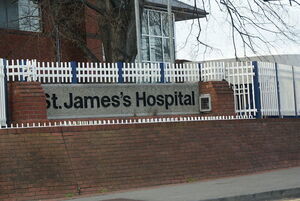
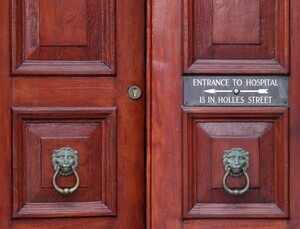


From top: St James’s Hospital, Beaumont and Holles Street; Neil Curran
“We’re in St. James’s A&E and the doctors have asked for the family to come in”.
As I read the text message from my father that Friday morning in September, it was as if the world had stopped for a second. When we are young our parents are bigger than Jesus and more powerful than the dinosaurs. But as we grow into adulthood, we face the harsh reality that most of us will outlive our parents and there is nothing we can do about it. I was about to face that reality head on.
In September of last year, my Mam was rushed to St. James’s hospital after she collapsed out of the blue. She had suffered from a brain aneurysm.
A brain aneurysm is a weakness in an artery that risks rupturing and when it does, it releases blood on the brain often resulting in a stroke and/or death. Unfortunately brain aneurysms show no advance symptoms. In my mother’s case, the bleed is referred to as subarachnoid haemorrhage (SAH).
As I walked into St. James’s busy A&E, I found my mother on a bed in a corner of an empty ward. Doctors had already placed defibrillator pads on her in anticipation of what might happen. My father, brother and I stood around the bed watching her heart rate fluctuate between 30 and 60 bpm, causing varying physical reactions from my mother as she drifted in and out of consciousness.
A young doctor brought us into a room privately. The look on this face did not inspire hope. My mother needed emergency surgery and the only hospital that could perform it was the neurosurgery department in Beaumont Hospital (the other is in Cork). However, there was no available beds in Beaumont so they couldn’t transfer her there until a bed freed up. The look on his face said it all.
The Doctor did not appear surprised and his familiarity with the words suggested it was not the first time he had to tell someone a bed wasn’t available. There was absolutely nothing that St James’s hospital could do for her other than keep her comfortable. There was already blood on the brain from the first bleed.
As a result, she was at a high risk of stroke but an even greater risk existed. The aneurysm would bleed again and when it did, it would likely be fatal. Speedy treatment was essential. Statistics show that 15% of victims of a ruptured aneurysm don’t survive even before they get to hospital, and 50% of patients never leave hospital for various reasons following admittance.
Later that day, by way of a phone call from a friend of the family who “knew “ someone in Beaumont Hospital, we learned that a bed was available and could tell us the name of the ward. We started to see hope, or so we thought.
Our own humility restrained us from blurting to the doctor that we knew a bed was available through our friend. In fact, it was quite embarrassing to consider that a bed may have freed up because “we knew someone”.
We asked the doctor to recheck the bed availability. It took a few more hours for both hospitals to communicate effectively between themselves that a bed in Beaumont was actually available. Long hours watching a volatile heart monitor while awaiting official confirmation of the bed was incredibly frustrating and distressing, knowing that we weren’t already in Beaumont.
My mother was transferred to Beaumont that evening and the surgery was completed successfully the next day. They managed to close the aneurysm and just in time too. She would remain an inpatient in Beaumont until such a time the medical staff were satisfied that they could transfer her back to St. James’s Hospital for further recovery.
The staff and level of care in Beaumont while she was there was excellent. We were very fortunate that my mother’s surgery was a success. Other patients in the Intensive Care units and High Dependency wards, some of which were much younger than my mother, were not so lucky.
The road to full recovery is a long one; it will take time for her short term loss memory to return if at all. There was a window where the risk of stroke and other issues would remain high. But with the aneurysm sealed, there is very low risk of further bleeds.
Unfortunately, our story doesn’t end there. When my mother was transferred to St. James’s Hospital some weeks later we thought we were on the home stretch. However A number of issues arose within days of her arrival.
Essential medicine to be administered by the hospital every 4 hours was not administered for at least 12 hours. The explanation given afterward was that they did not have the medicine available on the ward, the hospital pharmacy closes at 6pm and did not open until the next morning. They did not try to alternately source the medicine from Beaumont Hospital.
On a separate occasion, my mother was given the prescribed medication of another patient in error instead of her own. When we quizzed the nurse about it, she tried to reassure us that the medicine given would not affect her negatively however they were evasive in telling us what medicine had been administered!
We debated discharging her from the hospital and caring for her at home. We did not feel she was in good place in St. James’s following these incidents after the lifesaving care provided in Beaumont. However, a senior nurse intervened and gave assurances that there would not be further problems with my mother. She remained in the hospital and no further issues with her care was apparent.
Shortly after her discharge from St. James’s, she became in inpatient in St. Patrick’s University Hospital for mental rehabilitation for the brain trauma she experienced. St. Pat’s is a mental health hospital that deals with a variety of mental health issues for patients of all ages.
I was not familiar with the hospital prior to this and I imagine with the stigma of mental health in society, we don’t hear enough about the services they offer and the good work they do. The treatment and care in St. Pat’s have been world class. Of all the hospitals we have been in through 2017, St. Pat’s stands out. We have been very pleased with my Mam’s treatment and recovery and how well the hospital is run.
Throughout her care there, questions started to emerge about her treatment in the previous hospitals. While never explicitly stated by the doctors, there was concern alluded about some of the drugs she had been prescribed, the dosage, the duration they were taken for and the cold turkey approach when the course finished. It seemed that part of my mother’s treatment in St. Pat’s has been incorporating recovery from the withdrawal of some of these drugs.
But again our story doesn’t end there. My mother’s doctor in St. Pat’s wanted to reduce the dosage of one of her medications but needed to speak with the medical team in Beaumont first.
Despite his efforts, he could not get a response from Beaumont for a period of weeks. Eventually Beaumont responded to St. Pats in a voice message. What transpired was beyond comprehensive. Beaumont Hospital had no record of my mother being a patient there, despite having a life-saving brain procedure there. Her patient file was missing.
In addition, my mother’s first outpatient appointment was now scheduled over 2 months later than her first appointment should have been according to her discharge papers from Beaumont. Given the lack of communication from Beaumont, it also raises the question as to whether her dosage on this particular medication should have been reduced prior to this point.
As a family, we have been very fortunate prior to this that visits to hospitals have been limited to minor incidents. We all read the stories in the press about horrendous experiences in the hospital system but it’s hard to comprehend it until it happens to you. After all, aren’t these incidents one-off mistakes? It seems reasonable that the HSE would learn from mistakes made, or court settlements reached and make necessary improvements?
Between this and some other incidents, including my spouse’s experience in Holles St. National Maternity Hospital during the same period, it’s been a real eye opener to how broken the health service is.
With the exception of St. Pat’s, we have experienced a series of fundamental issues across three hospitals in Dublin over a short period of time. Generally speaking, most of the staff are doing their best. But it’s very clear that the infrastructure is broken but that seems to be just one component. The system, for the want of the better word, is not fit for purpose. That being said most of the issues we encountered were the result of human error by members of staff.
In 2017, a story hit the papers about the tragic death of Evan Morrissey (28) in 2014 who died from aneurysm related SAH due to a variety of shortcomings of care in South Tipperary General Hospital. The hospital admitted liability, apologised and a settlement was reached.
Also in 2017, a story emerged of a 60 year woman, Bernadette Surlis, was left completely blind and paralysed down the right side of her body due to a delay in correctly diagnosing and treating a brain aneurysm when she first presented herself to Sligo General Hospital in 2013. She was investigated for glaucoma and discharged.
She presented herself at the Sligo General Hospital again the next day, was eventually seen to by doctors but the aneurysm ruptured that evening at 7:30pm. She was transferred to Beaumont later that night at 1am by which time it was too late. She received a settlement of €5m in the High Court after suing the HSE alleging negligence in treatment and care at Sligo General Hospital.
Time is a critical factor when diagnosing and treating an aneurysm and it does not bear thinking about if my mother would have been in a similar scenario, had the family friend not intervened in securing a bed in Beaumont.
With the number of issues, court cases and settlements we see in the media, it really begs the question; is the health service getting better and if so, how do we measure it? I can’t help but feel that perhaps a view is being taken from the top that it’s cheaper to budget for court settlements than attempt to truly invest and fix the system.
As one doctor told us in Beaumont Hospital, there are roughly only 100 beds in neurology available for a population of 5 million people in Ireland. There are no private hospitals, it all goes through the public system.
Does the lack of beds mean that currently, there is a selective process for choosing who gets a bed/treatment for an aneurysm based on location, severity of the bleed, age or other reasons, rather than there being sufficient beds and services available to meet normal/average demand levels?
Just like currently, where there is the perennial crisis of insufficient beds and services for what is the normal high season for flus. In both cases, a proper level of bed availability to deal with the real demand should be provided.
Just where does the buck stop with responsibility and accountability?
Neil Curran is a improviser, trainer and appears on and produces Broadsheet on the Telly.
Pics: Wikipedia.Rollingnews