


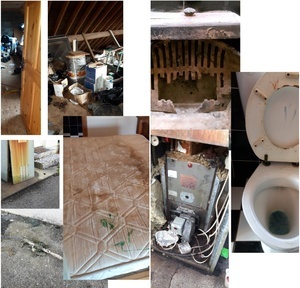
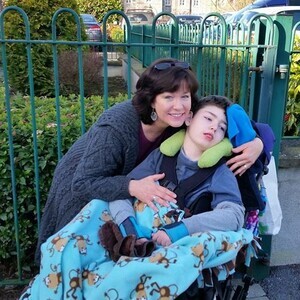
Tracy McGinnis with her son Brendan and (top) conditions at their current rented home
Dr Rory Hearne writes:
Tracy McGinnis and her two boys, Declan aged 9 and Brendan aged 13 (who is severely disabled), face the threat of becoming homeless.
Their story provides another stark example of why the government must take real action to solve the housing crisis and declare it a national emergency.
The experience of the McGinnis family shows the extra challenges and suffering faced by carers and the disabled in trying to find suitable and affordable accommodation in the midst of an unprecedented housing crisis.
I met Tracy, Declan and Brendan last week and spoke to her about her housing conditions, the impact on her children, how difficult it to ‘speak out’, and public attitudes towards the vulnerable and the housing crisis.
Brendan, who has just turned thirteen, was born with Congenital CMV, which means he can’t walk or talk, has severe epilepsy, cerebral palsy and scoliosis. He is not expected to live longer than 18. He smiled with his rainbow coloured teddy bear tucked under his arm as he sat in his wheel chair during the interview.
Tracy has a Master’s Degree and worked as a therapist and with NGOs before she had to leave her career behind to become his full time carer when he was three.
She explains that currently they live in a private rented house in Kildare which has major problems:
“the house is so cold and so draughty, the boiler leaks kerosene, there is no light coming into the kitchen, the ceiling is not insulated.
The environmental health officer said it is in violation of various standards. It is half under construction and there are rolls of fibre glass insulation in the attic which is open and the wind sweeps down through to the rest of the house and I am worried about it affecting Declan and Brendan’s lungs.
There is mould growing on the ceiling in the bathroom. I have no lease and the landlord is unregistered”. It is, she says, “unsafe unsuitable, unfit and its putting Brendan’s health at risk, and mine as I try to care for him in a place that’s not suitable and not modified and can’t be modified for Brendan’s needs”.
The photographs of the house shows just how unsuitable it is: a shower chair sitting unbalanced in a bathtub; no safety rails; and she is unable to use a hoist as the doorway is too narrow and the hoist legs cannot go under the tub.
Tracy describes it, as “dangerous, inhumane and risking Brendan’s life as well as my health and safety as his carer as I am forced to carry Brendan in my arms across a wet floor, through doorways, from one room to the other.”
She has been trying to find somewhere else in Kildare to rent, and that would take the state-supported Housing Assistance Payment, which is the government’s main form of social housing support. Under HAP, the local authority pays the landlord the rent and the tenant pays a lower rent to the local authority.
Tracy is eligible for the HAP scheme. However, she has found it impossible to find landlords that will take them.
Landlords, she feels, are discriminating against her, “the landlords were saying they don’t think the house would suit my son’s needs – I heard that a number of times”.
She can’t stay in her current accommodation and so is trying to find rental accommodation that would take the HAP payment and be suitable for Brendan’s needs near Kilkenny City which would be close to Brendan’s school and care supports, and Declan’s old school.
Tracy is terrified of becoming homeless.
She said:
“Brendan can’t go into emergency accommodation – a hotel or B & B. He needs to have his medical bed as it helps with pressure sores and his scoliosis – he needs his oxygen near his bed and this can’t happen in a hotel or B&B”.
Tracy’s situation highlights a major problem with HAP, which I have also found in my research on other families experience of homelessness. It’s extremely difficult for vulnerable families to find suitable and affordable housing in the private rental sector.
Modification grants are only available for local authority housing or for a family that owns their own home. Renting someone else’s home does not allow the family to avail of any home modification grants which means the family cannot modify the home to safely and properly care for the disabled family member.
As Tracy explains:
“if a family with a disabled child is left to the private rental market, they are left at a tremendous risk of homelessness. They could be given notice to vacate after a 12 month lease and be back at the near impossible task of trying to find a suitable rental house again .If they are not made homelessness, they are more than likely forced to settle renting an unsuitable, unsafe house”
As the photographs above demonstrate renting a house does not provide security.
A social house, she says, would be more appropriate as it can be modified to suit Brendan’s complex healthcare needs. “We need a long term house that we can make a home secure for our future and modify for Brendan’s care.”
She wants a permanent home as she doesn’t want to ever have to leave the home where Brendan will spend his last years with her and his brother.
“I want to stay there, in that home – in our home – where he was for his remaining time, which I hope and pray is a good number of years still to come. I don’t want to ever have to leave behind the home where all those final memories will have been created”
She explains also that Declan needs to be settled:
“Every day he mentions the word homeless”. Tracy explains of her 9 year old son. “That’s not an exaggeration. He asks ‘when we become homeless what will happen? I don’t want my friends to know’. Every day there is at least one sentence involving homeless. This is not fair and not right so I’m trying to do everything I can to rectify it.”
Tracy, Brendan and Declan’s story is not unique. There are tens of thousands of families and children facing homelessness or living in housing insecurity in Ireland.
What is important about their story is the way in which it highlights the fundamental need for us all to have a secure, permanent, home and the deep meaning that is attached to home – as a place where a family can carry out its daily routine without fear of disruption and as a place where love is put into practice each day – where the vulnerable can be cared for – where memories of loved ones are created.
And where they can be held on when people go. There is a concept in psychology called ‘ontological security’ which captures the importance of home- it is the idea of a secure base from which normal functioning can take place – without it people can suffer mental illness.
Housing therefore cannot be treated as just another commodity as policy currently does. It needs to be seen in its key role as providing a secure base – and the private rental sector in Ireland does not provide this and thus exposes people to real mental health stress.
The solutions to this crisis are clear: the government must declare the housing crisis a national emergency; the state must build social and affordable homes (for rental and ownership) on a mass scale and not leave it to the profit-seeking and failed private housing market; private tenants need to be given real security of tenure (remove the ease with which landlords can evict), and there should be a referendum to enshrine the right to housing in the constitution to guarantee all our citizens a secure affordable home.
It is obvious now that citizen action is needed to get this as the current political and state institutions have shown themselves to be unprepared to enact people-centred housing policies and instead are focused on suiting property industry and vulture investors.
But why is there not more public action and protest taking place around the housing crisis?
Tracy explains that those most affected by the crisis face huge challenges that make It difficult for them to raise their voice, “people are exhausted and depressed and all our energy is devoted to trying not to drown”.
She explains she would not have gone public if it wasn’t for Brendan’s needs and her fear of him, ‘literally dying’, if they had to go into emergency accommodation. Also, she believes that the equal marriage referendum mobilised people because:
it was ‘a happy subject – about a simple idea – an equal right to love’ but “people can’t wrap their minds around disability or homelessness because haven’t been touched by it but they have all been touched by love.”
This is a challenge to those campaigning on the housing crisis – how to connect with the large bulk of the population, increasing numbers of whom are affected by the crisis but do not see a common link with others affected, such as the homeless.
But if you think about it – most people have a home, however unaffordable or temporary – and perhaps this is the missing connection campaigners need to focus on – to get people to think about home, what it is, the importance of it, the impact of its loss, and why everyone should have the right to a secure and affordable home.
Part of the problem is that in terms of housing – too often people who are homeless or on welfare or low incomes are blamed for their problem –just looking for ‘hand-outs’ and ‘everything for free’ and are called ‘scroungers’.
The Taoiseach’s recent comments about ‘welfare cheats’ and standing up for ‘those who get up early in the morning’ doesn’t help this stigma and division.
Of course, part of the intention behind the ‘getting everything for free’ and ‘scrounger’ narrative is about trying to reduce the state’s and politicians responsibilty for supporting vulnerable people. But the vulnerable face homelessness – as Tracy’s case shows – not because of their own fault – but because the system excludes them and doesn’t value all human beings equally and their rights and dignity – because it puts investor’s profits and the ‘market’ first.
There is a lot you – as a citizen – can do to try end this crisis. Call your local TD, get involved in local housing action groups, a political party, get your trade union to raise the issue. This isn’t going to change until the public makes it a political issue and making the system feel the pressure of our abhorrence. It’s up to you, to all of us, to act to change it.
I will leave the last word with Declan who was a little shy when we met but emailed me later:
“I don’t want to be homeless. Brendan would be in danger if he goes into a hotel (emergency accommodation). And where would I go to school? And what about Brendan, how would he get care? I feel worried and scared about being homeless. I’m worried about us”.
How can your heart not be broken reading this? It enrages me to think that the Irish state, because of its failure to provide affordable housing, is doing this to tens of thousands of children every day – removing from them their secure base of a home.
Tracy has an excellent blog where she writes about her experience which you can read here:
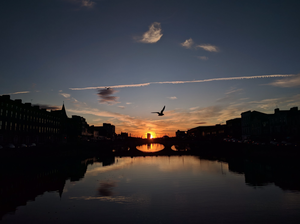
She is also speaking at the Inner City Helping Homeless annual homeless awareness campaign ‘Light the Liffey’ Tuesday October 10 at 8pm opposite CHQ building.
Dr Rory Hearne is a Post-Doctoral Researcher in Maynooth University, has written and researched extensively on housing, privatisation, and inequality and is a social justice advocate, he has written two reports recently on the housing crisis in Ireland; With Dr Mary Murphy: Investing in the Right to a Home; A Home or a Wealth Generator.