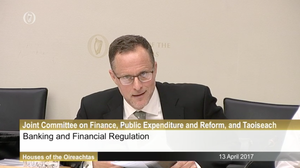
Jonathan Sugarman
This morning Jonathan Sugarman – whose 2007 warnings about breaches of liquidity requirements at Unicredit Bank Ireland were ignored by the Central Bank – appeared before the finance committee.
During his opening remarks, Mr Sugarman talked about his decision to come forward about what was happening in Unicredit ruined his life.
He also noted how other whistleblowers have been treated in Ireland, specifically Sergeant Maurice McCabe and former Garda John Wilson.
During the meeting, Mr Sugarman said the following…
On being unable to find a job for the past 10 years:
“I’m unable to find work, not even on the European continent...because the minute you Google my name, you see discussions about me in Dáil Éireann, Seanad Éireann, Australian television, Belgian television, Greek television about the fact that I tend to do my job very well. So much so, that I complied with the law.”
On his resignation:
“I said so in my letter of resignation that, as of this minute, I resign all of my duties because of issues of integrity, I cannot perform contractually what I agreed to do for the shareholders of Unicredit.”
On how the bank reacted to his resignation:
“They were concerned enough to actually offer me employment with another Italian bank in the IFSC, provided I withdrew my resignation.”
On not being able to get any compensation as no sanction has been brought against Uncredit.
“In the absence of a sanction, by the Central Bank, I have had zero legal recourse against Unicredit… because of the fact that the Central Bank failed to issue a sanction, as it should have, against the bank, for breaching the law by 20 times the permissible deviation, lawyers whom I have consulted with said, ‘Until Unicredit has been sanctioned, you have not got a leg to stand on’. Which is why I have now exceeded the time for an Employment Tribunal because there is no sanction.”
“I’ve exceeded the statute of limitations on Employment Tribunals because there is no sanction by the Central Bank. Had there been a sanction by the Central Bank I would have been rightfully able to go to the Employment Tribunal and say, ‘no employee can be forced to commit a crime. Here I am having been forced to commit a crime and sign over repeated crime. As I read out to you earlier, every day is a crime, every day is a breach or a crime in its own right.
“And when the Central Bank admitted to me, at our meeting, that they had sight of other breaches that had gone unreported, i.e. they had seen other crimes, during my tenure at Unicredit, you cannot force an employee to commit a crime. And, therefore, I had no choice, but to resign. And therefore, I should be entitled to receive compensation from the bank and from the Cental Bank of Ireland.”
On not being able to afford to take an action against the Central Bank:
“I have no means. Thanks to friends, I can feed myself. And when I needed to go to the dentist, a few weeks ago, my friends got together and paid the dentist.”
Earlier: Watch Jonathan