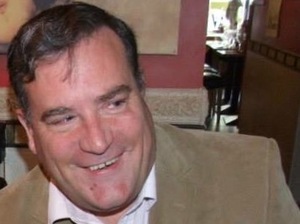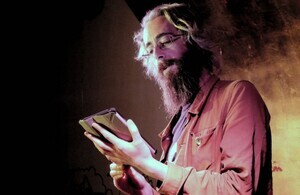
From top: Martin McGuinness in Downing Street; Dan Boyle
As a young man his sense of anger seems palpable. In older pictures there is a sense of a man who had learned the value of hope.
Dan Boyle writes:
Willy Lomax, the lead character in Arthur Miller’s Death of a Salesman, cuts a sad and pathetic figure. In writing about Martin McGuinness, I make no attempt to compare their respective characters. I merely borrow the play’s title to consider the role of politicians as salesmen, a role I believe McGuinness performed very effectively.
At least it is a role that politicians need to play, even though too many take a ‘whatever you’re having yourself’ approach to life.
The selling of ideas, concepts, ultimate destinations, but most obviously possibilities, should be a central part of the role of a politician. That so many take a ‘where are my people so I can follow them’ approach, is a tragedy and failure of politics.
The ability to identify key audiences; to measure and manage expectation; to use language to be understood and where possible inspire – these are the tools of that rare breed, the successful politician.
I once had a relatively private meeting with Martin McGuinness. The then evolution of politics on this island saw David Trimble and Seamus Mallon as the nexus of the Northern Ireland executive. It would be a number of years until McGuinness became the heart of that executive. At this meeting he was part of a Sinn Féin delegation meeting with the Green Party, seeking support for the early release of IRA prisoners.
The Green response was not as enthusiastic as the Sinn Féin team had hoped. Mr. McGuinness was most forthright is expressing his disappointment. I found him intimidating. Perhaps that feeling was as much informed by a preconception I held of Martin McGuinness and his reputation. Perhaps it was the hypersensitivity we Greens suffer.
In that brief meeting, through that flash of anger, I caught a sense of the Martin McGuinness for whom the bomb and the bullet had been his preferred methods of persuasion.
Or he could have been having a bad day. Making character assessments on the basis of one off meetings is always unwise. An even more superficial approach would be to look at photographs of the younger and older McGuinness. As a young man his sense of anger seems palpable. In older pictures there is a sense of a man who had learned the value of hope.
Nor should we be unaware of the realities of those who had lived in an apartheid statelet, where the hatred foisted on them created a violent response.
The identification of that violence as being self defeating must have been a difficult obstacle for him to overcome. To go from there to work with, work within and to seek to make work a system that had consistently undermined his community, must have required huge reserves of self evaluation.
That he managed to do that while mastering the timing of when to push, when to leap, when to take the risk, makes his an extraordinary achievement.
He did so more openly, more honestly, more effectively than anyone else in the republican movement. They will miss him. So will we.
Dan Boyle is a former Green Party TD and Senator. His column appears here every Thursdyay. Follow Dan on Twitter: @sendboyle