
Mantissa Float writes:
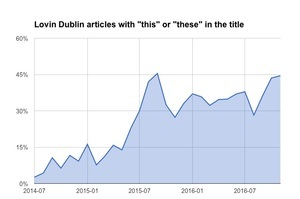
Ever wonder how many Lovin Dublin articles contained “this” or “these”? So did I…



Mantissa Float writes:
Ever wonder how many Lovin Dublin articles contained “this” or “these”? So did I…



MORE to folly

A padded wall at the newly renovated Krystle nightclub
Via Krystle nightclub, Harcourt Street, Dublin 2:
Krystle, Dublin’s only open-air nightclub, is set to reopen in spectacular fashion this weekend following a€1.1 million refurbishment.
Rarr.
The Penthouse and the Suite, the nightclub’s renowned VIP areas, have also undergone a full renovation.
These exclusive areas offer a safe haven for those who wish to relax and unwind behind closed doors, whilst those seeking complete privacy may indulge in a new luxurious private room, which has been created in the Penthouse.
SPLUTTER!
This deluxe new suite will accommodate groups of up to twelve and boasts a dedicated service bell and private en-suite.
Have we learned NOTHING?
*rings service bell*
Thanks Verity Morrison
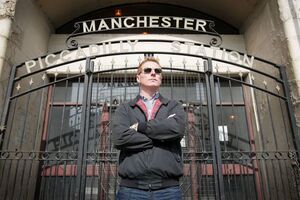
2016 takes another.
Inspiral Carpets sticksman Craig Gill, passing away today at age 44.
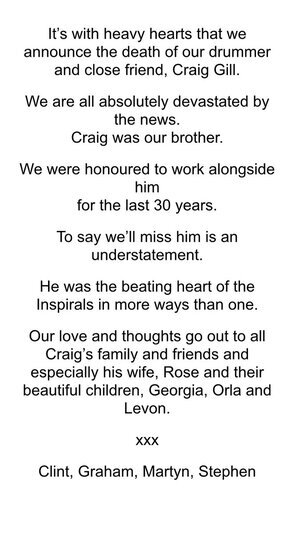
Below is the band’s statement:


Early compact-disc artwork. As dated as humanly possible, and catalogued by US pop-radio jamboree Crap From The Past (streaming and downloadable weekly).
As soon as CDs were introduced to the US marketplace, a handful of samplers were introduced as a guide to both consumers and retailers. For many, these were the first introduction to digitally-stored sound.
All of these CDs are extremely hard to find today, if you’d be looking for them at all. Most of them were pressed in West Germany, because US facilities weren’t up to speed yet.
Because for all the backlash the vinyl revival may have received, at least it didn’t result in cheap futurism…
Pew pew.
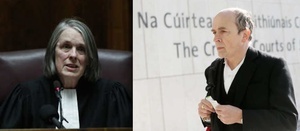
Chief Justice Susan Denham (left) and Patrick Gageby SC
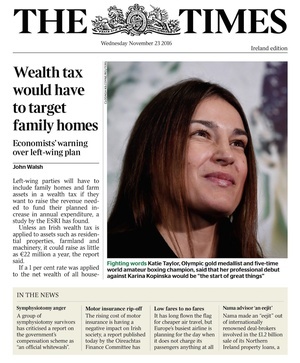
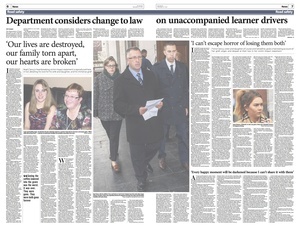
Earlier this year we highlighted the unusual circumstances surrounding the Supreme Court decision that allowed suspected paedophile swimming coach Geoge Gibney to escape justice.
The decision in November 1994 granted Mr Gibney leave to apply for judicial review on the basis that his right to a fair trial was infringed because of a delay in reporting the alleged offences.
This was the first case in Ireland to recognise that a delay in making a complaint of sexual abuse could preclude a subsequent prosecution.
What also marked out this case was that Patrick Gageby, one of Mr Gibney’s barristers, appeared before his own sister, Susan Denham, who was on the Supreme Court that day.
And court records show this hearing was not the only case in which Mr Gageby has appeared before his sister.
It was one of many.
In 1991 Susan Denham was appointed a High Court judge and a year later was appointed to the Supreme Court. Thomas Finlay was Chief Justice at the time and had responsibility for assigning judges to cases.
Ms Denham subsequently sat as a judge on at least two cases in which Patrick Gageby appeared as a Junior Counsel.
G v DPP [1994] 1 IR 374
People v Rock [1994] 1 ILRM 66
Mr Gageby became a senior counsel in 1995 and the practice continued under successive Chief Justices.
1994: Liam Hamilton appointed Chief Justice.
Larkin v O’Dea [1995] 2 IR 485
Incorporated Law Society of Ireland v Carroll [1995] 3 IR 145
O’Leary v A-G [1995] 1 IR 254
DPP v PG [1996] 1 IR 281
DPP v McDonagh [1996] 1 IR 565
DPP v McGinley 1998 WJSC 5791
POC v DPP [2000] 3 IR 87
2000: Ronan Keane appointed Chief Justice.
DPP v Edgeworth [2001] 2 IR
FMcK v AF [2002] 2 ILRM 203
2004: John Murray appointed Chief Justice.
O’Brien v DPP [2005] 2 ILRM 444
Gilligan v DPP [2006] 2 IR 389
Carmody v Minister for Justice [2010] 1 IR 635
These cases represent a relatively small fraction of Mr Gageby’s busy criminal practice during this period. However they involved key issues of constitutional and criminal law.
The number of judges on the Supreme Court has increased over the last few years, but there would always have been enough judges to avoid Ms Denham having to deal with cases involving her brother.
In July 2011 Susan Denham was appointed Chief Justice and the practice appears to have ceased.
Irish law is subject to general rules of fair procedure, including the principle ‘nemo iudex in causa sua‘ (no man shall be a judge in his own cause), which provides for the quashing of judicial decisions made in ‘circumstances which would lead a fair-minded and informed observer to conclude that there was a real possibility … that the tribunal was biased’.
Last year, the Supreme Court quashed a decision of a High Court judge who had held shares in one of the companies party to the litigation in circumstances where he had mistakenly failed to disclose the full extent of that shareholding.
In this instance Susan Denham, now Chief Justice, gave the majority verdict.
Ms Denham said objective bias was a matter not just for the parties, or the trial judge, but brought in issues regarding:
“…the fundamental concern for the manifest impartial administration of justice and the confidence which the people rest in the judiciary.”
Previously: The Chief Justice, Her Brother And How George Gibney Got Away
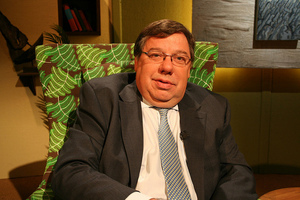
From top: Brian Cowen; Anthony Sheridan;
Anthony Sheridan, of Public Inquiry, speaks on deferential attitudes in Irish media towards politicians and other power-brokers, with reference to John Lee’s recent work with austerity architect Brian Cowen.
Anthony writes:
A well-informed, objective media is one of the cornerstones of a healthy democracy. Journalists in a healthy democracy do not just report news and current affairs; they also have a duty to be rigidly impartial in their analysis of events.
Disturbingly, Irish journalism comes nowhere near the standards necessary to robustly challenge the State and its agents particularly when it comes to political corruption.
The recent publication of Hell at the Gates by journalists John Lee and Daniel McConnell is just the latest example of the disquietingly close and frequently grovelling relationship between the media and those who wield power within the Irish political system.
John Lee, writing about an interview he conducted with former Taoiseach Brian Cowen as part of his research for the book provides us with good example of this cringing, extremely deferential type of journalism.
The headline gives a good indication of the tone of the article: An astute, self-aware, intelligent man.
It’s said of Lyndon Johnson, that he was at his best with an audience of one. I think this applies to Cowen. He uses your first name, looks you in the eye, is exceptionally articulate and sharp. In the fog of war that engulfed Ireland during his years at the top, much of this was forgotten. Yet he understands why that is.
He spoke about how he felt the day he became Taoiseach, the enjoyment of appointing a cabinet and the brief summer of calm before all hell broke loose.
Bright man that he is, he knew there were claims about him that he had to confront. As the interview progressed I merely pointed to where we were in the chronology, and without pause he would take on the issues that he has been given so much time to think about over those preceding four years. He happily accepted he had made a mistake in not addressing the nation.
Before making further comment on the article, I want to express my opinion of Brian Cowen, an opinion that I believe is held by the majority of Irish people.
At best, Cowen is a political idiot. I do not say this as an insult (although it obviously is); I say it because it’s a simple fact. Cowen is nothing more than your typical Fianna Fail backwoodsman, gombeen politician who never had to do anything courageous or visionary to reach the apex of political power.
As a privileged member of one of the many political family dynasties that have plagued Irish politics since independence he was effectively handed power following the death of his father.
He was literally enthroned as Taoiseach by the disgraced Bertie Ahern who was forced to resign after his true pedigree was exposed at a tribunal.
But when Cowen, for the first and only occasion in his mediocre career, was called upon to show courage and vision in leading the nation he failed miserably.
As one editorial put it: The worst Taoiseach in the history of the State.
And yet a stranger reading John Lee’s article could easily conclude that Brian Cowen was a politically intelligent, insightful and courageous man whose overriding mission in life was to promote the best interests of the Irish people.
A stranger reading the article would not see what most Irish people see.
That Cowen is a loyal member of the most corrupt political party in Ireland, the party that promotes the interests of property developers, bankers and other members of the golden circle that feed off the wealth of the Irish people.
A stranger reading the article would not see that Cowen is a loyal member of the party principally responsible for the economic disaster of 2008 that destroyed the lives of hundreds of thousands of Irish citizens.
However, a stranger who informed himself of Irish history over the past several decades would immediately recognise the rampaging elephant in the room – which is:
The Irish political system is seriously corrupt. In reaction to this political corruption a significant percentage of Irish citizens have rejected the legitimacy of the State and are in open rebellion.
A disturbingly large proportion of Irish journalists are either blissfully unaware of this dramatic shift in the political landscape or are willing collaborators in defence of the corrupt system.
Either way Irish journalism is suffering from a serious malaise that is not only bad for the profession but is having a very serious negative impact on Ireland and its people.
Irish journalism: Suffering from a serious malaise (Anthony Sheridan, Public Inquiry)
Top pic: TG4


