




Doodles created in the long shadows cast by everyday objects by Belgian illustrator Vincent Bal.



Doodles created in the long shadows cast by everyday objects by Belgian illustrator Vincent Bal.

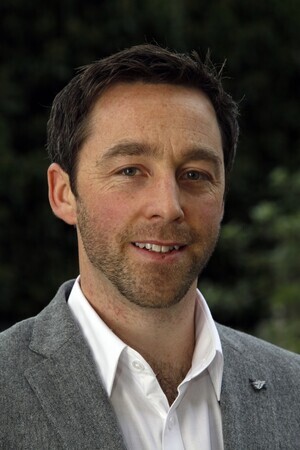
US president-elect Donald Trump and Dr Rory Hearne
We are in an unprecedented time of political upheaval. All the political rule books are being torn apart. Anything is possible.
Dr Rory Hearne writes:
What is the impact of Trump’s election on Irish politics? Could we see an Irish Trump or new right-wing party elected into the Dáil or even lead a new government?
This potential nightmare scenario is possible given the economic crisis and distrust in political parties and government in Ireland. However, this means that there is also an opportunity for a new progressive political movement in Ireland that would direct people’s anger and frustration towards achieving equality and social justice rather than fuelling hate and the scapegoating of immigrants.
Firstly, does the current state of our economy (and our future economic situation) provide the basis for an anti-establishment populist politics? The reality is that it does.
A significant proportion of people remain excluded from the so-called ‘economic recovery’. It is increasing inequality. Those at the top are gaining the most from increases in income and wealth. Small wage increases will make little difference for people struggling with debt and crippling costs of living (particularly families with children).
A third of our population suffers material deprivation, a fifth of households cannot cover their monthly bills, 86,000 are still in mortgage arrears, while unemployment disproportionally affects young people and disadvantaged rural and urban areas. A lot of the new jobs are ‘precarious’ – low wage, short term and insecure.
On top of this, we have the lack of affordable housing for renters and those looking to buy their home while over 6,000 are homeless (2,500 of those children). We have a two-tier apartheid health system and continuing emigration. Things are extremely difficult for most lower income and working class families and an increasing proportion of the ‘middle class’. The future is not just uncertain, but for many it is terrifying, and parents cannot see a positive future for their children in Ireland.
For decades, Irish governments have developed an unsustainable economy built on neoliberal policies of corporate tax avoidance, low wages, low public expenditure, privatisation and a lack of indigenous Irish enterprise. This model now faces a major crisis from Brexit, the Apple tax ruling and Trump’s potential reduction in corporation tax. This increases people’s sense of insecurity.
Not to mention the injustices of the bank and Troika bailouts – where the ECB and EU lumped us with the costs of bailing out the French and German banks. Fianna Fáil, Fine Gael and Labour then ensured we paid for it through enforced austerity that devastated our public and community services and investment.
And we still pay up to €2bn a year extra of interest on our debt solely to cover the costs of the bailing out the banks and the European financial system. The scars and wounds of the crash, austerity and the bailouts run deep while the political establishment has shown that it has no interest in understanding this, or responding in a progressive manner.
This also explains why the Irish people have completely lost faith and confidence in our political institutions of the Dáil, the government, and political parties. The Eurobarometer (EB) survey of the Irish public carried out in November 2015 (below) shows the collapse in trust after the crash in 2008 [i] and again after the election in 2011 when Fine Gael and Labour failed to fulfill their election promises.
It highlights the collapse in trust in political parties.

This disconnect between the people and political parties and government is shown by that fact that just 65% of registered voters actually voted in the general election in February. In Dublin just 62.8% voted (which is down from 68% in 2011) [ii].
This means that over one million registered voters did not vote at the election – which is twice the number who voted for Fine Gael. While the two dominant conservative parties, Fianna Fáil and Fine Gael, got their lowest combined vote, falling for the first time below 50%.
And little has changed since February.
The most recent Irish Times opinion poll showed that in terms of their core vote, Fine Gael had 20% and Fianna Fáil, 21%, while Independents had 20 per cent and 19% were undecided. These figures show, firstly, the large section of the population who are alienated from the mainstream parties (non-voters, independents and ‘undecideds’) and thus potentially open to new political alternatives, and secondly, that we are in a period of political volatility with support for parties changing dramatically in short periods of time.
But the election and recent opinion polls also show that the anti-establishment mood in Ireland is more supportive of broadly ‘left’ policies than right-wing Trumpism. Just contrast the increase in electoral support for the left (AAA/PBP and Sinn Fein) to the failure of the right-wing Renua.
The conservative tax-cutting and austerity agenda of Fine Gael was also rejected in the election as people sought investment in public services, particularly health and housing. This is backed up by the recent polls which showed people wanted the Budget to prioritise investment in healthcare, housing/homelessness and childcare over tax cuts.
This is why Fine Gael and Fianna Fail are panic-stricken over the public sector unions threatening action over pay. They are worried that the defiant spirit of the water movement is spreading across Irish society as people are no longer just passively accepting growing inequality and political corruption.
So the FF/FG government are trying to spread fear about the rise of the ‘militant’ left. Fine Gael Minister, Simon Coveney this weekend ‘warned about the rise of left-wing populism in Ireland’.
He said “There has been a rise in the politics of street protests in Ireland and there has been a rise in small political parties and movements that spend most of their weeks thinking about when they are going to organise the next protest”[iii].
They know that the corrupt conservative establishment is in major trouble. Of course if this approach fails to deter the increase in public support for the Left, where will they turn next to blame for the mess and inequality the government has caused?
It won’t be the corporate tax avoiders or growing wealth inequality. It is more likely to be the immigrants, Travellers, or ‘welfare scroungers’. And that is how Trumpism could develop in Ireland – in the near future a Fine Gael or Fianna Fail party declining in support in the polls or some revitalised Renua, will try whip up hate and blame immigrants (or the homeless or public servants or the militant ‘left’) for the on-going misery faced by so many people excluded from the ‘recovery’.
So far, here in Ireland, we have not seen this blaming of immigrants for the crisis. This is largely thanks to the water movement and the left political parties and independents who have focused people’s anger, correctly, on austerity, the bailouts, the ‘neoliberal’ privatisation model and thus offered a political alternative to the establishment parties, particularly Labour, who failed to stand up for ordinary people.
However, while the existing left parties (Sinn Féin, AAA/PBP and the Social Democrats) and independents are doing a good job, February’s election showed that combined, they achieved just under 20% of the vote. That is significantly short of the required support levels to deliver a progressive, equality orienated, government.
For all their own reasons the existing left are limited in their ability to win the support of a majority of people in Ireland. This means that there is a political space open to be taken by conservative right wing populists who could then gain a majority support if the left parties fail to take that space.
That is why now, more than ever, there is a need for a new, genuinely progressive, political movement in Ireland that can reach out and win the support of a majority to challenge the politics of inequality.
Such a new political alternative, if it is to be successful, must go way beyond what the existing left is doing and reach out to involve all those unrepresented – the non-voters, independents, the undecideds, the trade unionists, small business people, young people, the excluded rural and disadvantaged communities. It needs to break the ‘consensus’ framework of Irish politics –and offer a way of doing politics, a new vision for Ireland, beyond the narrow left/right and civil war divides.
Some might ask if there is likely to be support for another political party on the left? The answer is likely to be no there isn’t. And that is why if a new alternative is to be successful it can’t just be another traditional party. To fill the political space and gain public support it will have to be a new, flexible, open, hopeful, broad, and inclusive political movement not a party.
To be successful in this age of social media and citizen empowerment it should be citizen-led, a cross country (rural and urban), cross society and social class alliance, with no one particular group or sector dominating it.
It will have to present as its aim the unity of the people against the political establishment and their unequal and destructive policies. Like Right2Water it must be something that, when ordinary Irish people look at it, they are inspired and want to support it.
I have shown here that the political space is clearly there for such a new progressive alternative. A significant proportion of the Irish population do not feel represented by the existing parties. It is thus a time of opportunity and possibility for new political forces to emerge and capture the public mood and attention. The many social and economic crises, particularly growing economic inequality are likely to continue into the future.
This shows the growing need for a new people’s movement of unity and solidarity to address this. And, it would not have to start from scratch. There is a large potential activist base in the water movement potential support from progressive Independent TDs, civil society groups (such as the Right2Water unions), academics, community workers, artists and many others.
We are in an unprecedented time of political upheaval. All the political rule books are being torn apart. Anything is possible. The victory of Trump should serve as a warning of what can happen if there is not a progressive political alternative available to people. Can we make sure that mistake is not repeated here in Ireland?
Dr Rory Hearne – author and researcher – writes here in a personal capacity.

Damian Cullen tweetz:
In waiting room for doc with child. This is only bloody booklet with cartoon so she’s going to everyone asking to “read the story”. Christ.

Robocobra Quartet – jazzy hardcore from Belfast
What you may need to know…
01. Despite their designation as a quartet, sax-laden spoken-word hardcore outfit Robocobra Quartet call on any of fourteen members for their incendiary live excursions.
02. Having gigged on the regular since 2014, the collective have done the festival grind, including Electric Picnic and Brilliant Corners Jazz fest, as well as having released a limited lathe-cut 7″ via Smalltown America.
03. Streaming above is the band’s debut album in its entirety, Music for All Occasions, recorded in studios and venues around Belfast city.
04. Available now in various formats from their Bandcamp. Having finished the UK/NI swing of their album launch, more UK/IE dates are likely for next year.
Verdict: Dour, downtuned, swaggering post-hardcore as a framework for world-weary spoken word broadsides.

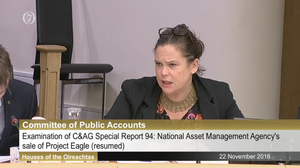
Patrick Long, of Lazard and Co Ltd and Mary Lou McDonald, deputy leader of Sinn Féin
This morning.
At a meeting of the Oireachtas Public Accounts Committee.
Patrick Long, of Lazard’s – Nama’s loan sales advisor on the sale of Project Eagle – is answering questions in relation to the Project Eagle sale.
From the meeting…
Lazard, the firm employed by NAMA to manage the Project Eagle sale, were only to be paid a fee if the sale went through. That’s motivation!
— NAMAwinelake (@namawinelake) November 22, 2016
.@MaryLouMcDonald “it was most peculiar, unique and irregular to be engaged as loan sale adviser without a tendering process”
— NAMAwinelake (@namawinelake) November 22, 2016
£4.3m paid by NAMA to Lazard who had “6 or 7” people working on Project Eagle sale for 1/2 year. Hmm, Lazard engaged Jan14, sale in Apr14
— NAMAwinelake (@namawinelake) November 22, 2016
Lazard says it’s the norm for the sales adviser to value the loans but that didn’t happen with Project Eagle.Lazard was #NAMA sales adviser!
— NAMAwinelake (@namawinelake) November 22, 2016
Watch proceedings live here
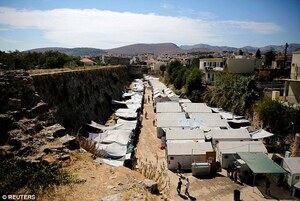

The refugee camp set up in the shadow of the Castle Of Chios, called Souda, on Chios Island, Greece and how parts of the camp looked after recent attacks on the camp
On Friday last, The Guardian reported:
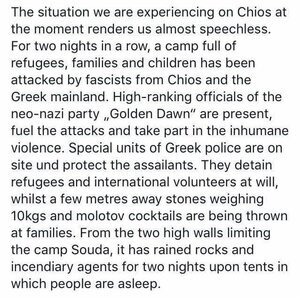
Dozens of people have been driven out of a refugee camp on the Greek island of Chios after two successive nights of attacks by a far-right group.
At least two people were wounded after attackers threw Molotov cocktails and rocks as big as boulders from elevated areas surrounding the Souda camp, activists said.
Three tents were burned down and three others were hit by rocks. A 42-year-old Syrian man was assaulted, while a Nigerian boy was hit by a rock.
Fearing a third attack on Friday night, about 100 former occupants refused to re-enter the camp, instead taking shelter in a nearby car park. “We do not have any kind of protection,” Mostafa al-Khatib, a Syrian refugee, told the Guardian. “No one cares about us.”
The mayor of Chios said the attackers were thought to be affiliated with Greece’s main far-right party, Golden Dawn. “Of course Golden Dawn supporters are suspected to have participated,” Manolis Vournous told the Guardian.
Activists and camp occupants said the rocks appeared to have been thrown with the intention of killing people. Tan said: “These rocks were probably the size of a shoebox, weighing approximately 15kg. Some of them I can’t even lift.”
There were conflicting reports about who started the clashes on Wednesday. According to Vournous, the unrest began after Algerians and Moroccans stole alcohol and fireworks from a shop, frightening local residents. But some activists claimed the events escalated after a planned assault by Golden Dawn.
The attacks followed a two-day visit this week to Chios and Lesbos, the adjoining Aegean island, by a team of MPs from the neo-fascist Golden Dawn and far-right parliamentarians from Belgium.
Further to this…
John Underwood, whose sister is volunteering on Chios with Be Aware And Share tweeted yesterday:
My sister, currently helping run a refugee school in Greece, has asked me to pass this on. The Nazis are literally back.
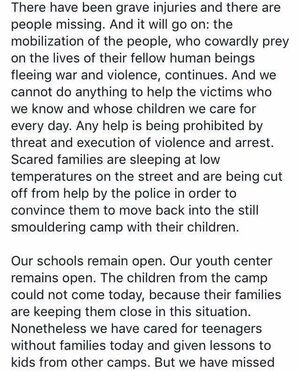
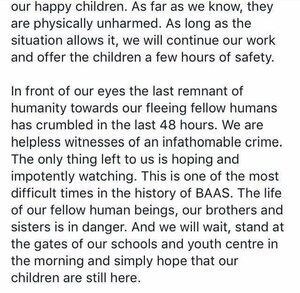
Readers may wish to note an academic paper published in 2013, called The Crisis before “The Crisis”: Violence and Urban Neoliberalization in Athens by Dr Dimitris Dalakoglou, of the University of Sussex.
In it, Dr Dalakoglou wrote:
Historically, since the 1920s the so-called para-state far-Right in Greece has functioned as the long arm of the state violent apparatuses, targeting people with left-wing affiliations during most of the twentieth century. The rise of the extreme Right after the outbreak of the 2010 crisis is a continuation of that tradition. Besides the Left or the anarchists, the current victims of extreme Right violence are mainly migrants.
A typical example of this escalation was in mid-May 2011, a few days before the start of the Syntagma Square movement, when a man in his forties was killed and robbed in the center of Athens, allegedly by migrants. Local extreme right-wing groups seized upon this incident to organize one of the country’s first large-scale anti-migrant attacks, with the tacit or explicit support of the police.
Anti-fascists and radicals were also targeted. Due to these organised fascist attacks, certain parts of the center became a no-go zone for migrants, especially people of colour.
The most prominent xenophobic group, the neo-Nazi Golden Dawn, was allegedly involved in many of these actions. Their unapologetic racism appears to be gaining in appeal. Golden Dawn received 7 percent of the votes in the national elections of May and June 2012; about half of the police officers serving in Athens voted for Golden Dawn, marking, if nothing else, the ideological links between state and para-state violent apparatuses.
The Crisis Before The Crisis (Dimitris Dalakoglou, Academia.edu)
Greece: Police must protect refugees from ongoing far-right attacks (Amnesty International)
Previously: Chios on Broadsheet
Pics: Reuters and Amnesty International

This morning.
But where?
Anyone?
Answer: Dun Laoghaire promenade.
Thanks Lee Miller
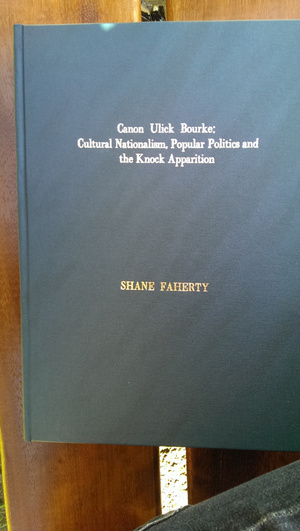
Shane Faherty, from academia/humanities blog Modern Distortions, discussing the disappointments of pursuing a Ph.D., the attitudes towards Ph.Ds in the post-austerity jobs market, and the inevitable trudge through call centres.
“When, at the age of 30, I started a Ph.D. in history in University College Cork I was pursuing a passion. Nobody does a Ph.D. in humanities for monetary gain, however, I did think that my employment prospects would be improved somewhat.
Little did I think that upon completion, four and a half years later, I would be facing into a year and a half of unemployment, underemployment and precarious employment where on two separate occasions I would find myself working in call centres.
The week I submitted my doctoral thesis in April 2015 my wife and I discovered we were expecting our first baby. The following week I was in the dole office. I didn’t expect to be there.
This should have been the most exciting time of my life. However, the multiplicity of feelings I was experiencing were underpinned by exhaustion and uncertainty. When I tried explaining why I was there tears welled up. The lady behind the counter told me to take my time. I told her I hoped this would only be temporary arrangement.
I applied for jobs. All sorts of jobs. I wasn’t expecting to get an academic position overnight but I thought I would get something that was halfway decent. I spent hours on some applications, days on others.
I didn’t even get an interview for any teaching or research positions but what was more surprising was my lack of success in applying for other work which I was more than capable of doing. It seemed the private sector weren’t falling over themselves to hire historians.
I got some occasional hours invigilating exams and doing instructional design work in UCC but nothing that lasted more than a few weeks. I graduated at the end of October, my family came down and it was a nice day, but underlying everything was a sense of anxiety. I still didn’t know how we were going to manage.
With our baby due in December I needed any kind of work fast. I applied for a temporary customer service role with Amazon in their Cork contact centre. This centre serves the UK marketplace. Seasonal work in Amazon is sort of an institution for a certain demographic in Cork.
My team were a mixed bunch and mostly overqualified. There was one other person with a doctorate but also a medical doctor, a computer programmer, a poet, a musician, a sports therapist and a variety of other people who really shouldn’t have been there.
They were a good bunch. Science fiction was openly discussed and critiques of consumerism were part of the daily routine…”
More here: Confessions of a Call Centre Academic by Shane Faherty

We’re not even into December and people are wishing this year away through sweary, extremely NSFW song.
Musical comedy sisters Flo and Joan count down the ways in which 2016 has been of royal disservice, including a rundown of deaths and questionable decisions.
