

https://www.youtube.com/watch?v=59Zcx9YbZxI
A Fail Army compilation of the main reason, besides cat videos, that the internet was invented.



British Prime Minster David Cameron and Taoiseach Enda Kenny arriving at 10, Downing Street this afternoon.
It’s not a caption competition.
Until you insist.
Via Harry McGee

Spotted on Bolton Street, Dublin 1 this morning.
Any excuse.
Thanks Brian Bolger (for pic and headline)

Nassau Street, Dublin yesterday
A displeased monk calls for the ‘return’ of the Book of Kells to Meath.
Via Wikipedia:
There are at least five competing theories about the manuscript’s place of origin and time of completion. First, the book, or perhaps just the text, may have been created at Iona, then brought to Kells, where the illuminations were perhaps added, and never finished.
Second, the book may have been produced entirely at Iona. Third, the manuscript may have been produced entirely in the scriptorium at Kells. Fourth, it may have been produced in the north of England, perhaps at Lindisfarne, then brought to Iona and from there to Kells. Finally, it may have been the product of an unknown monastery in Pictish Scotland
FIGHT!
Thanks Daniel


The Riverbank centre at 13 Merchants Quay (top)
A hot meal.
A fresh start.
John writes:
Merchants Quay Ireland is a beacon of hope for people who are homeless and struggling with addiction. Our Riverbank Centre on Merchants Quay offers a wide variety of services including meals, hot showers, clean clothes, and medical and mental health care.
Last year homeless men and women came to us for over 4,000 hot showers. This year we opened the Night Café, meaning our doors are now open nearly 24 hrs a day. As a result, we are in desperate need of the following hygiene products:
Soap/Shower gel
Shampoo
Toothpaste
Tooth brushes
Razors
Deodorant
Female hygiene productsIf you can help… please call us (Aislinn or Martina) at 01 524 0139 or drop them in to us at Merchants Court, 24 Merchants Quay. Thank you.

Former Secretary General of the Department of Finance Kevin Cardiff arriving at the Banking Inquiry this morning
#bankinginquiry Kevin Cardiff says Taois. Cowen had made his mind up on a guarantee long before the night it was signed off on
— Fergal Keane (@fergalrte) June 18, 2015
Cardiff on Cowen; “it would be a lie to say I never heard the Taoiseach say the F word” Rare levity at #bankinginquiry — Jonathan Healy (@jonathanhealy) June 18, 2015
Cardiff says that in Sept 2008, Dermot Desmond told John Hurley, CB governor, that we might need a guarantee #bankinginquiry
— McConnellDaniel (@McConnellDaniel) June 18, 2015
Cardiff says Gillian Bowler of Irish Life and Permanent was asking for guarantee #bankinginquiry — McConnellDaniel (@McConnellDaniel) June 18, 2015
Dermot Desmond advised the Central Bank that Ireland should introduce a bank guarantee, Kevin Cardiff told #bankinginquiry
— David Murphy (@davidmurphyRTE) June 18, 2015
Cardiff: ECB boss Trichet said save your banks he did not say guarantee your banks #bankinginquiry — David Murphy (@davidmurphyRTE) June 18, 2015
In addition, RTÉ reports:
“Mr Cardiff said several people, including Sean FitzPatrick, Dermot Desmond, and Charlie McCreevy, suggested the introduction of a guarantee some months beforehand. At the end of April 2008, Mr FitzPatrick, then Anglo chairman, suggested some form of guarantee to John Hurley. Around a week later, an individual noted as DD also suggested a broad guarantee. He could not recall whom.”
Inquiry hears Ireland was pushed quite hard into bailout (RTÉ)
Watch the proceedings live here
Read Mr Cardiff’s opening statement in full here



This morning.
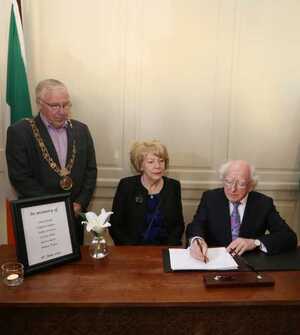
The Mansion House, Dawson Street, Dublin
President Higgins and Sabina Higgins sign the book of condolence for the six Irish students who died in the Berkeley balcony collapse.
The book will remain open until 5pm.
From top: dedications; Dublin Lord Mayor Christy Burke with President Higgins and Sabina Higgins; Madeline McDermott signs the book. queue forming outside the Mansion House.
(Sam Boal/Photocall Ireland)

Margaret Sullivan, public editor of The New York Times
This morning, on RTÉ Radio One’s Morning Ireland, reporter Laura Whelan spoke with the New York Times Public Editor, Margaret Sullivan regarding the paper’s coverage of the Berkeley tragedy.
The interview was conducted before former President Mary McAleese sent a letter to the newspaper, saying it “should be hanging its head in shame” over the article.
Margaret Sullivan: “Well I think the first thing that happened was the New York Times ran a short of brief and sort of to-the-point news story online, on Tuesday about this tragic and really terrible event that happened in Berkeley, California. After that, as I understand it, editors and reporters felt that they should develop the story in some way and looked for a different kind of angle and the angle that they ended up deciding on was this idea of looking more deeply at the J1 programme and that’s what ended up being this very controversial and very much criticised article and I think the criticism is completely valid.”
Laura Whelan: “A lot of people, Margaret, in Ireland, have been badly offended by this article. Can you understand these feelings?”
Sullivan: “Yes, absolutely, I completely understand where the criticism is coming from. I wrote a post today [yesterday] in something called the Public Editors Journal that said you know I understand the criticism, I called the article insensitive and, even though I can’t apologise on behalf of the Times because, as Public Editor, I only actually express my own, independent opinion, I did say that I personally was very sorry that so much pain was caused by this.”
Whelan: “Margaret, a Government minister here in Ireland [Aodhan Ó Riordain] has accused the New York Times of victim blaming. Would you agree with that stance?”
Sullivan: “There is an element of victim blaming in this article but I believe it was inadvertent. I know, for example, the lead reporter on the article – whose name is Adam Nagourney – he’s a very good reporter, he’s a very solid fellow and I’ve had a lot of correspondence with him today [yesterday]. He feels terrible about this. I think he feels that he essentially made a mistake.”
Whelan: “What changes will be made to the article now? It’s still available, up online.”
Sullivan: “Yes. The article is pretty much as it was to begin with. Mr Nagourney said that he made some, small changes before it went to print. But the Times’s policy is not to unpublish something once it’s been published and to keep the archive version of it pretty much as is. So I’m not expecting it to be taken down or, as we say, unpublished.”
Whelan: “I understand what you’re saying about the New York Times’ policy on that but I suppose given the level of feeling here in Ireland and the fact that the New York Times has now received a letter actually from Ambassador Anne Anderson, do you think this would maybe be an incident where perhaps the New York Times should go against its own policy and withdraw this article, take it down offline?”
Sullivan: “I don’t, again I want to sort of say, that I can’t speak for the paper, about that, all I can tell you is that, in my experience, that just never happens. I mean there can be criticism and there can be apology, there can be an acknowledgement but the story pretty much stays as is.”
Whelan: “In terms of the level of complaints received Margaret and, you know, the involvement of an ambassador, and also a Government minister here in Ireland, can you remember any other article, you know, going back a couple of years in the New York Times, that caused this much upset?”
Sullivan: “There certainly has been a great deal of complaint and many, many emails and, as you say, official ones. I’ve had, I’ve been in the role of Public Editor for coming up on three years and I would say it’s among the ones that I’ve had the most complaint and response about. But, you know, perhaps not at the very top of the list.”
Listen back here in full
Previously: Anything Good In The New York Times?

Bob writes:
Spotted this in GSM phone fixin’ store on Middle Abbey Street [Dublin]. Imagine the fun and the LOLs. 10-4…
