11043277_887123638016449_1082802367495268639_o11025896_887123641349782_3988329965125406015_o

‘sup?

Also: YIKES

Also: what is the green thing for pity’s sake?

Sean Cassidy writes:

I’m running for election in my students’ union in DCU [Dublin City University, Glasnevin, Dublin]. When I was canvassing some on-campus accommodation I came across a number of incidents where the service provided was disgraceful, including slugs in the communal kitchen. I’d appreciate if you could highlight this, because it’s simply not acceptable that this occurs in a university owned company.

But how did they get in?

They did ‘OK’ in the Leaving.

10419381_887123598016453_315484121516098683_n

Fair enough.

More distressing images here

suor angelica

Maybe bring a flask to be on the safe side.

Ten Thousand Miles Away.

A performance that celebrates “the connection between Ireland and America, exploring ideas of emigration and identity through a combination of poetry and song”.

Fight!

Stephanie Dickson writes:

I’m dropping you a line about “Ten Thousand Miles Away”, an unprecedented collaboration between New York’s Juilliard School (alumni Kevin Spacey, Jessica Chastain, Miles Davis, etc etc) and two Irish institutions, the Royal Irish Academy of Music and the Lir Academy.
The work, which is an interweaving of song and poems (WB Yeats, Seamus Heaney, Yeats, Paul Durcan) will premiere at the Lir [at Trinity College] at the end of this week (13 and 14) before going to New York for performances at the Juilliard around St Patrick’s day.

The Lir Academy of Dramatic Art at Trinity College Dublin. Friday March 13 at 8pm and Saturday March 14 at 3pm & 8pm.

Tickets here

1 2 3

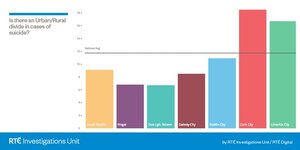
The breakdown of 14 years of official figures for suicide from the Central Statistics Office revealed on RTÉ One’s Claire Byrne Live last night.

The data, unveiled by the RTÉ Investigations Unit, probes the “misconceptions and realities of one of Ireland’s most intractable social problems”.

Ken Foxe writes:

The figures were broken down according to geographic area, county, province, age, gender, the person’s employment status, and even the way in which the person died.

Throughout the recession, reports frequently spoke of Ireland’s suicide ‘epidemic’ as the number of people taking their own lives appeared to inexorably climb. The number of people dying in suicides each year has been rising and that figure reached a new high in 2009 when 552 people took their own lives. However Ireland’s population, all through the boom, had also risen dramatically.

Between the census of 2002 and the census of 2011, the number of people living in the Republic grew by more than 650,000. While the actual number of suicides was climbing, this was to be expected in such a rapidly growing population.

Rising unemployment, collapsing investments and negative equity were all partly blamed for the increase, yet behind the stories, the rate of suicide was not changing in the way it was being portrayed.

The rate of suicide in Ireland hit its peak in 2001 at 13.5 suicides per 100,000 people and by 2004 – a “Celtic Tiger” year in which economic growth was running at 4.6 per cent – the rate still remained at 12.2. That 2004 rate of 12.2 per 100,000 has never been exceeded since.

Suicide – The Figures (RTÉ Investigative Unit)

Iggy

Augustinian priest Fr Iggy O’Donovan

Boy could he play guitar.

…Many, perhaps most of us, will I suspect find that we are being asked to vote not for the right cause over the wrong cause. Matters are far more complicated than that.

Churches have views, ideals and laws about these issues and they, quite properly, teach their members about those views. (Although in churches, there are differences of emphasis and variations in pastoral practice).
When we become legislators, though, as we do when we vote in referendums, we legislate for ALL our fellow citizens. We do not vote as members of this or that church or faith.

Of course we cannot leave our religiously based moral convictions outside the polling station, but we do need to remember the difference between civil and religious law.

We also need to remember that it is possible to have deep and passionately held convictions without seeking to have those convictions imposed by the State on fellow citizens who do not share them and may have opposite convictions which are equally deep and passionately held.

When we vote in referendums we legislate for all citizens not just members of a church (Fr Iggy O’Donavan, Irish Times)

Earlier: Annagry Is An Energy

(Pic: Examiner)

Broadsheet.ie
