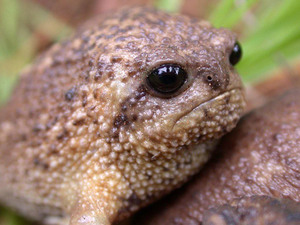
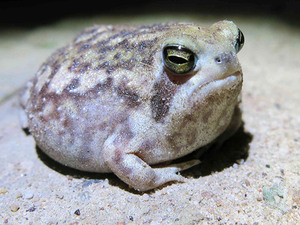


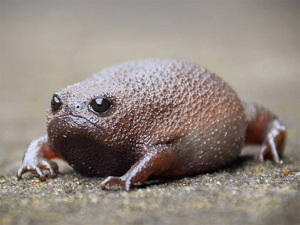


Desert rain frogs – the most censorious of all south African amphibians.





Zzup?
‘Pleann Bee’.
A one-hour TG4 documentary on World Bee Day, May 20, about the acclaimed All Ireland Pollinator Plan.
Deirdre Ní Choistín writes:
The All Ireland Pollinator Plan (AIPP), set up in 2015, is almost unique in reversing pollinator decline by engaging with Irish society, mobilising a citizen’s army of gardeners, farmers, community and sports groups, councils and other land owners to become pollinator friendly, protecting the environment and protecting the lives of future generations.
The success of the pollinator plan, and the huge community buy-in involved means that other countries, and the EU in particular, are looking to Ireland for help in improving the situation of their own pollinators….
‘Pleann Bee’ on May 20 at 9:30pm on TG4.
Pics TG4

‘Mibbe… can ye have a mibbe?’
Graeme Kelly writes:
Released yesterday…John Byrne’s classic (Bertie-featuring) 2003 Would You Die For Ireland?
Would YOU?

‘It appears very clear to me that I’m not the desired candidate for Fine Gael in the Dublin Bay South by-election. I’ve had no engagement from the leadership of the party …’ Former Fine Gael TD Kate O’Connell tells @TodaywithClaire | https://t.co/twLDUyAy36 pic.twitter.com/fzxQMU5OCx
— RTÉ News (@rtenews) May 7, 2021
This morning.
Today with Claire Byrne on RTÉ Radio One.
Kate O’Connell said over the years she has faced personalised commentary and attacks on her and thinks there was a “pushback” against her to replace her.
At one Fine Gael meeting, she said, her team arrived before her and someone had got a sod of turf and was going to present it to her in front of people at the meeting.
She said that was “designed to diminish” and tell her she was “not from here” but from the country.
She said a sign was also erected outside her pharmacy pointing towards the M50 saying “Westmeath this way“.
Ms O’Connell said attempts were made to label her as “undesirable, unsuitable and not good enough”.
Anyone?
O’Connell will not run in Dublin Bay South by-election (RTÉ)


Watch towers and cages were built at Glasnevin cemetery to protect the dead from the epidemic of grave robbing in early 19th-century Dublin
A Dying Business.
Harry writes:
Stories warning children of the bogeyman often have a historical basis. One of my favourite stories from the Blackpitts area of Dublin dated from a time when horse and carts were still employed for deliveries.
Mothers trying to get their children to come in from play during the long summer evenings would warn them that the headless horseman would be along soon and would take them away if they didn’t come in.
The origin of the “headless horseman” in this instance was due to the deeds of the body snatchers, conveying a stolen cadaver or two on their back of their cart. To evade the law and to hide their identity they would pull up the large collar of their 19th century coat to hide their faces making them to all intents and purposes appear headless as they passed by on their grim business with their delivery for one of Dublin’s anatomy colleges of the day.
During the 18th and 19th centuries, body snatchers who looted the cemeteries for cadavers to supply the anatomy colleges were known as “Resurrectionists”, or more commonly as the “sack-em-ups”. In the earlier years medical students often procured the bodies themselves by raiding a graveyard in the middle of the night.
A fresh burial was preferred and the pauper’s cemetery beside the Royal Hospital Kilmainham, “Bully’s Acre”, was a favoured one for grave robbing. The deceased were frequently buried in a shallow grave a metre or so down making access easy.
Robbing a body was a grisly business as related in the biography of the Irish physician Sir Dominic Corrigan, describing an incident when he was a student,
“We moved with our hands the recently deposited clay and stones which covered the head and shoulders of the coffin – no more was uncovered; then a rope was let down and the grapple, an iron hook with the end flattened out attached to the rope, was inserted under the edge of the coffin-lid.
“The student then pulled on the rope until the lid of the coffin cracked across. The other end of the rope was now inserted round the neck of the dead, and the whole body was then drawn upwards and carried across the churchyard to some convenient situation, until four or six were gathered together awaiting the arrival of the car that was to convey them to some dissecting theatre.
“What added to the ghastly character of the moonlight scene was, that the bodies were stripped stark naked, for the possession of a shroud subjects us to prosecution.”
Due to the law of the day nobody could own a dead body, it was easier to bring a prosecution for stealing property i.e., a shroud rather than having possession of a stolen body!
Body snatching soon became a lucrative business. The demand for cadavers was very high and the anatomy colleges including the Royal College of Surgeons in Dublin paid well for good specimens, an adult cadaver could fetch as much as 4 Guineas, (less than €5 in today’s money but a substantial amount back in the day), while children’s bodies were sold by the inch.
A letter to the medical journal, The Lancet, in the 1800’s, strongly criticised surgeons paying body snatchers for illegally-obtained cadavers. In the 1829 issue, there was a report of bodies being shipped from Ireland’s ports (for shipment, the cadavers were folded into barrels of whiskey, a “stiff drink” anyone?) and sent over to England and Scotland for dissection.
Mentioning that if Irish resurrectionists were being hired from overseas with no questions asked to the source of the bodies, how would surgeons in Britain know if the cadavers were furnished by foul means or good? The suspicion being that the resurrectionists may be murdering people to supply the trade rather than robbing a grave for a fresh corpse and soon enough the suspicions were proved to be true.
Two infamous Irishmen, Burke and Hare, murdered sixteen people in the city of Edinburgh, much easier than digging up corpses in graveyards and they sold them to Dr. Robert Knox at the Edinburgh Medical School. They preferred friendless individuals who were alone in the world, much less fuss if they unfortunately passed away. Most victims were guests in Hare’s lodging house, after plying them with drink and with the victim sound asleep, they murdered them by pinching the nose and lying on the chest to cause suffocation leaving no marks on the body.
The law eventually caught up with them and they were put on trial in 1828. Hare saved his neck by turning king’s evidence. Burke was hanged in 1829 and ironically publicly dissected. In a macabre turn of events grisly souvenirs were made from his remains. A calling card case was fashioned from a portion of his treated and tanned skin, embellished with decorative gold engraving. The skin was sliced from the back of William Burke’s left hand.
Many years later it was bought at auction in 1988 for £1050. The story made the national dailies but The Sun newspapers headline ‘£1000 Bid for Bit of a Burke’, was probably the most darkly amusing. Today Burke’s skeleton is preserved in the Anatomical Museum of Edinburgh Medical School.
With the demand for fresh cadavers resulting in multiple raids on various cemeteries many methods were employed to thwart body snatchers, placing heavy stone slabs over graves, installing cages (Mortsafes) around them, employing watchmen and erecting walls and watch towers in cemeteries.
Glasnevin cemetery in Dublin is surrounded by a high stone wall along with multiple towers. The towers look nicely decorative today but they were built to protect the dead from the epidemic of grave robbing in early 19th-century Dublin. Glasnevin even had a mobile watchtower that was moved around the graveyard when fresh graves were dug to prevent the bodies being stolen and ending up being dissected in one of Dublin’s anatomy schools. A pack of bloodhounds were also used to patrol the cemetery at night.
Public outrage eventually forced legislators to pass the British 1832 Anatomy Act, which enabled medical schools to use unclaimed bodies from workhouses and asylums providing anatomists with a legal source of cadavers, and grave robbing quickly declined.
So, if you are having stroll in the Botanic gardens in Glasnevin and you follow the wall it shares with Glasnevin Cemetery you will soon see some of the very same watch towers that were employed to prevent grave robbing back in the 19th century, enjoy your walk!
Harry’s Dublin appears here regularly, often on a Friday.
All pics by Harry Warren

Bringing #Ireland‘s History to Life. 🇮🇪 🇺🇸
My restored and colourised 1890 Robert French photo
of this stunning road in a place called America in Cloghbrack, County Galway which was once in County Mayo due to a border shift between #Mayo and Galway in 1898.#TheWayWeWere #Galway pic.twitter.com/VgFdKkllNf— Rob Cross (@RobCross247) May 6, 2021
Damn American imperialism.
Original here


This morning.
Lidl, Drumcondra, Dublin
Rapid Covid-19 antigen tests are now on sale priced €24.99 and limited to five per customer. Tests are not stored directly on the shelves. An antigen test uses a swab from your nose and is quicker than a PCR test, but, according to the HSE, is not 100% accurate.
After you.



What would happen if you fell into a black hole? German educational design studio Kurzgesagt has the skinny.
Which, rather terrifyingly, is how you would be, on your way in.