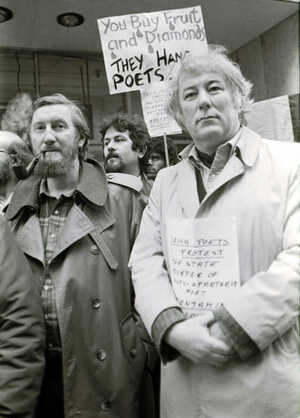

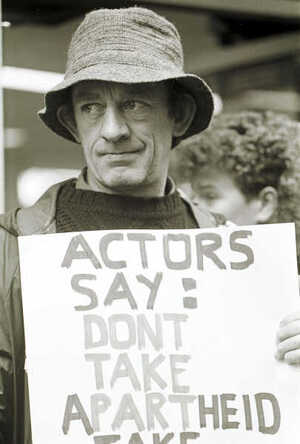
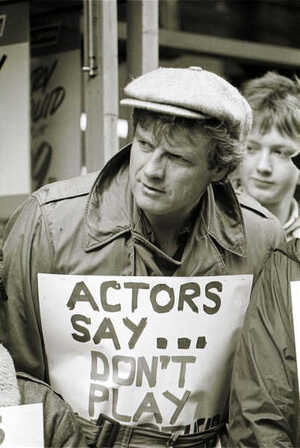
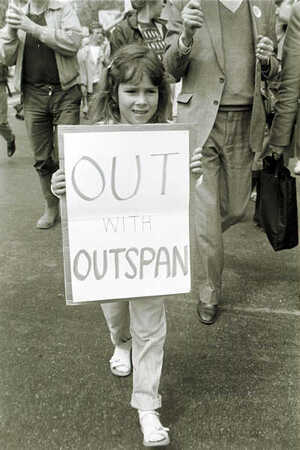


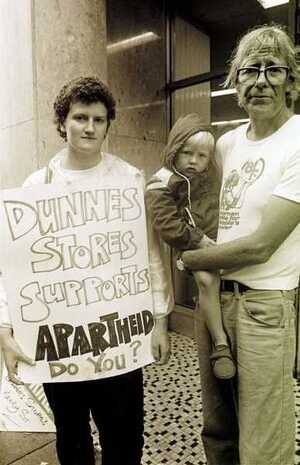
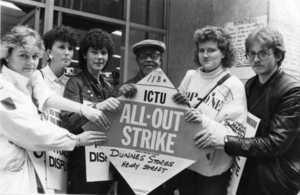
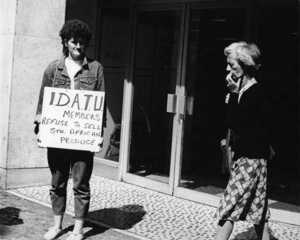
(From top: The late Seamus Heaney, the late Glenroe actor Mick Lally; former Glenroe actor Emmet Bergin; a young girl holds a poster of a ‘Out with Outspan’ slogan; all with Dunnes Stores workers at an anti-apartheid demo on October 19, 1985; sacked Dunnes Stores workers Mary Manning and Catherine O Reilly; Eamon O’Donoghue, Mary Manning, Catherine O’Reilly and Nicky Kelly outside Dunnes on Henry Street on 24 August, 1985; Mary Manning, and Marius and son; Sandra Griffen, Alma Bonnie, Karen Gearon, “Nimrod”, Mary Manning with anti apartheid activist Nimrod Sejake and Tommy Davis on May 25, 1985, and Mary Manning on strike outside Dunnes on Henry Street on August 1, 1984.)
Professor Tom Lodge writes on the History Ireland blog:
“On Thursday 19 July 1984, Mary Manning, a cashier at Dunnes Stores in Dublin’s Henry Street, told a customer that she would not check out any Outspan grapefruits. A few minutes later she confirmed with her manager that she would not sell any South African fruit that day or any other. She was upholding a decision made by her trade union, the Irish Distributive Administrative Trade Union (IDATU). Three months earlier the union had decided that its members would not handle South African goods. Mary Manning was supported by her shop steward, Karen Gearon, who walked out of the store with her. Most of the workers at Dunnes in Henry Street went on strike that day, and eight of them joined Mary Manning and Karen Gearon thereafter. They would stay on strike for the next two and a half years, surviving on strike pay of £21 a week, returning to work only after the Irish government prohibited the sale of South African fruit and vegetables in Irish stores.”
“The protest by Mary Manning and her colleagues was exceptional—they were joined only by a single worker at another store—and the Irish Congress of Trade Unions withheld even rhetorical backing for over a year. Nor at first did their actions appear to engender much sympathy among members of the public. The strikers established a picket line outside the store entrance, attracting derision and abuse from shoppers. People called the strikers ‘nigger-lovers’ and even spat at them. Two of the strikers received a visit from the Special Branch.
Public perceptions of the strike were to change, however. There was growing support for the movement, partly as a consequence of a meeting in London in December between the strikers and Archbishop Desmond Tutu while he was on his way to collect the Nobel Peace Prize in Oslo.”
…
“The Dunnes strike represented the high-water mark of the Irish Anti-Apartheid Movement’s public influence. By 1984 the IAAM had existed for twenty years. This was not the first time it had inspired assertive activism. In January 1970, for example, several hundred opponents of the Springboks rugby side had clashed with police while demonstrating outside the hotel accommodating the visiting players. Several thousand protestors assembled outside Lansdowne Road the following day. They did not halt the game, however, nor did they appear to have significantly affected the attitudes of Irish rugby officials or supporters. More than a decade later, in 1981, an Irish team toured South Africa, the Irish Rugby Football Union apparently undeterred by sharp condemnations from politicians across the political spectrum. The IRFU only decided officially to cease planning South African fixtures in October 1989, just a couple of years before the ending of the international boycott of South African sport. The attitudes of members of the rugby fraternity notwithstanding, according to Nelson Mandela the Irish ranked with the Dutch and the Scandinavians as leading Western nations in the anti-apartheid solidarity movement.”
An ‘boks amach’:* the Irish Anti-Apartheid Movement (History Ireland)
Pics: Photocall Ireland
Thanks Spaghetti Hoop




 [John Gilligan, top, and The Halfway House Pub, Navan Road, Dublin]