
Tag Archives: Abortion

image

Further to this week’s events and the request [details below] by two French filmmakers to talk to women who have sought an abortion in England, Broadsheet commenter Liggy writes:

It’s all very well kicking around the subject of abortion, the wrongs and rights, the political and the reality, the pomp and the circumstance but most women who have had one know the reality….

17 years ago, I had an abortion.

The boat from Cork to Swansea, long distance mainline rail train and the underground to Camden in London.

I remember being surprised that there were so many trees in that part of London. I was expecting it to be all concrete buildings and pavements.

The Marie Stopes clinic was in a huge old red-brick house. When I got there, I was given a sympathetic interview with a doctor and a nurse who were there to help me decide what to do for the best. There was no pressure to decide one way or the other. Just a promise of support either way.

I decided to go through with it,

No food or drink the night before, a fitful sleep in a local B’n’B owned by a Greek woman who the clinic recommended. She had some heartbreaking tales to tell of the girls that had stayed there before. There were no names, no faces to associate with the tales of rape, incest, slavery, money controlling husbands running off and life threatening medical conditions that a pregnancy would have made worse. The police were called but sometimes they could do very little. The clinic was the only hope of a life for most of these women.

The next morning, up early, back to the clinic, changed into my bedclothes, given the gas to help me fall asleep. Procedure. A lot of drug induced sleep. Some Tea. More deep exhausted drug inspired sleep. Some toast and tea. Sunlight coming through the blinds. Shallow sleep. Breakfast and discharge.

The boat back was the longest journey of my life but I read the 20p books I bought in a bundle from an Oxfam shop to pass the time. I also stuffed the stained Mickey mouse nightshirt that I wore during the procedure into a bin in one of the toilets. I did not want it any more. I felt guilty for leaving it for some poor cleaner to find.

I bled for a week afterwards and after that it was over. I was no longer pregnant and my body was returning back to normal.

That is all that is involved. The rest, like some of the above and the 100s of other posts on here are just opinions from various parties with vested interests trying to stop women from making a choice or promote their own agenda. How I became pregnant or my reasons for having an abortion are not political footballs to be kicked about by those who want to point score or scream “my view is right” the loudest.

I made a choice and it was the right one. I neither regret it nor take pride in it. It was just something that had to be done. I wish that my fellow Irishwomen had the same option in their own country, the chance to make a medical choice. That choice could be yes or could be no. We are in charge of ourselves enough to be able to decide.

Previously: Have You Taken The Boat?

(Getty)

marydoran

[youtube=http://www.youtube.com/watch?v=MFCQ85906Zk&start=661&end=851]

Last night on Al Jazeera’s ‘The Stream’, presented by Malika Bilal and Femi Oke, the subject of abortion was debated by Bishop of Elphin Kevin Doran, Doctors for Choice representative Dr Mary Favier, Seána Stafford of the Pro Life Campaign and Sarah McCarthy of Galway Pro-Choice.

We pick it up at the 11 minute mark.

Malika Bilal: “So what resources are there?”

Dr Mary Favier: “The resources are very limited and you’ve got to remember that for a woman who is faced with a crisis pregnancy and they want to end the pregnancy. Remember this woman was viciously raped. She didn’t just want to end the pregnancy, she wanted to not have a baby in these circumstances, with all types of cultural implications in her community for being an unmarried parent. I mean there are very significant issues here. In an Irish context there is no solution to that. This law is flawed because it doesn’t protect rape victims, it doesn’t protect those who are survivors of incest, those who have fatal foetal abnormalities and we thought it might protect those at suicide risk and it has failed this woman. Because I’d ask the bishop…”

Bishop Kevin Doran: [Talks over] “Does the baby not have any rights?”

Favier: “Just a second, Bishop. I’d ask the bishop, what would he suggest have been done? Should she have been tied down? Tied up? She already had court orders to act to hydrate her. What was his plan for 15 more weeks?”

Femi Oke: “Dr Favier, allow the bishop to answer and also Seána, I can see you wanting to jump in there as well so I’ll get to you in just a moment. Go ahead, Bishop.”

Doran: “Yeah, I think the answer to that question is that she should have been provided with proper psychiatric care from the moment she presented. Unfortunately, it seems her first contacts were with a private family planning agency which is a commercial operation and which is not set out to provide psychiatric care but only to provide a response to crisis pregnancy in terms of referring people on perhaps for abortion. But in my understanding the problem is she wasn’t provided with proper psychiatric care and I have to say that one of the challenges..”

Favier: “I feel it is the State who failed her rather than any individual institution.”

Doran: “She didn’t present to the State until she was nearly 20 weeks pregnant.”

Favier: “This woman didn’t necessarily have psychiatric problems. There is very good evidence to show that it’s only when women are denied access to abortion that their mental health deteriorates…”

Doran: “Nonsense I’m afraid.”

Favier: “…and this woman is an obvious example. She became suicidal because she was denied the opportunity to have her pregnancy terminated.”

Doran: “That’s absolute nonsense.”

Favier: “It was accepted that she should go to the UK because for your worldwide listeners you might think there is no abortion provided in Ireland. But there’s up to 4,000 every year in the UK and at least another 1,000 who are thought to have abortion online through medication pills. So Ireland does have abortion we just don’t have it in this country. And if you’re well-educated, middle class, affluent and can afford the €1,000 to get there, we sweep it under the carpet and say it doesn’t happen. But for women with disability who have no money, who are in this case have no right to travel in terms of documents. They’re the women who fall victim and foul of the State. And the State and its institutions like the Health Service Executive need to take responsibility. They failed this woman ever before she had mental health problems.”

Oke: “Alright, Dr Mary Favier take a breath for a moment because again, I personally find it upsetting that we’re unpacking one particular young woman teenager’s case. But we’re talking about an actual law.”

Previously: Staying In Tonight?

stream

Yikes.

On tonight’s episode of The Stream:

Dr. Simon Mills
Barrister and former medical doctor

Sarah McCarthy
Spokesperson, Galway Pro-Choice

Dr Seán Ó Domhnaill
Director, The Life Institute and psychiatrist

Seána Stafford
Spokesperson, Pro-Life Campaign

Kevin Doran
Bishop of Elfin

Tonight 8:30pm on Al Jazeera.

Expect more dodgy red herrings than feeding time at SeaWorld.

Watch it live here.

9035295490352973ruth903529509035297090352951903529729035295790352971Bvf1vVqIQAALIa5
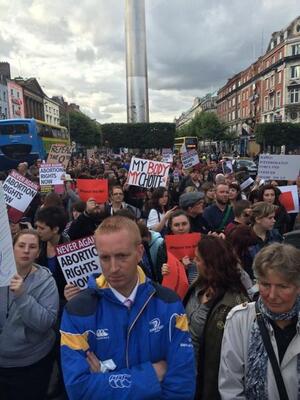
At the Spire, O’Connell Street, Dublin this evening protesting at the treatment of ‘Migrant X’.

(Ruth Medjbar and Sam Boal/Photocall Ireland)

Thanks Buzz

Meanwhile, in Cork

Bvf5fciIAAE927-

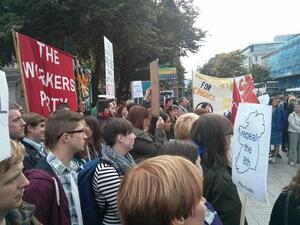
Outside the Courthouse, Cork city this evening.

Via Claire Murray

Meanwhile, in Belfast…

Bvf2PUDCMAEgzNVBvf2Re9CMAAUFi2

Outside Belfast City Hall this evening.

Thanks BelfastFemnet

Meanwhile, in London

Bvf49VuCQAARWkT

Bvf5SWWIMAAl1R-

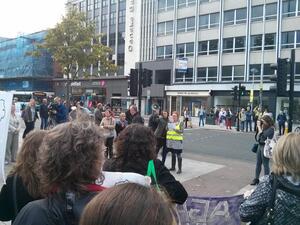
Outside the Irish Embassy, London this evening.

Thanks Soy Un Perderdor

Meanwhile, In Galway

BvgJx_PCMAAzG5v

Eyre Square, Galway this evening.

Thanks Oireactas Retort

Earlier: This Story Doesn’t Make Sense

Screen Shot 2014-08-20 at 11.00.16

Minister for Foreign Affairs, Charlie Flanagan, pictured arriving at Leinster House in July

Foreign affairs minister Charlie Flanagan spoke to Seán O’Rourke this morning and, at one point, they discussed the abortion story. Specifically, they talked about how the HSE are currently carrying out a review of the care given to the young woman.

Seán O’Rourke: “What about the possibility that what emerges from the report may suggest to you and colleagues that the Protection of Life During Pregnancy Act be revisited in some way?”

Charlie Flanagan: “Well there is a suggestion that the act isn’t working. However, I think before we can be conclusive on that, or before we can form an opinion on that, we need to be appraised fully of the facts and the circumstances. There is, built into the legislation, and you know, we’re not going to revisit the lengthy hearings, the submissions and the engagement that ultimately formed the act about this time last year. I think it’s important that the review mechanism, under the act, be allowed take place. If the current case means bringing that forward a few months, then so bet it. There doesn’t appear to be an appetite for a further referendum. However, it’s important that Government does address the issue in the context of the facts of this, of this particularly harrowing case so early into the operation of the legislation.”

O’Rourke: “What would you say to the suggestion, and it’s put forward increasingly by your partners, in Government, in the Labour Party, that 31 years on from the original amendment, the article 40.3.3 that was inserted into the constitution, that that should now, in the round, be examined with a view perhaps to putting the issue before the people again.”

Flanagan: “Yeah, well, I think it’s important that we look at, we’d say the Fine Gael position, my party position. And before the last election we made three essential and important points. Firstly, we said that we wouldn’t legislate for abortion in Ireland and we didn’t. Secondly, we said… ”

O’Rourke: “That’s disputed, but we’ll let that go.”

Flanagan: “We had to address, it was incumbent upon us to address the issue of the European Court of Human Rights’ judgement in the A, B, C case and that was addressed, in the form of legislation. And, thirdly, we promised that we women in pregnancy would receive an appropriate level of medical treatment that was necessary. That is inbuilt in the legislation and it’s important in the context of this case that you now mentioned, that there is adequate follow through on that and that we satisfy ourselves that there was an appropriate level of medical treatment and attention available to that person.”

Previously: At The Mercy Of The State

Listen back here


90098985Professor William Binchy (top) and Justice Adrian Hardiman (above)

HardimanX1992-page-001

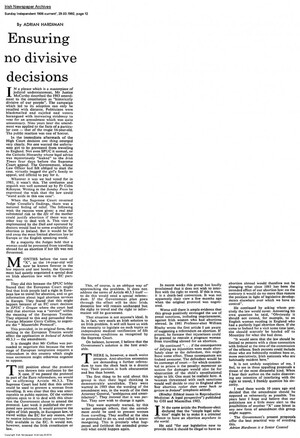
From March 1992, a piece written by Adrian Hardiman SC (Supreme Court Judge since 2000) in the Sunday Independent on the X case and Pro Life Campaign legal advisor William Binchy.

Anti-abortion extremists are demanding a further referendum to turn the clock back in a drastic way. Their position is both obscurantist and less than honest.

The first thing to be said about this group is that their legal thinking is demonstrably unreliable. They were warned in 1983 that the wording of the amendment was, in the words of the then Attorney General, “ambiguous and unsatisfactory”. They insisted that it was perfect. They now wish to change it again.

They were expressly warned, by this writer amongst others, that the amendment could be used to prevent women from travelling. They scoffed at the idea or pretended to do so, and called it scaremongering. This is precisely what happened and (without the amended protocol) what could happen again.

In recent weeks this group has loudly proclaimed that it does not wish to interfere with the right to travel. If this is true, it is a death-bed conversion. It was not apparently their view a few months ago when the original protocol was negotiated.

Worse still there is ample evidence that this group positively envisaged the use of penal sanctions, including imprisonment, against Irish women who had abortions abroad. In 1981 Professor-elect William Binchy wrote the first article I am aware of suggesting a referendum on abortion. If passed, he foresaw that injunctions could be granted to restrain a pregnant woman from travelling abroad for an abortion.

He continued “. . . if the consequences of defying an injunction were made absolutely clear to the defendant, this might (have some effect. These consequences are indeed awesome. The defendant would be in contempt of court — for which commital to prison is the penalty: moreover an action for damages would also lie for ‘destruction of the child’s constitutional right to life: One must be realistic here. A woman threatened with such sanctions (could well decide to stay in England after her abortion rather than come back to prison in Ireland’ (emphasis added). (Binchy: Ethical issues in Reproductive Medicine: A legal perspective”) published by Gill and Macmillan 1982.

In the same article the Professor-elect declared that-the “simple legal solution” might be to make it a criminal offence to have an abortion anywhere in the world.

He said “for our legislation now to provide that it should be illegal to have an abortion abroad would therefore not be changing what since 1861 has been the intended effect of our abortion law: on the contrary it would do no more than restore the position in light of legislative developments elsewhere over which we have no control”.

He continued by asking whom precisely the law would cover. Answering his own question he said, “Obviously it should not extend, for, example, to an English woman residing in England who had a perfectly legal abortion there. If she came to Ireland for a visit some time later, she should scarcely be hauled off to Mountjoy for what she had done.

“It would seem that the law should be limited to persons with a close connection with Ireland at the time of the commission of the offence. Such persons could include those who are habitually resident here or, more restrictively. Irish nationals who are habitually resident here.”

Via Oireachtas Retort

Previously: And So It Came To Pass

Not So Fast

Just William


“Our Values Are Considerably More Subtle Than You Might Think.”

Senior Moment

He Hasn’t Changed A Day

Eamonn Farrell/Photocall Ireland

hse-plan-navan-hospital-drogheda-louth-390x285

The woman refused an abortion has spoken with The irish Times about her experience.

Over the following weeks, she says, she had a number of meetings at the IFPA [Irish Family Planning Association] and though the process seemed to be in train she was told some weeks later that the estimated cost of travelling to England, having the abortion and possible overnight accommodation could be over €1,500. An individual in the IFPA, she says, told her the State would not fund the costs

“I said we’re getting too far, and she said, no, in England they carry out abortions up to 28 weeks . . . She said ‘that is not the problem. The problem is the money’.

“The next day, around 10am, I was taken in a taxi to another hospital . . . When we got there I thought they were going to help me. They brought me to a room where they did a scan and the pregnancy was 24 weeks and one day . . .They said they could not do an abortion. I said, ‘You can leave me now to die. I don’t want to live in this world anymore’.”

…On Monday night two doctors came, a psychiatrist and a gynaecologist, and said, ‘We are going to carry out the abortion next Monday but you have to be strong. You have to eat. You have to drink.’ I started to eat and I drank.”

She says she was told a few days later that the plan had changed.

“They said the pregnancy was too far. It was going to have to be a Caesarean section . . . They said wherever you go in the world, the United States, anywhere, at this point it has to be a Caesarean.

She says that a number of days later, two medics told her the authorities had been made aware of her situation and she would need a solicitor….

They said they could not do an abortion. I said, ‘You can leave me now to die. I don’t want to live in this world anymore’ (Kitty Holland, Ruadhán Mac Cormaic, Irish Times)

Screen Shot 2014-08-17 at 23.02.29

Camille Hamet and Séréna Robin write:

We are two young French film makers working on a documentary about Irish women traveling to England to have an abortion. It will be broadcast on French public TV Public Sénat in December.
We just arrived in Dublin and plan to stay in Ireland for two months. We are already in touch with the IFPA [Irish Famile Planning Association], the ASN, Doctors for Choice and Senator Ivana Bacik, among others. But we are currently looking for Irish women that would agree on sharing their own personal experience of abortion. Our main challenge is to find a woman that would agree to let us follow her while she is in the process of seeking an abortion in England. Anonymity will be contractually guaranteed but we don’t even know how to reach them to discuss it. Therefore, we were wondering if it was possible to mention our project on Broadsheet. It would be very helpful. If anyone would like to help us  regarding this please don’t hesitate to contact us.at taketheboat.themovie@gmail.com.
Here is a link to the project. You can also check its Facebook page and its Twitter account.