Tag Archives: Abortion

Screen Shot 2014-08-18 at 14.17.46

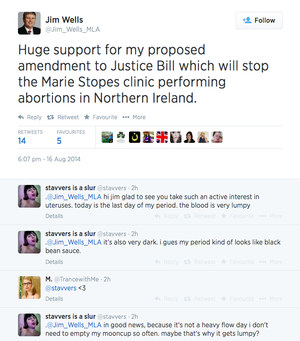
DUP MLA for South Down Jim Wells receives feedback from the electorate as he attempts to prevent private clinics performing abortions in NI.

A staunch flegger and pro-lifer, what’s not to like?

[youtube=https://www.youtube.com/watch?v=_BSfHxrGso8&start=172&end=218]

Here’s Jim getting hysterical on a visit to Dundalk in 1986 as his colleague Peter Robinson was appearing in court for his part in a disturbance in Clontibret, Co. Monaghan.

Calm down, dear.

Good times.

Screen Shot 2014-08-18 at 10.33.12
Screen Shot 2014-08-18 at 10.34.24

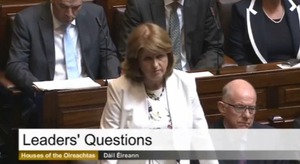
Deputy Catherine Murphy asked the Tánaiste Joan Burton a number of topical questions on the final sitting of the Dáil before the summer recess (July 17) in light of the UN HRC hearings in Geneva.

The Labour Party leader firmly ruled out any hope of new legislation for victims of rape and incest and those seeking terminations for medical reasons (TFMR).

Deputy Catherine Murphy:
“This week’s damning review of our human rights practices by the United Nations Human Rights Committee makes for grim reading but it is hardly surprising. Our failure in regard to the Magdalen laundries survivors, the symphysiotomy survivors, those who spent time in mother and baby homes and those who were victims of clerical child abuse is shameful. However, we stand to repeat the mistakes of the past if we do not act to address the grossly discriminatory laws that govern abortion. The UN committee confirmed that we are in breach of the International Covenant on Civil and Political Rights by denying women the option to avail of abortion in certain circumstances, namely, rape, incest, fatal foetal abnormalities and where a woman’s health is in danger. I would argue that we are not only in breach of the covenant but also in breach of basic humanity in denying an abortion to a woman who has been raped, is a victim of incest or has to endure carrying to full term a pregnancy when there is no prospect of delivering a live baby. I found it profoundly chilling to listen to the remarks of the principal officer of the Department of Health who told the committee that denying these women the right to abortion was the will of the people. I question what people are meant. The eighth amendment to the Constitution was inserted more than 30 years ago and attitudes have changed significantly since then, as recent polls have shown.

The Labour Party is a socially progressive party. The Tánaiste is the leader of that party as well as the deputy leader of this country, and she is also one of the few women in a decision-making role in this Government. Is she going to use her powerful position to bring about change in this area and, if so, how is she going to do that?”

Tánaiste: “In regard to the issues arising around fatal foetal abnormalities, the Deputy will be aware that some time ago the Government legislated successfully in regard to the X case. That is reflected in our legislation and is an issue that both parties in Government have addressed. In regard to fatal foetal abnormalities, I am on record as stating that I would like to see a situation where it is possible to address them. As of yet we do not have agreement on that in the programme for Government. It is a personal position and I have been on public record in this regard over a long period.

Deputy Catherine Murphy: “I know we have legacy issues and it is very uncomfortable to consider past failures in hindsight. We are asking how we allowed such things to happen and who was in power at the time, but will the pattern be repeated by people in power now, and will we have the same conversations in 30 years?”

Deputy John Halligan: “Exactly.”

Deputy Catherine Murphy: “The same committee might then be reviewing how the country dealt with issues like fatal foetal abnormalities, for example, or people who have been raped or subject to incest and who have been denied their human rights. The Tánaiste indicated her personal views are on the record but I ask her as Tánaiste – deputy leader of the country – and the leader of the Labour Party for her position on the issue.

I went to Liverpool Women’s Hospital with people who were part of a study group on fatal foetal abnormalities. People were put through a tortuous process where, for example, they would have had to retrieve the remains of a baby they wanted by way of something like DHL delivery, which is absolutely appalling. It is inhumane and we cannot rely on a 31 year old referendum decision, presuming that people have not moved on when so many events have taken place in this country. We need a referendum, as the Tánaiste knows, if we are to change that position. Does the Tánaiste accept we need a referendum and will she commit to working towards such a referendum?”

Tánaiste: “There has been an extensive process with the Constitutional Convention, which considered various issues and reported findings. As I pointed out, the Government and the Dáil has dealt with issues arising from the X case. Those had been unresolved over a very long period of years. We want a position in Ireland where every baby is a wanted baby. The Deputy spoke about cases and the people she accompanied in Liverpool, and those are tragic circumstances as the babies are wanted but their life outcomes were in doubt because of medical issues.

It was referenced in Geneva that on a previous occasion, the Irish people gave a view – as was their entitlement – on what they wanted reflected in the Constitution. I did not share the view at the time and my party and others like me recommended voting against the amendment to the Constitution. As a democrat, the Deputy must recognise that the people voted for the eighth amendment to the Constitution. The Government has legislated for and dealt with issues surrounding the X case, which has been a difficult issue in this country over a very long period. That is what was agreed in the programme for Government.

Deputy John Halligan: “So the Tánaiste will not agree to a new referendum.”

Leaders’ Questions July 17 2014

Previously: Violation Once Again

Without Consent

What The Man From The UN Said

RTE_Logo

RTÉ journalist Dyane Connor spoke to Rachel English on Morning Ireland earlier, to discuss the case of the woman whose baby was born by Caesarean section after a panel of experts turned down her request for an abortion.

Neither journalist mentioned that the woman was raped.

Rachel English: “We’re joined by RTE reporter, Dyane Connor. I suppose I should say as well, Dyane, that there are legal restrictions on what we can say about the woman at the centre of this case but what can you tell us about her.”

Dyane Connor: “Yes, there is a court order in place, so she cannot be identified at all, to protect her identity. We do know that she was in her second trimester when she was admitted to hospital, requesting an abortion. Now, as it required under the new legislation which came into effect at the beginning of this year, she was assessed by a panel of three medical experts – two psychiatrists and an obstetrician. I understand it was decided that she did have suicidal thoughts but it was decided not to carry out an abortion, instead to terminate the pregnancy by a Caesarean section. Now when the woman was told of this, she was very upset and she began a hunger and thirst strike. At this point, the HSE went to the high court to get an order, to allow it to hydrate her, because, for a woman to undergo a Caesarean section, I understand, it’s very dangerous if she is dehydrated. Now a further court date was set, subsequently to this, the woman I understand did agree to allow a Caesarean section to be carried out and this was performed when she was either 24th going on her 25th week of pregnancy, the baby was delivered.”

English: “Now this practice if we go back for a moment, this practice, the assessment by a medical panel. This was introduced under the Protection of Life During Pregnancy Act, so what happens? How does this work?”

Connor: “Well, once the legislation is called upon, the woman is seen by three medical experts, so you have to psychiatrists who are examining her mental health and then an obstetrician who obviously, in this instance, made the decision that the baby is considered viable, can survive outside the womb. Now an option that was open to the woman, when she was refused an abortion, she could have I suppose asked for a review of this decision which would have meant that a panel of ten medical practitioners are then called upon. This has to be done within, no later than three days, after the initial decision is made. Once the panel has convened to review that decision, they then must make a decision no longer than seven days. Obviously time is of the essence in this case. Now, it’s very important as well to stress that the termination of a pregnancy is the ending of a pregnancy. In the first three months, we would refer to it as an abortion. But in later stages of pregnancy, this termination of a pregnancy can be the delivering of a baby by Caesarean section if an obstetrician believes that the baby is viable.”

English: “As you mention the timeframe here, can we go back over that for a moment because there does appear to be some confusion. Now, it’s reported that the young woman here, that she first asked for an abortion when she was eight weeks’ pregnant. And, yet, some time seems to have passed before she was assessed by this panel of medical experts.”

Connor: “That’s correct. A colleague of mine, Emer Lowe, was also working on this story over the weekend and sources close to this woman say she did find out she was pregnant in her first trimester and that she asked her doctor for an abortion and she claims that she wasn’t given the options that should be open to a woman in a situation like hers. And it was impossible for her to travel abroad for an abortion in her circumstances. But it was her second trimester before she went in to hospital, looking for the abortion.”

English: “What’s known now about how the young woman is and, indeed, how the baby is?”

Connor: “I believe the woman is quite upset and traumatised and the baby was born by Caesarean section and is being cared for and treated in a hospital at the moment, where the baby will remain for the coming months. What happens then is still not clear. But I understand that at the moment, it looks like the baby will be taken into care.”

English: “Dyane, thank you very much indeed.”

Anyone?

Listen back here

Woman sought abortion at eight weeks (Kitty Holland, Irish Times)

Meanwhile, on the BBC..

Woman denied abortion in Republic of Ireland ‘was raped’ (BBC)

image_283635_320Sarah Ditum

Via The New Statesman:

The story reported in today’s Sunday Times is a catalogue of violation. First, a woman was raped (violation one). She sought an abortion but apparently doctors obstructed her from getting the treatment she needed (violation two); although many Irish women travel to the UK in this situation, the woman in this case could not because she was a foreign national with uncertain immigration status, and her limited English likely compounded her vulnerability.

Desperate at this stage, she expressed suicidal intent and went on hunger and fluid strike: the Health Service Executive (HSE) obtained a court order under the Protection of Life During Pregnancy Act 2013 for the forcible rehydration of the woman (violation three). Finally in early August, a certificate was issued allowing for a medical procedure to be carried out upon the woman: the next day, the baby was delivered by caesarian (violation four), at 24-26 weeks gestation, which is the very cusp of viability. The baby is still receiving medical care. The condition of the woman has not been reported.

…And what trauma. As an onlooker to this case, what strikes me is the constant traffic of foreign objects through this woman’s body, imposing foreign wills. The penis of the rapist who forced himself into her. The nasogastric tube stuck into her nostril and down against her resisting throat. The scalpel of the doctors who cut her open, their hands in her belly, the moving horror of another body within your restrained flesh. The unbelievable awfulness of being compelled to provide life to the child of the man who raped you. And the terrible silence of voicelessness, a woman with no tongue that would let her be heard. This is the violence the Irish state imposes on women. This is why Irish women are campaigning to “Repeal the Eighth”: because women know that we are human, and none of us should have to live under a law that says otherwise.

Violation after violation: why did Ireland force a woman on hunger strike to bear her rapist’s child? (Sarah Ditum, New Statesman)

Sarah Ditum

Earlier: Without Consent

Thanks Orla

Screen Shot 2014-08-17 at 01.13.32

A woman who became pregnant as a result of rape believes the state denied her access to an abortion for months, until the foetus became viable. Earlier this month, the baby was delivered prematurely through a Caesarean section, which was authorised under the Protection of Life During Pregnancy Act.

The young woman, a foreign national with limited English, was not able freely to travel abroad for an abortion because of her legal status in Ireland. She discovered she was expecting about eight weeks into the pregnancy, and immediately sought an abortion because she had been the victim of a traumatic rape.

Months later, the woman believed she had been effectively refused an abortion, or the ability to travel abroad for such a procedure, by the state. She then went on a hunger and liquid strike.


State ‘denied abortion’ to rape victim (Mark Tighe, Sunday Times)
(behind paywall)


90306736A Pro-Life demonstration outside Leinster House last Summer

Henry McDonald, Ireland correspondent of The Guardian reports this evening:

Pregnant women in Ireland could be blocked from having an abortion even if they are at risk of suicide after conceiving as a result of rape or incest, under new guidelines issued to Irish doctors.
Experts warned that the Guidance Document for Health Professionals, which has yet to be made public  but has been obtained by the Guardian, will give power to doctors, obstetricians and psychiatrists to prevent vulnerable women from terminating their pregnancies.

….The 108-page guide does not include provisions for an independent committee to make decisions on treating those with “suicidal intent”, which was a key demand among campaigners for reform…initial referral for women including those with “suicidal intent” begins with her own GP.

If the GP agrees, he or she will refer the woman to three doctors – including one obstetrician and two psychiatrists – who will decide whether there is a real risk to the woman’s life through suicide. If her request is rejected, she will go through an appeal system involving another two psychiatrists and another obstetrician….

Pregnant women face abortion ban in Ireland even if they’re a suicide risk (Henry McDonald, The Guardian)

(Leon Farrell/Photocall Ireland)

Thanks Sido

00135011

In a week that saw [at the UNHRC in Geneva] a principal officer at the Department of Health admit that Ireland’s abortion law discriminated against women who could not afford to travel to Britain, Dublin South East TD Lucinda Creighton [on yesterday’s Marian Finucane programme on RTÉ Radio One], chose another story to discuss…

Marian Finucane:You picked out as well a story in the Business Post called ‘NAMA Offers Deals To Stop Developers Seeking Bankruptcy Abroad’.”

Lucinda Creighton:Yeah. I just had a quick look at that. I suppose the thing that strikes me about this is that we have to be very careful when we’re trying to resolve the huge problems that we still obviously have in the property sector. A lot of major players who have been embroiled now for a number of years in trying to resolve debt overhang etc with NAMA that we don’t forget about all of the other business in the country that is literally you know collapsing under the weight of debt and this is something that Morgan Kelly and many others have pointed to as one of the biggest challenges to economic recovery in this country so. I have a fear, I have a concern that if we talk about special circumstances for bankruptcy where people involved in property development and speculation in the past and we ignore the huge existing problem and challenge for a lot of people in small business who can’t afford to go to the UK for bankruptcy purposes for example, being truthful. It’s just not an option for them. You know I think prioritising one cohort of business people above others is actually, firstly is completely unfair and secondly actually risks ignoring probably the biggest challenge we have to economic recovery which is getting the small and medium sized enterprise domestic economy back functioning.”

Listen here (scroll to 48 minute mark)

Previously: No Solution

What The Man From The UN Said

Laura Hutton/Photocall Ireland

rodley

Sir Nigel Rodley

Over the last two days the UN Human Rights Committee in open hearings in Geneva, Switzerland has been examining Ireland’s human rights record.

The committee’s chairman Sir Nigel Rodley closed proceedings today with an address that included the following..

Ireland’s treatment of women:

“the Magdalene Laundries, the Mother and Baby Homes, the child abuse, the symphysiotomy – it’s quite a collection and it’s a collection that has carried on [for a] period that it’s hard to imagine any state party tolerating. And I guess I can’t prevent myself from observing that [they] are not disconnected from the institutional belief system that has predominated in the state party.”

On Ireland’s laws on women’s reproductive rights:

“the recognition of the primary right to life of the woman who is an existent human being has to prevail over that of the unborn child and I can’t begin to understand by what belief system the priority would be given to the latter rather than the former. It is good to see that in 2013 at last that is clearly being clarified. I’m sorry that the clarification does not extend to the health of the woman.”

On the Protection of Life During Pregnancy Act:

“Life without quality of life is not something many of us have to choose between, and to suggest that regardless of the health consequences of a pregnancy a person may be doomed to continue it at the risk of criminal penalties is difficult to understand, even more so arguably for rape where the person doesn’t even bear any responsibility and is by the law clearly treated as a vessel and nothing more.”

ICCL [Irish Council For Civil Liberties] Wholeheartedly Endorses Coruscating UN Comments on Ireland (ICCL)

(Getty)


Earlier: Nightmares

Minister outlines Ireland’s position on abortion at UN Human Rights Committee (RTÉ)

90275634

[A protest at Dublin Airport Busarus by the Perform Collective for Choice in 2013]

Further to figures released today by the UK Department of Health.

Niall Behan of the Irish Family Planning Association writes:

“At least 3,679 women were forced to travel to the UK last year to access a safe and legal abortion because they are denied these necessary health services in their own country. Every day our clients tell us about their experiences of being abandoned by the Irish health care system and forced to rely on the services of another country.

“Since 1980, over 158,252 women have had to make the journey to the UK to access abortion. These women are not criminals but the law treats them as such because they are seeking a service that is illegal in almost every circumstance in Ireland.

“The criminalisation of abortion does not deter women from seeking an abortion but it does act as a barrier to receiving care. Abortion is the only other area of health where the Government can ignore its duty of care and shift the onus of seeking services onto women.”

IFPA

(Eamonn Farrell/Photocall Ireland)