
Thomas Collins writes:
The drink section in Aldi, Sandyford, Co Dublin on Good Friday.



Thomas Collins writes:
The drink section in Aldi, Sandyford, Co Dublin on Good Friday.
 [A press release from Drinkaware.ieMEAS (Mature Enjoyment of Alcohol in Society) today]
Splutter!
John writes:
“Ms. Fionnuala Sheehan, the head of drinkaware.ie/MEAS, compares the exclusion of the drinks industry from Alcohol Awareness Week to the past persecution of black people and Irish people. Might be a bit of a stretch.”

An Irish twist on the vintage Budwesier wassup? ad
By ADT students, shortlisted by Daretobedrinkaware to run “a campaign promoting responsible attitudes to alcohol”.
Stay for the chunk blowing.
Thanks Eoin Lyons




Photographer Fabian Oefner adds a few drops of alcohol to a glass, ignites the vapour and captures the resulting plumes (which look oddly similar to x-rays of the of the human brain cortex) in a series of high speed shots.
Video and a little more explanation here.

Or didn’t know you thought. Or knew you didn’t think. Or whatever. You’re me beshfuggan mate in anyways.
My Drunk Kitchen’s Hanna Hart breaks down some common misconceptions about alcohol for Mental Floss.
Previously: 30 Life Hacks Debunked

My cousin made this #irishwordsfordrunk visualisation. http://t.co/XCIg6EZJlO
— Rudy Hellzapoppin’ (@RudyHellzapop) September 23, 2013
It’s often said that the Eskimos have 200 words for snow. We have 200 #irishwordsfordrunk. 1 Addled 2 Air (cont) http://t.co/EOXPPRs90H
— Rudy Hellzapoppin’ (@RudyHellzapop) September 23, 2013


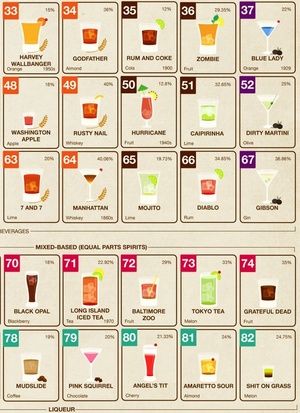
 Various beverages organised by their alcoholic content, taste and year of creation by Brazilian designer Mayra Artes.
Full sized version here.

As UCC announces a pilot programme of alcohol-free accommodation at Victoria Lodge (above), few will remember the tragic incident of a 19 year old student who died as a result of a binge drinking session.
In 2009, a second-year Arts student consumed more than ten cans of beer and about half a litre of vodka while celebrating his hurling team’s win.
A UCC 2010 study on alcohol consumption showed that 46pc of male and 45pc of female students reported binge drinking more than once a week, and that all who reported drinking alcohol reported at least one adverse consequence.
Student died after heavy drinking session (RTE News, November 2010)
UCC offers ‘dry’ apartment for students who want ‘quieter surroundings’ (Irish Examiner)
Pic: Google Street View
Thanks June
 And de GAA.
“The use of sponsorship and advertising is necessary for premium brands to maintain market share in a very competitive environment. Anything that impedes this could have a detrimental impact on the potential of the wider agri-food sector.”
“Like every parent, I am of course concerned to ensure that Irish people, and especially our youth, treat drink responsibly. I believe that more focused and targeted education in primary and secondary schools is the best approach in achieving that. Indeed, I see involvement in sport as a positive conduit to more responsible use of alcohol.”
John Bryan, President, Irish Farmers’ Association
Farmers back alcohol sponsorship of sports (Stephen Rogers, Irish Examiner)
Meanwhile…
Longitudinal studies consistently suggest that exposure to media and commercial communications on alcohol is associated with the likelihood that adolescents will start to drink alcohol, and with increased drinking amongst baseline drinkers. Based on the strength of this association, the consistency of findings across numerous observational studies, temporality of exposure and drinking behaviours observed, dose-response relationships, as well as the theoretical plausibility regarding the impact of media exposure and commercial communications, we conclude that alcohol advertising and promotion increases the likelihood that adolescents will start to use alcohol, and to drink more if they are already using alcohol.
Also…
In 2009 Professor Iain Gilmore warned of “very little evidence that health messages work to prevent binge or harmful drinking“. Then Alcohol Concern Chief Exec Don Shenker also wrote of a “real concern that the very message ‘Why let the good times go bad’ will actually reinforce the notion that you need alcohol to have a good time”. Looking forward, Drinkaware has certainly not yet convinced the public health community at large of its role or ability to delivery activity that genuinely addresses alcohol misuse.
Hat tip: Niall Crumlish and Brian O’Connell
(Photocall Ireland)