

Tag Archives: Anne-Marie on Wednesday

enda-kenny-nicolas-sarkozy-dimitris-christofias-2012-1-30-10-1-22

anne-marie-291x300

From top: Taoiseach Enda Kenny and then French President Nicolas Sarkozy in 2012

It is time for us now to re-examine the EU project, to question its direction and to remind it of its founding purpose and to forego the lap-dog like personas our leaders assume when they go to Europe.

Anne Marie McNally writes:

What a week it has been. It was a mass exodus. Britain exited Europe. David Cameron exited office. The Labour shadow cabinet exited in their droves and we exited the Euros followed swiftly by Iceland forcing England to say goodbye to all things European for the second time in a week…the drama.

Online and off the debate has raged following the seismic Brexit result. Those on the leave side both here and in Great Britain declared it a ‘working-class revolt’ and pointed to people who had voted leave as a direct rejection of the undemocratic nature of the EU project and the effects of the austerity the institutions have imposed on working and middle-class communities across Britain and Ireland.

Those on the Remain side argued that Britain had made the single biggest mistake in its European history; that leave voters had now opened the door to anti-immigrant rhetoric (or worse) and had essentially facilitated both racism and recession to take hold across Great Britain.

Both sides of the argument are not without merit and the realities we now find ourselves in are entirely uncharted waters with neither side being entirely sure how to sail through what are undoubtedly choppy currents.

The arguments on the Remain side cannot be underestimated. There is no way of avoiding the reality that jobs have been and will continue to be lost, the economy has and will suffer and sterling has and will continue to weaken.

Many on the leave side will say ‘great, the financial big-wigs in the City will suffer’ and that’s true (we’ve already seen the million/billionaires having share wealth decimated) but it’s worth remembering that vast amounts of inclusion projects, community development projects and youth services are funded directly via EU initiatives. These will cease.

Vulnerable communities will notice their absence in a far greater way than Michael O’Leary will notice a few million gone from his personal stash.

In addition to the pulling of direct EU funding from community initiatives, UK Government funding is also likely to reduce as a result of economic hardship – either real or imagined because make no mistake, when there is a plausible excuse to cut such initiatives they do.

We’ve seen it here – our community sector suffered disproportionate cuts at the first sign of recession back in 2008 and it hasn’t recovered since.

Those on the margins of society and those suffering in working class communities are the ones who bear the brunt of these cuts. I worry about a nose being cut off to spite a face in the Brexit result.

On the flip side there are the arguments, the non-racist or ignorant ones, for Leave.

The reality that the EU has ceased to be a democratic project and that the notion of solidarity – one of the pillars upon which the EU was established – has long since been abandoned.

People have watched as unelected technocrats have assumed dictator-like positions of power and have sat on high issuing instructions for the whipping of the ‘little people’ in their kingdoms.

Citizens of every EU country watched as the Greek crisis unfolded, and whether you agreed with the Greek’s handling of their own economy or not – you had to be a least slightly concerned by the lengths the EU institutions were prepared to go to smash democracy into the ground in that country and if the citizens had to go with it then so be it, it seemed.

Likewise with the current refugee crisis – only the Trump supporters among us will look at images of families being water cannoned or lined up behind barbed fences or fished from the seas without feeling utterly aghast at the lack of human solidarity on display from the EU institutions who should be leading by example.

There is a massive disconnect between citizens and the EU and never has that been more clearly stated than in the Leave result.

It is time for us now to re-examine the EU project, to question its direction and to remind it of its founding purpose, to forgo the lap-dog like personas our leaders assume when they go to Europe and to begin challenging the undemocratic processes that have created a Game of Thrones style hierarchy of countries – us wildlings are getting angry and the self-appointed leaders will pay the price of that anger.

But I fear we may suffer huge hardship to our ranks before those on high hear the message.

Anne Marie McNally is a founding member of the Social Democrats. Follow Anne Marie on Twitter: @amomcnally

anne-marie

anne-marie-291x300

From top: Anne Marie canvassing during the last General Election; Anne Marie


Wouldn’t it be great if equal attention was paid to online trolling and the far more ubiquitous and damaging elements of the traditional media who seek to create division and hatred between us and our fellow humans?

Anne Marie McNally writes:

Last week I wrote about the horrific tragedy in Orlando – the hatred and intolerance that had bred the killer who carried out the atrocity and the public narrative which had sought to justify various positions of different groups which, in either a direct or indirect way, had facilitated such a tragedy.

This week is tragically no different. Jo Cox, a Labour Member of Parliament, a mother, a loved one, was brutally murdered as she went about her constituency business as normal on Thursday afternoon.

She was slain by a man reportedly shouting “Britain first”, a man who later identified himself in court with the statement: “My name is death to traitors, freedom for Britain.”

Jo herself was an ardent supporter of refugee rights and humanitarian efforts. Yet despite these pretty obvious pointers, many in the public space seemed loathe to label the murder as a far-right act.

‘Na, it was just a mad-man saying anything at all, his comments meant nothing’ went the refrain…probably from those who nod in agreement with Daily Express and Telegraph headlines about ‘Migrants taking Over’ or ‘Rapists hide among them’ or ‘One out of every five killers is an immigrant’ (Am I crazy that I’m worried about the other 4?!)

One of the most disappointing things I encountered during my recent outing in the General Election campaign was the insidious racism that was becoming evident in people’s everyday lexicon. They would never in a million years identify themselves as racist but it was there.

No matter what way you dress it up if you’re saying ‘I’m not racist BUT….. look after our own first; or there’s too many of ‘them’; or they’re getting benefits/jobs/school places/houses etc. etc.’…then yes, you may not mean to be but you are rationalising racist rhetoric.

In a culture where that attitude is not only being propagated by far-right extremists but is instead becoming parlance du jour for front pages and Betty next door out pruning her roses or changing her tyre, it is not difficult to see why extremists feel more comfortable mingling with Joe and Josephine Soap.

In a thankfully less serious but also horrifying way, we have seen our own racist attacks in this country recently, not least of which was the beating of an Afghan family with young children in the leafy Dublin suburb of Rathfarnham.

The rhetoric and indeed the proliferation of outlets for such rhetoric, hate speech and violence to be promoted and propagated is extremely worrying but so too is the counter-culture which, perhaps unwittingly or perhaps not, in some cases, seeks to dull the sound of legitimate dissent by labelling it as hate-speech, trolling or online abuse.

It is an entirely different thing to call out a politician for questionable policies or actions you don’t agree with than it is to threaten rape, murder or harm to family members.

Let’s not conflate the two. To do so is a dangerous perversion of free-speech, political discourse and active engaged citizenry.

Labour TD Joan Burton’s comments over the weekend called for ‘the problem of online abuse to be confronted and tackled now’ before it gets too far out of hand.

We’ve all seen idiots at play on social media. We’ve all seen the hateful crap and often the bile that online commentators can spew. It’s not acceptable.

Every right-minded person knows that, and in most cases, calls it out.

However we’ve also seen some of the stuff that has been labelled by Joan Burton, Lorraine Higgins, (the former Labour Senator who crusaded to control social media) and others, as hate speech and it’s not.

It’s not abuse. it’s simple disagreement with political actions, there’s a significant difference.

The other day I pointed out something regarding a former representative who I, and others, thought had acted inappropriately.

I was accused of ‘waging a war’ of ‘going after him’ and various other hyperbolic statements, none of which were true. I was simply pointing out something I disagreed with, in a respectful and appropriate fashion.

If we seek to close such responsible political discourse by means of somehow avoiding the irresponsible and dangerous elements of online trolling then we do ourselves a serious disservice.

Wouldn’t it be great if equal attention was paid to the far more ubiquitous and damaging elements of the traditional media who seek to create division and hatred between us and our fellow humans wherever they may hail from?

And…I know I can trust that the comment section under here will have armies of those who respectfully disagree with me and think I’m an awful person without wanting to cause me harm or spew bile at me.

And that’s perfectly OK, in fact it’s healthy – you wouldn’t want me looking to close the comments section would you?! ;-)

Anne Marie McNally is a founding member of the Social Democrats. Follow Anne Marie on Twitter: @amomcnally
newsocracy

anne-marie-291x300

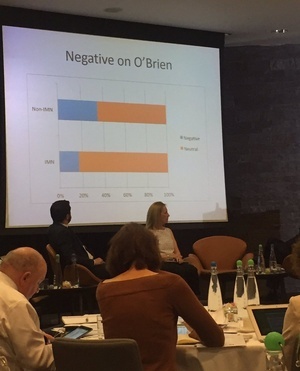
From top: A visual from the Newsocracy Conference in Limerick last Friday; Anne Marie Mcnally

Journalism as we know it and as it should be is in extreme danger in this country.

Anne Marie McNally writes

On Friday last I spoke at a conference in Dublin hosted by MEP Nessa Childers. The title of the event was ‘Newsocracy- Safeguarding Journalism and Exploring owner Influence’ and the theme was (obviously!) the relationship between media ownership and unbiased Journalism.

The panel was made up of representatives from media outlets and other agencies including Facebook, the Broadcasting Authority of Ireland, the National union of Journalists, academics from the field of communications, and journalists from various backgrounds.

By a country mile the overwhelming message from the speakers was that Journalism as we know it and as it should be is in extreme danger in this country.

Possibly the most worrying part of the day came when Professor Roddy Flynn from DCU’s School of Communications presented the findings of a research piece which examined the treatment of four of the biggest news stories of recent times across various media outlets.

Two of those stories centred around your favourite redacted personality with a penchant for litigation.One was the reporting of the Moriarty Tribunal findings and the other was the Siteserv/IBRC and Catherine Murphy story.

The results were interesting to put it mildly.

In relation to the Moriarty Report, a study of 140 articles published about the Tribunal in Independent News and Media (INM) titles and a further 227 in non-INM titles between March 23 and April 2, 2011, showed that, in general, INM titles were more likely to focus on Michael Lowry than on Denis O’Brien with the difference being reported as ‘statistically significant.

Similarly in relation to the reporting of the Siteserv/ Catherine Murphy story, the study found that the frames used to report the story differed significantly between INM tiles and non-INM titles with the former tending to frame the story in the ‘abuse of privilege and right to individual privacy’ context while others chose the ‘public good’ frame more regularly.

Given that the circulation figures for INM titles far outstrip all others this is a worrying, if not surprising, reality in our news media and surely has repercussions for the democratic process if media is to truly be considered the Fourtht Estate of any healthy democracy.

We, of course, are also aware of the campaigns waged by INM titles on perceived ‘political rivals’ including Sinn Féin and Lucinda Creighton in recent times representing yet another worrying departure in news media in this country.

After Professor Flynn had dropped that particular nugget of academic proof on the difference in reporting based on ownership into the conference, the tone continued apace.

Daniel McConnell, the Political Editor of the Irish Examiner and former Irish Independent Political Correspondent, delivered a speech entitled ‘No Country for Brave Men’ which was a fascinating insider’s insight into the politics of newsrooms and the changing landscape of Journalism as a profession.

Daniel spoke about precarious working conditions for young graduates entering the profession and how even the type of reporting we receive on specialist subject such as the Courts, has become dumbed down by virtue of the fact that new entrants are very rarely trained into specialities and are more often than not just stuck on a beat that’s available rather than tailored to any particular skill set.

Gemma O’Doherty followed up in her now trademark fashion of burning the establishment to the ground in what was a cutting and incisive speech on the often toxic relationship between our National Broadcaster, politics and the issue of looming litigation and/or influence.

I had gone along to speak on the importance of Social Media in political campaigns and had always intended to make the point that despite my being an evangelist for Social Media, I still very much value and understand the importance of using the medium in harmony with traditional media.

I pointed out that during the so-called ‘constitutional crisis’ caused by Catherine Murphy’s speech it was only this online outlet, Broadsheet.ie, which stood by and held firm in the belief that Article 15:12 of the Constitution protected them to report the utterances of a national legislator in the national Parliament while every other (more adequately resourced) media outlet in the country cowered in the face of threats from the redacted one on high.

I know, having been in the maelstrom of that particular crisis, that it was not journalists who were the problem, it was overly-cautious legal teams wielding control over media outlets.

On that basis I’ll end this piece in the same way I ended Friday’s speech – it is not brave journalists we need – we have them – it is brave media outlets prepared to give voice to those journalists.

Anne Marie McNally is a founding member of the Social Democrats. Follow Anne Marie on Twitter: @amomcnally
depp:heardanne-marie-291x300

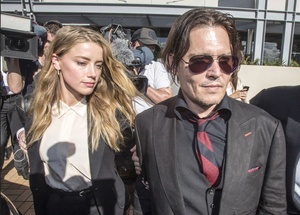
From top: Amber Heard and Johnny Depp; Anne Marie McNally

Anne Marie McNally writes:

No way, it can’t be true, sure I LOVE him.’ – Me, in a fleeting moment of ridiculous ignorance upon hearing of the Johnny Depp abuse claims.

It’s true, I’ve been a fan of Johnny for as long as I can recall and apart from his obvious charms, there’s all the lovely fuzzy stories of him in full Jack Sparrow costume visiting children’s hospitals and bringing joy to smiling little faces, there’s the lovable rogue element to him but a wife beater, not in a million years surely?

Without casting any aspersions on either Mr Depp or Ms Heard in this particular case, it got me thinking about our attitudes, in general, to such allegations.

How could a good looking, intelligent, articulate, lovable man do something so heinous? Shouldn’t they be huddled figures with gnarly noses, sleeveless vests with beer and sweat stains and a general air of menace about them? But if they were, who would ever fall in love with them?

My initial, albeit momentary, reaction surprised me. How dare I make a judgement so quickly on a woman’s allegations just because I had a particular image in my head of her alleged abuser.

SAFE Ireland, an organisation that helps women and children in dangerous domestic situations, have previously called for a large scale study into domestic violence and its type and severity.

But in a survey with 40 women who had interacted with the criminal justice system on issues of domestic abuse over one third of them reported suffering either physical, emotional or psychological abuse on a daily basis while over half reported a serious threat to their lives.

Were they all partnered up with Vlad the Impaler or was it Joe that you have a pint with on a Friday or Paul who you get a lift to work with – you know, guys as respectable as Johnny Depp appears to be? You know the answer to that and it’s as scary as is it unpalatable.

Now let me say, to be clear, I’m very aware that domestic violence is not a women’s only issue and we are increasingly seeing men presenting to services as victims of domestic abuse but by a country mile female victims outnumber them.

SAFE Ireland estimates that on average 4000 women and children a year spend time in the extremely limited (and under-resources) refuges for victims of domestic violence. 4000!

And they’re just the ones who find the capacity to make a break for it and seek help. How many others are physically, emotionally and indeed financially trapped in a violent home life?

Women’s Aid, another organisation engaging with victims of domestic abuse, saw its funding cut by 31% during the recession and it has yet to be reinstated.

Despite that cut, the organisation managed to establish a 24/7 helpline and in the first month of operation the demand for the ‘out of hours’ service surpassed expectations by 283%.

There also currently exists a loophole in our laws which means that women in ‘dating relationships’ are not protected by the Domestic Violence Act.

Many victims presenting to organisations have never lived with their partner and are therefore not protected under the Act.

We’re also now firmly in the digital age and online interactions have become a significant part of any relationship yet there is no legislation to address cyber-stalking for example.

The laws are inadequate for the protection of people who are victimised in this way but the criminal justice system has more serious issues than that in this regard.

A couple of months ago I had cause to ring the Guards in the early hours when a horrifically violent scene played out in a house I was overlooking. I could not only hear, but see, the assault being inflicted on this woman. I rang 999 and desperately pleaded with them to come immediately.

The dispatcher calmly asked me was it ‘an assault or a domestic?’ I retorted ‘is there a difference?’ and she told me yes, yes there was. An assault would illicit a faster response time.

Seriously. (I like to think she told me that in a female solidarity kind of eye-roll way but either way the truth of that was horrific.) ‘Well then put it in as a serious assault and get someone here immediately’ I told her.

She did and they arrived very soon after to be fair but not in time to stop the woman requiring removal in an ambulance.

There are myriad nuances to be worked out but work them out we must because domestic violence is a real issue that’s not going away and as a society we have to be prepared to confront it and address it head on.

So it is conflated with other serious crimes against the person rather than considering it somehow ‘less than’ because it was between a couple or ‘behind closed doors.’

And that stands whether it’s Johnny gorgeous lovely fuzzy Depp or Tommy sweaty beer guzzling wifebeater down the road.

Anne Marie McNally is a founding member of the Social Democrats. Follow Anne Marie on Twitter: @amomcnally

Top pic: PA Wire

artgroup
anne-marie-291x300

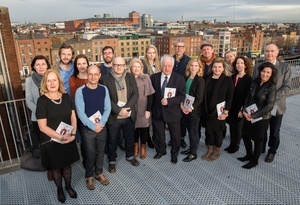
From top: Directors, actors, producers at the launch of the Bord Scannán Na hÉireann/Irish Film Board (IFB) 2016 Production Catalogue; Anne Marie McNally

Take a bow.

Ireland is bottom of the European league for Investment in Culture and the Arts.

Anne Marie McNally writes:

It’s us. We sing, we dance, we make music, we count some of the greatest literary giants among our current and past heritage and we have stage & screen actors who are the envy of the world. That’s before we talk about directors, producers, casts, crews, and a whole plethora of people involved in creating and fostering the arts in this country.

Each one equally important & the need for us to support and nourish these talents is surely a no-brainer. You would think wouldn’t you? You’d be wrong.

Last Week Enda unveiled his latest instalment in the long-running saga ‘distorted democracy’ by announcing his 18 -count ’em-18 Junior Ministers.

A Government with just 59 seats now has 33 ministerial posts. But try as you might, you cannot find a Minister with responsibility for Arts among that 33.

From Government ranks there are shouts about the millions that have been pumped into the Arts recently. What they’re not clarifying is that the vast majority of that funding was specifically for State commemoration events related to the 1916 anniversary. It was not sustainable targeted investment in the arts.

We are bottom of the European League for Government Investment in Culture and the Arts. According to the National Campaign for the Arts , data from the Council of Europe shows that in 2012 Ireland spent just 0.11% of GDP on the Arts and Culture, compared to a European average of 0.6% of GDP.

It’s hasn’t gotten any better, in any form of real sense, since 2012.

The Arts directly employ approximately 21,000 people and that doesn’t count the many volunteers or unemployed artists across the country striving away at their passion and trying to bring joy into people’s lives through a kaleidoscope of creative endeavours.

During the recent 1916 commemorations the outpouring of pride and sheer awe that followed the hour long celebration of our culture on RTÉ, ‘Centenary’, was indicative of how important our creative side is to us.

Twitter went into overdrive and every demographic roundly commended the project as stunning. It was followed closely by Laochra in Croke park. A similar spectacle that showcased the strength of our music, dance, and theatrical efforts.

It’s just such a pity that the State’s interest was fleeting and only preoccupied with this specific window of time. Imagine if the same effort and funding was directed towards the Arts in a consistent and sustainable fashion?

Imagine the talent that would be nurtured and fostered and how the strength of our artistic output could continue to wow both the domestic and the international crowds.

The Campaign for the Arts estimates that for every €1 invested by the Arts Council, more than €0.70 returns directly to the exchequer in taxes.

For a net cost of €0.30, Arts Council investment generates €2.50 in turnover, more than an 8-fold return on investment. Any decent financial brain would see the merits in those returns.

But the economics of this, while hugely important, should not be the sole driving factor.

We are talking about the very fabric of our society-the je n’sais quoi that makes diaspora around the globe feel connected to home, makes third and fourth generation emigrants identify with Ireland and makes us here at home proud of our immense talents and our cultural identity.

Those artists who create this magic are not an infinite resource, they are most assuredly finite and if Government policy continues to disrespect and undermine the arts then we will watch helplessly as our vibrant artistic community withers away and our reputation for world class artistry goes with it.

Anne Marie McNally is a founding member of the Social Democrats. Follow Anne Marie on Twitter: @amomcnally

tonyo'brien

anne-marie-291x300

From top: Tony O’Brien, chief executive of the HSE; Anne Marie McNally

Do we want to live in a country where our wellbeing is determined by our bank balance?

Ann Marie McNally writes:

A conversation over a few pints on Saturday night went something along the lines of ‘I went the doctor last week and she sent me straight to the hospital with a letter for an urgent appointment…three days later I got a letter for an appointment in the middle of July’.

The person, my own demographic, was horrified to learn that I didn’t have private health insurance.

I don’t, I cancelled it about three years ago when, despite paying around €1800 a year, it still cost me a fortune to be treated for a broken leg in the swift clinic of which I was only entitled to claim €300 back.

The economics of it didn’t make sense to me so I cancelled. I figured, hey I get an MOT every year, I’m doing good and surely I’d be better of saving a few bob for an emergency medical fund in case it’s ever needed. Seemed rational at the time.

Fast forward three years and the visit to the doctors which resulted in the information that I was to make my way to the hospital post haste.

The Doctor (whom I’d paid €70 to see) asked me the insurance question. No, says I, but I’d be prepared to pay for the required procedure privately.

She nodded understandingly but said;

‘Can I advise that unless you have approximately €10,000 you’re prepared to spend on this then I don’t recommend you go the private route. The initial consultation may be fine but if there are further interventions and a possible hospital stay involved then the costs will rapidly mount.’

Needless to say, I was shocked and promptly reassured her I’d stick with the public system!

I trotted off to the hospital and 3 days later when I got the letter advising me of the mid-July appointment, I was pleasantly surprised. That’s not bad at all I thought, 2.5 months, that’s a hell of a lot better than I’d expected.

It was only in conversations with friends the following day that I realised my expectations were ridiculously low.

A significant health concern, a doctor’s letter with urgent written all over it and my expectation was for an appointment longer than 2.5 months into the future! Is that how conditioned to poor public services I had become?

In the meantime, had I the financial wherewithal to stump up the money that it would have cost (still an undetermined amount), I’d have been seen to that week and any potentially dangerous issues dealt with or peace of mind restored with an all-clear.

My health, and potentially my life, was to be determined by how much money was in my bank account. In a civilised democratic society my health was suddenly less important than the person who had more money than me. T

hat’s ultimately what it boils down to…your wellbeing is determined by your bank balance.

How civilised is that?

Last week a Motion the Social Democrats put forward was signed by 89 TDs. A majority of the Dáil and a mixture of deputies from across the party and independent spectrum. Soon after, the newly appointed Minister for Health intimated on national media that he supported something similar.

That Motion was a call for the establishment of a Cross-Party Forum on Health with a view to achieving a single tier universally accessible healthcare system.

A system where medical need rather than bank balance would determine your healthcare treatment. A civilised system.

In Post World War 2 Britain the Tories and Labour came together and agreed on the need for such a system.

They put their differences aside and they made it happen, for the good of the nation. It’s time our politicians took a similarly mature approach to this most fundamental of issues.

Anne Marie McNally is a founding member of the Social Democrats. Follow Anne Marie on Twitter: @amomcnally

90417295

anne-marie-291x300

From top: Micheál Martin at Leinster House last week; Anne Marie McNally

Fianna Fáil’s confidence agreement with Fine Gael leaves us with an opposition party on the fence.

Anne Marie McNally writes:

The white smoke has billowed. Just 70 days since the country went to the polls we have a Government – or something resembling one anyway.

It wasn’t without it’s drama and Frank Underwood would probably blanch at the deals that were likely done by Michael Noonan in the 12th hour as Independents wavered on the brink of acquiescence.

The juicy prize was wagging in front of them but in their peripheral vision they could see angry constituents asking them to uphold their pre-election promises.

In the end the spectre of the prize won out for the majority of them and Enda’s wife relaxed in the Dáil gallery safe in the knowledge that her trip to the Dáil to witness the coronation was not to be in vain. For those political anoraks amongt us it was akin to a really gripping episode of House of Cards.

And what a house of cards it has delivered; a situation where the ‘main’ opposition party has a supply and confidence agreement with the main Government party. It’s kind of hard to oppose stuff when you’re tied into expressing confidence in it.

That said, I welcome the new form of politics that this Dáil will inevitably require however I think a signed agreement to supply confidence goes a step further than simply acting constructively in opposition.

It’s one thing to be a practical opposition party or independent that will consider each issue on its merits and vote accordingly (opposition should not mean NO to something just because it originates from the Government side) but it is an entirely different thing to have a signed agreement forcing you to support a No Confidence Motion in a Minister about whom any kind of dodgy revelations or evidence of poor decisions might surface.

It’s going to be a really difficult fence for Fianna Fáil to sit on and their arses will be tormented with splinters by the time the fence topples. While they sit on that fence Sinn Féin will continue to lob dung balls at them as apparent supporters of Government and some of that dung will stick.

To counteract this, Fianna Fáil will feel the need to assert their opposition credentials by creating the odd convenient row with Fine Gael but nothing that’s going to be too controversial or threatens to bring the cosy arrangement to the ground – at least not before the opinion polls suggest it might be in their interest to do so!

I love an auld opinion poll, it comes with the territory of being one of those nerds but watch now as suddenly opinion polls become a main conversation point in the local boozer on a Saturday night.

Plenty of ‘Jaysus, Fianna Fáil are hitting 33% and Enda’s only on 26%, I’d say they’ll pull the plug soon’ dramas will ensue and in the midst of yourself and myself looking at them, behind the scenes the strategists of both Fianna Fáil and Fine Gael will be glued to them.

To say that they won’t impact on longevity of Government decisions is wholly unrealistic. Of course they will and it’d actually be irresponsible if they didn’t.

There’ll also be key flashpoints throughout the next few months not least the leadership issue within Fine Gael. While the general wisdom on the surface suggests that there is no grá for a bitter leadership battle and the door will be edged open to allow Enda to exit stage left gracefully, in reality once the knives start circling they tend to become sharp very quick.

The same general wisdom suggests that Leo Varadkar is the front-runner by a country mile to take the reins. Should that be the case, I reckon you’ll see Fianna Fáil’s supply of confidence go south very quick as Leo sharpens his teeth on their neck!

All this before even getting to Michael Lowry’s agreement with Fine Gael –  but that’s a whole other days work right there.

There are interesting times ahead, no doubt, but let’s hope those interesting times don’t result in painful times for citizens.

Anne Marie McNally is a founding member of the Social Democrats. Follow Anne Marie on Twitter: @amomcnally

90409480

anne-marie-291x300

From top: Soc Dems Stephen Donnelly and Glenna Lynch (with Isobel and Rory Baillie) launching the party’s ‘Cherishing Children Equally’ initiative at Fitzwilliam nursery and montessori school in February; Anne Marie McNally

All the international evidence points to the benefits for both society and the individual of having an early-years system where the development of the child is prioritised but also where the mother is empowered to be the best version of herself she chooses to be.

Anne Marie McNally writes:

Last Week’s CSO report declaring Ireland as a ‘pricey young and fertile nation’ highlighted the fact that we now have the 3rd most expensive cost of living in the EU with the second highest fertility rates!

Now this presents quite the conundrum because one of the key factors in the increased cost of living is the astronomical costs of childcare in this country. Not much point being fertile, eh, if you can’t afford to have children while maintaining the option to have some form of life outside the home. (Note I said ‘option.)

I recently asked women in my social and professional circle what was the biggest issue they felt facing them today in a broad societal context. All gave varying expressions of the one topic – equality.

Some expressed it as a desire for more maternity care acceptance in the workplace, some expressed it as a desire for recognition of their professional goals, and others spoke about wanting to be better able to balance work/life demands – all different aspects of the same topic.

Affordable and accessible childcare is one the most fundamental factors in ensuring gender equality in the workplace and wider society yet we have one of the most underdeveloped childcare systems in the world with many families paying the equivalent of a second mortgage for factory-style childcare.

All the international evidence points to the benefits for both society and the individual of having an early-years system where the development of the child is prioritised but also where the mother is empowered to be the best version of herself she chooses to be – either as a stay at home parent or in the workplace.

Choice is the key factor here.

If the glass ceiling is broken, and some would argue that it isn’t- (I personally would say that it is at least cracked) – but if it is, it was broken for that very reason – that women could choose their own paths in life, whatever that path may be.

Thankfully, more and more we are seeing co-responsibility relationships. We are beginning to lose the culture of man as breadwinner, woman as carer. It is an evolving process and here in Ireland we are not very far along the path.

Remember, it’s really not all that long ago that Irish women were forced, by law, to give up their job in the civil service as soon as they married! That type of legacy is a hard one to deviate from, but we are, and as each generation reaches maturity we get a step further away from that draconian past of ours.

Women have to have the self-belief that they can do it. They can go toe to toe with the guys and perform equally. We have to believe that because it is true. We have to – and when I say we, I mean men too – we have to teach our daughters that they can do anything they wish – we have to lose the ‘that’s a boy’ thing and ‘that’s a girl thing’.

Empowerment is not some idealistic notion, empowerment is telling yourself and your children every day that if you want it and you work for it then you can achieve it – regardless of your gender.

We have to move away from the notion that feminism is some female-only issue that requires women to stand on the proverbial soapbox to have our voices heard.

Instead we have to view feminism as men and women equally embracing the notion of equality – an equality where gender is irrelevant.

But for these ideals to be realised society has to provide the basics that not only encourage such gender equality but which facilitate it to be so and childcare is one of the most effective and important ways in which to do that.

Anne Marie McNally is a founding member of the Social Democrats. Follow Anne Marie on Twitter: @amomcnally

Rollingnews

latelate

anne-marie-291x300


From top: Ryan Tubridy, Oliver Callan, Dearbhail McDonald and Richard Corrigan on last Friday’s Late Late Show; Abbe Marie McNally; Anne Marie McNally

It took a mimic to express what many are still afraid to say.

Anne Marie McNally writes:

It’s a thankfully rare occasion that I’d be sitting watching The Late Late Show on a Friday night and last week was no exception.

I never thought I’d find myself in the position of getting home late on a Friday night only to discover, courtesy of Twitter, that I’ve missed an actual useful, real and impartial public affairs analysis on, of all things, The Late Late Show.

Fast forward a couple of hours and a surprisingly fresh Amo awakes to find that those lovely Twitter people – as they are wont to do-have clipped the relevant segment and its rapidly going viral.

And why wouldn’t it?

Finally someone had found the courage to say what almost every concerned citizen is thinking, and not only did he say it but he persisted in saying it even when The Fear almost propelled Ryan Turbidy across the desk to try and stop him saying it.

They say the best comedy is that which cuts closest to the bone and nobody can argue that Oliver Callan is ever far from the bone however his comments on Friday night were, unfortunately, not comedy but genuine and honest analysis of a situation where the nexus between big business and politics has infiltrated Irish public life to the point that not only is the media which is directly owned by the omnipotent Denis O’Brien potentially conflicted, but the media outside his ownership is so terrified of his penchant for litigation that it too finds itself stymied.

The result, Mr Callan surmised (correctly in my opinion) is that the average citizen has a less than detailed understanding of just how toxic and sullied some of our public representatives and aspects of political and business life are in Ireland today.

Mr Callan pointed to the fact that the people of Tipperary continue to elect Michael Lowry despite the findings of the Moriarty report. Is this because they don’t know or worse still because they don’t care, he asked.

He then made the very valid point that our Taoiseach, despite rousing speeches in the Chamber calling for action on the findings of Moriarty, allowed himself to share public stages throughout the past 5 years with Mr Denis O’Brien, a person about whom the Moriarty Tribunal made serious adverse findings.

Later today the Dáil will finally get to debate a motion on Irish Water. The wording of the Motion has yet to be agreed but it’s likely to contain something representing a compromise/fudge from both Fianna Fáil and Fine Gael.

There has been a bit of discourse in recent days about how, for many people, water charges are not that big of a deal.

While that may well be true, the reality of the situation is that Irish Water has become a very tangible representation of the golden circle and cronyism so rife in public life.

It can’t be far from many people’s minds just how connected the dots are if you draw a line between Esat, Moriarty, Lowry, O’Brien, Siteserv, Hogan, Enda and Irish Water. It’s like a paint by numbers exercise but the picture it paints sure ain’t pretty.

The vast majority of people I meet are suspicious that Fine Gael’s (& Labour’s) entrenchment on the water issue is due to certain future commitments or guarantees it may have provided to vested interests regarding the privatisation of water services.

That may or may not be the case but the fact remains that people’s trust has been so badly abused they now have a sense of unease about most actions of establishment politicians.

When you watch footage of Enda standing on international stages cosying up to Denis O’Brien after Moriarty has made his findings you cannot be blamed for wondering what the hell is going on?

When you know that Phil Hogan has a relationship with O’Brien dating back decades including a time when Hogan successfully sought donations from O’Brien for a FG campaign he was running and that this is the same Hogan who presided over the chaotic establishment of Irish Water, your nose twitches.

When you know that Michael Noonan led the Department which ‘missed’ the ‘unsatisfactory’ sale of Siteserv to O’Brien just before it went onto win 4 of the Irish Water metering contracts, you surely find yourself sniffing something rotten?

Unless you believe that all those interconnections are the most mutually beneficial episode of Blind Date ever, you’d hardly be wrong in thinking Oliver Callan hit the nail on the head the other night.

Just don’t wait for the media O’Brien owns to tell you that nor the other 50% of the media who are afraid of his over zealous legal eagles.

Anne Marie McNally is a founding member of the Social Democrats. Follow Anne Marie on Twitter: @amomcnally

90415723anne-marie-291x300

From top: Fianna Fáil TDs Barry Cowan and Jim O’Callaghan at Trinity College Dublin yesterday for talks with Fine Gael; Anne Marie McNally

You don’t abandon your political philosophy and direction in order to facilitate the establishment of a Government whose philosophy is entirely at odds with yours.

Anne Marie McNally writes:

Antagonism, confrontation, scepticism, Devil’s advocate; call it what you may, it is the song of the Irish political commentariat when it comes to dealing with politicians trying to articulate a position.

Whether you agree with the position or not is irrelevant – you should still be afforded the opportunity to listen to it and make an assessment based on the argument and not the opinion of the presenting broadcaster of the hour.

As someone involved in communications and messaging it can often be difficult to find a way of articulating a position in a way that will survive the inevitable mainstream media cynicism and its tendency to lean in favour of the safe and comfortable establishment of which it is undoubtedly a part.

You know if you met Joe or Josephine Soap on the street and explained your position they’d understand – they may not agree – but they’d understand it whereas by the time the media has parsed your message there are so many grey areas you could be the next E.L.James.

Op-Eds (Opinion pieces) can be useful in this regard but are notoriously difficult to have placed and certainly not available to you on any type of regular basis.

Right now we’re at the epicentre of the phenomenon. Political correspondents and broadcasters are frothing at the mouth to update you on what’s happening in ‘Government formation’ talks.

Lines are spinning from inside and outside political camps and nobody is sure from one minute to the next who is prepared to deal with who and if ‘being out of talks’ really means what it says and vice versa.

This confusion is entirely understandable, we’re now on day 54 of formation talks and with the Lannigan’s Ball shenanigans ongoing for so long who wouldn’t be confused.

My own party, the Social Democrats, sought to avoid such confusion by laying out a very clear position from day one – the arithmetic returned by the electorate means that no matter how much we dislike it, the only option for Government is based on agreement between Fine Gael and Fianna Fáil.

That was true on day one an it’s still true on day 54.

We took a decision not to delay the inevitable talks between the two so we refused to allow the parties to engage us in some shadow-boxing designed to convince the public they were ‘trying their best’ and were at least prepared to engage – yet for 40 of the 54 days neither FG or FF were prepared to engage with the only party they needed to engage with.

Everything that happened in between with Independents and other parties was simply a distraction that has served to delay the process. We didn’t want any part of that. We continue to take a very straightforward position despite the baying of the ‘step up and be responsible’ mob.

We have stated very clearly we will NOT be participating in Government however we will work constructively, with all parties, in a newly reformed Dáil in order to elicit the best outcomes for Irish society.

In a Minority Government scenario the opposition will be equally, if not more, powerful than the Government benches and as a result the Dáil will have to drop the Punch and Judy style politics and judge issues based on their merits rather than their proposers. That benefits everybody.

To my mind political responsibility is about standing for something you believe in, it is not about abandoning your political philosophy and direction in order to facilitate the establishment of a Government whose philosophy is entirely at odds with yours and whose direction for the country is one you actively campaigned against.

To do so would not be responsible it would be downright selling out. You know that old cliché ‘if you don’t stand for something you’ll fall for anything?

A Government for the sake of a Government and with every and any direction is not one worth having and I for one am not willing to fall for anything.

Anne Marie McNally is a founding member of the Social Democrats. Follow Anne Marie on Twitter: @amomcnally

Rollingnews