Tag Archives: Catherine Murphy

Screen Shot 2016-01-04 at 13.09.21

Anne-Marie McNally, of the Social Democrats, writes:

“This is a come-along event, no tickets required, all welcome on the evening. We’ll be talking about how we can and should do things differently – how do we make politics serve the people rather than the golden circle of the same faces and names that keep cropping up; and how do we develop and implement proper transparency with real accountability in a way that allows people to trust the system? I’ll open up, Catherine Murphy will speak, followed by Fintan O’Toole, then I’ll close.”

Previously: Someday My Prints Will Come

Policy Night

Screen Shot 2015-11-24 at 17.03.28Screen Shot 2015-11-24 at 16.58.12

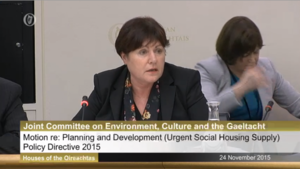
Labour TD Ann Phelan and Social Democrat TD Catherine Murphy in a Joint Committee on Environment, Culture and Gaeltacht yesterday

You may recall a post from yesterday in relation to the construction work which has begun on the  22 modular homes being built by Western Building Systems in Ballymun, Dublin 11.

Dublin City Council awarded the contract to Western Building Systems even though the Department of Education last year ordered for investigations to be carried out at schools built by the firm, after Rush and Lusk Educate Together National School in Dublin – which was built by Western Building Systems – was found to have major fire safety defects.

This morning, Jennifer Bray, in the Irish Daily Mail [not online] reports that the average cost of building a home under the social housing scheme is €11,000 less than the €191,000 cost of each modular unit.

Further to this, yesterday Labour TD Ann Phelan fielded questions from Social Democrat TD Catherine Murphy about the modular units at a meeting of the Joint Committee on Environment, Culture and Gaeltacht.

Their discussion came after Ms Phelan introduced a policy directive, to remind the four Dublin planning authorities to utilise all powers available to them to find solutions to the social housing situation.

Specifically, Ms Murphy repeatedly asked Ms Phelan to outline what additional powers the policy directive will give the local authorities.

Ms Murphy had already left the meeting when Ms Phelan finally addressed the question of additional powers but Ms Phelan told the meeting that the new directive will allow the chief executives of the four Dublin local authorities to “dispense with the normal Part 8 planning process” in any situation they deem to be an emergency.

From the meeting…

Ann Phelan: “It is intended to have the first 150 of the units delivered in the Dublin City Council area with the city council expecting the delivery of an initial 22 units by December, a further 128 units to follow in quarter one of 2016 to a fast track procurement process and 350 units across the Dublin region by mid-2016. This compares with a timeframe of up to two years to provide conventional social housing units. In light of this, and to support the use of the fastest planning process, in order for the modular units to be in place as quickly as possible, [Environment] Minister [Alan] Kelly has indicated his intention to issue a policy directive, under Section 29 of the Planning and Development Act 2000, as amended, addressed to the four Dublin planning authorities. A draft policy directive has been prepared in this regard and, as required, has been laid before both houses of the Oireachtas. The purpose of the draft policy directive is to remind those planning authorities of the statutory provisions of Section 179 of the Planning and Development Act 2000, as amended, and the related part 8 provisions in the planning and development regulations 201, 2001 as amended.

These provisions set out the procedure for local authority-owned development, such as the provision of new housing developments. In the context of the starting of these functions and, in particular, the need to provide urgent social housing to meet the needs of homeless families, the draft policy directive directs these planning authorities to utilise all powers available to them under Section 179 as appropriate, for the purpose of finding solutions to the social housing situation, presently faced and accelerating the delivery of social housing developments, to address the urgent and increasing need for social housing accommodation in the Dublin region. Subject to Oireachtas approval, this policy directive will issue to the Dublin planning authorities, under Section 29 of the Planning and Development Act 2000, as amended, and the four planning authorities will be bound to comply with the directive. The legislative basis for a policy directive underpins and strengthens any policy direction the minister may wish to issue. The issue of a policy directive in the context of the delivery of social housing will underscore the importance of the expeditious delivery of this programme of modular housing as approved by the Government. It is essential that this programme is expeditiously implemented. From a planning perspective, this draft policy directive is aimed at doing just that…”

Catherine Murphy: “I doubt that there’s anything actually in this that the local authorities are not familiar with. I mean we are all aware of Part 8s and the other part, maybe you might tell us what additional powers are in this that the local authorities wouldn’t be already familiar with. And in fact I would say that there’s, it’s probably, if they’d known that they had to plan for this a year ago, you know, you wouldn’t be, you wouldn’t be talking about, reminding them of their powers…The modular housing, I’ve got to say, I have grave concerns about the modular housing because it’s, it’s not cheap. It’s somewhere in the region of €190,000 a unit, if I’m right. It has a lifespan of 60 years. So it’s not a temporary solution. So we are putting something very permanent in place and planning should be something that looks at a variety of different things, including the provision of housing, including how that relates to the other services that should be available including the cohesiveness of the community that’s going to be developed.

And I have got to say that we’re in an emergency situation and that forces sometimes a less than optimum response. I think if we go back to the 1960s and we look at the high-rise that was Ballymun, in retrospect, it wasn’t a great idea. We’re back in a crisis situation again here now and I think it’s important that the department outline how they perceive these houses will be a short-term measure for people rather than just saying they’re short-term. And what length of time people are going to be in them? I mean modular housing or system-built housing is used in other parts of the world and it’s perfectly good when it’s in the right location and when it’s of a good standard. But it’s the other things that go with that I’ve got to say that I’ve got concerns, I’ve got some concerns about. For example, if it had a dual function, we’ve 25,000 students for example, accommodated around the country and if, for example, you had a housing that doubled as for the second part of its function, if it was to be, for example, student accommodation, you may place it in a different location, you may get a different type of accommodation, if that was the case. But I think that is really important, that we don’t end up with identifiable ghettos. And I think that that’s critical.”

Phelan: “…We have to respond to the homelessness situation and we have to remind planning authorities of the statutory provisions of section 179 of the Planning and Development Acts that are 2015. Part 8 of the planning and regulations 2001 to 2015 in relation to local authorities own development and direct those planning authorities to use and utilise all powers available to them under the above provisions, as appropriate for the purpose of finding solutions to the housing situation and accelerating the delivery of social housing developments to address the increasing social housing need in the region.

And these are those modular homes, you know, they can be delivered quickly and they are suitable, you know, for families. I understand why, I do understand you know, what you’re saying, I do understand that your concerns but this is a response, an immediate response to try and do something about the situation that everybody. This actually, this directive should be welcomed, I think by the deputies themselves. That this is the Government trying to do something to alleviate what is a really bad situation, particularly in the Dublin area. You know, even if we were to take it into our own lives, I don’t think any of us would particularly like trying to house ourselves with families in hotels. So the modular housing is perhaps I suppose you could say, on the issue of, some of them are up to an extremely high standard as Deputy Murphy has said herself and it is used quite a bit, even for elderly, particularly across Wales and across Britain. But there is nobody saying that this is a long-term solution to these families. This is a short-term solution.

Modular, on the longevity of modular housing, they have a lifespan of 50 to 60 years, so you know it’s not that anybody is saying that these are permanent houses for these people. This is the Government responding to the situation that is going to arise at Christmas again this year, where we will have those awful stories of people who are homeless, you know, on our streets, and this is the Government responding to that. I think in a very, very quick way. Twenty two units in Ballymun, going to be delivered, you know, very, very soon. They will house 22 families. Dublin City Council awarded the contract last Friday. The units are to be ready for the 21st of December. Again, I think this is to be welcomed.”

Murphy: “Just to come back on some of those points… You didn’t tell me what additional powers are in this, over and above what that the local authorities wouldn’t have been readily, they wouldn’t have readily available to them. I think there’s an element of blame game going on in relation to the local authorities not delivering and the department appearing to crack the whip it looks like to me. You didn’t tell me how the modular housing is going to have a limited lifespan for the individuals who will go into them, that it won’t be permanent housing for them…”

Phelan: “The issue of the short-term to long-term issue, the families will be moved from modular housing to normal social housing as soon as possible and there will be an on-site family placement service to deal with this. So it will be modular to social housing. The whole issue of, you know, sustainable communities is a key aim in planning and development considerations, so nobody wants to see them turn into ghettos as Deputy Murphy referred to. This is a emergency response to an emergency situation which is homeless people… Deputy Murphy has left, she was asking about the extra powers that were being given to the local authorities. This directive, what we’re speaking about, this actually goes beyond Part 8. Their powers, under Section 179, 6B of the Act, under which a local authority chief executive can dispense with the normal Part 8 planning process for the local authorities owned development where a proposed development is necessary for dealing urgently with any situation which the chief executive considers is an emergency situation calling for immediate action. So it actually goes beyond the council’s own planning process where the chief executive considers that a situation is an emergency situation that needs to be called for immediate action. He can actually take that decision. So that goes beyond, they are the extra powers that Deputy Murphy is speaking about.”

VIDEO: Modular homes to be built in Dublin by firetrap school firm (Elaine Loughlin, Irish Examiner)


denis

Denis O’Brien

Further to the the Denis O’Brien Vs Committee on Procedures and Privileges (CPP) brouhaha..

This morning’s  Irish Times editorial states:

“Is the CPP amenable to judicial review without fatally undermining the constitutional independence of the Dáil? From a political perspective, the crucial principle of the separation of powers between legislators and the judiciary means that the committee should be answerable only to the Houses. The answer must be an emphatic No.”

“That is also the clear purpose of the writers of the Constitution. Any other interpretation, however tempting to judges instinctively distrustful of the imperfection of political decision-making, will set the judiciary on a course of confrontation with parliament that it will rue, irrespective of the merits of Mr O’Brien’s cause. His case is ill-judged and dangerous, a regrettable move by a wealthy serial litigator. He should withdraw it.”

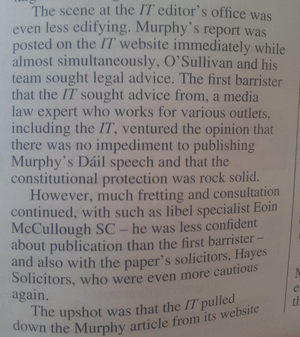
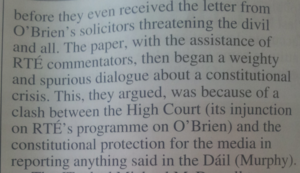
Readers may wish to recall the June 5 edition of The Phoenix, in which there was a report on how Ireland’s print media reacted to Independent TD Catherine Murphy’s speech in the Dáil on May 28, 2015…

Screen Shot 2015-08-05 at 09.29.15

Screen Shot 2015-08-05 at 09.28.14

Good times.

Previously: [REDACTED]’s 1.25% Interest Rate

You’ve Been Framed

unnamed

TDs Stephen Donnelly, Róisín Shortall and Catherine Murphy

Anne-Marie McNally writes:

TDs Catherine Murphy, Róisín Shortall, and Stephen Donnelly have agreed to launch an exciting new political venture. Speaking today the three TDs confirmed they have been engaged in ongoing discussions for some time. An event will take place on Wednesday to outline further details.

In a joint statement the three TDs said: “We are excited to be working together to offer a new credible political choice to the Irish electorate.” No further comment will be made until the event on Wednesday.

There you go now.

90377686

Independent TD for Kildare North Catherine Murphy

On May 26, the Committee on Environment, Culture and the Gaeltacht: Select Sub-Committee on the Environment, Community and Local Government met to discuss the Environment (Miscellaneous Provisions) Bill 2014.

During the meeting, junior environment minister Ann Phelan told the committee:

“I want to point out to the committee that while the Government is not presenting any amendments to the Bill at this stage in the process, it intends to propose a number of amendments on Report Stage in the Dáil. This will require a motion to be tabled to amend the Long Title and scope of the Bill. These amendments will cover a range of issues, including further amendments to waste legislation and provisions relating to water services legislation. While I am not in a position to go into more detail about the amendments at this stage, they will be published in good time ahead of Report Stage so that Deputies will have time to consider them in advance of the debate on the floor of the House.”

In response, Independent TD Catherine Murphy told the meeting:

“I have to tell the Minister of State that I do not like stuff coming to us on Report Stage. I know it can happen when things are worked on late in the day. It is nice to see the totality of what we are doing on Second Stage. The Minister of State has said that a motion will come before us. What is the nature of that motion? Will it be debated in the Dáil? If so, will that debate precede the Report Stage debate?”

“I am aware that a certain system applies if a quite substantial change is being made to legislation. I remember that a legal services Bill introduced by a former Minister, Michael McDowell, had increased in size by two thirds by the time it got to Report Stage. The Minister of State might tell us about the nature of the changes she is proposing in this regard, with specific reference to the nature of the motion that will come before the Dáil.”

Ms Phelan went on to insist that the deputies would “have plenty of time” to look at the amendments…twice.

Further to this, Ms Murphy said this morning:

“The deadline for amendments to be submitted is 11am this morning and a debate on these issues will happen in the Dáil next week – with late sittings likely. We have now had it confirmed that opposition will not get sight of the amendments that Government are submitting before the deadline passes. In effect, this ensures that opposition are denied the chance to table their own amendments to the Government proposals because we don’t know what they are. The deadline for submitting our amendments will have passed yet we don’t know what we are supposed to be amending. In what way is that proper democratic functioning of Parliament?”

Anyone?

Thanks Catherine Murphy

Photocall Ireland

turnout:zapponemurphy:donnelly:shorthall

From top: Senator Jillian Van Turnout; Senator Katherine Zappone.; TDs from left, Catherine Murphy, Stephen Donnelly and Roisin Shorthall

Via Irish Independent:

The three TDs are linking up with Senators Katherine Zappone and Jillian van Turnhout, who are both the Taoiseach’s nominees in the Seanad.The new centre-left party is likely to be set up by the end of the month.
The party will lean heavily on centre-left economic policy, social justice campaigning and political reform.

Finally.

FIGHT!

Also a name anyone?

New party to be headed by Murphy, Donnelly and Shortall (Niall O’Connor, Independent.ie)

catherine

Catherine Murphy in the Dail this evening

During tonight’s debate on the Commission of Investigation into certain IBRC transactions, including the sale of Siteserv to Denis O’Brien…

When I met with the Minister yesterday I highlighted that my main concern would be that the investigation does not end on Prom [Promissory note] night and that it extends into the time when the IBRC was in liquidation.

There are many issues that straddle both time periods and it is vital that the investigation can properly follow these threads.

For example, the purchaser of Siteserv, was already significantly indebted to IBRC. We know that on the 7th of March 2013 – one month post liquidation – that he wrote to the special liquidator seeking to reschedule his outstanding loans over a further 3 year period.

We know that he claims to have been allowed a similar extension by virtue of a verbal agreement he claims he had with the CEO of IBRC (Mike Aynsley).

We also know that, according to IBRC, the credit committee had never approved such a previous agreement yet Mr O’Brien maintains it was in place and he requested that the special liquidator be made to honour that verbal agreement.

I wish the minister to clarify if the assertion of such a verbal agreement will be enough to satisfy the Terms of Reference regarding the ‘contractual obligations’ required in relation to investigating issues that straddle pre & post liquidation.

We know that the credit committee met on the 23rd of May 2013 – two months after Mr O’Brien’s approach to the special liquidator and at that time the outstanding balance owed to IBRC by Mr O’Brien was in the region of €325million.

It is worth, at this point, asking the question as to why someone, so heavily indebted, was allowed to make significant purchases from IBRC rather than being asked to pay down his outstanding loans. Were other bailed-out banks financing this buying exercise? Was he borrowing from Peter to pay Paul?

Interestingly, an article that appeared in the UK edition of the Sunday Times in January 2012 showed that in 2011 & 2012 the IBRC refinanced some of Mr O’Brien’s loans and increased their security stake in some of his investments. It seems illogical that in the same time period they allowed him to purchase Siteserv for example.

The point here is that some of the documents I am referring to relate to the Special Liquidators era hence the need for the period to be covered by the terms of reference.

In recent days, The Chairman of IBRC (Mr Dukes) has made much of the fact that the Central Bank conducted a review, prior to July 2012, and apparently found no problems.

Contradicting that assertion however is a relevant piece from the FOI documents from inside the Department when they said

“We are concerned that the Central Bank report compiled on the transaction vindicates their position. To be clear we are concerned with a number of the decisions taken by the bank in relation to this transaction.”

….Yet It was not until I received an FOI of July 2012 internal Dept memos did we learn that the Department officials were expressing serious concern over the effectiveness of the CEO and the management team and they had serious concerns over the way a number of large transactions, including the Siteserv sale had been handled.

….Another significant issue that raised its head in some of the early reporting of this controversy but has since been replaced by other developments is the share activity in Siteserv prior to its sale.

Various sources of information told me that the Siteserv share activity in November 2011 – the period during which the bidding process was underway – was irregular and that there had been a significant share spike around the time it was sold resulting in a nice windfall for some lucky investors.

Unfortunately it was indicated to me that some of those investors may not have been so much lucky as they were well-informed. Indeed the Chairman of IBRC confirmed in an RTÉ interview that Denis O’Brien for example, had been given advance notice of the sale before it was announced. Did others have similar information?

The unfortunate thing here is that while I know what insider trading is, I don’t yet know how we deal with it here in Ireland. On foot of my information regarding share activity, I wrote to the Irish Stock Exchange who advised me that it was not within their remit and that I should talk to the Central Bank.

I wrote to the Central Bank who told me it was outside of their remit. I then wrote to the Office of the Director of Corporate Enforcement whose reply came back today to tell me that it does not appear to come within the remit of their office.

….In my speech on May 28th I referred to loans held by Mr O’Brien that were due to be repaid in full in 2011 and 2012. We know they were not repaid in that timeframe.

Effectively, once the agreed term expired, those loans were in default and became callable on demand. IBRC’s own terms and conditions allowed them to charge default interest rates yet they chose not to do so in this case.

Many sources have come forward both before and since that speech, to say that they had personal experience of being both performing and non-performing borrowers of IBRC and their experience of their loans being called in, in a ruthless fashion and other defaulting borrowers talk of the punitive interest rates applied to them.

…..The plight of the former Irish Nationwide Mortgage holders and the way in which they have been treated by IBRC compared to the very favourable environment that seems to have been provided to Mr O’Brien for example is perhaps an indication.

Catherine Murphy, Independent TD for Kildare North

Continue reading →

90382652

Catherine Murphy (left) and Ann Marie McNally, communications and policy advisor, at the High Court on Tuesday

How did we get here?

And what have we learned?

Catherine Murphy TD writes:

Recent events seem to have taken on a life of their own but it useful to look back to where it all began.

Back in early 2014 my team and I started looking at the circumstances surrounding the awarding of the controversial water metering contracts and the uncanny way that the same names seemed to pop up at every hands turn.

Crucial to our early research was a piece that Broadsheet.ie had done titled ‘Thicker than Uisce’ and this very detailed timeline led us into many different directions that have culminated in the events of the past few weeks.

I have been to every one of the Irish Water protests, I had six months on Leader’s Questions in the Dáil from June-December 2014 and I raised the water issue on nine of those occasions.

At all times I made the point that the protests and the reaction was about more than just water – it was about something bigger; the sense that things always seem to work in favour of the big guys and never the little guys.

I made a speech in the Chamber on December 4 and again on December 10 where I raised Siteserv and some of the names that have now come into the public domain through the FOI process.

I followed it up with a series of (ongoing) parliamentary questions and FOI requests and it was April 2015 before answers began to emerge – painstakingly slowly.

Roll on to recent events – a situation where significant information from extremely credible sources comes to my attention; information which I firmly believe to be in the public interest.

I believe I have a duty, as an elected representative, to pursue the truth, to get to the bottom of the situation and to ensure that at no stage were the citizens of this country disadvantaged for the benefit of some powerful people.

In pursing that objective I used every parliamentary avenue open to me including taking to my feet on the floor of the Dáil and putting the allegations to the Minister and asking him to let people know the facts.

I never for a second considered that somebody with money and power would somehow influence how my privileged words would be, or not be as was the case, reported in the majority of media outlets across this country.

For anyone to claim that this was never the intention is belied by the letters and emails received by numerous media outlets, including Broadsheet, warning them not to report my speech.

What is really concerning is that most, though thankfully not all, media outlets bowed to the pressure. The fear of deep pockets managed to control almost the entire press corp of the country.

In the age of social media we are lucky that many citizens had the opportunity to access fair reports as is their right, however a large cohort of our citizens still rely on mainstream media and until the Sunday Times took a stand on the Sunday following my Thursday afternoon speech, those citizens were bereft of information from their elected parliament. That cannot be acceptable.

There has been a very valuable lesson in this. We have got to look at how our Fourth Estate operates. Issues such as ownership, editorial v legal considerations and public interest must be evaluated and mainstream media organisations now have to pose some very serious questions to themselves about what is more important; their role in democracy or their fear of upsetting the wrong people?

The parliament and the judiciary for their parts, must now look at our defamation laws and assess whether or not they are fit for purpose. It is not enough to know what went wrong; we must take steps to put it right to ensure we never have a repeat of this debacle.

Catherine Murphy is Independent TD for Kildare North.

Previously: Catherine Murphy on Broadsheet

(Sasko Lazarov/Photocall Ireland)

Screen Shot 2015-06-03 at 21.44.08

Finance Minister Michael Noonan on Six One this evening

Finance Minister Michael Noonan appeared on RTÉ’s Six One this evening to explain why a Commission of Inquiry will be carried out into certain transactions by IBRC.

“What has changed my mind on the process [of a review into IBRC] is that, since then, new allegations have been made. There’s no evidence underpinning any allegations but the allegations are now causing public concern and the review, in my view, is insufficient to deal with the new allegations so I recommended that the Government do a full Commission of Investigation which would report but the end of the year…”

“A new set of allegations emerged, surrounding the speech made by Deputy Catherine Murphy in the Dáil and that, together with the fact that there were cases before the courts about the publication of Deputy Murphy’s speech heightened public concern and I believe, at this stage, it’s in the public interest to put the matter in the hands of a judge who, under the powers of the 2004 Act will examine everything, including the original allegations which gave rise to the review by the liquidators and  taking into account the new allegations as well…”

“There may be wrongdoing but, if there is, there’s no evidence of it in any set of allegations. And all we have is a series of allegations but there’s public disquiet, it’s increasing, it’s in the public interest to have these matters fully investigated. We can’t have a belief going around that there was actions that were improper and that, in some way or another, the taxpayer lost out…”

When pressed by host Brian Dobson about the drip feed of information, following the way in which he answered questions put to him in the Dáil by Catherine Murphy – she asked 19 parliamentary questions before she got a comprehensive reply – Mr Noonan said:

“I answered questions, absolutely fully in the way questions are answered in the Dáil. There were full answers made but, obviously, if you go for Freedom of Information and look for a full file, you’ll get background information as well. But there’s a methodology in the Dáil, if somebody feels the answers they got are inadequate. They can refer it to the Ceann Comhairle and adjudicate. Now the questions were adequately answered and of course there’s a drip feed of information – there’s thousands of documents, thousands of pages of documents in IBRC and thousands in the Department of Finance… You don’t produce full files when one specific question is asked”

Mr Noonan’s department has also released a four-page document containing the draft terms of the inquiry.

From the draft:

Screen Shot 2015-06-03 at 22.03.05

Screen Shot 2015-06-03 at 22.04.16

Meanwhile…Philip Ryan in the Irish Independent reported tonight:

“The Department of Finance has discovered a tranche of board meeting minutes from the Irish Bank Resolution Company (IBRC) which Finance Minister Michael Noonan previously said he had not received.”

“The minutes include the IBRC board meeting where the sale of Siteserv to a company owned by businessman Denis O’Brien was discussed. However, the details of the sale, including the payment of €5m to Siteserv shareholders, was not outlined in the documents… A Department of Finance source said the files, which are described as ‘board packs’ were “incorrectly filed” in the Department and only recently discovered… A Department of Finance source said the documents do not change the fact that the Minister was not made aware of the details of the Siteserv deal or any other significant transactions at IBRC.”

Hmmm.

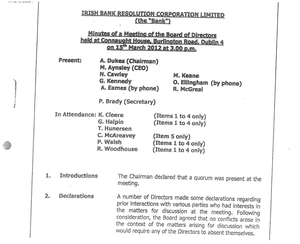
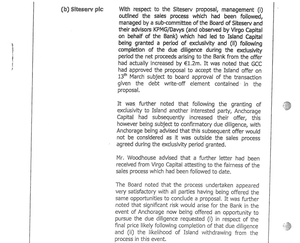
The Department of Finance has since published the minutes from the meeting on March 15 2012:

Screen Shot 2015-06-03 at 22.55.55 Screen Shot 2015-06-03 at 22.57.04

Screen Shot 2015-06-03 at 23.00.40

Screen Shot 2015-06-03 at 23.01.18

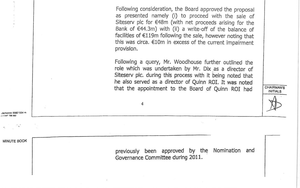
Readers will note the presence of former IBRC senior executive Richard Woodhouse at the meeting on March 15, 2012.

But, following a press conference held by former IBRC chairman Alan Dukes on April 24 of this year, the Irish Times reported, on April 25, that:

“Mr Dukes also revealed that Richard Woodhouse, then IBRC’s head of asset management, was kept out of discussions over the Siteserv deal within IBRC, as he also managed the relationship between the bank and Mr O’Brien. ‘We appointed Tom Hunerson instead, and also Peter Rossiter, the chief risk officer, to oversee the transaction,’ said Mr Dukes.”

Anyone?

Previously: NOKPMG!

Government gives go-ahead for commission of investigation into certain IBRC transactions (Philip Ryan, Irish Independent)

Noonan says inquiry will examine preferential interest rates given to IBRC clients (RTE)

Siteserv: attacks on civil servants ‘regrettable’, says Moran (Irish Times)


Judge Donal Binchy’s written judgment released today giving his reasons for granting an injunction to Denis O’Brien and Irish Bank Resolution Corporation against RTÉ.

Court issues written judgment on O’Brien injunction (RTÉ)

“What is particularly curious is that Deputy Murphy is persistent in her claims even though I have made clear that what she is saying is untrue and she has repeatedly made erroneous and untruthful statements about my banking relationship.”

Denis O’Brien yesterday.