


This afternoon.
Fitzwilliam Square, Dublin.
Name that model anyone?
(Thanks Stephen Walsh)



This afternoon.
Fitzwilliam Square, Dublin.
Name that model anyone?
(Thanks Stephen Walsh)

Oh my.
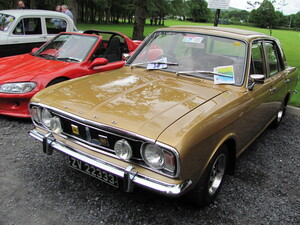
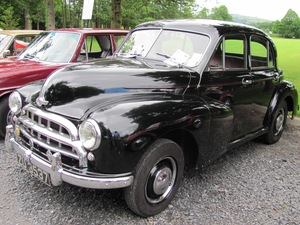
The NCBI Classic & Vintage Show was held yesterday in the grounds of St. Columba’s College in Whitechurch near Tibradden at the foot of the Dublin mountains.
All week Patrick ‘Carspotter’ Cummins will be featuring his favourite cars from the show beginning with the three beauties (above).
1. Ford Cortina 1600E: “A Mk 2 Cortina sporting the ‘E’ designation which stood for ‘executive’. This high-end model is well reputed. My own father drove a wine-coloured one in the mid 70s and it was his most memorable car.”
2. Sunbeam Alpine: “What a beautiful automobile! The Sunbeam had very a continental appearance despite being one of the famed sports cars developed by the Rootes Group in the 1950s. I would guess this example is from early-mid 1960s.”
3. Morris Oxford: “Designed by Alec Issigonis of Morris Minor and Mini Cooper fame, the Morris Oxford was Morris’ first step-away from the old-style of ‘body-on-frame’ construction.”
Name those years anyone.
More impeccably aged jammers tomorrow.
Pics: Patrick Cummins

The Four Courts, Dublin this morning
A beautiful old Gestapo staff car Mercedes acquires lebensraum
Name that model and year anyone?
Thanks Pedant
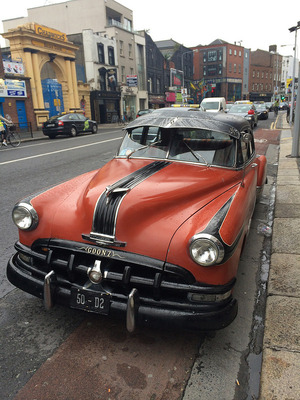


A trio of cars outside the Thomas House, Thomas Street last night for the launch of Imelda May’s new album, Tribal.
Anyone care to name them?


[Bernadette Wyer, above left, The first female President of the RIAC and model Esme Manserth Wallace outside the Mansion House , Dawson Street, Dublin today]
Ahead of this weekend’s RIAC [Royal Irish Automabile Club] National Classic Car Show. at the RDS, Ballsbridge, Dublin.
Name those cars anyone?
The irish Veteran & Vintage Car Club
(Mark Stedman/Photocall ireland)
 Jaysus.
Spotted in Prague, Czech Republic, today.
Thanks Shiela Larkin
Meanwhile…
 Hong Kong, this evening.
Thanks James Lloyd


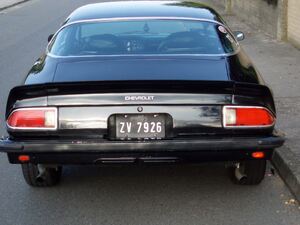 Spotted in Cork.
A 1975 Chevrolet Camaro (Z28). It’s a 5.7 Litre V8 automatic.
It does about 20 gallons to the mile on sunny days.
Coincidentally, the owner says it is currently for sale.
Update:
 We would have used Lars’ photos of the car but the lighting didn’t quite work out (example above).

 Rover P5 (3.5 Coupe): “Rover’s P5 series was a popular selection of saloon cars in the UK during the late 50s and early 60s available in different forms. This is the 3.5L “Coupe” edition in Mk 1-A. The 1-A boasted a front quarter window as well as some mechanical improvements over the ordinary Mk 1.”

 Porsche 911SC: “What struck me when passing this 1978 Porsche 911 on Stephen’s Green was the immaculate condition of the bodywork. The SC title was reintroduced on the 911 in the 930 series and by 1978 it was the base model. The owner tells me that it had been restored some years ago and he uses it as a daily driver.”
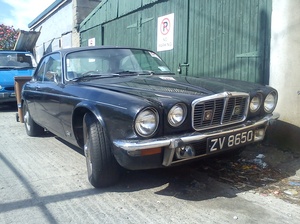
 Jaguar XJ: “This is one of the first series of Jaguar XJ Saloons probably from some time in the early 1970s. It is the larger engined 4.2L with the straight-six XK power-plant. Jaguar took control of the Daimler company prior to the launch of the XJ and badge-engineered versions were produced under the guise Daimler Sovereign.”
Pics and text: Patrick ‘Carspotter’ Cummins

 1987 Renault 4: “A common sight on Irish roads in the past was the Renault 4 and these were even used by the Department of Posts & Telegraphs. A huge production span of over thirty years means that millions have been produced. An interesting feature on these vans was the column gear-change (gearstick beside the dashboard). Although the van was most popular in Ireland, the car was originally a small hatchback and exists in other body styles too.”

 Ford Mustang: “The Ford Mustang Mk 1 was put into production in 1964 becoming one of the most popular cars to ever grace the roads and spurring on a host of imitators. This is the GT model which is a fastback version and visually based on the high-performance Shelby Mustang.”
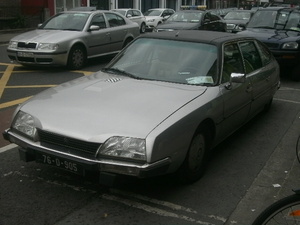
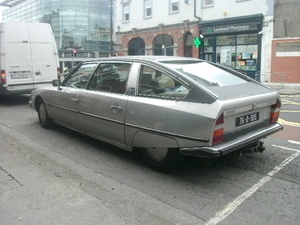 1976 Citroen CX: “Citroen have always had an avant-garde twist to their styling that is all the while quintessentially French. The CX is no exception with it’s long front, curved rear and hydro-pneumatic suspension system. This is one of the earlier models but they were built up until 1992 with very few major styling changes. It was replaced by the Citroen XM.”
Pics and text: Patrick ‘Carspotter’ Cummins
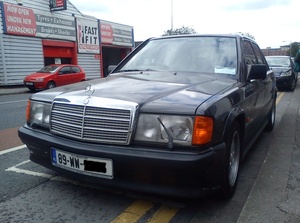
 Mercedes 190E Cosworth: “Mercedes introduced their W201 chassis in 1982 and developed a very sophisticated mid-size luxury saloon. In standard trim, most popular options were the 1.8L and 2.0L petrol injection engines and the 190D which include a variety of diesel engines. In 1984, Mercedes wanted to go rallying and, so, used the W201 chassis as a basis for their car. They recruited the help of the famous Cosworth company to improve their already-robust 2.3L engine and the result was the Mercedes 190E Cosworth 2.3-16 (for 16 valves). A much sturdier 2.5L engine replaced the 2.3L in 1988 and that’s what we have here in “Evo 1″ form (i.e. the first of three phases of this particular model). It never did go rallying but became successful in the German Touring car series, DTM.”

 Triumph 2000: “Aimed at a new market opening, the Triumph 2000 offered refinement and comfort at a much lower production price and running cost than top-range Jags and Rovers of the 1960s. The Mk 1 model here was replaced by a Stag-esque Mk 2 in 1969. This one had a three-speed automatic box.”

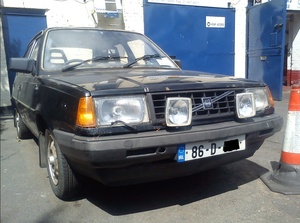 Volvo 340: “I don’t have a love affair with old Volvos but they seem to be popping up quite a bit. DAF wanted to expand on their production car range so Volvo jumped on board eventually taking control of the company’s complete road-car division. The 340 (and saloon 360) came initially with the controversial variomatic transmission found in DAF’s smaller cars but expanded to include conventional manual gearboxes. Volvo’s high safety standards were upheld and the 300 series sold well in the UK despite its drab appearance.”
Pics and text: Patrick ‘Carspotter’ Cummins