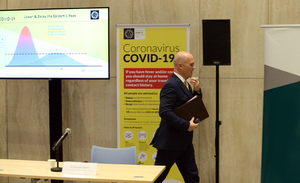

From top: Chief Medical Officer at the Department of Health Dr Tony Holohan; Donnchadh Ó Conaill
Since the outbreak of Covid-19, there seems to have been almost as much discussion of misinformation around the virus as there has been of the virus itself.
What has not been commented on so much is something slightly different: not misinformation, but information. Specifically, how should we (the non-specialist public) think about expert views and decisions which have been taken based (at least in part) on expert advice?
Given that people who are relatively well-informed about the outbreak disagree on some important issues, how should we (the relatively not-well-informed) evaluate the different claims?
I am not talking here about advice on which there is a strong consensus, i.e., the need for social distancing, to frequently wash your hands, etc. I am interested specifically in views concerning how societies as a whole should react, on which there is less consensus.
Many European countries have closed their schools and restricted businesses, but not all have done so (and some did it much more quickly than others). Some have imposed travel restrictions, but again not all; some but not all have already moved into lockdown. None reacted as quickly as Asian countries like South Korea or Taiwan.
Simplifying a great deal, we can ask: which country’s response is correct?
Part of the problem is that we cannot simply ‘trust the experts’. The worry here is not some generalised distrust of officialdom or the elites.
This is a dangerous phenomenon when it comes to public health, and may yet play an important role if and when a vaccine for Covid-19 is developed. But the problem I have in mind is different. It is that the experts disagree, and different official bodies in different states have made different decisions.
Another easy option is to rely on what some specific experts have advised. Anyone following discussions of the pandemic online will have come across criticism of the Irish authorities for not reacting quickly or decisively enough, based on what other countries have done and on
In thinking about how the Irish government have handled this, it is worth keeping some things in mind. First, there does appear to be some disagreement among even very well-informed people as to what the best response should be.
More specifically, while everyone agrees on the need to flatten the curve, there is disagreement as to how to best do this: which response would be most effective, how quickly each response should be implemented, how long they can be kept in place, etc.
Second, it’s not sufficient to acknowledge one’s lack of expertise but to then reach a firm conclusion based on what some specific expert or experts have said.
Part of our lack of expertise is precisely not knowing how representative the views of any specific expert are, or of how well-founded their views may be. Even experts can make mistakes, or be working with dubious assumptions or faulty data. We should look for further reasons to accept what even someone with a high degree of expertise is telling us.
It is worth considering a specific example, the widely-shared article by Tomas Pueyo.
Note that he is not an expert, in the sense of being an epidemiologist or someone who works in a closely-related field, though he clearly has some relevant expertise in terms of statistics and modelling. Nor does he seem to have access to information which is not generally available.
That said, I think there are reasons to take his views seriously. First, his article has been read millions of times, so if his analysis of the data was fundamentally flawed there is a good chance this would have been pointed out (at any rate, there are large incentives for other people with relevant expertise to point out flaws in a very widely-read article on such an important topic).
Likewise, the data he is drawing on is publically available, which again provides an opportunity to correct any mistakes or selective use of statistics.
Second, many of his specific claims make sense (e.g., his discussion of the way mortality rates seem to be sensitive to the availability of intensive care facilities).
None of us can evaluate new information without relying on what we already assume to be correct, and it seems correct to suggest that if the number of patients who need intensive care outstrips available facilities, more of these patients will die.
Third, Pueyo goes through his reasoning in a fairly detailed fashion. Even a non-expert reader (like myself) can see how the evidence he marshals supports his conclusions.
To a fairly large degree (though not entirely) the persuasive force of his argument does not rest on his status as an expert or because we trust him to have found the right data and analysed it correctly.
In other words, the more you can see how a given conclusion is supported by specific examples or data, the less weight you will need to place on basically trusting that specific experts know what they are doing.
We can never avoid placing any weight on this; it is the basic issue facing all non-experts attempting to understand what an expert on a specific topic is saying. (And versions of this problem arise even for other experts; no-one is going to be able to double-check all the data or verify all of the experimental findings which they accept as true.)
This is the price we pay for relying on experts; at a certain point, we must simply trust their expertise. But Pueyo has minimised the degree to which we must place this kind of trust in him.
To be clear: I’m not saying Pueyo is definitely correct, let alone that it is obvious what governments should do (even setting aside the complicating factor that each government will be faced with a different set of circumstances).
But there are good reasons to accept his argument, and good reasons to worry that Ireland’s response, at least initially, was too slow.
Donnchadh Ó Conaill is a postdoctoral researcher in philosophy at the University of Fribourg in Switzerland. He is writing here in a personal capacity.
Rollingnews