Update:
Meanwhile…
Earlier…

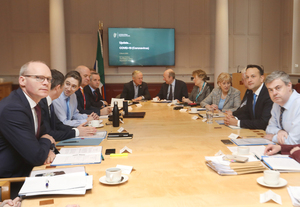
A Cabinet Subcommittee meeting yesterday on Covid-19 with politicians and officials including Tanaiste Simon Coveney (left)
This morning.
Tánaiste and Minister for Foreign Affairs Simon Coveney spoke to Dr Gavin Jennings on RTÉ’s Morning Ireland about the coronavirus.
He spoke about the Department of Foreign Affairs advising Irish people not to travel to anywhere in Italy while conceding that Ireland cannot “control” people travelling from Italy to Ireland.
They later discussed the immediate figure of public gatherings in Ireland with Mr Coveney indicating that fresh advice on this is imminent.
From the interview…
Jennings: “You announced packages yesterday of nearly €2.5billion to help people to stay at home. How soon will it be before more people are asked to stay at home?”
Coveney: “Well as the Taoiseach outlined yesterday, and I think [Health Minister] Simon Harris has been doing it as well, I mean there are, there are different phases here in terms of how you respond to something like this. We are currently in the initial, what’s called, ‘containment phase’.
“In other words, anybody who tests positive, we want to establish who they are, where they’ve come from and the likely source of infection. And so the vast majority of the 24 people who’ve tested positive in Ireland so far have come form Northern Italy and they’ve brought it home with them.
“And of course then our public health team have followed all of the contacts that those people have had to try to make sure that we follow any others who may have been exposed to that virus.
“That’s been the focus so far which is really about containment and minimising the number of people who are exposed to the virus. But I think it is inevitable that we will move on to what’s called the ‘delay phase’ which is essentially trying to stop the spread of a virus in a population that has no immunity and recognising the reality that we effectively have no vaccine and no treatment for this virus right now.
“And therefore the only way that we have of effectively limiting the numbers of people who contract the virus is through old public communication and of course providing comprehensive and good healthcare to people who have symptoms.”
Jennings: “At what point will that happen? At what point will we move on to a ‘delay or mitigating phase’ and that more people are asked to stay away from each other?”
Coveney: “Well, I mean, in some ways, that’s already starting. I mean we’ve, we cancelled, or postponed at least, a large rugby fixture, we’re also cancelling, essentially, St Patrick’s Day parades across the country. And if our public health team make further recommendations in relation to public gatherings, we will follow that advice and I understand that Tony Holohan, who is the chief medical officer and his team will be meeting today at the National Public Health Emergency Team and they will be looking to, to give clearer and more detailed guidelines around public gatherings. So that we can give people and organisations more direct advice on that, sooner rather than later.”
Jennings: “It looks that there are kind of two choices. Lock everything down before thousands become infected or lock everything down after thousands become infected, like what’s happened in Italy. Why are we waiting to make more moves here?”
Coveney: “Well, we are, I think trying to provide responses that are proportionate. So you know if you shut a country down without good reason and evidence to back that up, then I think you can cause significant damage to people’s quality of life also. And so what we’re trying to do is follow the public health advice that is appropriate, given the level of threat at any given time.
“And, you know, I’m a politician, a policymaker, we need to listen to experts in terms of the recommendations and the advice that they give. And I think that we need to follow that. This response needs to be health-driven and that is what we’re doing, rather than politicians going off on solo runs and doing things that aren’t recommended.
“We’re very much working with our public health team, with the HSE and with the chief medical officer. Meetings are happening literally every day. Advice and discussions are happening at a European level and at a national level and as you saw yesterday, the Government will respond comprehensively on the back of public health advice.”
Jennings: “You were on television last night [Claire Byrne Live], taking questions for some time and beside you was a doctor and an expert academic, talking about increasing social distancing. They were talking about measures like closing schools, universities, pubs, restaurants and more.
“Now you got briefings yesterday from health experts, privately, can you just explain to us what they’re thinking is as to what point more social distancing, more restrictions will be introduced. We’ve what 24 cases in this State, 36 cases on the island of Ireland. At what point will more measures be introduced?”
Coveney: “I mean I think the direct answer to that question is when it will be effective to do that. And I think it’s important to say that the Government isn’t ruling out any course of action.
“If this virus takes hold and starts to spread in clusters in different parts of the country, we will need to respond very firmly to that. To try to delay the spread of the virus as best we can. I mean if you look at, and I’m learning about this like everybody else is, but from what I’m told, if you look at how a virus like this spreads in a population, the challenge for us is to slow down the spread of that infection, to give health authorities the time and the space to be able to respond to that comprehensively and to give populations also the time to actually understand how they can protect themselves and their families.
“So instead of this being a dramatic peak where very large numbers of people are impacted by the virus in a very short period of time, we’re trying to actually spread out that curve over a period of time, so that we can respond in the appropriate way to protect, most importantly, vulnerable citizens from this because don’t forget the vast majority of people who will be impacted by this virus will get through it.
“They will have relatively mild impacts on their health but maybe up to 20 per cent of people who contract the virus will have a significant health impact and of course a small percentage, for a small percentage, it could be fatal.
“And if you have very large numbers in the population impacted, well then even small percentages can mean thousands of people losing their lives. So this is something we are monitoring on a daily basis and you know as the Taoiseach said yesterday, really the challenge for the country here, potentially, if the spread of this virus happens on a worst-case scenario basis, this is a challenge that is totally unprecedented…”
Jennings: “Yes.”
Coveney: “…in Irish modern history.”
Jennings: “If the challenge is that big though why not move earlier? If the Taoiseach says almost 60% of people could become infected, what grounds are there not to move to delay with mitigating measures now?”
Coveney: “Well… I think that what we’re trying to do here is to respond to a crisis as it develops. And if you use all your ammunition on day one and then effectively…”
Jennings: “Do you not want to move before it develops?”
Coveney: “Yes, we are and we are doing that. That’s why we have already cancelled very big events, that’s why we have taken unprecedented action in relation to travel advice. That’s why we are preparing now, in our health service, to add significant bed numbers to decant people from hospital who don’t need to be there. So that we create space to try to deal with a problem that could become much, much worse, very, very quickly. So a lot is happening. And of course the advice will be upgraded on a daily basis.
“You know the special Cabinet committee on Covid-19 is meeting again on Friday, again on Monday after that. The national public health emergency team is meeting again today. And of course will update the Government, in relation to advise.
“So you may find that the Government moves to do a lot more very quickly but I think we need to do that on the basis of good, public health advice rather than on the back of political pressure.”
Jennings: “But there may be people this morning, listening, minister, who may decide to move before Government advice, before pubic health advice. People who are organising events, people who are organising matches, people who are organising parties, public gatherings who will think ‘will I wait for the advice from Government’ or is the responsible thing for me to do now, to keep people away from each other where possible?”
Coveney: “Well I think, as the Taoiseach said yesterday, I think we should all think carefully about unnecessary public gatherings and I think you will get advice shortly, if not even this evening, but certainly in the next few days on public gatherings and numbers and proximity and so on.
“But we want to make sure that advice is accurate and based on as sound, on evidence-based as we can provide it. So what I would say to people is if you are organising seminars, if you’re bringing people together for whatever reason, whether it’s a concert, whether it’s a sporting fixture, whatever it is, keep a close eye on the HSE website and we will be proving updated information on public gatherings shortly.”
Listen back in full here.
Rollingnews
Meanwhile…