
Tag Archives: coronavirus

Tonight.

Claire Byrne Live on RTÉ One.

A patient ‘with coronavirus’ called ‘Paul’ and living in Ireland spoke ‘from his hospital bed’ with Ms Byrne.

Paul “I went abroad for a short trip and then I came back to Ireland where I live. I felt OK for a couple of days, then I started to have a little bit of fever and given that I was abroad I decided to self-isolate myself and call and explain the situation. So what they did was send a medical officer to my apartment and the medical officer took a swab of my throat and nose. After 24 hours I was notified about the positivity of the test and an ambulance picked me up at my place and drove me to the hospital.”

Claire Byrne: “Can you tell me a little bit more about how you felt when those symptoms first happened?”

Paul: “The only symptoms I had was, basically, the fever. I didn’t have any respiratory problem, any lung inflammation, any cough, any sneezing so was just the fever but again based on the fact I was abroad I preferred to self-isolate myself anyway because I was not sure if it was safe to go around. But I didn’t have any severe symptoms, I actually feel great now. I had a fever for a couple of days and now from Friday, I don’t have any more symptoms and so I am just here in the hospital being tested for the virus.”

Byrne: “And when the medical officer came to your apartment what was that like? Was that person in full protective gear?”

Paul: “Yes. That person came to my apartment and he was fully, lets say, dressed up. The actual test took less than five minutes, he came into the apartment, he was dressed up, he came to my bedroom because I was in my bedroom, he tested and then he went away. And again I was notified in 24 hours.”

Byrne: “Was that scary when you found out you had Covid19?”

Paul: “I was a little bit worried of course but its a new virus and all this information is going around, but at the same time I was not scared because it is clear now of course it is something we have to fight. It might be dangerous but at the same time most of the people recover and that is the official information that we have. So based on the facts, and that I am quite young, I was not scared.”

Byrne: “So you got the notification that you had Covid19, how long did it take before you were taken to hospital?”

Paul: “A short time, less than an hour. So basically the HSE called me back and they notified me, they had a lot of questions about people I was in contact with, about my co-workers, and these kind of things just to understand if someone else could have got the virus from me. Then in less than an hour the ambulance was at my place and they picked me up and they drove me to the hospital very quickly.”

Byrne: “And since then you have been in isolation?”

Paul: “Yes, I am currently in isolation in a private room and the nurses and medical officers are really, really nice with me. What is going on is I am being tested everyday for the virus and when I will be negative for twice in a row, so for two consecutive days it means I will be free of the virus and I can go back home.”

Byrne: “Can you tell me a little bit about wast it is like to be in isolation in hospital? How much of the medical staff do you see or how much contact do you have?”

Paul:
“There is not a lot of people going in and out of course, it’s a new virus and they try to contain to keep at a minimum the amount of contact. The only thing I would say is that it is boring, I am here and I just have to read, watch some movies and that’s the only things. Apart from that I am fine.”

Byrne: “You mentioned that the HSE asked you who you had been in contact with, how detailed was that questioning? What do you remember about that?”

Paul:
 “They just asked me basically what did you do before calling us? I came back from the trip, and I went to work for one day because I felt OK and I didn’t have any symptoms. They just asked me all the details of the people I might have been in contact with so they were able to contact those people and they take all the procedures to eventually block the spreading of the virus.”

Byrne: “I know you have been in isolation as you say and you have been reading and watching what has been going on so based on your experience what do you think about what some people call the panic on social media about Covid19?”

Paul: “I am not probably the right person to talk about that because I am not on any social media but what I can say and it’s based on my experience is that I think it is what people should do is that not listen to people that are not, they don’t know what they are talking about. What I mean is that follow the information that is on the websites of relevant authorities.”

Byrne: “You will be there until you get two consecutive days of negative tests, do you have a time line on that? Has anyone said to you this is how long this might take to work through your system?”

Paul: “No, they didn’t tell me exactly, but again the relevant websites, you can check for that. I think it depends on person to person, it depends on the symptoms you had, if they are more severe it may take longer. I am just waiting here and hope that it will happen soon.”

Earlier: claironavirus

Watch back in full here

UPDATE:

UPDATE:

Tonight.

Douglas, Cork.

Jonathan writes:

If anyone is heading into Dunne’s in Douglas for some jacks roll… don’t bother…

Meanwhile…

Ah here.

Time for Plan b.

Earlier: How Much?

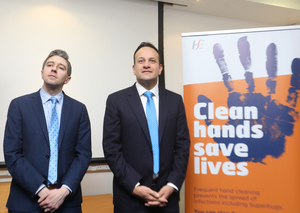
Minister for Health Simon Harris, Taoiseach Leo Varadkar, Minister for Business, Enterprise and Innovation Heather Humphreys, and Chief Medical Officer Dr Tony Holohan at a press briefing in Government Buildings earlier today

This evening.

Ingrid Miley, of RTÉ, reports:

The Government is to introduce emergency legislation in the Dáil to amend the rules on sick pay, which will see Illness Benefit rise from €203 per week to €305.

It will be available from the first day of illness rather than after six days as at present, and conditionality will be waived to allow the self employed to receive it.

There will be no minimum number of PRSI contributions, but medical certification will be required.

Emergency legislation aims to amend rules on sick pay (RTÉ)

Rollingnews

Earlier: “We Can’t Sugarcoat This”

From top: cabinet sub-committee on Covid-19 this morning; St Patrick’s Parade in Dublin on March 17 last year

This afternoon.

Via RTÉ:

St Patrick’s Day parades have been cancelled in Dublin, Cork and Waterford today following concerns over the coronavirus.

The Cabinet Sub-Committee dealing with the Coronavirus decided to cancel the St Patrick’s Day Parade in Dublin after meeting this morning.

It follows an announcement from Cork City Council to cancel their parade.

More as we get it.

Covid-19: St Patrick’s Day parades in Dublin and Cork cancelled (RTÉ)

Rollingnews

Earlier: Now Wash Your Brain

Alternatively…

This morning.

Gardiner Street Middle, Mountjoy, Dublin 1.

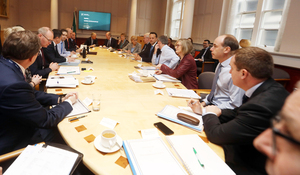
A Cabinet Subcommittee on Covid-19 held at the Health Protection Surveillance Centre with, middle pic from left: Tanaiste Simon Coveney; Minister for Finance Paschal Donohoe; Minister for Health Simon Harris; Chief Medical Officer of the HSE Dr Tony Holohan; Minister for Communications, Climate Action and Environment Richard Bruton; Minister for Transport, Tourism and Sport Shane Ross; Minister for Business, Enterprise and Innovation Heather Humphreys; and Taoiseach Leo Varadkar.

Did we not de-elect these guys?

33 cases of coronavirus are confirmed on the island of Ireland (RTÉ)

Earlier: “We Can’t Sugarcoat This“

Leah Farrell/RollingNews

Meanwhile…

The Taoiseach is to shorten his traditional St Patrick’s visit to the US because of the coronavirus.

Leo Varadkar will begin his trip in Washington on Wednesday and will not visit New York as previously planned.

He was due to attend a UN event in New York as part of Ireland’s bid for a seat on the United Nations Security Council.

A Government spokesperson said the Taoiseach is looking forward to attending a series of engagements in Washington on Wednesday evening and Thursday, including meeting President Donald Trump at the White House.

Taoiseach to cut short St Patrick’s trip to US (RTÉ)

Meanwhile…

This morning.

Via Mail Online:

The Six Nations committee has decided to postpone the last day of matches until Halloween as concerns ramp up around the coronavirus.

Federations met on Monday morningThe games affected include Wales v Scotland and France v Ireland, and follows the disruption of Ireland’s clash against Italy and England’s trip to face the Italians in Rome.

The entire final round of Six Nations matches ‘could be postponed’ and will not be played until a Hallowe’en ‘Super Saturday’ on October 31’….

Pic: IRFU

From top: St Patrick’s Day Parade in Dublin last year; Minister for Health Simon Harris

This morning.

Minister for Health Simon Harris spoke to Dr Gavin Jennings on RTÉ’s Morning Ireland about the coronavirus.

It follows reports yesterday that 1.9million people in Ireland, or 40 per cent of the population, are ‘likely’ to become sick with the virus.

As of this morning, there have been 21 confirmed cases in the Republic of Ireland.

The interview also came ahead of a Cabinet sub-committee on Covid-19 meeting later today.

Among matters they discussed included how people forced to stop working will cope financially, the number of Intensive Care Unit beds in the country and St Patrick’s Day festivities.

Mr Harris also told Dr Jennings that there is “a moderate to high risk” that Ireland “will follow a pattern seen in other European countries”.

From the interview…

Gavin Jennings: “Have you made a decision on paying people who have to stay at home. If people are going to be asked to self-isolate for 14 days to help contain the virus, how are they going to do that with no income? Are they going to get sick pay? Or are you going to give them statutory pay?”

Simon Harris: “So, at the moment, as you know. If you’re out sick, or told to stay at home, you can access social protection supports. The challenge is you can’t access them for a number of days.

“One of the things we’ve been looking at across Government is can you reduce that waiting period so people can get support more quickly. And that’s something we’ll be considering today.

“The best way of doing it is something…”

Jennings: “Sorry, have you made a decision yet?”

Harris: “The Cabinet committee will make a decision today. We met with, and I wasn’t, I wasn’t involved in these meetings but the trade unions and the employer representative groups had meetings with Government officials in Government buildings. And we receive recommendations at the Cabinet committee.

“The only thing we’re trying to…we’re very clear on what we want to do here. And we want to provide the support. The only question that remains is how best do we do that and we’ll consider that this morning.”

Jennings: “At the moment, all confirmed cases are being treated in isolation in hospital. How much longer is that going to be the case?”

Harris: “So that is a clinical call that will be made by the public health emergency team. And let me just explain why that is. One of the reasons we’ve been asking people who have tested positive and have the illness, even if they’re reasonably well in themselves.

“One of the reasons they’ve been staying in hospital, rather than self-isolating at home is, remember this is a very, very new virus. And it’s providing an opportunity for our healthcare professionals to continue to monitor and learn more about it. And that information will stand us in good stead.

“But you are quite correct. You will get to a point in time where it will not make sense for people who have tested positive, but are reasonably well, to take up a bed when there could be somebody who’s positive and not well, who requires that bed. So we have a protocol in place to enable people who test positive to self isolate at home and our public health emergency team will decide when to make that switchover.”

Jennings: “What are you going to do when there are more critically ill people than there are ICU beds? What’s the plan?”

Harris: “So there’s a couple of elements to this plan. The first, as you know, is we’re expanding ICU capacity and we gave another €21million to the health service last week to open more ICU beds….”

Jennings: “Brings it up to about 300, isn’t that right?”

Harris: “That’s about right. They’re continuing to look at opportunities across the health service to open more beds and those beds will be funded. We’re also going to engage our private hospitals, it’s quite likely that if you got to a situation where this virus outbreaks in a serious way, that many elected procedures in private hospitals could yet be cancelled. So they may have capacity. So we’re looking at that as well.”

“We’re also looking at one of the other ways you can increase capacity, is obviously increasing the workforce. So lifting any kind of restrictions on recruitment. Up until now obviously all recruitment, you’ve only been able to recruit funded posts. That’s the norm. But making it more flexible to recruit more people, bringing back from experts, and also looking at the possibility of our model two hospitals, they’re our smaller hospitals, Gavin, having capacity to do more in relation to isolation.

“I do need to say, and I know you know this, but it’s important for our listeners to know this. Most people who get this will not require ICU. Even those who require hospitalisation, many of them will not require ICU. But it is true that we have a shortage here in Ireland.

“But indeed there’s a global shortage and this is a challenge that we’re seeing, health services are seeing it in Italy today. So everything that can be done is being done.”

Later

Jennings: “Italy had 20 confirmed cases on February 21, now it’s almost 16,000. And they have 16million in lockdown. We have 21 confirmed cases and everything is going ahead as normal. Why aren’t we trying to get ahead of this disease?”

Harris: “So we really are. And I wouldn’t accept that everything is going ahead as normal. We had our first confirmed case of this last weekend and since then you’ve seen the benefit of the work that’s been done since January with the number of key decisions made. We’ve shown a willingness to cancel events, as is appropriate. There were a number of rugby games due to take place in this country over the weekend that didn’t on the basis of public health advice.

“We’ve set up a stakeholders forum to bring together all of civic society, unions, employers, voluntary groups and that’s met twice. There’s a new Cabinet committee convened. We’ve changed our protocols so the national ambulance service is now doing a really good job, going out and doing testing in people’s homes. Saves them having to come into the hospital. We have information and experts available in all of our airports providing information and we’ve expanded our ICU beds.

“And we will do more. But it is important to say, I mean Ireland is at at early stage of progression here compared to other European countries. You referenced Italy but look also at France, at Germany, the UK. But you’re right. There’s a moderate to high risk, we can’t sugarcoat this. There’s a moderate to high risk that we will follow a pattern seen in other European countries and that’s what we’re preparing for and what we’re working around the clock for.”

Jennings: “France is cancelling public gatherings of over 1,000 people. Germany is considering doing the same. Is it responsible to allow St Patrick’s Day festival and gatherings to go ahead now?”

Harris: “So I’ve been Minister for Health for nearly four years and I’ve learned  a lot in that time. And what I’ve learned mostly is that if you listen to your public health advice and public health experts, you won’t usually go far wrong. Our public health experts are considering the issue of St Patrick’s Day as we speak and I expect clarity to be brought to that within the next 24 to 48 hours. I’ve no interest to be making decisions to be seen to take action if our public health experts don’t believe it will make a difference.

“But whatever our public health experts guide us on in terms of St Patrick’s Day is what the Government will go with. The chief medical officer and others are providing us with expert advice, round-the-clock, in what is a fast, evolving situation. This is changing not just in Ireland but around the world on a very regular basis and we’ll meet again this morning just after 11am and we’ll have a chance to assess this.”

Jennings: “But there are also political decisions that need to be made, decisions that will need to be made by politicians and by Government. Do you really think that you’re showing responsibility by allowing these gatherings go ahead?”

Harris: “Well, just to be clear, they haven’t gone ahead yet. So the Italy V Ireland rugby game did not go ahead because the public health advice was that it shouldn’t proceed. And we will take the same approach to St Patrick’s Day in terms of the public health advice. We will follow that to the letter….”

Listen back in full here

Rollingnews

Meanwhile…

This afternoon.

Government Buildings, Dublin 2

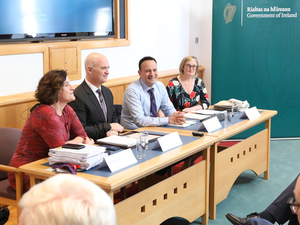
A COVID-19 (Coronavirus) with above, from left: Deirdre Watters, Head of Communications, Department of Health; Dr Tony Holohan, Chief Medical Officer, Irish Department of Health; Acting Taoiseach Leo Varadkar and Elizabeth Canavan, Assistant Secretary General at Department of the Taoiseach.

Elective surgeries, appointments cancelled at UL hospitals (RTÉ)

Rollingnews

Meanwhile…

Um.

Care to share the joke?

Seeing as we’re all going to DIE.

Sasko Lazarov/RollingNews/Pool