

Tag Archives: Dr Julien Mercille

90250688Mercille

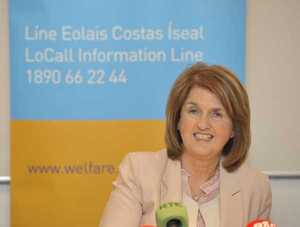
From top: Tanaiste Joan Burton launching a ‘dole cheat’ helpline in 2012 and Dr Julien Mercille

The coalition’s agenda:

Tough on welfare fraud.

Soft on corporate crime.

Dr Julien Mercille writes:

Last week confirmed once again that in Ireland, the government always finds the resources to control ordinary people, while the establishment gets away with it. Indeed, a lot of energy has been put into tackling welfare fraud while corporate crime is left undisturbed.

Transparency International released a report ranking OECD countries for their efforts to reduce corporate bribery and corruption. Among 41 countries, Ireland comes near the bottom, meaning that our government has one of the worst records of all. This is not the first time that international organisations have warned of the lack of progress on fighting corruption in Ireland.

The report investigates the extent to which action has been taken against Irish companies and individuals who bribe public officials abroad to obtain contracts, licences and concessions.

Only four countries are classified as having adopted an “active enforcement” stance, which is good. Six others are deemed to have “moderate enforcement”, and nine “limited enforcement”. Then, 20 countries conduct “little or no enforcement” to ensure their firms do not spread corruption around the world. Ireland, you guessed correctly, is in this last category.

Incidentally, Greece, which has been demonised in the media for its corrupt practices, comes out better than us, in the third category.

Transparency International stated that Ireland pledged to tackle bribery when it ratified the OECD anti-bribery convention 12 years ago. But since then, “there has not been a single prosecution and there are no signs that the law will be enforced”. This contrasts sharply with the top four countries (Germany, Switzerland, the UK and the US), which have completed over 215 prosecution cases in total.

The conclusion: “Precious few resources are invested in tackling corruption or white collar crime in Ireland and it appears that helping fighting international bribery is not a government priority either”.

Now, compare this to our government’s energetic efforts to fight social welfare fraud.

To get an idea of the problem, consider that the Department of Social Protection spends about €20 billion annually in social welfare payments. Fraud amounts to about €40 million a year, or a rather small 0.2% of total spending. Sure, fraud is a problem, but it’s not as if the system is in disarray.

Nevertheless, Joan Burton’s department is conducting a full-scale assault on fraudsters.

Last week, reports came out again that since December 2014, 20 police officers have been assigned to a Special Investigation Unit (SIU) to assist Joan to catch those who commit welfare fraud. The Gardaí are stationed throughout the country.

But this is not all. The Department’s Compliance and Anti-Fraud Strategy proudly lists a number of cutting-edge measures it is now taking, including:

– Over 1 million reviews of welfare claimants conducted in 2014.

– Over 900 staff working on fraud in the department and in communities throughout the country.

– 600 cases now before the courts, and there is even a target to submit 300 fraud cases for prosecution in 2015.

– Inspections at airports, construction sites and road checkpoints.

– Predictive Analytics Modeling: analytical techniques to identify claims that are more likely to be fraudulent.

– Legislation enacted in 2012 now allows for up to 15% of a person’s social welfare entitlement to be deducted without his or her agreement when there has been overpayment in the past.

It is understandable that some steps be taken to reduce welfare fraud. But the problem is that the policy is once again directed at ordinary people, while elites get away with it.

First, as stated above, no significant steps have been undertaken to tackle corruption and white collar crime.

Second, if unemployment was lower, we’d save a lot on welfare payments. Therefore, the austerity implemented since 2009 by Labour, Fianna Fáil and Fine Gael politicians accounts for a significant chunk of welfare expenses since it has raised unemployment and lowered people’s incomes.

Third, corporate welfare is huge in this country. Think of our ultra-low 12.5% corporate tax rate. Think of the €64 billion we injected in the banks to bail them out. Or the €365 billion bank guarantee we provided to banks. When is the police going to investigate that with the same amount of detail as for welfare claimants?

Now imagine the following:

900 staff dedicated to catching white collar crime. Over 1 million reviews this year alone of government and corporate officials’ expenses. 600 cases of bankers brought before the courts and prosecuted for the reckless moves they made that triggered the crisis. Gardaí units investigating the IFSC (International Financial Services Centre) and interviewing bankers.

Predictive Analytics Modeling to spot which bankers are more likely to cause trouble in the future. Inspections in Parliament offices to find out which politicians exactly had the brilliant idea of implementing austerity since 2009. Legislation to take money straight out of those guys’ salaries when fraudulent practices are detected.

Those kinds of policies should be on political platforms in the upcoming elections. It would gather quite a few votes.

Julien Mercille is a lecturer at UCD. His new book, Deepening Neoliberalism, Austerity, and Crisis: Europe’s Treasure Ireland (Palgrave) is out. Twitter: @JulienMercille

(Sasko Lazarov/RollingNews.ie)

imageMercille

From top: Tanaiste Joan Burton during protests in Jobstown, Tallaght, last November, Dr Julien Mercille.

When defending civil disobedience and non-violent protests nothing trumps King.

Dr Julien Mercille writes:

Last week we learned that over 20 anti-water charges protesters are expected to be brought to court shortly in relation to the events in Jobstown last November. You will recall that this is when Joan Burton was held up in her car for about 2 hours and when someone threw a water balloon at her.

The police arrested 40 protesters in the wake of the events in Jobstown, including a number of teenagers and three public representatives. This means that about half of them will be charged with a range of offences, including “violent disorder”, “criminal damage”, and “false imprisonment”. A conviction on the latter charge almost always leads to a jail sentence, and possibly a life term in prison. Yes, you read that right: imprisonment for life for keeping Joan Burton in her car for two hours.

I’m currently traveling in the US South and visited the Center for Civil and Human Rights in Atlanta and related landmarks. The civil rights movement of the 1960s in one of the most important periods in US history as it indeed civilised the country. For example, black people gained important rights through sustained campaigns of organised civil disobedience.

One striking thing about progressive social protests is that the principles they embody don’t change that much historically. Basically, when facing an oppressive structure of power that denies them fundamental rights or opportunities, and when negotiations with the ruling class lead nowhere, people decide to take other means to pressurise political leaders to change.

Protesters are inevitably labeled as ‘deviant’, ‘dangerous’ and ‘radical’ by “respectable” and “very important” people. But well organised and united campaigns are often successful in securing rights that in later years are taken for granted, often forgetting, unfortunately, that they were won through struggle, not because ruling classes granted them out of generosity.

The history of the civil rights movement is fascinating and its lessons it provides for today are numerous.

For example, in 1963, civil rights leader Martin Luther King Jr. was thrown in jail for peacefully protesting. There, he wrote his “Letter from the Birmingham Jail”, which explains some principles directly relevant to the anti-water charges movement and other campaigns. The Letter is a short read and is available here.

First, civil disobedience, or breaking the law nonviolently, is justified if the law is wrong. The law reflects the structure of power in a society and as such often benefits the powerful. After all, as King said, “We should never forget that everything Adolf Hitler did in Germany was ‘legal’”.

Similarly, legal codes in the US made slavery and segregation legal. In the 1950s and 1960s, blacks refused to yield their seats on public buses to whites even though this was what segregation laws ordered. They sat at restaurant counters reserved for whites, against the law. Activists organised ‘freedom rides’ on Greyhound buses through the South with whites and blacks sitting in seats normally reserved for whites only. For all this, they got arrested, beaten, jailed, and killed. They were doing things illegal, but right.

Second, the immediate enforcers of the law are the police. Although often depicted as preserving “order” and “preventing violence”, the police in fact serve power and often arrest those who attempt to win their rights or fight injustice. That’s one reason why our political leaders who have enabled the US military to use Shannon airport on its way to destroying Iraq have never been arrested or imprisoned, but water charges protesters have.

Third, nonviolent direct action seeks to force ruling classes to negotiate when they have refused to do so. Waiting passively for political leaders to change their ways is bound to fail. They know very well that what they are doing is wrong, because they benefit directly from it. Waiting passively only leads to delaying justice indefinitely, and “justice too long delayed is justice denied”.

Indeed, “freedom is never voluntarily given by the oppressor; it must be demanded by the oppressed”. As King stated, “we have not made a single gain in civil rights without determined legal and nonviolent pressure”. Hence the need for organised, effective popular actions including boycotts, sit-ins, marches, etc.

Those principles have guided some of the direct action protests against water charges. Similarly, they may well lead to the imprisonment of a number of activists.

Paul Murphy TD said he hoped he would not be jailed. However, if he is, along with others, this may mark a positive turning point in the water campaign movement. My guess is that this would energise the anti-water charges campaign. Opposition parties would capitalise on the situation. Austerity parties—Fine Gael, Labour, Fianna Fáil—could lose some popular support. International media could cover the story critically, conveying the message that the Irish government can’t handle its domestic affairs. The government could thus shoot itself in the foot.

Julien Mercille is a lecturer at UCD. His new book, Deepening Neoliberalism, Austerity, and Crisis: Europe’s Treasure Ireland (Palgrave) is out now. Twitter: @JulienMercille

Top pic: The Irish Sun

-1x-1julienm-226x300

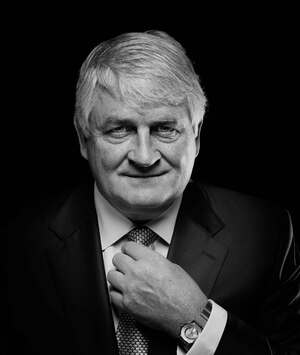
From top: Denis O’Brien, Dr Julien Mercille


Why does Denis O’Brien sue everyone?

Because he can.

Dr Julien Mercille writes:

The number of legal actions Denis O’Brien has launched against free speech over the last several months is dizzying. Let’s summarize them briefly and look at the related problems of media concentration and Ireland’s defamation laws.

1. In May, O’Brien obtained a legal order to prevent RTÉ from reporting on the state-owned bank IBRC (formerly Anglo Irish) and Siteserv. He did not want his banking affairs to be discussed in public. RTÉ abdicated and postponed airing the report.

2. A few days later, Catherine Murphy TD claimed in the Dáil that IBRC had apparently made loans to O’Brien on favourable terms. But he asserted that no media outlet could report on her declarations because he had a court judgment saying so. Almost [but not all; Broadsheet, The Sunday Times and Village magazine] the whole national media abdicated and waited to publish the statements.

3. O’Brien then sued the parliament itself and the State for allowing Pearse Doherty TD and Catherine Murphy TD to make claims about his affairs with IBRC.

4. O’Brien then sued the Dáil’s Committee on Procedures and Privileges (CPP) because it ruled that Catherine Murphy did not abuse Dáil privilege when she made claims about him.

5. Then, last week, O’Brien’s lawyers ordered the satirical news website Waterford Whispers News to take down an article about himself entitled “Denis O’Brien Receives 20 Year Jail Sentence For Mobile Phone Licence Bribe in Parallel Universe”.

6. Broadsheet immediately reproduced the article, and almost as immediately got a similar order to take it down. But it left the piece online.

7. O’Brien’s lawyers then went after Broadsheet’s internet provider, asking to take the article down. As I write these lines, the case is pending.

In short, the whole drama is so exciting that nobody needs to watch soaps and detective stories anymore: it’s all happening in real life.

Two enabling factors for the string of legal actions above are the concentration of media ownership and defamation laws.

Ireland’s mass media landscape is among the most concentrated in developed countries. Notably, we don’t have a single left-of-centre outlet. The Guardian has no equivalent here. The information we receive is thus coming from a quite narrow centre to right-wing spectrum. Sure, there are exceptions and some journalists produce excellent critical progressive stories, but unfortunately, they remain exceptions.

This partly explains why the mainstream media reaction to the above explicit attacks on freedom of speech has been relatively muted. By this I mean that one would have expected a more forceful defense of the right of journalists to investigate and report on matters of great public interest.

It doesn’t help that Denis O’Brien controls a large chunk of our national media. His Independent News & Media (INM) accounts for 40% of all newspaper sales in the country and includes the largest weekly and Sunday broadsheets, the Independent and Sunday Independent. His Communicorp group includes Today FM, Spin, 98FM and Newstalk, the country’s largest supplier of radio news.

But the government has failed to reduce media concentration and increase diversity. In June, Minister Alex White (Labour) issued some “Guidelines” that pretend to address that, but as observers quickly pointed out, they don’t.

The National Union of Journalists described the policy as “an abject failure of the government to tackle powerful media interests in Ireland”. Indeed, “Successive governments have allowed a small group of powerful people to gain control of the media” and the new Guidelines are “incapable of undoing that damage”. All we witness is “the transfer of power from one baron to another in the face of appalling political cowardice”.

The Irish Examiner, in a strongly worded statement, agreed with those criticisms and noted that ironically, the Guidelines had been released in the wake of the political storm that arose when Denis O’Brien prevented the national media from publishing Catherine Murphy’s statements against him. Such context could have provided at least a pretext for the minister to do something that had some bite, but the strategy has remained toothless.

To increase media diversity, progressive alternative media should thus be strongly supported. (And no, that doesn’t mean Facebook or Twitter).

Another issue is to reform Ireland’s defamation laws. In the cases above, such laws govern the balance between the right of the media to make claims about individuals like Denis O’Brien that could end up damaging his reputation (if, say, his banking affairs are exposed) vs. the right of Denis O’Brien to protect his reputation and restrict public debate about him.

The problem is that Ireland’s defamation laws are some of the most plaintiff-friendly in Europe: in other words, they really benefit the likes of Denis O’Brien when the media says something critical about him. In other countries where the value of free speech is more important, like the United States, it is the opposite situation: the law makes it difficult for people like Denis O’Brien to sue the media and win and it is thus easier to challenge powerful people.

The problem with Ireland’s laws is that they benefit the wealthy. That’s because launching a legal action against the media is often costly because lawyers need to be hired and cases can last for a long time. Therefore, it’s unlikely that an ordinary person will take the risk of launching and getting involved in convoluted legal processes.

And so we go back to the government’s role again, which has upheld defamation laws. It should reform them to protect freedom of speech, which is essential in a democracy.

Julien Mercille is a lecturer at UCD. His new book, Deepening Neoliberalism, Austerity, and Crisis: Europe’s Treasure Ireland (Palgrave) is out. Follow him on twitter:  @JulienMercille

Previously: Everyone Must Get Sued

donald_tusk550Mercille

From top: Donald Tusk, President of the European Council; Julien Mercille

There is a dangerous spectre haunting Europe.

But it’s not from the left.

Dr Julien Mercille writes:

What does it mean to be a “radical” in politics?

A “radical” is simply someone who wants to achieve social change that is thorough and fundamental. It is contrasted to those who believe that the current system is largely fine and that only minor improvements are needed.

The term is often used by conservatives to make progressives look dangerous, as in “those radicals are a threat to the stability of our country”.

For example, Stephen Collins, the Irish Times political editor, had an article this weekend echoing Donald Tusk, the European Council President and former Prime Minister of Poland.

Both of them discussed European elites’ real worry about the rise of Syriza in Greece: “political contagion”. This just means that if Syriza is successful, it will empower “radicals” elsewhere, so that progressive parties could grow in other countries, including Ireland. This is because people in Europe will see that it is possible to challenge successfully the troika and bring to power governments that reflect people’s interests to a greater extent.

Therefore, the European and Irish establishments seek to discredit progressives by labeling them as “radicals”. It is supposed to make you think that radicals = extremists = no stability, and therefore I should vote for the traditional parties.

A look at a few examples from Collins’ and Tusk’s articles illustrates how this tactic works.

Collins states that “a spectre is haunting Europe… and that spectre is political chaos”. In Ireland, almost half of voters have now deserted the traditional parties and moved towards independents.

Collins labels those emerging politicians as “radicals”, including Sinn Féin, the Anti-Austerity Alliance, and People Before Profit. They are “extremists” who threaten the “political stability” provided to us by Fianna Fáil, Fine Gael and Labour. Indeed, between 1932 and 2007, Fianna Fáil won approximately 40% of the vote, but is now at about 20%. The “radicals” have thus stepped in to fill the void. The same thing happened in a number of European countries.

Tusk voices similar concerns. He says the stand-off between Syriza and the European establishment has given “new energy to radical political groups”, and created a “pre-revolutionary atmosphere”. He says he fears “ideological or political contagion” from the Greek crisis, not “financial contagion”.

He thus reveals the real reason that motivates European and global elites to humiliate Greece. It has very little to do with economics and everything to do with nipping in the bud the threat of an example that could inspire progressives elsewhere. If the motivations were purely economic, the crisis could be solved relatively quickly and easily: give new loans to Greece, stop austerity, cancel part of the debt, and allow the economy to recover.

Tusk says just as much: he is “concerned about the far left”, which is advocating “this radical leftist illusion that you can build some alternative” to the current EU economic model.

In short, the traditional parties are pictured as embodying “stability” and “moderation” while leftists are depicted as “radicals”.

In fact, the traditional parties are radicals too, but conservative ones. They have sought, and have been successful, in reorganizing society drastically during the crisis, so that those in power dominate ordinary people to a greater extent than before.

Consider the following few examples among the policies enacted by the ruling parties that have contributed to raising the deprivation rate from 11.8% of the population in 2007 to 30.5% in 2013 (the latest available data).

– Cutting or freezing employees’ wages: a new Central Bank survey shows that 84% of Irish firms either froze wages (60%) or cut wages (24%) between 2008 and 2013. This is so drastic that when compared with other European countries, Ireland comes second only to Estonia for the extent of wage cuts during the crisis. This is of enormous benefit to employers.

– Transfering the private debts of banks onto the shoulders of ordinary people by orchestrating a €64 billion bank bailout and a blanket guarantee that made us responsible for €365 billion of bank liabilities.

– Keeping our ultra-low corporate tax rate at 12.5% and opposing a financial transaction tax that would raise much-needed revenues for public services.

– Implementing JobBridge and other similar cheap labour schemes to provide employers with low-cost workers.

– Privatising a number of public services to allow the corporate sector to increase its profits while often leading to worse services for people.

– Cutting numerous community and public services that make it more difficult for citizens who need them to access them. The effect is to disempower people. This applies to cutbacks of about 40% to all of the following: Rape Crisis Centres, Violence against women programme, projects for youth, drugs programmes, Family Support Agency, etc.

Those moves, and many more, are by definition very radical, in the conservative direction. It is thus not true that the traditional parties are “moderate”, nor do they provide “stability”. In fact, they alienate people, and this is why we have witnessed all over Europe the rise of progressive forces.

It is thus conservative radicalism that is dangerous. Progressive radicalism is good because it calls for an in-depth transformation of society in a way that would reduce inequality.

For example, the corporate sector would pay its fair share of taxes, bankers would pay their own debts, the economy would have started growing way earlier by stimulating it instead of asphyxiating it with austerity, and quality services would be provided.

Julien Mercille is a member of the Irish Greek Solidarity Committee. His new book, Deepening Neoliberalism, Austerity, and Crisis: Europe’s Treasure Ireland (Palgrave) is out now. Follow him on twitter:  @JulienMercille

greeceMercille2

From top: Busking in Athens, Greece; Julien Mercille

The most vulnerable people in the European Union will bear the brunt of the failure of austerity.

For years to come.

From Greece, Dr Julien Mercille writes:

The inhumanity of austerity is made particularly clear through the pain it inflicts on children. This is especially true in Greece, where children have absorbed much of the negative effects of the troika’s assault on the country.

As I write this, in Athens, the Children’s Hospital Aglaia Kyriakou’s radiotherapy department for children with cancer is at risk of closing due to lack of funding. The centre is reportedly unique in Greece for the type of treatments it offers.

The troika should reflect on its responsibility in this state of affairs. And so should Enda Kenny, who has sided unashamedly with Brussels and Berlin in negotiations with Greece. This is why Yanis Varoufakis, the former Greek finance minister, described Ireland as one of Greece’s “most energetic enemies”.

Children will suffer the consequences of austerity for years to come, with their lives likely affected permanently. This is because living in households affected by unemployment or large drops in income means a deterioration of their diets; increased levels of stress; some humiliations in front of friends and classmates; difficulty in doing well at school; and so on.

Unsurprisingly, those impacts are not measured with any degree of urgency. The most recent data often goes back to 2012 and in some cases to 2013. Contrast this with the flood of economic and financial information released daily and monthly and you begin to understand what matters to those in power.

A Unicef report from last year based on official data paints a dark picture of children’s suffering in Greece and in other developed countries due to austerity.

Surveying 41 affluent countries, it states that since 2008, 2.6 million children have entered poverty on a net basis, for a total of about 76.5 million in all countries surveyed. It concludes that the Great Recession ‘had the greatest impact on the weakest, and possibly for the longest time… The progress made in education, health and social protection over the last 50 years is now at stake’.

Also, youth unemployment has skyrocketed. Compared to 2008, there are now 1 million extra young people not in education, employment or training in Europe, for a total of 7.5 million. This ‘epidemic of youth unemployment’ is a ‘pathology of austerity’.

Greece consistently ranks among the worst affected countries. Add to this the fact that the situation now is undoubtedly much worse because the report is based on data that is two or three years old, and the picture is even darker.

The report compared how various indicators changed between 2008 and 2012. Here are some key results.

Child poverty increase: Greece comes 40th out of 41 countries (i.e., almost the worst one). Greece’s child poverty rate zoomed from 23% to 40.5%. Countries that did better include Mexico, Chile, Estonia, Lithuania and Turkey, which would not be considered as developed or European as Greece. Ireland is ranked 37th with an increase of almost 11 percentage points, from 18% to 28.6%.

Youth unemployment increase: The youth unemployment rate (for 15-24 year olds) has gone up in Greece and currently stand at over 50%. Greece also ranks 40th in terms of its worsening rate of youth who are not in education, employment or training (NEET), which increased almost 9 percentage points, from 11.7% in 2008 to 20.6% in 2013.

[The unemployment rate of 50% is higher than the NEET rate because the latter divides the number of NEET youth by the total population in their age group, whereas the unemployment rate divides the number of unemployed youth by the number of youth who are part of the labor force, a smaller number than the total number of youth because those in education are not counted as part of the labor force].

Severe material deprivation increase: The rate doubled in Greece to reach over 20%, a worsening surpassed only by Hungary in Europe. Children are considered to be severely materially deprived when they live in households that cannot afford 4 of 9 determined items such as paying rent, keeping the house warm, eating meat or proteins regularly, etc.

For example, since 2008, the percentage of households with children not able to afford a meal with meat, fish, chicken or a vegetable equivalent has more than doubled, reaching 18% in 2012.

Four questions were asked to people in the 41 countries on the subject “how has your life changed between 2007 and 2013?” as follows:

(1) Do most children in your country have the opportunity to learn and grow every day, or not?

(2) Are there times in the last year that you have not had enough money to buy food for your family?

(3) Did you experience stress today?

(4) Overall satisfaction with life?

Overall, Greece ranked 41st, and the ranks per question were (1) 41st, (2) 39th, (3) 39th, (4) 41st. Ireland ranked 38th overall. Clearly, austerity is not a success.

In short, our political leaders like to take pictures with kids when they run for election. That makes them look gentle, generous and considerate. However, the facts speak for themselves. Children are not a priority, and the European establishment couldn’t care less about them.

Julien Mercille is a member of the Irish Greek Solidarity Committee. His new book, Deepening Neoliberalism, Austerity, and Crisis: Europe’s Treasure Ireland (Palgrave) is out this month. Follow him on twitter: @JulienMercille

CJK4If2WEAA3pd1stephencollins

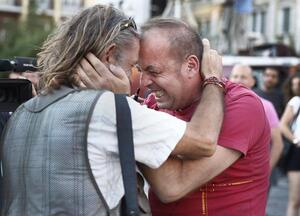
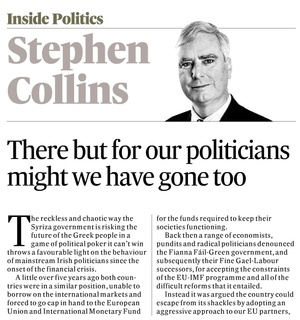
Celebrations last night in Athens, Greece (top) and a column on Saturday from Stephen Collins, Irish Times Political Editor

It’s Oxi Monday.

Greece has rejected spin, bullying and extreme media bias.

Dr Julien Mercille writes:

It is now clear that the NO side has won the referendum in Greece by a substantial margin of 61% to 39% for the YES side. Therefore, the Greek people have rejected the bailout offer from their creditors and associated austerity conditions.

What this does for now is to give a democratic mandate to Syriza to negotiate for a better bailout package with European authorities, which may now involve some debt relief. It remains to be seen to what extent the creditors will be influenced by the referendum’s outcome, however.

The result is a tremendous victory for ordinary people over European elites in every capital, who have tried to bully the Greeks into accepting more austerity while piling up more debts on their shoulders.

The arrogance of power was visible all along. As it became clear that the NO side would win, Brian Hayes, the Fine Gael MEP, called on Syriza’s leaders to “ditch their aggressive, provocative language”. Nevermind that it is the troika, not Syriza, that has inflicted pain on Greece.

It is also important to observe that even if heralded as a great democratic moment, the referendum could only be partially considered as such. Democracy is supposed to refer to the expression of one’s opinion as coming out of a free exchange of ideas and discussion about a subject. There isn’t supposed to be blackmail in that process.

But this is what the Greeks have endured in the days before the vote and before.

First, shortly after Alexis Tsipras, the Greek Prime Minister, announced that a referendum would be held, the European Central Bank (ECB) decided to restrain credit to Greece, forcing its banks to close and pushing the country deeper into crisis, a move that has been widely recognized as financial blackmail. And the troika has always been opposed to Syriza. Earlier, in February, the ECB had cut off its main credit line to Greek banks in a move difficult to justify on economic grounds.

Second, this has been compounded by the last five years of drastic austerity implemented in Greece, resulting in a deterioration of the economy and social fabric. Effectively, Greece is now faced with a humanitarian crisis. Voting in such a situation of fear and desperation is not exactly one’s idea of ideal democracy.

Third, the Greek and European media have been hysterically in favour of a YES vote, repeating ad nauseam that a NO vote would lead to catastrophe. That’s not a balanced and open discussion of the issues, it’s mere propaganda.

For example, the Irish Times’ weekend edition had four opinion pieces on Greece. Three were clearly in favour of a YES vote.

Alan Ahearne, the right wing economist who was adviser to Minister for Finance Brian Lenihan in 2009-11 when austerity package was rolled out in Ireland, had a piece criticising Syriza for supposedly being guilty of weakening the Greek economy which allegedly was doing great before it came to power. Nevermind that it is the troika austerity policies enacted by the governments that preceded Syriza that crashed the economy.

Recall that Ahearne, not so long ago, authored a report entitled “Condoms and House Prices: The Irish Experience”. In it he claimed that contraception was a “major factor” in pushing up house prices to such high levels.

Ahearne also praised NAMA as a “bold and radical action” and “a proven way of solving banking crises” because it “protects taxpayers”. He also said that austerity was “necessary in countries with large fiscal deficits”, especially in Ireland.

Does it matter to the Irish Times that this record turned out to be wrong on every count? Not at all, it seems, as Ahearne still gets his op-eds accepted for publication.

John Bruton, the former Fine Gael Prime Minister, also had an article trying to discredit the views of Nobel Prize winning economists Paul Krugman and Joseph Stiglitz, who both advocated a NO vote.

In the third article, Stephen Collins talked about Syriza’s “juvenile behaviour” which he said was “risking the future of the Greek people”, something which apparently “throws a favorable light on the behavior of mainstream Irish politicians” who he claimed have done the right thing here during the financial crisis (nevermind the policy of austerity). He also says that the last bailout to Greece gave it “the most generous lending conditions ever”, but nevermind the fact that the country has been plunged into a humanitarian crisis.

The fourth piece was by Diarmaid Ferriter, and is supposed to give the balance needed by adopting a position more supportive of Greece. But when you read the piece, it is so mild that you wonder if anybody would be convinced by it. Indeed, it talked about the role of a Cork man in Greece’s war of independence in 1801, whose relevance to the current referendum is beyond me. It also discussed a few things said by the Irish government about Greece in the 1970s, whose relevance again escapes me.

The idea of “balance” in journalism is always brought up by the mainstream media to pretend they are objective and impartial. However, this is problematic for two main reasons.

First, it is not true. The mainstream media is very biased towards the interests of those in power and is not balanced at all. That’s why you see many right wing economists, financial “experts” and politicians from the austerity parties (Labour, Fine Gael, Fianna Fail) writing and talking in newspapers and on the radio and television. However, you very rarely see trade unionists and members of progressive organisations allowed to do the same.

Second, the goal of journalism should not be to reach some kind of mystical “balance”, but simply, to tell the truth. For example, austerity applied in an economic downturn is anti-growth: so just say it like that.

How ridiculous the idea of “balance” is can be understood with a number of examples. Imagine we had a referendum about whether or not to grant the right to vote to women (if they didn’t have it). Would we then really hope to have 50% of news pieces giving us all the supposed arguments why women are too stupid, irresponsible, immature and emotional to get the right to vote? No, we’d just want to be told that women should be able to vote.

It’s the same thing for any other topic. When the subject is inherently debatable, fine, we should aim for “balance”. But there are so many important issues that are rather clear and which only require to be explained for what they are.

In any case, this time, the propaganda lost. But many other battles are coming up this week, as a deal still has not been struck with Greece.

@JulienMercille is lecturer at UCD and the author of The Political Economy and Media Coverage of the European Economic Crisis: The Case of Ireland (2015, Routledge). His new book, Europe’s Treasure Ireland (Palgrave), will be out this month.

CIpwaIQW8AExlDL Athens, Greece this morning

What’s worse than a run on the banks?

Letting the Greek people decide their own fate.

Dr Julien Mercille writes:

Tomorrow [Tuesday June 30], the Greek government is supposed to pay back an IMF loan of €1.5 billion. But Greece doesn’t have enough money for that. So it needs to receive new loans from the European Union to pay it back along with some other loans that will have to be paid in the near future.

However, the EU says it will only lend Greece the new money if Greece agrees to a series of austerity measures. But Greece is not ready to do that to the extent that the EU wants to.

Of course, the whole drama is a scam because austerity measures do not work to revive an economy in a downturn – they actually make it worse. So why are the EU and IMF insisting on those measures, if everybody knows they don’t work? Because they want to restructure the Greek economy in a way that benefits corporate power.

This involves a range of things like privatization of state assets that can be taken over by private interests, cutting salaries and pensions to make labour cheaper for employers, enacting low corporate tax rates, etc.

Therefore, it goes without saying that the troika is very much opposed to ordinary people having any say in this, because it knows full well that such policies would not be accepted. The troika thus has to oppose democratic forces.

This became clear when, tired of negotiating with the EU governments, Greece pulled off a nice trick: a popular referendum. Greek people will vote, next Sunday July 5, on whether they want to accept or reject the latest offer from the troika.

The fact that the very idea of a referendum was greeted as a bombshell in the media shows how unaccustomed we have become to resort to democratic decision making in Europe. In fact, there is nothing wrong in letting people decide on matters that will affect their lives. This should be the norm, not a surprise.

But elites everywhere are horrified, in particular, the Irish government. Enda Kenny reiterated once again that Syriza should get serious and that Ireland wouldn’t support debt write-offs, even though it is obviously what is needed.

Joan Burton said that Syriza is just interested in lecturing the rest of Europe about economics than being serious. Michael Noonan said emergency funding to Greek banks could be cut off unless a deal is reached. And you can safely bet that many other politicians thought the same.

The reason is a classic one in power systems in which a minority of elites seek to control the majority of the population: the threat of a good example. This means that if Syriza is seen to be winning and provide a clear and working alternative to austerity, this is likely to embolden similar forces elsewhere in Europe and could ultimately spell disaster for conservative forces like the Irish government.

Those who think that’s a conspiracy theory don’t understand how power works. For example, Stephen Collins, the conservative Irish Times commentator, does understand, and says exactly the same thing. He wrote a piece that pointed to the threat of “contagion”, i.e., the threat of a spreading Syriza example in Europe:

“If Syriza gets a substantial debt write-off and further financial aid with no serious commitments to political and economic reform, the response of the main Irish parties to the crisis here will be utterly discredited. The political implications of that are obvious. Sinn Féin in Ireland, Podemos in Spain and any number of populist left and right wing parties would be on the march in Europe. Political contagion rather than economic contagion would become a real threat to the euro and the future of the EU itself.”

Since our leaders are opposing the Greek people and Syriza, the only hope to change anything is an international campaign of solidarity and action at the grassroots level.

The Greek Solidarity Committee has just been formed in Ireland and needs members. This week it will organize a series of events and protests. Its facebook page will provide all details. Last week some of its member conducted a sit-in at the offices of the European Union in Dublin in which I participated (only to report for Broadsheet, of course).

Finally, the media has become filled with scare and horror stories of a potential Greek exit from the eurozone. Of course, the potentially destabilising consequences of Grexit are real. However, there are two main reasons why such fears might be exaggerated.

First, in my opinion, it would be very unlikely to see Greece exit the Eurozone because this could well mean closer relations with Russia or even China, for example to obtain needed loans. Greece might leave NATO. Greece could participate in Russian pipeline projects, etc. I find it hard to believe that the United States (and Germany and Europe) will tolerate that.

In fact, there have been press reports that yesterday President Obama spoke to Angela Merkel and that the two agreed that it was “critically important” to find ways to keep Greece in the eurozone.

The White House has issued a statement: “The leaders affirmed that their respective economic teams are carefully monitoring the situation and will remain in close touch. The two leaders agreed that it was critically important to make every effort to return to a path that will allow Greece to resume reforms and growth within the euro zone”.

Moreover, the US treasury secretary, Jack Lew, urged the IMF and European finance ministers to find a “sustainable solution” to Greek recovery in the eurozone, including debt relief is necessary. Lew said it was “important for all parties to continue to work to reach a solution, including a discussion of potential debt relief for Greece, in the run up to the 5 July referendum” planned by Syriza on Sunday.

Second, let’s assume I’m wrong and that Greece does exit the eurozone. Well, that most likely won’t be as catastrophic as we’ve been led to believe. For the first few months, sure, it will be tough and chaotic. But after that, growth could finally kick in and things should get at least better than they are at the moment.

Argentina, which did default and de-pegged its currency from the US dollar in 2001-2002, saw years of strong growth in the years that followed. If Greece even sees half of that growth, it would be amazing compared to the pain austerity has inflicted onto it since the troika got involved.

Such a successful default could actually provide an example to other European countries that exiting the eurozone is not the end of the world, but may actually be the beginning of a better life.

@JulienMercille is lecturer at UCD and the author of The Political Economy and Media Coverage of the European Economic Crisis: The Case of Ireland (2015, Routledge). His new book, Europe’s Treasure Ireland (Palgrave), will be out next month.

00134483

Mercille

A candlelit vigil in memory of Savita Halappanavar (top) and Julien Mercille

It’s Monday.

It’s 9.41am.

It’s Mercille on Monday at 9.41am.

Dr Julien Mercille writes:

Last week, the Irish government got hammered three times because of the way it mistreats its citizens: by Amnesty International on abortion, by the Rape Crisis Network on funding cuts, and by the United Nations on a poor human rights record under austerity. We will have to organise and push back, because rights are not granted—they are won.

(1) First, Amnesty International released a thundering report on abortion, entitled “She is not a Criminal”. It says that Ireland’s approach to abortion is “deeply rooted in religious doctrine”.

Let’s start with this line that summarises it nicely: “The Irish state and religious institutions enforce harmful gender stereotypes and have institutionalized violence against women and girls”.

Or this one: “Ireland’s abortion law continues to criminalize abortion in cases of rape, incest and fatal or severe foetal impairment, perpetuating the suffering of survivors of sexual violence and of women and their partners already grappling with a devastating loss”.

And a last one: “The long history of the criminalisation of abortion in Ireland is part of a broader social and political context in which the state and religious institutions have subjected women and girls to strict, punitive social controls around their sexuality”.

The report underlines that human rights bodies worldwide have repeatedly maintained that “restrictive laws on abortion, including those that exist in Ireland, violate women’s and girls’ rights to life, health, privacy, non-discrimination and freedom from torture and other ill-treatment”.

Ireland’s record is atrocious: it “has long had one of the world’s most restrictive abortion laws” and has refused to reform its laws despite repeated criticisms from numerous human rights bodies.

The recent reform of the Protection of Life During Pregnancy Act 2013 has brought no significant change. In fact, in the first case of denial of a lawful abortion under the new rules (the Ms. Y case), this is what happened: “health care providers coerced a young, suicidal woman, pregnant as a result of rape, who qualified for a lawful abortion on suicide grounds, to continue with her pregnancy to viability and then deliver by caesarean section”.

There is thus a lot of room for improvement on this front.

(2) Secondly, Tusla, the State’s Child and Family Agency, decided to end funding for the Rape Crisis Network of Ireland (RCNI), which is the umbrella body for the country’s 16 rape crisis centres. Last year, they received 18,000 calls, texts and emails and supported 1,900 people through counseling. The cut amounts to €250,000—70% of RCNI’s income.

This comes on top of significant cuts to rape crisis centres around the country since 2008 when austerity started. For example, the annual budget of the Dublin Rape Crisis Centre was cut by €300,000, about 30% of its budget.

Other Centres have been targeted in a similar fashion. Last year, two Rape Crisis Centres (in Clare and Tipperary) even had to close temporarily because of government cuts to their funding.

Those who believe that cutting services to rape victims will “increase Ireland’s economic competitiveness” and will “reassure the global markets” probably believe anything.

A more sensible explanation was provided by the Irish Examiner: it called the cuts “regressive, dangerous and almost a tacit expression of misogyny”. The cuts say to “rape or abuse victims that this service, one they can turn to in a moment of great crisis, is not regarded as important, much less essential”. It noted that “This society’s record in supporting victims of rape, abuse or crime is not enviable”.

(3) Thirdly, the United Nations examined Ireland’s compliance with its international obligations with respect to housing, education, health, non-discrimination and other issues.

Ireland got hammered again. The UN said a referendum on abortion must be held to protect the rights of girls and women. It also said that the division between Church and State seems “to be a little fuzzy” in this country.

It questioned discrimination in schools against disabled children, non-Christians and Travellers, given that schools are dominated by the Catholic Church.

The effects of austerity were also noted. In the words of the Irish Human Rights and Equality Commission, the burden of austerity measures “has fallen disproportionately on those least able to bear its impacts”. In other words, the most vulnerable have been targeted the most.

There are also concerns about “Direct Provision centres for asylum seekers, nursing homes for older people, day and residential services for persons with intellectual disabilities and care services for children—many of which are run on a for-profit basis”.

Many other examples could be added, but it is clear that the government is not in the business of caring about Irish citizens.

The trap in which we must not fall is to sit back and hope that the government will reflect on its actions, recognise its mistakes, and then choose to rectify the situation. Politicians know perfectly well what is going on—they are the ones doing it! In any case, it’s rather obvious that closing a rape crisis centre will affect rape victims. Or that cutting government services will affect those who depend on them.

Therefore, the point is not to “talk to power” and explain to the government that what it is doing is wrong. Popular pressure needs to force political leaders to change what they do. Because rights are won through social action. They are not granted by the powerful out of generosity.

@JulienMercille is lecturer at UCD and the author of The Political Economy and Media Coverage of the European Economic Crisis: The Case of Ireland (2015, Routledge). His new book, Europe’s Treasure Ireland (Palgrave), will be out in July 2015.

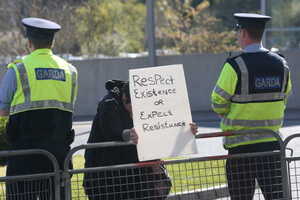
90377429MercilleProtests in Blanchardstown, Dublin last month and Julien Mercille (above)

It’s Monday.

It’s 9.32am.

Do not hit ‘snooze’.

It’s Mercille on Monday at 9.32am.

Dr Julien Mercille writes:

Governments are not moral entities. Water charges policing has given us quite a few demonstrations.

This week the government announced that it is moving to introduce new legislation allowing Irish Water to collect the water charges from those who refuse to pay from their welfare payments or wages.

The government says this will only apply to those who do not want to pay, as opposed to those who are not able to pay. But how do you determine if someone is truly not able to pay, or refuses to pay?

Who knows, but we can bet it will involve hiring an army of consultants and lawyers to ponder over the question, come up with a (flawed) scheme, implement it, monitor it, review it, etc.

The cabinet has also approved a proposal that those who haven’t paid their water charges will not be able to sell their house until they pay what they owe Irish Water. Finally, another plan is to allow landlords to deduct the charges from tenants’ deposits.

Such measures reveal how authoritarian and anti-democratic the government is. It will simply come up with any scheme needed to do what it wants to do.

The government spin on the new measures is that they are “good news” because they mean that nobody will be jailed for not paying the water charges.

That this is presented as a generous move displays the very low standards of morality which characterise the Irish state. While at it, we should also rejoice that imprisonment for life has also been ruled out for those who won’t pay the charges.

Justice is elusive in this state. Punishment is reserved for those who oppose government power, whereas those who defend it are handsomely rewarded and live comfortably. In recent weeks we have witnessed, among other things:

– Six police officers going to Paul Murphy’s house before 7am to arrest him without warning. Three others were also taken in relation to Joan Burton’s two-hour captivity in her car. In total, 23 people were arrested following the Jobstown protest.

– Five protesters were given jail sentences for 56 days (Damien O’Neill, Paul Moore) and for 28 days (Bernie Hughes, Derek Byrne, Michael Batty) for crossing a 20-meter perimeter around the workers installing water meters (they were freed after a little more than two weeks in jail).

– Joan Collins TD was arrested along with 12 others for demonstrating as Irish Water was installing a meter.

And we can add to this: arrests related to Shannon airport while government officials still roam free even if facilitating US militarism; the fact that bankers who played a direct role in bringing about the economic crisis are still free while banks are attempting to repossess thousands of ordinary people’s houses across the state; that TDs and ministers who have shattered the lives of so many by implementing austerity are either still in office or comfortably going about their business.

This only confirms the pattern that the rule of law is political and geared towards protecting those in power.

Indeed, some Garda leaders seem aware of the political nature of the policing going on in the state. In a job interview, Garda Commissioner Nóirín O’Sullivan asked a candidate about his views on “left wing political extremism in Ireland” and on left wing politicians. The candidate said he was “taken aback” and “uncomfortable” with such types of questions, and understandably so.

Moreover, the Garda Representative Association complained that there was a “sinister and dangerous element” in the protest movement and that “anti-water-charge protests are taking valuable resources away from the investigation of crime”— excluding state crimes, of course.

The Garda Association said it wanted to be better armed, for example with Uzi submachine guns and Taser guns. That’s worrying.

When she got arrested, Joan Collins TD said “I break laws that are immoral”. This is seen as outrageous by respectable politicians, but in that, it only follows a long tradition of peaceful civil disobedience which has won rights for people around the world. Many have made similar statements, of which a sample:

“One has a moral responsibility to disobey unjust laws.”
-Martin Luther King Jr.

“Protest beyond the law is not a departure from democracy; it is absolutely essential to it.”
Howard Zinn

“If it is of such a nature that it requires you to be the agent of injustice to another, then I say, break the law.”
Henry David Thoreau

These are people who, if still alive, would be at the water protests—and would probably all be arrested.

@JulienMercille is lecturer at UCD and the author of The Political Economy and Media Coverage of the European Economic Crisis: The Case of Ireland (2015, Routledge). His new book, Europe’s Treasure Ireland (Palgrave), will be out in July 2015.