This afternoon.
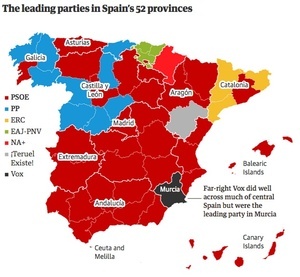
The Socialist Party (PSOE) of caretaker Prime Minister Pedro Sánchez won the highest number of seats but fell short of an absolute majority at the repeat general election in Spain on Sunday.
With around 99% of the vote counted, the PSOE had taken 120 seats – three fewer than the result it managed at the April 28 general election. The conservative Popular Party (PP) won 87 seats – a major gain from the 66 seats it secured in April, its worst result ever.
But far-right group Vox saw the most significant rise, jumping from 24 to 52 seats, to become the third-largest party in Spain’s lower house, the Congress of Deputies.
Socialists win repeat Spanish election, Vox becomes third-biggest force in Congress (El Pais)
Meanwhile…
Across Europe and beyond, as an increasingly fragmented political landscape becomes more polarised and voters increasingly see issues of identity, not the economy, as the key battleground, countries are finding elections no longer have clear outcomes.
Sometimes, this can mean no government can be formed at all: Spain has been ruled by Sánchez’s caretaker administration since April and that looks likely to continue for some time. Another example is Israel, where elections in September failed to resolve the deadlock left by equally inconclusive polls in April.
Other times, coalitions can be built, but only after increasingly difficult negotiations: the Netherlands (208 days) and Sweden (more than four months) set new records in 2017 and 2018. Belgium has now been 170 days without a government, though that is still some way off its 541-day record after the 2010 elections.
Why is this happening?
In part because, from Germany to France, Italy to Austria and Spain to Sweden to Israel, fewer and fewer people are voting for the big, broad-church centre-right and centre-left parties that have dominated their respective national political stages since the end of the second world war.
Spain’s PP and PSOE would once garner 80% of the vote between them; they managed barely 48% on Sunday. In the Netherlands, the three big mainstream parties scraped barely 40% together at the previous general election – roughly the proportion that any one of them might previously have expected.
Spain stalemate shows inconclusive elections are the new normal (The Guardian)
Graphic: The Guardian