

Comprehensive.
Joe Cleary writes:
“The HSE’s website for Mental Health Services for Louth, on today, World Suicide Prevention Day. It’s blank…”



Comprehensive.
Joe Cleary writes:
“The HSE’s website for Mental Health Services for Louth, on today, World Suicide Prevention Day. It’s blank…”

Anon writes:
My husband was phoned today by his GP’s secretary who informed him that funding for Heartwatch has been withdrawn and the service has been discontinued with immediate effect.
Anyone?
Patients in Heartwatch proven less likely to die (Priscilla Lynch, Irish Medical Times, 2012)
Pic: Wikipedia


A timeline of events surrounding the refusal of abortion to an asylum seeker who said she had been raped, according to versions given by the HSE and The Irish Family Planning Association.
They can’t all be telling the truth.
January 2014: The Protection of Life During Pregnancy Act 2013 comes into force
Section 9 of the Act provides that it shall be lawful for
– an obstetrician at an appropriate institution (a list of which in the Schedule to the Act includes most hospitals within the State)
– to carry out a medical procedure in respect of a pregnant woman in the course of which, or as a result of which, an unborn human life is ended
– where three medical practitioners (an obstetrician and two psychiatrists) having examined the pregnant woman, have jointly certified in good faith that there is:
(i) a real and substantial risk of loss of the woman’s life by way of suicide, and
(ii) in their reasonable opinion (being an opinion formed in good faith which has regard to the need to preserve unborn human life as far as practicable) that risk can only be averted by carrying out the medical procedure.
February 2014: The woman in this case conceives, allegedly due to a rape in her country.
March/April 2014: The woman arrives in Ireland claiming asylum.
Early April 2014: Pregnancy identified during routine refugee medical assessment by Health Service Executive. HSE nurse refers woman to Irish Family Planning Association (IFPA) for confirmation of pregnancy and advice.
Pregnancy confirmed by IFPA.
The woman informs IFPA that she is not capable of going through with the pregnancy and could die because of it. IFPA informs woman that abortion is available in England up to 24 weeks but that documentation would have to be arranged in order for her to travel for England and that this process would take six weeks.
A subsequent hospital scan finds that the woman is 8 weeks and 4 days pregnant which even allowing for a six week delay in processing travel documentation should permit an abortion in England within the 24 week time limit. Documentation is completed by IFPA and submitted and the woman believes the process is underway.
Late May 2014 (14-15 weeks pregnant): The woman is informed by an IFPA counsellor that although it is not too late for her to have an abortion in England which it is stated can be carried out at up to 28 weeks (in fact the deadline in England is 24 weeks but the woman is still well within that limit) the cost of the abortion ‘could be’ over €1500 Euros (including travel, abortion and possible overnight stay’) and that the State would not fund these costs.
The woman is told the problem is money.
She does not appear to have been given details of charitable organisations in the United Kingdom, which fund abortions for impoverished women. The woman then states: “I could die because of this pregnancy.I am prepared to kill myself.” That evening, the woman attempts suicide, but is interrupted.
Contact between the IFPA and the woman apparently breaks down after she is moved to a new accommodation centre within the direct provision system.
Around this time, the IFPA make contact with the HSE nurse who initially referred the woman alerting that nurse to her deteriorating mental health. It is unclear whether or not the question of termination under the 2013 Act was discussed in this phone call. It does not appear to have been discussed with the woman by the IFPA.
Mid/Late July: The woman goes to a General Practitioner, explains the situation and states that she is suicidal. She is subsequently admitted to a psychiatric hospital and is interviewed by two psychiatrists. Her pregnancy is confirmed at 24 weeks and 1 day – too far progressed for abortion in the United Kingdom.
July 25- 27: Woman commences thirst and hunger strike.
Care order obtained permitting hydration.
Panel of three experts convened. Current reports ( “the woman’s request for a termination on the basis of suicidality was acceded to” HSE) indicate that the panel was in agreement that the woman was suicidal, and that the pregnancy would be terminated (although initial reports indicated that the expert panel’s decision was not to terminate, due to the objections of the obstetrician on the panel).
July 28: The woman informed that abortion would be carried out the following Monday, August 5
July 30-August 2: The woman is informed that termination to be by way of Caesarean:
According to an interview with her in the Irish Times, she was told “The pregnancy was too far. It was going to have to be a Caesarean. In the world, in the United States, anywhere, at this point it has to be a Caesarean.”
In fact this is not correct.
Methods of late term abortion in the United States and elsewhere involve non-Caesarean procedures such as dilation and evacuation and intact dilation and extraction. Both of these procedures, in contrast to Caesarean section, involve the death of the foetus.
It should however be noted that the medical procedure contemplated by Section 9 of the 2009 Act, which the HSE has stated was assented to, also necessarily involves, by definition, the death of the foetus.
The HSE has stated that “it is important to note that a pregnancy can be terminated by way of delivery through Caesarean section.”.
However Section 9 does not permit ‘termination of pregnancy’. What it permits is ‘a medical procedure in the course of which, or as a result of which, an unborn human life is ended’.
A finding that Section 9 was applicable necessarily meant that the woman was entitled not just to a ‘termination’ of pregnancy, but to have that pregnancy terminated in a way involving the death of the foetus. This appears to be something, which has been misunderstood or ignored by the HSE both in the information provided to the woman and in their subsequent statement of this week.
August 5: Following a meeting with an obstetrician, the woman consented to a Caesarean. As stated, irrespective of the fact that the woman was being told that a Caesarean was her only option, it would appear that if a decision had been made under Section 9 she was entitled, by reason of the wording of Section 9, to another method of termination.
Conversely, if a decision had not been so made, she was entitled to be informed of her right of appeal. Neither of these matters appear to have been communicated to her prior to her giving consent to the Caesarean.
August 6: Caesarean carried out.
On the above timetable, the woman should have been over 25 and quite possibly over 26 weeks at the time the procedure was carried out (on the basis that she had been one day over the 24 week limit for obtaining an abortion in England prior to starting her thirst and hunger strike on Friday July 25).
However a report in the Irish Independent describe her as 23-25 weeks at the date of the Caesarean.
August 13: The woman is released from hospital.
August 16 – 21 : The woman’s story breaks in The Irish Independent. Initial reports indicate that the woman’s application under Section 9 of the 2013 Act was refused.
This is subsequently denied by the HSE who state that the application was successful and that the procedure was carried out by Caesarean. As stated above, this appears to be inconsistent with Section 9 itself.
Anyone?
(IFPA/HSE)
BREAKING: The patient suspected of having #Ebola virus in Ireland will arrive at Mater isolation unit this morning http://t.co/V7m7P4TxpF
— TheJournal.ie (@thejournal_ie) August 15, 2014
Alternatively….
The HSE has said there are no confirmed, or suspected, cases of Ebola in Ireland. More follows #ntfm — Newstalk 106-108fm (@NewstalkFM) August 15, 2014
The HSE has said there are no confirmed or suspected cases of Ebola in Ireland
— RTÉ News (@rtenews) August 15, 2014
Any excuse.
HSE denies report of suspected Ebola case in Ireland (RTÉ News)

Alan Daly writes:
“Received this during the week. Not only has Ms C Kelly been deceased for the past 7 years, she also never received any ‘continence products’…”
Right so..




[At a press conference earlier to release the report into maternity deaths at Portlaoise Hospital were from top: Natasha Molyneaux who lost her son Nathana and Health Minister James Reilly; Mark Molloy and Rosin who lost their baby Mark from left: solicitor Rachael Liston, Shauna Keyes who lost her baby Joshua Keyes Cornally and Shauna’s mother in law Margo Mills; Rosin Molly who lost her baby Mark and from left: Chief Medical Officer Dr Tony Holohan, James Reilly and Dr Kathleen MacLellan]
The Clinical Director of the Midland Regional Hospital in Portlaoise has apologised to the parents whose babies died at the maternity unit at the hospital.
In a statement this afternoon John Connaughton said the hospital and staff wish to apologise unreservedly for the unacceptable communication with the families at a time they most needed honesty compassion and kindness.
Asked why the parents of the babies were not told at the time of their death why the children had died, Mr Connaughton said investigations had begun but these investigations did not proceed at the rate they should have and that was unacceptable and cannot happen again.
Apology to parents over Portlaoise hospital deaths (RTE)
Maternity Service At Portlaoise Hospital Unsafe (Irish Times)
(Sam Boal/Photocall Ireland)
 Dr Rhona Mahony, Master of the National Maternity Hospital is getting a ‘privately funded’ top-up of €45,000 in addition to her salary and allowances of more than €236,000)
Mr Kenny [in the Dail this afternoon] said of the of the 44 agencies involved in the HSE audit, seven had replied to say they were compliant, 13 were non-compliant and others either needed more time to respond or needed legal advice.
Mr Kenny said the same rules should apply to senior managers as to those on the frontline.
He was reacting to reports that ten of the country’s State-funded voluntary hospitals and health agencies are breaching official Government policy on pay for senior executives.
Earlier: That’s Why They Call It Fundraising
(Laura Hutton/Photocall Ireland)
Meanwhile…
Well now – of all the CEO/Masters re top-up – the Independent and RTE News picture the only woman, and yes – she is my sister. Sexist much?
— Jane Mahony (@JaneMahony) November 19, 2013
Oh.
 The HSE Children and Family Services has published the Annual Report 2011 and Annual Report 2012 and a series of reports carried out by the National Review Panel (NRP) for Serious Incidents and Child Deaths – showing 38 children in HSE care, or known to the HSE, died in 2011 and 2012. There were 60 deaths in total between 2010 and 2012.
The reports have found there were 15 deaths and one serious incident concerning children in HSE care, or known to the HSE, in 2011 and 23 deaths and one serious incident in 2012.
The report states the HSE were not notified of four deaths which occurred in 2011 until 2012, but that these deaths are included in the 2011 figures.
Of 2011’s 15 deaths:
Eight died by natural causes.
Two died by an overdose.
Three died by suicide.
One died from a road traffic accident.
One died in an ‘other accident’.
Of last year’s 23 deaths:
Nine died by suicide.
Two died from road traffic accidents.
Four died in ‘other accidents’.
Seven died by natural causes.
One died by homicide.
Further details from the reports below:


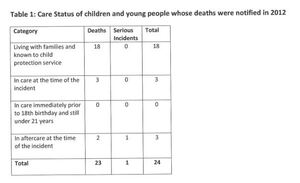
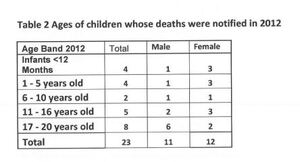
The following table details the total number of deaths of children in HSE care, or children know to the HSE between 2010 and 2012.

Reports in full here
Previously: Of The 36 That Died In Care

Heart sinking stuff.
Rosa Corcoran writes:
The latest comical communication from the Lourdes Hospital in Drogheda. It’s Kafkaesque…Thanks for playing Irish ‘Health Care’ System bingo, do call again. Yours insincerely, anonymous ‘Validation Officer’

Following the case of Maria in Greece, above, Mick McCaffrey, of the Sunday World, is reporting that Gardaí took a seven-year-old blonde-haired, blue-eyed girl from a Roma family in Tallaght, Dublin yesterday and placed her in HSE care.
Mr McCaffrey writes:
“Gardaí received a tip-off from a member of the public that a six or seven year-old girl was living with a large Roma family but looked nothing like any of her supposed siblings.”
“Officers from the child protection unit attached to Tallaght station called to the home on Monday afternoon and spoke with two Roma adults. There were a number of children in the house and one was a young girl who had blonde hair and striking blue eyes. She looked nothing like anybody else in the house but the adults maintained that the girl was their daughter.”
“They were asked to produce a birth certificate but could not find one. In the meantime gardaí made contact with a hospital consultant in and asked if it was possible for Romas to give birth to blonde children, considering their natural dark complexions.”
“The consultant said that this would be extremely unusual.”
Blonde-haired, blue-eyed girl, 7, taken from Roma family in Dublin (Sunday World)
Pic: BBC