
Tag Archives: Irish Water

90310309

The first water meter getting installed in Maynooth, Co Kildare on August 8, 2013

Irish Water should stop installing water meters in homes, the Commission for Energy Regulation (CER) has declared, warning that the cost of completion will cripple efforts to improve water quality and supply.

In a submission to an Oireachtas committee which is investigating options, the CER – Ireland’s water regulator – said finishing the programme was not a priority.

So far 58 per cent of households have had meters put in place – the installation efforts have been strongly opposed in some places – but several hundred thousand properties remain to be linked. No money has been put in Irish Water’s 2017/18 capital budget to finish the work.

Meanwhile…

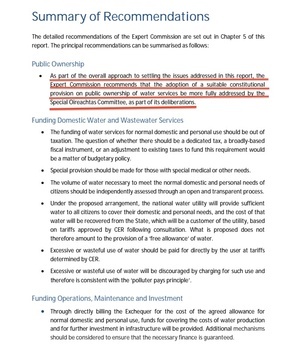
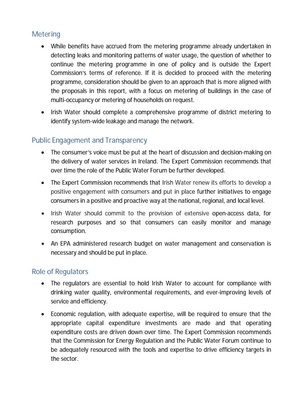
You may recall the publication of the Report on the Funding of Domestic Public Water Services in Ireland by the Expert Commission on Water Charges in November.

Further to this.

Today, at 2pm, the report will be discussed at a meeting of the Joint Committee on the Future Funding of Domestic Water Services.

Representatives of the Department of Housing, Planning, Community and Local Government, Irish Water, and the Commission for Energy Regulation will attend the meeting.

Watch the meeting live, from 2pm, here.

Regulator says Irish Water should not proceed with metering (Sarah Bardon, Irish Times)

Previously: Denis O’Brien, Fine Gael And The Water Meter Deal

Rollingnews

UPDATE:
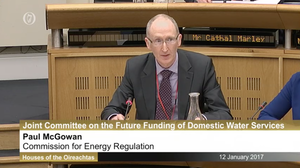
Screen Shot 2017-01-12 at 15.10.54

At the meeting of the Joint Committee on the Future Funding of Domestic Water Services…

Paul McGowan, of the Commission for Energy Regulation (CER), said it is not calling for the installation of water meters to be abandoned completely.

In response to a series of questions from Fine Gael TD Kate O’Connell – in which she queried the CER commenting on water meters and asked why the CER thinks it’s appropriate for the project, which, she said, is 75 per cent finished, to be abandoned…

There was the following exchange:

Paul McGowan: “Specifically, in relation to metering, we were asked the committee a number of questions in relation to metering and that was the basis on which we offered ideas and views in relation to the future of metering, at the committee’s request. So, that was the genesis of those answers.”

Metering is a regulatory matter, I would say. It forms the basis in utility regulation for a large element of charging regimes, right across energy, water and other utilities. We recognise that the first phase of the metering was a decision that was taken by Government and that was [inaudible] so to speak to Irish Water, and to us, as a decision. And future consideration of further roll-out of metering.

“For example, to apartment buildings and those houses, or customers, who haven’t been metered in the first place was always going to be something that we would be looking at, in due course, in the overall cost-benefit, the cost of doing it and what would the benefits be.

“And that ultimately we would have worked with Irish Water to determine what’s the most efficient approach to close out the metering programme. So it is, it is something that a regulator would have a very close interest in.”

Kate O’Connell: “So, would you say, sorry, I probably phrased it incorrectly at the start. What you’re saying is that abandoning, or not abandoning it, stopping it, it’s to do with areas that there’s challenges about the metering, it’s not overall metering?”

McGowan: “Well to come back to that..”

O’Connell: “Yeah, I need you to clarify your statement essentially.”

McGowan:To be very clear, we did not say that we should abandon…”

O’Connell: “Right, okay.”

McGowan: “To be absolutely clear. What we said was that, at this time, to proceed with another major programme of metering investment, given that the, as we see it, the proposal from the expert commission, was that the vast majority of water should be paid by the State and that only excessive use charged to customers. In that context, we said that, at this time, there are other priorities for capital investment but that we can come back and look at whether there was a case for further metering in due course.”

“But in the meantime, there were other options that could be looked at. And that was the context within which we replied to the committee. We did not boldly state that metering should be abandoned. We just said, at this time…”

O’Connell: “Park it.”

McGowan: “Yes…”

Watch the meeting live here

UPDATE:

Speaking about costs…

Mr McGowan said:

Irish Water, at this stage of its evolution, is a high-cost utility. We would expect that because it has inherited 34 different water authorities but our analysis would indicate that they’re up to twice the cost of an efficient utility so what we will be doing over this revenue control, and the following revenue controls, is ensuring that they deliver the efficiencies to get down to the level of efficient operation, a level of cost of an efficient operation.”

90419314
alankellyirishwater_large

From top: Brendan Howlin; from left Former Irish Water head of PR Elizabeth Arnett, Labour TD and former Minister for the Environment Alan Kelly and Pat Tierney, CEO of Irish Water in December 2014

It’s all free water under the bridge.

“We were under the cosh to build a huge utility like Irish Water. To get a national metering programme in place and charge for water in the space of three years, which we just should have said no to. I’m sorry we didn’t.

“Within Government, we certainly had that battle with Fine Gael. At a critical point, the decision we made was to stick with it as opposed to pulling down the Government at that stage.

Because we were afraid of the consequences for our country if we pulled the Government down. But we paid too high a price for that and we should certainly have stood our ground in relation to Irish Water.

“This was one of the things we had to make progress on. Because they were signing off monthly on the paycheck for the nation, in order for us to pay pensions and pay the cost of wages and so on.

“Under normal circumstances, that should have been a ten year project. I certainly think it was handled badly.”

Brendan Howlin, Labour Party Leader in today’s Irish Mirror

Irish Water is Labour’s “biggest regret” while in Government says party leader Brendan Howlin (James Ward, The Irish Mirror)

Lest we forget…

Minister for Public Expenditure Brendan Howlin has said that there cannot be a situation where people decide to not pay their water bill.

It follows on from Environment Minister Alan Kelly’s comments on Monday night, in which he refused to rule out measures that could mean unpaid charges are recouped from peoples’ wages and social welfare payments.

Outside the Dáil fellow Labour politician, Minister Brendan Howlin told UTV Ireland

There can’t be a situation where anyone of us decide not to pay our bills. If you come to a supermarket checkout and decide “Nah, I’m not paying the bill” and walk off – that’s just not the way the system works.”

Minister Howlin: People cannot decide to not pay water bill (UTV March 24, 2015)

Rollingnews

90432804904328169043280890432797

Saturday.

Dublin city centre.

Joan Collins TD joined demonstrators in support of a student who was found guilty on Friday of false imprisonment of Joan Burton TD during the Jobstown protest.

The 17-year-old denied falsely imprisoning the former Tanaiste and her advisor Karen O’ Connell who were allegedly trapped in two garda cars for three hours during the demonstration at the Fortunestown Road in Jobstown in Tallaght in November 2014.

He was aged 15 at the time of the protest. The judge imposed conditional discharge on both charges and will be spared a criminal record.

Friday: If You Tolerate This

screen-shot-2016-09-20-at-11-49-43

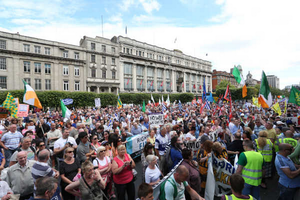
People on the Right2Water rally against water charges in Dublin last Saturday

Diarmaid Ferriter misses the point about the movement against water charges. The key to understanding why hundreds of thousands of people have taken to the streets since 2014 lies not in a discussion about the abolition of rates during the 1970s but in the impact of austerity in this State since 2008.

The communities from which the water protests emerged were those who had suffered most from cutbacks under both Fianna Fáil and coalition governments. They were consistently told that there was no alternative to these policies. But the implementation of water charges was, for many, the straw that broke the camel’s back.

The fact that, despite derision from commentators, the movement not only sustained itself but grew, makes it more likely that people will feel that protest over housing, child poverty and numerous other issues may also be successful.

Anyone who wants to see a “civic-minded Irish Republic” should therefore be applauding those who took part in the largest social movement in this country for decades.

Dr Brian Hanley,
Cabra,
Dublin 7.

Water charges and social protest (Irish Times letters page)

Previously: Torrential

Sam Boal/Rollingnews

90429923dara

From top: Irish Water protest in Dublin city centre on Saturday; Dara Quigley

What I would have told the thousands at Saturday’s Right2Water rally.

By Dublin-born activist and blogger Dara Quigley (full text at link below)

Dara writes:

If it had been possible to blag my way past security and onto the Right2Water stage on Saturday, this is what I would have said:

“They said, when the water charges protest began, that it was a threat to democracy. As a human being, standing in front of a sea of humanity, it’s safe to say, they got that one wrong. We’re the ones saving democracy.

The government, the regime – they’d love to take voices, like mine, out of the equation. Voices at the sharp edge of austerity, voices at the sharp edge of a thousand economic cuts.

Let me save them some trouble. Tonight, I’ll be sleeping in a psychiatric hospital. Up until two months ago, I was dependent on methadone.

I’ve spent most of my life being controlled in one way or another.But, that does not make what I have to say any less important, any less valid or any less legitimate than what comes out of the mouths of the clowns and failed school teachers currently playing at being leaders.

They aren’t even a government. They are a glorified press department for EU officials, civil servants and insiders who operate under a veil of secrecy. Vulture funds and multinationals who operate in a protected environment of shadow economies and brass plates.

But we are seeing through the smoke and mirrors to what lies beneath.

The government, NTMA and NAMA have the cheek to tell us that they are acting in the best interests of the taxpayer. Which taxpayers? Because the people benefiting the most don’t seem to be paying much, if any, tax or contributing anything to this society.

We have a state broadcaster RTÉ, the R must stand for Regime because the state is the people.

RTÉ is outsourcing its responsibilities to the BBC. It took the BBC highlighting money bags changing hands to expose the corruption of NAMA. Selling our country off to vulture funds for the benefit of a select few….

…Natural diamonds are formed under extreme pressure and time. This regime has created a generation of diamonds who sparkle because of their flaws, not in spite of them. Diamonds are also tough and if you think feet on the street scare this government, voting terrifies them.

It’s time to take our responsibilities as citizens seriously. I’ve been to hell and back but the devil met his match and there is nothing in any of this to be afraid of, unless you have something to lose and that isn’t anybody standing here today.

…I know how much voting terrifies this government, I tried to collect more than one voter registration form at Rathmines Garda station. I was told it’s limited to one per person, this is simply not true. Who are the Gardaí protecting by limiting voter registration forms? Certainly not the citizens.

We are taught, from an early age, to fear revolution, we are told it leads to civil war. Does this feel like civil war to you?

Or does it feel like fun? Have some fun, report these crimes, march on your local station to register your whole area to vote and get out next Saturday for Repeal the Eighth march in Dublin.

Our economy and society is modeled on the behaviour of pigeons, survival of the fittest, everybody out for themselves.

The reality is more complex and beautiful than this regime can possibly imagine. In reality, we are more like a flock of starlings, producing intricate, amazing patterns all arising from one fundamental rule: no one bird is allowed to get lost.

This is the type of society I want to see, where no one person is allowed to fall between the cracks, nobody gets lost and no person is homeless. Jobstown are innocent.

Sparkle like the natural diamonds you are.”

Degrees of Uncertainty (Dara)

Pic: Dara

childrenscourt

This morning.

The Children’s Court, Smithfield, Dublin 7.

A protest gathers ahead of the trial of a 17-year-old for ”false imprisonment’ during a sit down demonstration in Jobstown, Tallaght, Dublin in November 2014. Former Tanaiste Joan Burton is listed as a witness for the prosecution.

Friday: Paul Murphy TD: Will You Get Behind Us?

Pic via Anti Austerity Alliance

Screen-Shot-2015-07-28-at-10.52.55

Irish Water protesters outside the GPO in Dublin on June 20, 2015

This morning, the Irish Independent‘s environment editor Paul Melia reports that Irish Water will need approximately €300million from the State to make up the cost of suspending water charges.

He also reported that Irish Water is to rerun its public information campaign to “convince” people to pay.

Mr Melia spoke to Katie Hannon earlier on RTÉ’s Today with Seán O’Rourke show.

From their discussion.

Katie Hannon: “According to documents seen by the Irish Independent, as the phrase goes, the Government has been informed that Irish Water is going to require almost €300million to compensate for the suspension of water charges. The Department of Housing, Planning, Community and Local Government said the shortfall would be made up for in 2016 but haven’t announced their intentions for the next two years. Additionally, Irish Water believes that it is going to have to launch an enormous and costly campaign to convince the public of the need to pay for water services if charges are re-introduced after March of next year when the current period of suspension will have run its course. Paul Melia, environment correspondent for the Irish Independent has been writing about this and he joins me on the line now. Paul, welcome.”

Paul Melia: “Thank you.”

Hannon: “Almost €300million is what you’re saying the cost will be upfront. Can you break that figure down for me?”

Melia: “Certainly, these are financial projections that were provided by Irish Water to the department in June and what they’re saying is that, for 2016, there’s going to be a revenue shortfall of €123million or so. Now this figure isn’t new, we know this figure and that’s basically because charges are going to be suspended, have been suspended for the second half of the year. So, Irish Water says this is the cash shortfall we’re going to have. Now, the Government has said that they will make up that difference and, you might recall, there was a water conservation grant last year which cost €110million. This shortfall of €123million – there’s a gap there of somewhere of €13million, up to €20million that the Exchequer will be able for this year. So that’s all been addressed and sorted out. There’s no funding issue for this year. Where it gets interesting is that Irish Water has come up with two scenarios. A scenario if billing returns next year and a scenario of no billing returns. And what they have said to the department is: if billing resumes from the second quarter of next year, which is expected, or sorry, that’s when a decision will be made, there will still be a revenue shortfall of about €125million now this is because there will be no billing for the first three months, so there’s about €65million or so missing there. And then, also, the balance is made up of they believe that people just won’t pay, that they’re going to have to go back and re-engage with householders and say to them: ‘look, we’re Irish Water, this is the job that we have to do and this is how we have to pay for it’. So, their public information campaign starts all over again.”

Hannon: “And tell me Paul, before I let you go any further, remind people how much has already been spent on convincing people that they need to pay for water?”

Melia: “Well I mean there’s been two, certainly in May, there was a report, Irish Water had spent about €350,000 on outside public relations, this was on top of their fully-staffed press office which I think has three people in it. And then there was an expensive advertising campaign last year as well which talked about basically how water came from the clouds to the tap essentially, that cost about €650,000 or so. So there’s about €1million all in, there’s probably more than that. But that’s certainly, more or less, what’s been spent to date. So, they’re talking about rerunning a lot of that stuff again. If the charges come back in…

Hannon: “Of course, just to stop you there again, ‘if’ is a very big if there, isn’t it? Because certainly the political temperature would indicate that that is a very big if.”

Melia: “It certainly is. I mean I think more than 100 TDs in the Dáil are opposed to water charges in any way shape or form and this expert commission that the Government has established, that’s meant to look at the long-term funding model for Irish Water, in other words, how will the day-to-day operations, which cost in or around €1billion a year, plus the capital expenditure programme be funded. They’re due to report back at the end of March of next year. And then they will recommendations with the Dáil committee. That Dáil committee then will examine that and it will make recommendations to the Dáil itself and it will be put to a vote. So TDs will ultimately decide whether or not domestic water charges are reintroduced or whether they’re abolished permanently. As you said, the political temperature at this stage certainly is that they’re not going to be reintroduced.

Listen back in full here

Irish Water needs €300m to make up for loss of charges (Irish Independent)

Rollingnews