

Gulp.
Donagh writes:
Luckily, I decided to have a glass of water before I made my morning coffee! Top notch water quality in Cork city, as usual…



Gulp.
Donagh writes:
Luckily, I decided to have a glass of water before I made my morning coffee! Top notch water quality in Cork city, as usual…



From top: IBRC logo; Senator Michael McDowell; Tom Hunerson
Yesterday.
In the Seanad.
Senators discussed the Commission of Investigation (Irish Bank Resolution Corporation) Bill 2016 which is at its second stage.
This is the Cregan commission which is examining sales of assets by State-owned IBRC, including the sale of Siteserv to Denis O’Brien €45.4million, while Siteserv owed Anglo €150million.
During the Seanad discussion, Senator Michael McDowell said the following:
As Senator Diarmuid Wilson stated, this commission of investigation arises mainly out of the Siteserv controversy. It is notable that on 25 April 2015, the former chairman of IBRC [Alan Dukes] stated that the board had rejected a Department of Finance proposal to appoint a senior civil servant to the board on the basis that such an appointment would be unsuitable.
In the same article in The Irish Times, he stated a Mr Woodhouse had been kept out of discussions regarding Siteserv because he personally handled Mr Denis O’Brien’s relationship with IBRC. He stated a different executive in IBRC, Mr Tom Hunersen, had handled the Siteserv transaction.
This is worrying because, three years earlier, a posting (in comments) appeared on the broadsheet.ie website suggesting Mr Aynsley, Mr Hunersen and Mr O’Brien were socialising together at the time when the transaction in case was taking place.
It is also worrying that Mr O’Brien was reported in 2014 by The Irish Times as having made a major investment in a Massachusetts-based IT firm in which Mr Hunersen was one of the moving parties. The former chairman of the IBRC claimed Mr Woodhouse had stepped aside from this transaction.
He seems to have re-emerged recently in the context of the story in The Irish Times that many Members of this House read last week. Again, the question arises as to whether there is a connection between him and Mr O’Brien.
A more fundamental question arises as to who is organising the campaign of intelligence-gathering of Mr [Mark[ Hollingsworth, the so-called journalist engaged in coming to Members of this House, among others, and passing himself off as one seeking to identify the source of leaks about Mr O’Brien’s dealings with IBRC. These are very serious issues.
This matter is particularly relevant because, according to the story in The Irish Times, a major British security firm was the recipient of the material collected by Mr. Hollingsworth in Dublin.
We heard later, according to evidence given in the High Court, that a USB key appeared on the desk of Mr O’Brien and that he, for the first time, discovered the material that Mr Hollingsworth was privy to in Dublin.
The use of an English security firm in this respect is not a new phenomenon in Ireland. We should remember also that there was elaborate industrial espionage and surveillance in the context of the takeover of the Independent News & Media group at the time between the O’Reilly interests and the O’Brien interests, if I may use that term.
In that case, newspaper reports indicated that 11 operatives operating from a Dublin hotel were engaged in fairly extensive surveillance of the then managing director of Independent News & Media and that it was eventually determined that an English espionage firm or intelligence-gathering firm called Esoteric lay behind that.
Surprisingly, Independent News & Media, which later came under the control of Mr O’Brien, largely speaking, has been unable to work out who commissioned that investigation.
I am also worried in another respect. It was reported in the media that Irish Water had concluded an extensive contract with a company in the Isle of Man [Another 9 or A9 Business Recovery Services] chaired by Mr Leslie Buckley and, in which, Mr Denis O’Brien was a large investor. He is described in its publicity material as a leading Irish entrepreneur.
The function of that company is to advise Irish Water against the hacking of its sites. It appears the main business of this company in the Isle of Man, which is owned by Mr O’Brien and chaired by Mr Buckley, an associate of Mr. O’Brien, concerns computer security and countermeasures against computer hacking.
Although no particular figure was put on the computer security services of Irish Water, it is interesting that it was suggested in the media at the time that, over five years, €1.2 million was spent on this kind of activity on the part of Irish Water.
One must bear in mind also that at least one of the newspapers controlled by Mr O’Brien has, since the emergence of the dispute about water charges and the legislation we considered in this House some days ago, run a fairly heavy campaign, with many editorials and articles, on the subject of Irish Water. This is a serious matter.
I will finish on two points. Last week in a different context, although Mr O’Brien had a walk-on part in it, the Ceann Comhairle, as Chairman of Dáil Éireann, publicly queried whether it would be necessary to introduce a system of fines to strengthen the powers of the Chair to prevent the abuse of Dáil privilege.
This House has its own Standing Orders, its independence and its own Committee on Procedure and Privileges.
As a member of that committee, I do not believe Members of this House are disposed to abusing their privilege at all, nor do I believe the use of financial penalties to preserve the privacy of important people the Irish political and economic environment should be permitted by this House. I do not believe we should go down that road. It is for the other House to make up its own mind on fines for its Members.
We must remember that these Houses are the defendants in a court action brought by Mr O’Brien. He has sued the institutions of this State. He has also sued individual Members of these Houses on occasion and has threatened to do so on many more occasions.
Free speech is very important. As far as I am concerned, the Cregan commission is dealing with just one set of issues, the activities of the IBRC, only some of which involve Mr O’Brien or companies connected with him.
However, there are other major issues to be borne in mind arising from the Moriarty report, which found Mr O’Brien had indirectly channelled the guts of €1 million to former [Fine Gael] Minister, Deputy [Michael] Lowry, after the awarding of a telecommunications licence to him.
It found that elaborate efforts to deceive the Moriarty tribunal had been made, including the falsification of letters to cover up the involvement of the relevant parties. I wish all speed and every success to the Cregan commission.
I welcome this legislation. Members have an obligation to be fair but not to be entirely impartial but it is important that these issues be dealt with in a process that is fair and impartial and, above all, has the means of establishing the truth, because the Irish people do deserve the truth.
Transcript via Oireachtas.ie
Previously: The Journalist Who Came In From The Cold

Joe O’Toole expected to resign as chair of the expert commission later this afternoon. @IrishTimes
— Sarah Bardon (@SarahBardon) July 5, 2016
That’ll learn him.
We Have To Pay For Water, Says Charges Overview Chief (Irish Examiner, July 4, 2016)
Rollingnews

You may recall previous reports detailing how Irish Water spent €16million on extending its lease – by 10 years – at its Colville House, Talbot Street, Dublin 1 headquarters just three days after the general election.
Further to this…
Irish Independent reports:
Jerry Grant has been appointed managing director of Irish Water. The former head of asset management in the utility, he replaces John Tierney who was the company’s first boss.
… Ervia group chief executive Michael McNicholas said Mr Grant brought 40 years of experience to the role.
You may recall how Mr Grant was managing director of RPS Consulting Engineering from 2002 until 2012 – before he joined Irish Water in 2013.
Mr Tireney was Dublin City Manager from 2006 to 2013.
RPS advised Dublin City Council on the Poolbeg incinerator project which has to date cost the State almost €100million with more than €30million going to RPS, even though the original contract was for €8.3million.
The EU found the contract between Dublin City Council and RPS did not conform with EU law.
Good times.
Jerry Grant replaces John Tierney as new Irish Water boss (Irish Independent)
Previously: Chief Running Water

From top: Irish Water bill; Brendan Ogle
But will the 32nd Dáil subvert its democratic mandate to keep Irish Water running?
Brendan Ogle writes:
When Right2Water exploded onto our streets on 11 October, 2014 as the umbrella campaign for the anti-water charges movement a promise was made.
Unusually in Irish public life this promise was kept.
The promise was that Right2Water would be around AT LEAST until the next election seeking the abolition of the regressive double water tax. We also promised that this would be the number one issue in the next election.
For a year and a half commentators and establishment politicians sneered at these claims and repeatedly told us that the campaign had dissipated.
After election 2016 nobody is sneering.
What seemed unlikely, or even impossible, has happened. Labour have been humiliated by their traditional voters and Alan Kelly has been humiliated by what remains of Labour.
Fine Gael have lost one third of their seats and the two large right wing ‘Irish Tory’ parties, Fine Gael and Fianna Fail, can’t even claim that they command the support of a majority in this divided state combined. Seismic change.
Irish Water has been rejected in the polls and, politically and financially, is a beaten docket with charges now suspended. Irish Water, and the privatisation agenda that it represents, has been beaten up, but it is not yet beaten.
Last week Fianna Fail failed to deliver on its electoral commitment to abolish the super quango when given the opportunity in a Dail vote.
Fianna Fail joined a long list of 59 TDs who either abstained on this vote or were unavailable. Even worse, however, is that the vote was carried by 60 TDs vs. 39 TDs and the 60 even included John Halligan and Finian McGrath as Independents.
So, for now, Irish Water continues to function on life support. It’s time to pull the plug.
The day before this vote I attended a very positive meeting of the three Right2Water pillars. This involves trade unions, political parties and independents, and also community activists, working together to seek abolition of Irish Water.
These three strands worked together since 2014 and delivered the largest (per capita) and most peaceful protest movement anywhere in the world today.
Our objectives are simple. We want Irish Water abolished and replaced with a single national water and sanitation board funded through progressive general taxation.
We also want public ownership of the public water supply protected in a new Article 28 Section 4:2:1 of our Constitution to read:
‘The Government shall be collectively responsible for the protection, management and maintenance of the public water system. The Government shall ensure in the public interest that this resource remains in public ownership and management.’
This will require a referendum and in the coming weeks a Bill sponsored by Joan Collins TD and signed by Sinn Féin, PBP, AAA and other Independents goes before the Dail proposing exactly that.
Since the beginning public debate of the Irish Water issue has been conducted as if a fiction were true. That fiction is that Irish Water, the meters and the billing system is not about privatisation.
All across the globe vulture funds and corporates are taking ownership of public water supplies and turning our human Right2Water into a right to profit for the 1%. They are turning that which we need to live into a commodity that they can turn off and deny to citizens at will.
Apart from ‘financial services’ nothing delivers bigger profit margins for these vultures than our life sustaining water.
From Bolivia to Berlin, and from Portugal to Portroe corporate interests have ensnared politicians to do their bidding and hand the people’s water over to them.
But the people have fought back and prevented this happening or even won water back through re-municipalisation as has happened in Bolivia, Berlin and Paris for example.
Water in Paris and Belin were both re-municipalised in 2014 following rising bills, lack of investment in new infrastructure and public pressure.
The Cochabamba water war took place in Bolivia’s third largest city in 1999 and 2000. A community coalition ‘Coordinadora in Defence of Water and Life’ won after public protests which saw one protestor killed. The privatisation was reversed.
Of course, on the rare occasion that the media have put this to them, politicians in Fine Gael, Labour and the Greens have rejected the argument that they are engaging in a privatisation quest.
And they have been allowed to issue bland denials of what is blindingly obvious without being held accountable.
That is now about to end. If privatisation is not the agenda behind Irish Water then this ‘Government’ can save itself no end of trouble by simply supporting Joan Collins’ bill when it goes before the Dail.
I personally believe that the expected failure of Fine Gael to support this bill, or further obfuscation by Fianna Fail or Shane Ross’s ‘Independents’ that prevents this vital bill from being passed, will be a subversion of the democratic mandate of the 32nd Dail that will require a response.
This Government is barely a Government at all and it is already hanging by a thread before it has even begun.
People power led to a massive change in the electoral shape of Ireland in the February election. I don’t believe for one minute that the necessary change is complete.
In fact I believe it has only just begun.
Brendan Ogle is Unite Trade Union and Right2Water Co-ordinator


Oh.
Last night.
Leinster House , Kildare Street, Dublin 2
An Irish Water protestor attempts an impromptu interview with former Minister for the Environment Alan Kelly with unwelcome consequences.
Sam Boal/Rollingnews
Meanwhile…

Fair enough.
Sam Boal/Rollingnews


Paul Murphy tweetz:
Freedom Of Information figures from Irish Water. 21% drop of revenue in last quarter, non-payment over 50%.
Irish Water says over 20% drop in bill payment (RTE)
Previously: Water Cooler


Further to reports that Irish Water spent €16million on extending its lease – by 10 years – at its Colville House, Talbot Street, Dublin 1 HQ.
Three days after the general election.
Niamh Brennan, the Michael MacCormac professor of management and academic director of the UCD Centre for Corporate Governance, writes in today’s Irish Times:
As it is, the governance of Irish Water is unusual, in that it is structured as a wholly owned subsidiary of another State body, Ervia (formerly Bord Gáis Éireann).
Initially, the board of Irish Water comprised 14 directors, of whom 10 were independent non-executive directors (ie, they did not work in Irish Water on a day-to-day basis) and four were executive directors.
Then, the minister for the environment at that time, Alan Kelly announced he would be putting in place a new unitary board, combining Irish Water and parent company Ervia.
…By the end of November 2014, all the non-executive directors were gone, leaving Irish Water with a solely executive board, comprising (according to the 2014 financial statements) Michael McNicholas, chief executive of the parent company, Ervia; John Tierney, managing director of Irish Water; Brendan Murphy, Ervia group finance director; and Michael O’Sullivan, Ervia group commercial regulatory director.
Thus, there is currently no direct non-executive oversight of these four executive directors on the board of Irish Water. Instead, Irish Water is subject to the control and oversight by the board of Ervia, its parent company.
The position of chairman of Ervia is currently vacant, following Rose Hynes’s resignation in October 2015. How can the board of Ervia be operating effectively without a chairman?
In November 2015, Irish Water announced that John Tierney would be stepping down as managing director at the end of April 2016.
Who is Irish Water’s managing director now? Does Irish Water currently have a managing director?
There is a large section on Ervia’s website on transparency, including web pages for Ervia and Irish Water board meeting minutes. These web pages are empty. Transparency indeed.
Lifting lid on Irish Water reveals unusual governance (Niamh Brennan, Irish Times)
Related: Irish Water extended HQ lease by 10 years in €16m deal (Fiachra Ó Cionnaith, Irish Examiner)
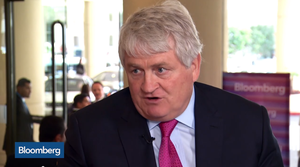
Denis O’Brien speaking on Bloomberg earlier today
Denis O’Brien did an interview with Bloomberg earlier this morning in which he talked about Digicel, the IPO which didn’t happen, Google and Facebook.
Towards the end of his interview, Mr O’Brien spoke about Irish Water.
Presenter: “A final question and this goes away from telecom, Google and Facebook, what are your views on the delays of forming an Irish Government?”
Denis O’Brien: “Well, it has been fraught, it hasn’t worked out as well as it should. I think the Government were wrong to back down on the water, Irish Water. You know they, it was the right thing, all the infrastructure is Victorian for the supply of water in Ireland, people have a lot of, they have free water in many, many cities in Ireland so it… they gave up on that and set up a commission to evaluate what they should do with Irish Water so that’s kicked in the air and down the field whereas it should have actually stayed. And the investment, you know, there’s an investment programme of between €3bn and €4bn that was supposed to go into that – that now is under question.”
Presenter: “So what parties would you like to see in power?”
O’Brien: “Well I really don’t care who’s in power but I think there needs to be stability in Ireland, I would have a concern if there’s a lack of stability that will affect foreign direct investment and, you know, it’s a time in Europe where there’s a lot of unsettling things that are happening. You’ve got Brexit, you’ve got immigration, you’ve got a very polarised Europe…”
Watch the interview in full here
Irish Billionaire O’Brien Says Government Water Climbdown Wrong (Bloomberg)
Irish Billionaire O’Brien Holding Off on Digicel IPO for Now (Bloomberg)
Preview: Denis O’Brien And THAT Siteserv Deal

An independent water commission? Is the “Great Irish Fudge” now being served up with mugs of Irish Water? This traditional political confection contains generous amounts of common and exotic nuts.
It looks inviting, tastes sweet at first, but has a sticky consistency, a bitter aftertaste and inevitably costs more than the initial price tag suggests.
Regularly repackaged to appeal to the whimsy of its target market, its familiar scent wafts once again from Ireland’s “can’t stand the heat” political kitchens. As any time-pressed chef knows, serving up a tried and tested favourite, when all that’s left on the menu are old chestnuts and red herrings, guarantees at least some measure of reprieve in the last-chance saloon.
Patricia Mulkeen,
Ballinfull,
Co Sligo.