
Tag Archives: Julien Mercille

CHsMDIjWgAAVTA5

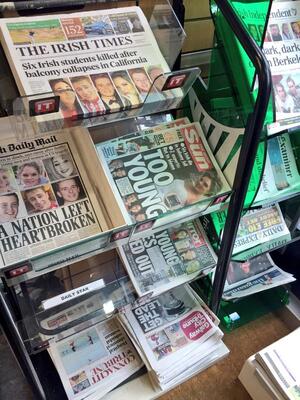
Dr Julien Mercille addresses the lack of coverage of the the 500 suicides caused by austerity, according to a major Irish study released on the same day of the Berkeley tragedy.

Dr Mercille writes:

On Tuesday, we learned about two tragedies: one has received extensive coverage, but the other has been ignored by the Irish media.

The first tragedy is, of course, the six Irish students who died in Berkeley, California, due to the collapse of a balcony, while away in the United States for the summer.

The second tragedy is that austerity and recession have resulted in 500 deaths by suicide in Ireland between 2008 and 2012, according to a major study by a team of researchers at University College Cork released two days ago [1].

Those are “excess” suicides, i.e., suicides that happened on top of the number of suicides that would have been expected if pre-recession trends in suicide rates had continued unchanged after 2008. As I write this, the study got zero mention in the whole Irish media except for one short article in the Irish Examiner.

The study confirms that economic crisis and austerity have led to higher numbers of suicides in many countries. Previous research had looked at 54 countries in Europe and the Americas and estimated that there were 4884 excess suicides in those countries in 2009 when compared to previous years.

Another report found that over 1000 excess suicides happened in England in 2008-2010. In Spain, the economic crisis has led to an 8% increase in suicide rates. In Greece, suicides appear to have risen by more than 60% since 2007. In the United States, between 2008 and 2010, there were 4750 more suicides than expected.

The Irish study found that the bulk of the 500 excess suicides are accounted for by men (the rate of suicide for women has been little affected by the recession and austerity).

One reason is most likely the loss of men’s construction jobs in the wake of the housing bubble collapse, which has led to unemployment and mental health problems that can lead to suicide.

However, there have also been 5029 more male and 3833 more female cases of self-harm (excluding suicide) than if pre-recession trends had continued, and thus women also have felt negative consequences.

The Irish media gave us a lot of details about the students killed in Berkeley, including individual profiles, pictures, and testimonies.

But we know nothing about the 500 people who killed themselves out of desperation or for any other reason under austerity. We don’t know their names, their faces, their families, what they were doing, or the circumstances of their deaths. We don’t even know they died.

How can the difference in media attention be explained? The main reason is very simple: talking about the deaths of 500 people by suicide under austerity automatically points the finger at the governments and politicians who have implemented such a policy, in Ireland and Europe. It also points a finger at the media, which has actively supported the policy. The media has thus little interest in talking about it, just like it has little interest in documenting the negative consequences of austerity in general.

On the other hand, talking about the Irish students who died in Berkeley leads to no such accusations. It’s a tragedy, period, and therefore makes it to the front pages.

[1] Corcoran P, Griffin E, Arensman E, Fitzgerald AP, Perry IJ (2015) Impact of the economic recession and subsequent austerity on suicide and self-harm in Ireland: An interrupted time series analysis. International Journal of Epidemiology (advance access here).

@JulienMercille is lecturer at UCD and the author of The Political Economy and Media Coverage of the European Economic Crisis: The Case of Ireland (2015, Routledge). His new book, Europe’s Treasure Ireland (Palgrave), will be out in July 2015.


90381253

julienm-226x300

Denis O’Brien, top, and Dr Julien Mercille, above

He’s redacted everyone.

EVERYONE!

But NOBODY gags Julien Mercille.

(unless you ask his permission first and use the ‘secret’ word)

Dr Mercille writes:

Last week in the Dáil, Catherine Murphy TD talked about Denis O’Brien and his dealings with IBRC. What she said is obviously of public interest, because the State owns the bank, and we’re thus entitled to know how it is dealing with its customers.

Ms Murphy said a couple of interesting things:

-IBRC apparently made loans to Denis O’Brien on favourable terms, like charging him an interest rate of 1.25% when IBRC could have charged 7.5%. If true, this means a significant loss for IBRC, because we’re talking about loans of up to €500 million.

-The former CEO of IBRC apparently made a verbal agreement with Denis O’Brien to allow him to extend the terms of his expired loans. This verbal agreement never went through the credit committee for approval.

These statements were published on the parliament’s website, so anybody can read them there.

But Denis O’Brien is not happy with the statements being circulated, so he’s now claiming that no media outlet can report them because he has a court judgment (injunction) that says so. But we don’t even know what this court judgment says, because it hasn’t been released.

Nevertheless, most media outlets in the country have chosen not to publish Catherine Murphy’s statements for the moment. They will now ask the courts this week if it’s OK to do so.

The legal issue seems to boil down to this: normally, the Irish Constitution (Article 15.12) allows the media to publish whatever is said in the parliament. But now, there is this court injunction in favour of Denis O’Brien that says the opposite. In short, the issue is: Who has priority, Ireland’s Constitution, or Denis O’Brien? Lawyers will argue over this one and we might know the outcome of their debates in the next few days.

A few points are worth bearing in mind to contextualize the whole controversy.

First, it all goes back to inequality. Ireland is an unequal country. Before anybody denies this, just pick up a copy of the 2015 Irish Rich List, and you tell me if there’s equality in this country. In fact, income inequality has risen in most nations over the last several decades, a result of right-wing economic policies.

Inequality means that a minority of powerful people have significant control over others’ lives. So to prevent this type of scandal from erupting again, we need to reduce inequality.

Second, and related, Ireland’s inequality is reflected in its concentration of media ownership and the lack of a strong alternative press. The situation now is that the owner of the bulk of Ireland’s media is using the courts to prevent the whole media from reporting on his affairs. If Denis O’Brien controlled just a tiny bit of the Irish media, and if nobody controlled more than a tiny bit of Ireland’s media, power would be more dispersed and it would be more difficult for one tycoon to determine much of what we read, hear and watch on TV.

We also need to strengthen the alternative media that prints progressive news stories consistently—and no, that’s not Facebook or Twitter.

Third, the hypocrisy of the mass media should be noted. The media has systematically supported the interests of the rich and powerful. For example, it has cheered on the bank guarantee that made citizens responsible for banks’ liabilities; it has consistently called for austerity even though it doesn’t revive economies in a downturn; it doesn’t talk seriously and to the extent needed about a range of issues like poverty and deprivation, payments to bank bondholders, how a public health care system is the best option, how Podemos and Syriza are rising in Spain and Greece, etc. (I give more details on this in my book on the media’s coverage of the economic crisis, which is now available for free in pdf here)

However, it would not be hard to report the work of those who have looked into this issue. For example, when is the last time you saw the media discussing the work of Michael Taft, the economist of the union Unite, who writes excellent economic analysis at his Notes On The Front website? Why don’t we hear more about the findings of the Nevin Institute or Tasc? Those are arguably the best sources of economic analysis in the country, but the media mostly ignores them.

In short, the mainstream media should be supported in its attempt to report on Catherine Murphy’s statements, but should also be reminded that it is in large part responsible for setting the conditions allowing the powerful to control so much of what goes on in this country.

@JulienMercille is lecturer at UCD and the author of The Political Economy and Media Coverage of the European Economic Crisis: The Case of Ireland (2015, Routledge). His new book, Europe’s Treasure Ireland (Palgrave), will be out in July 2015.
Uplift

Mercille

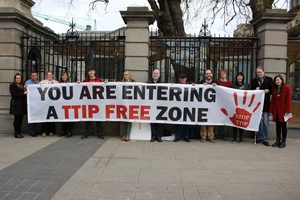
Members of Uplift outside Leinster House, Dublin last month (top) and Dr Julien Mercille (above)

If passed The Transatlantic Trade and Investment Partnership will introduce a new wave of regulation-free trade between America and Europe.

But is it good news for Ireland?

If only we had a smouldering French-Canadian egghead to explain it all….

Dr Julien Mercille writes:

TTIP (pronounced “Tee-tip”) is the Transatlantic Trade and Investment Partnership, a US-EU trade deal that political leaders have been attempting to implement for the last two years. It hasn’t been discussed a lot in the media. One reason is surely that if more people knew about it, popular opposition would rise, although there have already been protests against it.

President Obama is currently attempting to obtain from the US Congress the authority to deliver trade deals faster, including TTIP, but negotiations have been animated as a number of Democrats are opposed. Some in Congress have said an arrangement could be passed this week.

At the same time, the European Parliament will soon vote on TTIP, on June 9th. It will then debate many issues, principles and red lines related to the proposed pact. So the next few days will be interesting.

One of the most important points about TTIP is that although it is often referred to as a ‘trade deal’, in fact, it’s much better to think of it as a deal that seeks to alter regulations to benefit corporations.

Secondly, there has been a big push from politicians to present TTIP as key to revive Europe’s stagnating economies, implying that if we can only pass it, an economic bonanza awaits us and jobs will be created. However, as economist Dean Baker said, this is ‘complete nonsense, unless we define down bonanza to mean finding a quarter on the street’. Therefore, ‘as growth policy, this trade deal doesn’t pass the laugh test’.

An analysis by the UK-based Centre for Economic Policy Research is regularly quoted in support of the deal. What it says is that TTIP would increase the EU’s GDP by €119 billion and US GDP by €95 billion. This represents a 0.5% increase in EU GDP and a 0.4% increase in US GDP.

But this is not at all as fantastic as it might sound, for the following reasons. To start with, it’s based on economic modeling, forecasting and estimating, what some would call guessing. Also, the think tank that produced the study is overall very favourable to the deal.

But let’s say we put all that aside and look at their numbers. The study says that the above GDP increases will be achieved only in 12 years, when TTIP is fully in place. This means that by 2027, EU GDP will have grown by 0.5% due to TTIP. This translates into a very small boost to EU GDP of less than 0.05% annually until 2027. Imagine if a leftist politician presented a growth plan that would boost GDP by 0.5% in 10 years—that would be laughed at in the mass media.

And this is under what the study calls their ‘ambitious’ scenario, in which TTIP could be implemented as fully as possible. Under their ‘less ambitious’ scenario, which presumably means ‘more realistic’, growth would be even smaller.

Finally, the study does not say anything about job creation due to the pact.

Therefore, if the deal is not really about growth, what is it about? Conventional trade barriers between the EU and the US are already very low, and thus there is not much room for improvement here. So, what’s at stake is really non-conventional barriers, i.e., regulations. All the big players in various industrial sectors face some regulations that they wish could be removed, amended or made more flexible so they can maximize profits. And that’s what TTIP is about.

The problem is that in many cases, regulations are good and important to protect customers, the environment, health, and a range of other areas to maintain our quality of life.

The difference between Europe and US regulations is well illustrated in the case of chemicals. In general, Europe uses a precautionary principle that requires companies to demonstrate that new chemicals are safe before they can be sold on the market. But the US approach puts the burden of proof on regulators to establish that there is evidence of danger before action is taken against the chemicals.

Therefore, many chemicals are tightly restricted or simply banned in the EU, but are allowed in the US. A recent analysis found 82 pesticides allowed in the US but restricted or barred in Europe.

From a consumer perspective, those regulations are essential protections. But from the industry’s viewpoint, they’re barriers to trade that if removed could open up markets for more profits.

In this respect, investor-state dispute settlement (ISDS) mechanism that is part of TTIP has attracted much criticism from progressives. ISDS essentially creates special panels that decide on issues that arise in disputes between transatlantic investors and governments. They’re outside the control of governments.

For instance, if a US company claims that a regulation imposed by a European country deprives it of profits by imposing costs on its business, the firm could decide to take its complaint to the special panel, rather than to the government’s legal system. The worry, of course, is that those panels will be pro-business, otherwise, why would corporations want to bypass the regular court system?

One relevant example that illustrates the potentially negative consequences of ISDS is the ongoing action by Big Tobacco firm Philip Morris, which is suing the Australian government. The reason is that in 2011, the government implemented a range of public health measures such as plain packaging for cigarettes. Philip Morris is unhappy because such measures reduce smoking and thus cut into its profits. So it’s using an ISDS mechanism to try to force the government to overturn the public health legislation.

Other similar cases have occurred with other countries and in different industries. It is the kind of legal actions that would now be supported in Europe if TTIP comes to pass. Clearly, ISDS puts profits and the interests of corporations before that of ordinary people.

Do you still want this TTIP?

@JulienMercille is lecturer at UCD and the author of The Political Economy and Media Coverage of the European Economic Crisis: The Case of Ireland (2015, Routledge). His new book, Europe’s Treasure Ireland (Palgrave), will be out in July 2015.

ncad1
MercilleFrom top: NCAD college, Dublin last month and Julien Mercille

Yes.

They are revolting.

But why?

Dr Julien Mercille writes:

Students are rising. In Quebec (Canada), Amsterdam, London and elsewhere, students are taking matters into their own hands and trying to resist austerity, neoliberalism, and the commercialisation of education.

But the media has been discreet about how it’s also unfolding in Ireland. You could almost call it ‘the propaganda of silence’.

In Quebec, students have been protesting forcefully for several years against hikes in tuition fees and austerity. The current government there is led by the Liberal party, similar to Fianna Fáil or Fine Gael. It’s implementing an austerity programme, including cuts and attacks on education, health care and social services. Like here, austerity seems only to apply to ordinary people, while corporations and the rich are not subject to the same actions by the state.

About 130,000 Quebec students were recently on strike for one day and about 60,000 for many more days. This is nothing new: in 2012, as many as 316,000 went on strike for similar reasons. The police has reacted violently, causing injuries to the protesters.

In the Netherlands at the University of Amsterdam, students have occupied buildings. They propose an alternative to managerial policies that have turned education into a service to the corporate sector.

One slogan in the protests has been: ‘We are not asking for a free university; We are asking for a free society; Because a free university in a capitalist society is like a lecture hall in prison’.

Similar events have taken place elsewhere, at the London School of Economics (LSE) and the University of the Arts in London, as well as at York University and the University of Toronto in Canada. The motives: students want to be creative, not cogs in a machine designed to serve the needs of the powerful while absorbing higher fees.

1

In Ireland, higher education has also suffered under austerity. The chart (above)) shows that real public expenditure per student has dropped by a whopping 27% since 2006 (Central Statistics Office data).

2

Meanwhile, this (above) shows that student fees have increased (Higher Education Authority data). The divergence with decreasing public funding is clear and reveals that students (and their parents) have had to assume an increasing portion of the cost of their education, a trend not unique to Ireland.

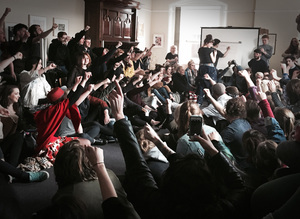
This is what the students at the National College of Art and Design (NCAD) in Dublin reacted to when they conducted a one-day sit-in on the College’s premises and sent a letter to its Director, Declan McGonagle, in which they noted that ‘the administration’s primary concern at present is the management of revenue, rather than the education and welfare of its students’.

NCAD staff back the students, stating: ‘we fully support the student concerns about management of funding, resources and student numbers… the reputation of the college is endangered by the actions of Senior Management, who have presided over a situation which incrementally places the operation and reputation of the college in peril’. Staff then ‘overwhelmingly supported’ a motion expressing ‘no confidence in the leadership of the college’.

The students have also received support from other student unions, Ireland’s biggest union, SIPTU, and academics in Ireland and abroad, who wrote that they ‘are concerned by the continued corporatisation that has consumed higher education in recent years… We urgently need another model of what higher education might be—one guided by the pursuit of learning rather than the pursuit of profit’.

They’ve also received support from the University of Amsterdam and from the University of the Arts in London.

At NCAD, student numbers have increased drastically but staff numbers have been cut: undergraduate numbers have risen by 33% since 2010 (from 780 to 1,033 students), ‘in line with the College’s ambitions’, according to NCAD’s website.

However, staff numbers have dropped by 15%; fees have increased but the extra revenues does not seem to have been directed towards improving educational facilities; there is now even a fee to see the college doctor; fees for some Masters programmes have increased from €2,850 to €3,900; and NCAD says that its core funding had decreased by 50% since 2008.

On top of that, three months ago, the Comptroller & Auditor General told the Public Accounts Committee that NCAD’s accounting practices were ‘not fit for purpose’, including failure to comply with procurement guidelines and delays in preparing its annual accounts.

How has the Irish media reacted to the protests? It simply has not talked about them in any significant way. A search in the Nexis database for news pieces covering the NCAD protests over the past month returned a total of only five short articles in the main newspapers and RTÉ news.

This is not due to a lack of resources to send journalists to investigate the situation, because it is happening right in Dublin. It is not an oversight, because activities at NCAD have been ongoing for days and anybody who cares to know would find out what is going on. It is not because the events are not important, as they are Ireland’s equivalent to worldwide student protests against austerity and funding cuts on education.

Plain and simple, this is a refusal to cover anything that denounces power, unless it becomes too big for it to be ignored, like the water charges protests. The last thing elites want is to advertise the fact that there are ongoing challenges to their rule.

@JulienMercille is lecturer at UCD and the author of The Political Economy and Media Coverage of the European Economic Crisis: The Case of Ireland (2015, Routledge). His new book, Europe’s Treasure Ireland (Palgrave), will be out in July 2015.
gkoregandan

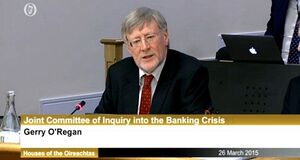
Mercille From top: Geraldine Kennedy; Gerry O’Regan; Dan O’Brien; Julien Mercille

An inevitable thing happened at the banking inquiry.

Dr Mercille Writes:

Last week, the Banking Inquiry forced some members of the media to undergo questioning about their poor performance during the housing bubble years. They didn’t enjoy it.

The Inquiry’s media deliberations started with myself and [Dublin Institute of Technology journalism lecturer] Harry Browne, who provided a critical look at the media.

Then, a string of media individuals were called in to reassure everybody that what we said was garbage.

The media’s defence mostly has revolved around personal attacks and flimsy arguments. I don’t want to delve too much into the personal diatribes because it distracts from the important issues, but many are funny, so here is a short list of what I’ve been called:

-A “messiah” and “self-appointed guru”, and also “an obscure academic” (Gerry O’Regan, ex-editor of the Irish Independent).

-“The finest conspiracy theorist I have heard in a long time” (Geraldine Kennedy, ex-editor of the Irish Times).

-A “man of the hard left” (Dan O’Brien, a hard right-wing journalist)

-“I attach no credence whatsoever to Dr. Mercille and his views regarding the Irish Examiner. They are from a planet I neither recognise nor inhabit and they do not apply to the Irish Examiner” (Tim Vaughan, Irish Examiner editor).

-“Far left”, “not a media academic”, and has “never worked in the Irish media” (Michael Clifford, Irish Examiner journalist).

The real issues, however, are this: the Irish media has a record of failure over the last 15 years on reporting economic issues of the highest national significance.

It’s easy to see: news organisations missed the housing bubble in 2000-2007, and then from 2008 onwards, have argued that austerity is the best strategy out of the downturn, even though it actually worsens economic performance.

Therefore, if accountability was a value espoused by our media, a lot of journalists and editors should by now have been fired for incompetence.

A few responses to the (false) claims that have been made at the Inquiry and since then will clarify the role of the mass media during the housing bubble and since then.

-“Saying that the media conveys elite views is a conspiracy theory.”

A conspiracy happens when a few people plot in secret outside the normal institutional channels to accomplish something from which they benefit personally. This has nothing to do with my analysis of the media, which is an institutional one: the media give us the views of the elites because they’re owned and funded by elites. Nothing surprising in this.

-“Journalists just reported what the ‘experts’ said so they shouldn’t be blamed for missing the housing bubble.”

This is very interesting and is often heard from journalists attempting to absolve themselves of any blame. When you think about it, it is actually a very harsh indictment of the media.

Indeed, it implies that journalists don’t think and are not critical of anything: they only report what others say, like robots.

I recall a senior RTE journalist who said to me that he wasn’t to blame for missing the housing bubble because he wrote his articles in this way: “When I come back from lunch, I check my smartphone, and I’ve usually received about 12 press releases from companies and the government. I just copy them and that’s my article!” Great. Journalists are supposed to think and challenge viewpoints, not report them without question. Thankfully, some journalists still believe in those principles and apply them.

-“We really tried to find out but all the experts were telling us the economy was fine.”

For example, at the Inquiry, former Irish Independent editor Gerry O’Regan claimed that the Irish media had missed the boat on the banking crisis, but that “it was not for want of trying,” and that the state of the banking sector was “hidden from the view of everybody” at the time.

Really? In 2007, when Morgan Kelly wrote his newspaper article essentially predicting that the Irish banks would collapse, he first sent it to the Irish Independent, whose editor was Gerry O’Regan. What happened? The editor wrote to Kelly and told him his article was “offensive” and that he wouldn’t publish it.

-“Commercial interests don’t affect news content.”

Advertising revenues are crucial to today’s news industry. For example, at the height of the boom, 17% of the Irish Times’ revenues came from property advertising only, which means nearly €100 million over the period 2002-2006.

In any case, some journalists have already revealed in published academic research that they faced pressures not to attack the banking and property sectors during the housing bubble.

-Some, like Irish Examiner journalist Michael Clifford, say that “The notion of ‘the media’ as some homogenous beast that takes a line and follows it like a political party, for instance, is complete garbage.”

Yes, and that’s why nobody is saying that. The media reflect the range of opinion among elites. So there is diversity in the news, but it is relatively narrow.

-“If you can’t give examples of journalists who have been prevented from their editors or owners from challenging those in power, then you can’t say the media represses contrarian viewpoints.”

First, we have academic research that has reported on journalists who said they were leaned on not to criticise the housing bubble. But more broadly, the point is that those who work in the media, journalists and editors included, mostly agree with the values and principles of the organization they work for.

It’s the same in any institution: for example, if you’ve been a military officer for years, you probably believe in armed operations in world affairs, or at least you’re not too strongly opposed to that. Those who don’t assimilate their organisation’s values will most likely leave it or be forced to leave.

So most journalists won’t question or challenge elites, because they largely agree with them on the basics of policy. Sure, policy will be questioned in the details, but not fundamentally.

Therefore, when editors claim that they never came under pressure on the part of commercial interests or owners, in a sense, that’s probably true, because no pressure is needed to make them toe the line, with which they agree. (Of course, some journalists are very much aware of the pressures they face, so there are always exceptions).

-In his Sunday Independent article yesterday, Dan O’Brien [former Irish Times Economics Editor] insinuates that I overlooked a clear warning he supposedly gave to the nation on Prime Time in April 2006 about the housing bubble.

This is not at all true, and would mean that Dan O’Brien counts himself, together with David McWilliams and Morgan Kelly, as having warned us all about the bubble. But you don’t need to do any research to find out that O’Brien is wrong. In the same article, he says himself that he didn’t have a clue about the housing bubble until 2008:

“I did not see the size of the risks building up in the financial sector in Ireland and across the western world before 2008. I accept this was a failing and do not seek to distract from my culpability.”

But then he complains that I should have classified him as one of those who warned us about the impending crisis. Go figure. This is indeed reasoning from another planet.

@JulienMercille is lecturer at UCD and the author of The Political Economy and Media Coverage of the European Economic Crisis: The Case of Ireland (2015, Routledge). His new book, Europe’s Treasure Ireland, will be out in a few months.

Yesterday: Don’t Hate Him Because He’s Beautiful

90374415Dr Julien Mercille at the Banking Inquiry during the week

You may recall dreamboat Canadian-born UCD academic Dr Julien Mercille gave evidence at the Banking Inquiry last week.

Dr Mercille, author of The Political Economy and Media Coverage of the European Economic Crisis: The Case of Ireland, discussed media collusion in the boom and bust.

How did that go down?

Irish Independent?

“… Chasing red herrings and matters of no consequence remains a risk when competing politicians from different parties gather in conclave.”

“This week, they devoted some hours to considering the views of some obscure academic by the name of Julien Mercille. He has cast himself in the role of being some kind of messiah when it comes to the media, and its alleged involvement with spiralling house prices.”

“When it comes to the foibles of newspapers, in particular, Mr Mercille seems to be an expert on all those ”unknown unknowns” which challenge lesser mortals. Such is the way of self-appointed gurus. However, his arguments suffer from one overwhelming weakness – I cannot recall him predicting the crash either.”

Gerry O’Regan former Irish Independent editor

Irish Examiner?

“Finding out why was never going to be easy, but the inquiry got off to a pretty poor start on Wednesday. Before newspaper editors, including the Irish Examiner’s Tim Vaughan, the first witness was an academic chap, Julien Mercille.”

“Dr Mercille lectures in the department of geography in UCD and is the holder of a Phd on ‘the political economy’. He has written academic publications on matters such as the war on drugs, but he is not a media academic, and has never worked in the Irish media. He has penned a book based on the newspapers’ coverage of the property boom and bust.”

The thesis of his book is that the media is largely a tool of “the elites” and reflects their views at the cost of telling “the truth” or catering for “ordinary people”. It’s not clear whom exactly the elites are, but it’s safe to say Dr Mercille does not include among them highly-educated, well-paid and pensioned academics. Those souls are far more likely to be “ordinary people”, in search of “the truth”, whatever that is in a political context.”

“Dr Mercille’s thesis on the media derives as much from his political perspective as from any neutral examination of the function and performance of newspapers. His columns and media appearances suggest his politics chimes with that of the so-called far left, although Dr Mercille told the inquiry he would consider himself “progressive”, rather than left- or right-wing.”

“There’s nothing wrong with any of that. Diversity of opinion is a positive feature of public life. What is baffling is why an important Oireachtas inquiry, on a very tight schedule, found it useful to hear about the media from a man who could not be described as either a practitioner or an expert. Perhaps the politicians thought this passed for the ‘balance’ they habitually contend is lacking in coverage of their affairs.”

Michael Clifford, ‘Special Correspondent’ Irish Examiner

Sunday Independent:

Dr Mercille is a man of the hard left. In his hard-left worldview, capitalism is dominated by interconnected elites, who are in the minority, but because they wield all the power they are able to keep the majority poor and suppressed…..

Last year I was invited to debate the role of the media with Dr Mercille at a conference. In preparation for the event, I read his work carefully. His claims about the failings of the media during the bubble period are based on articles which appeared in this newspaper, the Irish Independent, the Irish Times, and episodes of RTE’s Prime Time. He claims that when this output is analysed it shows a highly unbalanced picture of cheerleading for the boom and only a tiny amount of time and space given to dissenters.

Interested in analysing his evidence, I contacted Dr Mercille and asked him to share the database he had collated. It turned out that he had not gathered the data in the normal way that any rigorous academic would do, so that the findings could be replicated, tested and built on. As such, it is not possible for anyone to know what was included in his study and – probably more importantly – what was not included.

The issue of what is not included in any study is important because it is the most common fault found in academic work.

As Dr Mercille’s evidence base is not available, it is impossible to assess the accuracy of his study, but there is reason to question it.”

Dan O’Brien, Sunday Independent.

Sunday Business Post:

A former Irish Times journalist,[Harry] Browne’s assertion that the media were “property porn” cheerleaders for choosing to feature property programmes and lifestyle features, distinctly smacked of poacher turned gamekeeper. The architectural nerd in me enjoys watching property, interior design and restoration programmes. I like watching cooking programmes too. Perhaps we should blame them for rising obesity levels? Or blame travel programmes for inspiring wanderlust?
Browne’s peer, UCD academic Dr Julien Mercille, was no more enlightened when he suggested that journalists could have predicted the property bubble and the crash itself. I anticipate a much more intriguing week this week, as the focus shifts to estate agents and their role in the bubble.

Tina Marie O’Neil, Sunday Business Post

Irish Times:

Geraldine Kennedy: “I listened to Dr. Mercille with great interest yesterday. Without doubt he was the finest conspiracy theorist I have heard in a long time. I was disappointed that his material was not evidence based. He gave one fact in his submission which was that there 40,000 articles written in The Irish Times about economic policy and the property boom and only 78 about affordable housing. That is absolutely wrong. It is very easy to press a button and get “property bubble” without taking into account all the other formulations of expressing that same phenomenon. Between the years 2008 and 2013 the country was banjaxed, it was bankrupt. Unless we want it to be Greece, one had to try to bring the country out of the mire. I noted yesterday that he seemed to support Argentina and in something else I read about him he supported—–

Deputy Joe Higgins: “Does Ms Kennedy dispute the figures and the percentages that he outlined in terms of the support for…”

Kennedy:
“No. I do not know but I would be surprised.”

Higgins: “But Ms Kennedy said that his contribution was not facts based and
now she says she does not know.”

Kennedy: “I do not know as I did not study that period because the terms of reference of the inquiry given to me were for 2002 to 2007. His figures were for 2008 to 2013 which is beyond my period as editor and I did not study that before coming in here. I will say that I believe, personally, and would probably have pursued the policy as editor, that there was very little option for Ireland unfortunately but to try to get its house back in order. It required great sacrifices by ordinary people.”

Higgins: “Yes. In other words, Ms Kennedy supports it. Did she support then the bailout of the financial markets rather than the people who were victims?”

Higgins: “How is that balanced journalism?”

Chairman: “I am going to move on.”

Former Irish Times editor Geraldine Kennedy at the banking inquiry.

Good times.

Update: Dr Mercille responds

Media grilled as Bank Inquiry bearpit uses hindsight to predict past (Irish Independent)

Michael Clifford: We all had the economic blinkers on (Irish Examiner)

Media Played Little Role In Inflating The Property Bubble (Dan O’Brien, Independent.ie)

Geraldine Kennedy, irish Times (banking Inquiry)

Previously: Mercille Live

For Those Who Shouted Stop, He Salutes You

renua:it
t4_-371666110-226x300Lucinda Creighton and Harry McGee of The irish Times (top) and Julien Mercille

How do you sell another right-wing party like Renua?

With a little help from the people behind Mr Tayto and the man from the Irish Times.

Julien Mercille writes:

What’s the link between Renua, Tayto crisps, Diageo and Baileys? Answer: they’re all sold to us by the same marketing firm and consultants.

To come up with its name and image, Renua hired Noel Toolan, a marketing consultant with extensive experience in promoting alcohol products, in particular for Diageo with whom he worked for many years, while serving as Head of worldwide marketing for Baileys.

Renua also worked with a brand-design firm called Dynamo, which has been doing the branding work for Tayto crisps among others. They state on their website that “We have been associated with everything Tayto for over a decade… from the much talked about Tayto Chocolate bar to product innovation with Tayto Nuts Tubs and Tayto Popcorners.” They also work to promote alcohol products like Bulmers “to grow the brand from Irish market to the rest of the world,” of which they “are massively proud.”

This is what politics has become today. Politicians hire marketing agencies to promote them the way crisps and beer are promoted. Of course, that doesn’t exactly lead to meaningful public debate.

But from the viewpoint of those in power, it’s a pretty good strategy. The electorate is now disillusioned with the political establishment due to the harsh austerity of the last few years. There is thus space for new parties to come into being and gain in prominence.

Who knows, maybe Lucinda Creighton is a better manager than Enda Kenny to implement right-wing policies. Maybe a new face will reduce popular protests for a while. A segment of the establishment may thus want to put its weight behind Renua, thinking that it will better serve its interests.

It’s almost impossible for Renua, however, to distinguish itself through its policies, because they’re essentially the same as those of the other main parties. So they need to focus on empty statements, on coming up with a new logo, with new colors, a new slogan, new faces, etc. Anything that means nothing but looks good will do. And on those grounds, Renua may not have done so poorly.

Especially since the new party has received a big promotional boost from the media. There are many examples, but let’s stick to Ireland’s newspaper of record, the Irish Times, and in particular Harry McGee, its political correspondent.

McGee praised Renua as “well organised, highly-motivated and focused” as well as “ambitious.” There is also “little doubt” about Lucinda’s “abilities as a politician.”

In an article that pretends to be investigative journalism, entitled “Renua: The Making of a Political Party”, he went out of his way to present the party in a positive light, with the Irish Times in effect acting as an advertising agency.

The Times even made a 12-minute video about how Renua came into being, interviewing its leaders, advisors and ordinary people telling us how great and trustworthy the party is. Watch it and read the article, and see if you laugh or cry:

The article shows that the Irish Times is not in the business of challenging power but rather on a mission to glorify it. In the video, Harry McGee has tea with Creighton, asking her soft, irrelevant questions that make her look good while the cameraman is busy capturing her smiling in just about every possible angle.

The camera then follows Creighton everywhere, showing her as dynamic, decisive, caring and likeable. McGee also talks to people at Dynamo and he tells us about the artistic process to conceive the logo and all the details involved.

But beyond that, what do we know about Renua? It’s yet another right-wing party in the country and it labels itself as pro-business and pro-entrepreneurialism. Looking at its website and that of Lucinda Creighton, its leader, a few things are clear:

– Renua is empty: it’s striking how the whole project is based on vague and meaningless statements. One of the party’s “core beliefs” is that “There is no greater moral and political issue than securing the future of children.” Every policy point and strategy is about as imprecise as that.

– Renua has no understanding of economics: Creighton’s website states that “The current Government did a good job of stabilising the economy after it was destroyed by Fianna Fáil.” She was also once quoted as saying that “austerity and growth were not incompatible.” It would be hard to come up with more incorrect claims. In fact, the current government crashed the economy by implementing austerity, which by now should be clear to all.

– Renua has hyper pro-business values: its website states that “RENUA Ireland believes in a society that encourages families, communities and businesses to embrace an ethic of enterprise and improvement.” A family based around an “ethic of enterprise”? Wow. Is that when family members have to bill each other for favours?

– Renua is full of contradictions: a lot of statements are designed only to appeal to the electorate, like saying they believe in “real family values”, children, communities, etc. But those have been attacked continuously under austerity. Not so long ago, Creighton said that she supported government spending cuts because “the Government has no choice. We have no option but to proceed and implement the decisions that were announced in the Budget.” “We have to face up to the difficult decisions that have to be made,” she said. “That’s what we came into government for. It’s obviously not going to make us popular, but we have to do it.”

On top of that, Renua will keep water charges. That obviously doesn’t help families, children and communities. But maybe some people can be convinced otherwise, if Harry McGee and the Irish Times keep working hard on it.

@JulienMercille will appear at the Banking Inquiry this Wednesday to talk about the role of the media in the economy. He is lecturer at UCD and the author of The Political Economy and Media Coverage of the European Economic Crisis: The Case of Ireland.

00158967
t4_-371666110-226x300Michael Noonan (top) and Julien Mercille

Why is Michael Noonan courting property developers and vulture fund managers?

Has he learned nothing?

Julien Mercille write:

Our Minister of Finance, Michael Noonan, is cosying up again to the same developers and banks who crashed the country. A few days ago he met with them to explore ways of financing new construction.

Celtic Tiger developers Johnny Ronan and Michael O’Flynn and others were present at the “low-key”, “behind-closed-doors” meeting in the luxury Marker Hotel in Dublin’s Dockland. They said it’s “good to see” the key players in construction in the “same room again”.

The Irish Independent conveyed Noonan’s thoughts without challenge with the headline “It’s Time for us to Stop Scapegoating Property Developers—Noonan”. A tough press challenging the government indeed.

The Sunday Times went further and backed the strategy while defending the developers. The editors were explicit: “It’s Time to Bring Developers in from the Cold”, they said. They stated that Noonan’s comments about scapegoating were “right on the money”. Then followed a pathetic defense of those directly responsible for the crisis as the editors asserted that:

-Since the crash, “much time and energy has been expended in scapegoating” bankers, developers and politicians, which is harsh because “most of the culprits have been punished in one way or another”.

-And “if we keep obsessing about the mistakes and injustices of the past we are in danger of losing the capacity to move forward”, and that’s why “Noonan’s comments make perfect sense”.

-If we don’t bring developers back, we won’t be able to build the houses we need because those developers “have experience of dealing with the myriad issues involved in turning an empty field into family homes”.

-We shouldn’t forget that the only thing most developers did “was borrow too much money from banks”, something we all did anyway because we were all partying.

Oh wow. Reality turned on its head.

In fact, bankers and developers haven’t been scapegoated at all, otherwise they’d be in jail or would have been forced to do community work for years to compensate for the mess they’ve caused. Second, if we forget about the mistakes of the past, well, we’ll make them again.

Third, the way to build the social housing units needed is to involve the government more in this task, not discredited developers. Rory Hearne provides a lot of progressive ways on how this could be done here.

Last, we didn’t all party. The truth is that a small minority of VIP’s partied, and everybody else then cleaned up their mess.

Indeed, good reporting from yesterday’s Sunday Business Post revealed that in 2008, a mere 22 Celtic Tiger developers were responsible for a staggering €26 billion of debts to banks. Compare that to the €64 billion that taxpayers injected in banks to recapitalize them.

Michael O’Flynn had total borrowings of €1.8 billion primarily owed to Anglo Irish. Johnny Ronan was one of the “most ambitious developers of the boom” and owed €1.6 billion mostly to Anglo Irish. Denis O’Brien owed €1 billion primarily to Anglo Irish. Bernard McNamara owed €1.7 billion, mostly to Anglo Irish. Sean Quinn owed €2.9 billion, almost all of it, you guessed it, to Anglo Irish.

But Noonan has been meeting up with other characters as well: foreign vulture funds, many from the United States, that have been buying up Irish property by the ton.

Again, the Sunday Business Post has done very good reporting on this, with journalists Ian Kehoe, Emma Kennedy and Roisin Burke in particular spelling it out as it should be in articles entitled “Who Owns Ireland and Who Wants to Buy it”, “Vulture Funds Turn Screw on Apartment Renters” and “Why Vulnerable Mortgage Holders Are in the Line of Fire”.

They show how foreign interests are capturing large chunks of the country’s stock of property, and warn that they are most likely to leave in the short term, once the assets have gone up in value, at which point they’ll sell them back to… Irish people.

This highlights an important point about the mass media. Of course, there’s a lot of regurgitation of government propaganda.

You can find that in editorials, opinion and news sections. Uncritical reporting is definitely one way to make a long and rewarding career in Irish journalism. If you establish good contacts with influential politicians and report descriptively on whatever they say with no questions asked, you’ll get a secure job. If you defend them when they’re attacked, you’ll be praised beyond retirement.

But there’s also excellent information in the press. The reason is that the business press caters to, well, business people, and decision makers. Those people need good information, otherwise it would be hard for them to make any decisions. So there is good analysis in the business press, albeit presented from the point of view of someone in business. It’s also often buried in the back pages, but it’s there.

@JulienMercille is lecturer at UCD and the author of The Political Economy and Media Coverage of the European Economic Crisis: The Case of Ireland. He will provide evidence to the Banking Inquiry later this month on the role of the media during the housing bubble years.

90157355JulienMercille_313ver2RTE Television Centre (top) and Julien Mercille (above)

It’s Monday.

It’s 9.10am.

It’s Mercille on Monday.

Julien Mercille writes:

A fortnight ago a scandal involved Europe’s largest bank, London-based HSBC and its Swiss banking arm, in a large tax evasion scheme.

The charges are that the bank helped its clients hide accounts while providing services to corrupt businessmen and criminals.

Some have called it the biggest banking leak in history. Newspapers immediately gave much attention to the story, but the UK’s Daily Telegraph gave it minimal coverage. Why?

It’s partly because the Telegraph feared that HSBC would stop funding the paper through advertising. Peter Oborne, the Daily Telegraph’s chief Political Commentator, actually resigned in protest because his paper’s editor let commercial advertisers influence the news content and reporting.

HSBC also used to sponsor RTÉ’s Drivetime radio show, which suggests obvious conclusions, but more on that below.

Advertising revenues are crucial to the news industry. They allow newspapers to be sold for a cheaper price, making them more competitive.

This affects news content because corporate advertisers tend not to subsidise television programmes or news stories that seriously question or attack their own business or the political economic system of which they are part, which would be contrary to their interests.

The same goes for corporate or state ownership of the media: owners don’t favour stories that directly challenge government or the corporate sector simply because that’s directly against their interests.

Former Telegraph executives and journalists have confirmed the allegations, saying they were ‘spot on’, and additional claims have been made that:

– HSBC pays about £3.5 million per year to the Telegraph in advertising fees.

– The paper’s commercial department is ‘stronger’ than the editorial one and this has been a ‘dirty little secret for some time’. The Telegraph ‘can’t afford to offend’ some ‘key advertisers’. This means ‘stories being softened, stories being downgraded in terms of placement, headlines softened or stories not run at all’.

– HSBC withdrew advertising from the Telegraph three years ago after negative reporting on the bank.

– Often, ‘If there was a story related to a big Telegraph advertiser and something that was deemed critical was going to appear, subsequently you’d get a call of irritation from someone very senior saying: “We’ve heard that you might be running a story about Tesco… Did you know that they spend X amount with us advertising each year?’

The Irish media faces the same situation. For example, RTÉ gets about €150 million in advertising revenue every year, and in 2008 before the economic crisis that reached €240 million. It’s almost half of its total annual revenues (the other half is made up by the TV licence fees it collects).

Some of its main sponsors are banks, insurance firms and car companies:

-Ulster Bank
-Bank of Ireland
-RaboDirect Bank
-Aviva insurance
-Chill insurance
-Volkswagen
-Volvo
-Mitsubishi Motors
-Land Rover
-Toyota
-Burger King
-Coca-Cola

The full list can be seen here.

A quick look at RTÉ’s website shows how desperate it is for corporate advertising, telling potential advertisers that RTÉ is ready ‘to help you plan the process of getting your message across the largest audience in TV, Radio, Print and Online in the Irish market’ and that advertising on RTÉ ‘is the ideal platform to enhance your tactical plans or long term brand objectives’.

There are telling examples: Bank of Ireland sponsors RTÉ Radio’s The Business show by paying a fee of €160,000 for 12 months.

Ulster Bank sponsors RTÉ’s Drivetime radio programme by giving the show €260,000 for the year. Before that the sponsor was Danske Bank, and before that, HSBC bank. Who really thinks those shows will give us a critical and objective picture of financial issues?

A clear example of the significance of advertising to the Irish media is the large amount of funding from property advertising received during the housing boom years.

The Irish media went even further than benefiting from property advertising money: they became owners of property websites, acquiring a direct stake in the growing housing bubble.

For example, in 2006, Independent News & Media bought PropertyNews.com (along with the PropertyNews monthly newspaper), the largest internet property site in Ireland.

In 2006, the Irish Times bought the property website MyHome.ie for €50 million, along with the website newaddress.ie, which aims to make it easier for home owners to move residences.

Also, most newspapers published weekly supplements for commercial and residential property, ‘glamourising the whole sector’, while ‘glowing editorial pieces about a new housing estate were often miraculously accompanied by a large advertisement plugging the same estate’, in the words of Shane Ross, former Sunday Independent business editor:

‘Unfavorable coverage of developers and auctioneers in other parts of the newspapers was regularly met by implied threats from property interests that advertising could go elsewhere’. Moreover, a reporter working for an Irish news organisation stated that journalists ‘were leaned on by their organisations not to talk down the banks [and the] property market because those organisations have a heavy reliance on property advertising’.

Some people will deny that advertisers and owners influence news content. That’s contrary to all evidence, but think about it this way. We don’t have any problem understanding that a trade union newspaper reflects the trade union’s viewpoint.

Or that a student paper reflects the students’ viewpoint. Or that a television show that would be sponsored by Greenpeace or Amnesty International would promote environmental and human rights issues. Or that a radio station sponsored by the Irish Palestine Solidarity Campaign would highlight views favourable to Palestine.

So why is it so hard to understand that a show sponsored by Ulster Bank or Bank of Ireland will likely present favourable views of bankers? Or that a programme sponsored by private health insurance companies won’t tell you that a private, profit-driven health care system is inefficient, wastes money, and bad for people’s health? Or that a show sponsored by a car company won’t exactly be keen on promoting real alternatives to our car culture?

@JulienMercille is lecturer at UCD and the author of The Political Economy and Media Coverage of the European Economic Crisis: The Case of Ireland. He will provide evidence to the Banking Inquiry on the role of the media during the housing bubble years.

Related: Ireland’s Biggest Problem Is RTÉ Says Max Keiser

(Mark Stedman/Photocall Ireland)


tubridyRyan Tubridy during Friday’s Late Late Show

Further to Friday night’s Late Late Show.

Julien Mercille writes:

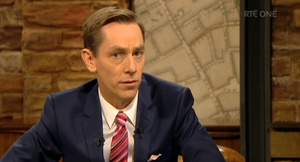
Last Friday Paul Murphy TD of the Anti-Austerity Alliance was on RTÉ’s The Late Late Show where Ryan Tubridy questioned him about the water charges protests that have sprung up throughout Ireland recently.

Many on social media have noted how Tubridy was biased against Murphy, showing that he disapproved of the protests, or at least the ones that involve civil disobedience.

Another way to see it is that Tubridy was pretty good from the standpoint of protecting government interests. He’s paid handsomely for that. His current salary is €495,000, and in 2011 it was €723,000. He asked all the right questions to try to discredit the water charges protests and Paul Murphy by:

– Bringing up the protests that left Joan Burton in her car for two hours during which she was apparently ‘intimidated’ and asking multiple times whether this was ‘appropriate’ and saying the protest should have been more ‘civilised’.

– Asking whether Paul Murphy gets a ‘thrill’ from being arrested because this allows him to get in the media.

-Bringing up the protest against President Michael D. Higgins and suggesting it was wrong because the President shouldn’t be challenged.

– Asking why would anyone protest the water meters closer than 20 meters if the courts said they should stay beyond 20 meters.

– Trying to picture Paul Murphy as being ‘anti-everything’ but not proposing any positive alternative.

Those are standard tactics of a media establishment that fears real democracy. Real democracy involves more than voting for two or three similar parties once every few years. It is about people being able to make decisions that affect their own lives and participate in policy at the national and local level.

The problem with that from the establishment’s viewpoint is that the policies that would be favoured by the majority of people would often turn out to be completely different from those that have been imposed on us over the last few years of austerity.

For example, who, other than the government, would want to implement policies that have forced 31% of the population into deprivation, up from only 12% in 2007?

Who would cut violence against women programmes by 38%? Who would cut health care spending by a mind-boggling 27%? Or community development by 44%? Or drugs programmes by 37%?

The media used rather flimsy arguments to try to cast a negative light on those who protest. We’re still talking about Joan Burton’s feelings while in her car, but less so about those who have suffered from the cuts.

The strongest reason gathered to oppose protesting the President is that… well, he’s the President, after all. If you oppose cutting government services, you must be doing so for personal glorification, not because you care about people. Or maybe you just reject everything like an immature child.

The sole mention of civil disobedience brings hysterical reactions, even though it’s been used around the world to resist immoral policies. Howard Zinn, the celebrated American historian, put it this way during the Vietnam War (Hollywood’s Matt Damon read those lines in a video here):

‘Civil disobedience is not our problem. Our problem is civil obedience. Our problem is the numbers of people all over the world who have obeyed the dictates of the leaders of their government and have gone to war, and millions have been killed because of this obedience. Our problem is that people are obedient all over the world, in the face of poverty and starvation and stupidity, and war and cruelty.
Our problem is that people are obedient while the jails are full of petty thieves, and all the while the grand thieves are running the country. That’s our problem. We are going to need to go outside the law, to stop obeying the laws that demand killing or that allocate wealth the way it has been done, or that put people in jail for petty technical offenses and keep other people out of jail for enormous crimes. My hope is that this kind of spirit will take place not just in this country but in other countries because they all need it.
People in all countries need the spirit of disobedience to the state, which is not a metaphysical thing but a thing of force and wealth. And we need that kind of declaration of interdependence among people in all countries of the world who are striving for the same thing.’

Those thoughts should enter the media debate in Ireland.

@JulienMercille is lecturer at UCD and the author of The Political Economy and Media Coverage of the European Economic Crisis: The Case of Ireland. He will provide evidence to the Banking Inquiry {in March] on the role of the media during the housing bubble years.

Earlier: The Paul Murphy Takedown