Tag Archives: Katherine Zappone

Professor Ciarán Ó Coigligh

Following the death of Dr Ann Louise Gilligan, wife of Children’s Minister Katherine Zappone:

May the Lord have mercy on the soul of my late good friend and former colleague of almost forty years, Anne Louise Gilligan, and may she rest in peace. It was a privilege to work with Anne Louise and our mutual friend Katherine Zappone over the years on many projects supportive of poor urban and rural students.

I valued Ann Louise’s and Katherine’s friendship all the more because it did not prevent me giving expression to the fact that same-sex attraction is a disorder that can be overcome and affected individuals restored to orderly sexual orientation; that people are robbed of their human dignity by being defined solely in terms of sexual attraction and grouped under the hideous acronym LGBT; and that a (sexual) relationship between two women or between two men cannot be conjugal, cannot be consumated, and cannot constitute marriage.

I hope that these views are respected and not disparaged in the School of Nursing and Human Sciences. I would be happy to deliver a lecture which would present a Catholic Christian response to same-sex attraction, informed by the latest research in the area. It was a great sadness to me when Anne Louise told me that she had outgrown her Christian Faith.

Please God, she may have regained her belief and returned to the practice of the Faith. It is an even greater sadness to me that our mutual friend Katherine gives ever-more strident voice to calls for the liberalisation of legislation allowing the murder of an infant in the womb as a response to threatened suicide.

The death of a relative or close friend is often a time to assess one’s life’s achievements, beliefs and practices. It is my prayer that Katherine will use this time of sadness to reassess her espousal of a number of causes which besmirch a record of solicitude for others and particularly the poor.

I am, with every good wish,

Ciarán Ó Coigligh, survivor of same sex abuse.

Text of an e-mail sent to all Dublin City University (DCU) academic staff yesterday from Professor Ciarán Ó Coigligh, President of Newman College, Dublin and formerly of the Irish Departments in NUI Galway, NUI Dublin and Saint Patrick’s College, Drumcondra, DCU.

Thanks Philip

This afternoon.

In the Dáil.

Minister for Children Katherine Zappone made a statement on Mother and Baby Home Commission of Investigation.

During her statement, Ms Zappone said she has appointed forensic archaeologist Niamh McCullagh, who carried out the preliminary excavations in Tuam, Co Galway, to lead a team of international experts to advise the commission.

She said the team – whose terms of reference she is publishing today – will carry out further geophysical surveys to examine “the extent of potential burials on the site”.

The minister said she will receive an initial technical report by the end of June, while a more detailed report on options for the future of the commission will be submitted to her by the end of September. She said the reports will be available to the public.

Starting from July, on the first Friday of every month, Ms Zappone said she will publish a monthly update on her department’s website.

And she said she’s appointed an “experienced, qualified facilitator with an international reputation” to help her hold a series of consultations with former residents of the homes who were in the homes without their mothers.

An open invitation to these consultations in Dublin and elsewhere – depending on the expressions of interest – will be sent out tomorrow, she said.

Further to her previously announced idea of establishing some kind of a truth commission, Ms Zappone also said she will be inviting the UN Special Rapporteur on the promotion of truth, justice, reparation and guarantees of non-recurrence Pablo de Greiff, from Columbia, to Ireland.

She said, over the summer, she will undertake a “scoping review” in relation to possibly extending the commission’s terms of reference.

Readers will note Ms Zappone said in March that she would be carrying out this same scoping exercise.

Finally, she said:

I sometime wonder, if I’m around in 2027 or 2037, what will they say, on Reeling In The Years about 2017. Will it be the year 2017, that the international media descended on Tuam as we, once again, declared our outrage at past deeds. Or will it be a year where we faced up, womaned up and maned up and decided that we will do things better.”

“This is a defining moment for us. As a member of Government, and the only Independent woman in Government, I feel a huge sense of responsibility to begin to heal the fractured trust between our citizens and our State. It is a time that someone shouted stop, it is a time that we all shouted stop and I believe that a model of transitional justice will help us move forward with that. “

Meanwhile…

In response…

Catherine Connelly said:

I’m extremely concerned about the distinction you’re drawing between children who were in the homes with a mother and without a mother. I believe you are misinterpreting, either deliberately or unintentionally, the report that was done by the commission.

“On page three of your speech today, you’re going to set up consultations with those who were resident as children without their mothers.

I think that is a shocking distinction, maybe I’m misreading it, perhaps you can explain it. I believe that you’ve taken that, inappropriately from the Mother and Baby Homes Commission of Investigation where the commission  simply, in their interim report, and I believe the motivation for the interim report was to draw attention to the way that this government and previous governments have dealt with the mother and baby homes and left them outside of the redress scheme most unjustly.

“And they made the point that children without mothers had a particular grievance, they did not say that babies who were in there with their mothers should not be included.”

Dáil proceedings can be watched live here

Previously: ‘I Have Had Many Grown Men Cry In My Presence’

Screen Shot 2017-05-09 at 18.28.18 Screen Shot 2017-05-09 at 18.28.45 Screen Shot 2017-05-09 at 18.29.20

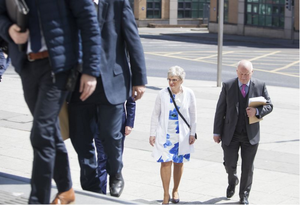
Minister for Children Katherine Zappone arriving at the Central Criminal Court of Justice today

Earlier today.

The trial of Solidarity TD Paul Murphy and six other men – who are  charged with falsely imprisoning Ms Burton during a water charges protest in Jobstown, Tallaght in November 2014 – continues.

The six other men are Kieran Mahon, of Bolbrook Heights, Tallaght; Michael Murphy, of Whitechurch Way, Ballyboden; Scott Masterson, of Carrigmore Drive, Tallaght; Ken Purcell, of Kiltalown Green, Tallaght; Frank Donaghty, of Alpine Rise, Tallaght; and Michael Banks, of Brookview Green, Tallaght.

They deny the charges.

RTÉ reports:

Minister for Children and Youth Affairs Katherine Zappone has told the Circuit Criminal Court she was “deeply concerned and frightened for the safety” of former tánaiste Joan Burton during a water charges protest in Tallaght in 2014.

However, it was put to her that she previously refused to condemn the protesters during a  pre-election television debate.

She was giving evidence in the trial of Solidarity TD Paul Murphy and six other men who are charged with falsely imprisoning Ms Burton and her assistant during a water charges protest in November 2014.

Ms Zappone, who was an independent Senator at the time, said she dialled 999 twice as she felt deeply concerned for the safety of the then-tánaiste after protesters surrounded her car as she left a graduation ceremony in Jobstown.

However, defence counsel Sean Guerin played an excerpt from a pre-election television debate in which Ms Zappone was accused by an audience member and one of the protesters of “condemning us”.

In reply the then-senator said “I do not condemn at all what was going on in Jobstown that day”.

However, in the witness box today she did not agree with Mr Guerin that this was a public refusal to condemn the protesters.

Zappone ‘deeply concerned and frightened’ for Burton at protest (RTE)

Leah Farrell/Rollingnews

Screen Shot 2017-03-28 at 16.23.55Screen Shot 2017-03-28 at 16.26.07

From top: Sinn Féin TD and spokesperson for Children and Youth Affairs Donnchadh Ó Laoghaire and Minister for Children and Youth Affairs Katherine Zappone


You’ll recall the second interim report from the Commission into Mother and Baby Homes which was given to the Minister for Children Katherine Zappone last September.

This interim report was to identify any matters that the commission felt warranted further investigation as part of the commission’s work.

Last week Fiach Kelly, in The Irish Times, reported that the indemnity agreement signed in 2002 between the then Minister for Education Michael Woods and 18 religious congregations – which served to cap the orders’  liability – may be extended to include children abused in mother and baby homes.

Mr Kelly reported:

Well-informed sources said the delay in its publication was due to the controversial nature of the proposed form of redress.

One source suggested that it may never be published if there had not been public outcry over the commission’s confirmation last month of the discovery of the remains of babies and infants at the site of a former mother and baby home in Tuam, Co Galway.

Further to this.

This afternoon.

In the Dáil, during Priority Questions.

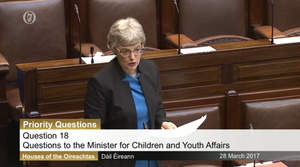
Sinn Féin TD Donnchadh Ó Laoghaire raised the second interim report in the Dail this afternoon after asking what steps the State is taking in regards to protecting unmarked graves – other than the remains recently found at the Bon Secours mother and baby home in Tuam, Co. Galway – in order to prevent them from being interfered with.

Mr Ó Laoghaire also claimed that the second interim report does not recommend widening the terms of reference in the Commission into the Mother and Baby Homes.

From their exchange…

Donnchadh Ó Laoghaire: “It’s my understanding, Minister, that the second interim report was before Cabinet this morning. The 27th of July last year, you issued a press release saying that the commission was to report back in September. That report has still not been published. Now you’ve committed to publishing it by the end of the month. It’s not published today, to the best of my knowledge. I presume it will be published in the coming days so I want to hear from you, when you intend to publish it.”

“But also, minister, to outline the reason for the delay because it has been with your department and with you for some six months now. And that has caused a great deal of concern and anxiety among survivors and I think it’s important that we get a sense of, for what reason was, what I think, was an inordinate delay in publishing this report was.”

“And also to state, Minister, it’s my understanding or has been reported that the report does not recommend an expansion of the terms of reference. That being case, I believe that the Commission [into Mother and Baby Homes] is no longer fit for purpose.”

Katherine Zappone: “Thank you, deputy Ó Laoghaire, I’m interested in your comments in that regard. I’d like to bring my comments though, responses, back to the question that you actually have asked me. As I know, I will take up some of those issues later on in terms of other questions and I think again in terms of the question about making decisions to bring forward injunctions. The Government, arguing, has the responsibility, something that we should consider, I’m saying I’m not necessarily, not willing to consider that. But my understanding and in terms of the advice that I have received that in order to do that, we need to have it brought to our attention, that there are some real concerns in relation to a preventative measure, in terms of different sites that may require, that may require an injunction. On the basis of people who have an interest in that regard. And so I would be open to hearing from those and consider the issue again in that regard.”

Acting Ceann Comhairle: “Thank you, Minister…”

Anyone?

Previously: ‘What’s In It That’s So Frightening?’

Screen Shot 2017-03-10 at 12.52.21

Minister for Children and Youth Affairs, Katherine Zappone

This morning.

On RTE’s Today with Sean O’Rourke.

The Minister for Children and Youth Affairs, Katherine Zappone spoke to Mr O’Rourke about several matters.

These included the Commission of Investigation into Mother and Baby Homes; Sgt Maurice McCabe; Taoiseach Enda Kenny telling RTE about a fictitious meeting with Ms Zappone prior to her meeting Sgt McCabe; and the results of yesterday’s Comptroller and Auditor General’s report which showed 18 religious congregations have, up to 2015, paid just 13% of €1.5billion redress costs associated with the compensation scheme for victims of abuse at religious residential institutions.

They began discussing the announcement Ms Zappone made yesterday that a scoping exercise will be carried out to examine calls for an expansion of the Commission of Investigation into Mother and Baby Homes’ terms of reference “to cover all institutions, agencies and individuals that were involved with Ireland’s unmarried mothers and their children.”

Sean O’Rourke: “When will you announce an extension or a broadening of the terms [of the Commission of Investigation into Mother and Baby Homes]?”

Katherine Zappone: “It’s a, it will be a number of weeks I expect. One of the first things that my department is doing is pulling together the ways in which the country dealt with these issues when the Commission of Investigation was established in 2014, looking at these issues about what institutions, what settings should be included and what should not.”

“At the time it was decided that it was appropriate to have a sample representative of settings but I suppose, in light of the discovery of, in terms of Tuam and the ways in which we are all trying to come to terms with this and Sean, you know, in the last number of days, I’ve listened to so many people, trying to reflect on the meaning of what has gone on in our history.

“And I have had, you know, many grown men come to me and cry in my, in my presence, trying to come with an understanding of what this meant for unmarried women and their children but also, you know, who is responsible, what was it about our society, how could people behave in this way. So, I’m sorry, I’m just trying to come to terms back to, you know, you’re saying how long will it take?

“There were decisions made in terms of the terms in 2014. Now that we’ve had this discovery, we’re trying to come to terms with it, as a nation. We need to look again at whether or not we need to include other institutions.”

Sean O’Rourke:Does every person who has a story to tell, and wants that story to be told, have a right to have it heard?

Zappone: “And so, yes I think so. And so, as the minister for children, another thing that I’ve identified that I would like to progress is not only perhaps to look at the extending the terms of reference of the Commission of Investigation but also to initiate a process throughout the country whereby there may be other ways in which we can keep the victims and the survivors at the centre of our attention to provide them with opportunities maybe for publicly to speak their truths which so many of them wish to do. And isn’t a possibility in the context of the Commission of Investigation.”

O’Rourke: “You spoke in the Dáil yesterday about museums of mercy, for instance, of memory, I beg your pardon, in Argentina and Chile. I think reference as well to South Africa – what model might you be thinking of?”

Zappone: “I’m referring to what’s known as a transitional justice approach to dealing with, now that we’re coming to terms with the fact that there was a wide scale large scale human rights violations on behalf of unmarried mothers and their children throughout the country, four decades. Is it enough? Is it enough to have a legal process of Commission of Investigation? It’s very important that we have that. But, in other countries, when they try to move on from what are considered to be repressive regimes, into a new era, they know that there maybe other ways in which there are opportunities for people to tell their truths, to remember what happened. Or to commemorate, a national day of commemoration, would be an example. Or other people are suggesting, perhaps the State ought to acquire some of the properties of where unmarried mothers were affectively put in against their will.”

“And to use that in other ways, as we try to, as a society, cope with, understand and move beyond and to heal, to a new way and a new time where we wish to be.”

O’Rourke: “It’s been quite a tumultuous month, not just for the Government, or the country, but also in particular for you, as minister for children and youth affairs. It was, I think, the 9th of February, when Katie Hannon had that report on Prime Time about the shocking allegations, false allegations, made against Maurice McCabe and then there was a political crisis

Later – speaking about the confusion over who knew what when in relation to Sgt Maurice McCabe 

O’Rourke: “You seemed to want it both ways at a certain point. A statement was issued on your behalf saying, initially, that you had informed relevant Government colleagues about the meeting, and then, subsequently, the position was oh it would have been highly inappropriate to brief Cabinet colleagues about matters pertaining to a protected disclosure. To what extent did you yourself add to the confusion?

Zappone: “Well, as you indicated there, I was out of the country for a very brief time. A long-standing family commitment. So I was not able to, I suppose, add my own voice, to offer the clarity in the way that I think I normally do in terms of issues that arise and coming to the media to address that. And so, given the time difference, distance, sorry the time differences, and the geographic distance I wasn’t able to be there, be there myself in order to offer that clarity about what happened, why I made the decisions and I think still, those decisions, I accept that, I have learned from, in terms of the way that we operate as a Cabinet. To perhaps be more explicit with information that one carries in the decisions that are being made. I said then, as I continue to say now, my prime concern was the protection of the McCabes and my understanding was that, with the information that I had shared, particularly with the Taoiseach, that their concerns would be incorporated into the tribunal of inquiry.”

O’Rourke:Did you fear, at a certain stage maybe, in the earlier part of this week you were still away, that your own membership of the Government was on the line. That you might have to leave Cabinet?

Zappone: “I, no, I, I didn’t think that, Sean?”

O’Rourke: “Or be forced out?”

Zappone: “Sorry?”

O’Rourke:Or be forced out? That you might have been sacked?

Zappone:Oh, ok, I’ll tell you, what, again, no, what was most on my mind was to ensure that a way of responding to this kept us moving to an appropriate response to the McCabes and I think, as you know, things have continued and certainly, under my own direct, sense of powers, as minister of children, I have, I ordered the establishment of a statutory investigation by HIQA, in terms of the way in which Tusla manages child abuse allegations, and I’m very pleased to say that I….

Speak over each other

Zappone: “…terms of reference have been agreed within the last week and that investigation will be initiated.”

O’Rourke: “And that’s an important part, perhaps the most important part of the bigger picture. But to go back to the politics of this for a minute. What did you think of what emerged afterwards to have been a fictitious account given by the Taoiseach on [RTE’s] This Week about having met you before you met the McCabes and told you ‘be sure you take a good note’.

Zappone: “Well, as you’ve already indicated. I was in the States when that programme [Prime Time] happened. When I came back, I responded to the media, I put on the record in the Dail, in terms of what happened. And that I know now, and I think everyone else knows that the Taoiseach has agreed with that account.”

O’Rourke: “At the same time, by all accounts, and his own not least, he’s been forced into a position where he’s brought forward, and significantly, it would appear, the date of his departure as leader of Fine Gael and as Taoiseach.”

Zappone: “I suppose, Sean, those are issues and decisions in relation to the Fine Gael party. I, as a Cabinet minister and engaging with this very,very, very difficult issue in relation to the McCabes, obviously, had a history, a complexity, my focus was on them. I behaved in relation to a concern for them. I communicated with the Taoiseach in a way that I thought that was appropriate. And what happened after that is outside of my control.”

O’Rourke:Should you have been more explicit in Cabinet. And I know there’s a constitutional bar on you giving details of Cabinet discussions but could, and should you have been more explicit about insisting Tusla needs to be brought into much more, front and centre, into the terms of reference of what was originally setting out to be, or being set up, as a Commission of Investigation?”

Zappone: “I suppose everything we do at the Cabinet table, Sean, comes as a result of a discerning process. And as I said, I have learned some lessons from this in terms of, you know, maybe bringing to the table things that before I might have felt were appropriately kept with me. But, at that particular moment, my discernment, as I said, my understanding and my reading of the terms that were in front of me, my communication with the Taoiseach was what I knew, from the McCabes, would be part of the investigation. And the judge who was leading that subsequently confirmed that, even before we actually enlarged the terms of reference.”

O’Rourke: “I suppose we have so many strands to the, our relationship with our troubled past and talking about, particularly, where children are concerned for now. We’ll talk politics later but, that are on the agenda at the moment, not least what’s emerged about the amounts of money being paid as part of the whole Redress arrangements which cost now over €1.5billion. The expectation, hope that it would be a 50:50 split between the State and the Church, mainly the Catholic Church, hasn’t materialised. What do you think should happen?”

Zappone: “I would be very much in agreement with my colleague, Minister [Richard] Bruton and support him in his re-engaging with the religious orders in order for them to make contributions to the redress scheme. Because they do share the burden of the responsibility. And I will support him in those discussions.”

O’Rourke: “And what about something that Micheal Martin, the Fianna Fáil leader, said to us on the programme a few days ago. That he felt it would be appropriate, now it wasn’t exactly in the context of redress, that the Catholic Church should hand over its hospitals is what he identified specifically to the State?”

Zappone: “Yes, I, you know, I reflect on that. I think, underneath that recommendation, is that the desire for all of us to ensure and to see that people are held accountable for what has gone on and in terms of the abuses that were done in relation to children, as well as women over the last number of years. Who is responsible? And if those people who are responsible? How much of they pay? How much should the State pay? Should we extend terms of reference, even for the Commission of Investigation that I’m overseeing and supporting and does that, does that mean that, ultimately, those people, the survivors, who are looking for compensation, ought we, the State, the religious orders, who ought to pay for that and how do we make those decisions. It’s all part of that space, Sean. And, I think, you know, if people are offering solutions on how to move forward, I’m listening to those. But I think we need to spend time reflecting on how to do this in the best possible way.”

O’Rourke: “The Taoiseach said, briefly, if possible, you might respond to this. That during the week, ‘women did not impregnate themselves, nuns did not reach into family homes and take babies out’. Do you think in any truth-telling process, you would set up, there’s any possibility, remote or otherwise, we will hear from men in large numbers, other than those who have suffered in the institutions? About what they knew? What they did?

Zappone: “That’s a great question, Sean. You have asked it. And I hope that the men here, you as a man, asking that question, I would love to see that happen.”

Previously:  ‘They Exclude And Stall While We Die’

‘Running Out The Clock’

Rollingnews

17098447_1264037323643748_4609777203332495076_n

This morning.

In the Dáil.

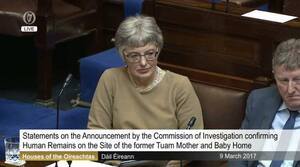
Before deputies made statements about the confirmation last week that human remains have been found at the site of the former mother and baby home, run by the Bon Secours order, in Tuam, Co Galway.

The Minister for Children Katherine Zappone told the Dáil that, by the end of the months, she will publish an interim report that the Commission of Investigation into Mother and Baby Homes gave her last September.

She also said a scoping exercise will be carried out to examine calls for an expansion of the commission’s terms of reference “to cover all institutions, agencies and individuals that were involved with Ireland’s unmarried mothers and their children.”


From Ms Zappone’s speech:

Experience tells us it can take time to shine a light on dark periods of our history. The truth is hidden. Sometimes hidden in plain sight.

It takes the brave testimony of survivors, long studies by historians and the dogged determination of investigative journalists to bring a spotlight to events which were previously only whispered about – in this case for generations.

It is now almost a week since the Commission of Investigation into Mother and Baby Homes confirmed what we had all feared.

Today I wish to place on the record of this House the Commission’s update that significant number of human remains are buried in the site of the old Mother and Baby Home in Tuam.

For survivors, loved ones and campaigners such as the tireless Catherine Corless it was a moment of vindication. After decades and years of hard work, determination and unwavering commitment the truth has been laid bare for us all to see.

This House, and our entire state, owes a debt of gratitude to Catherine Corless for her work.

Many men and women alive today spent time in that institution, either as children or as young women. Today I offer them my personal solidarity and, as a citizen, my personal apology for the wrongs that were done to them.

Deputies will know that the Commission of Investigation into Mother and Baby Homes continues its work.

You will also know that cases have been made that the terms of reference of this Commission should be reviewed.

I want to acknowledge the calls made since Friday for an expansion of the Terms of Reference to cover all institutions, agencies and individuals that were involved with Ireland’s unmarried mothers and their children.

I can commit to Deputies that a scoping exercise will be carried out to examine this. As Minister I will be announcing the detail of this exercise in the coming weeks. As Minister I will also be publishing the second interim report of the Commission by the end of this month.

I am also mindful that by design the Commission is largely concerned with questions of legality; of legal liability, of compliance with the laws of the day and so on.
These are important questions.

They are however not the only issues which we should consider.

What happened in Tuam is part of a larger picture.

Part of a tapestry of oppression, abuse, and systematic human rights violations that took place all over this country for decades.

As a modern open society we must not treat these as isolated incidents but rather confront what was a dark period in an honest, mature and reflective way. We must acknowledge that what was happening in these institutions was not unknown. We must acknowledge that what was happening in these institutions was not without the support of many pillars in society.

We must acknowledge that this very House debated legislation that allowed for those residing in institutions such as County Homes to work for little or nothing in return for the so-called charity that was shown to them.

Lest we contend that people did not know what was happening, let us remember that some members of this House spoke out against it.

In the Finance Committee debates on the Health Bill 1952, which took place in July 1953, Deputy Kyne condemned putting unmarried mothers in county homes to effectively involuntary labour as “having revenge on her”.

While Deputy Captain Cowan described as “absolute brutality” the fact, as he described it, that “They are not let out even”.

Earlier than that — before our Constitution had been finalised — members of the Oireachtas also raised questions about the ill-treatment of so-called illegitimate children.

Thus, as I said, this history may be dark, but it was not entirely unknown. We must acknowledge that sometimes it was fathers and mothers, brothers and uncles, who condemned their daughters, sisters, nieces and cousins and their children to these institutions.

And that sometimes it was not.

We must accept that between 1940 and 1965 a recorded 474 so-called “unclaimed infant remains” were transferred from Mother and Baby Homes to medical schools in Irish universities.

We must listen to, record, and honour the truth of people’s experiences. We must commit to the best of our ability to recognising, recording and making reparations for the truth.

Making these commitments and honouring them will not be easy. But we must – for those who suffered and also for future generations.

Establishing the truth is important for many reasons – but not least to ensure that the darkness of the past will not return in the future.

Irish women and Irish children must never have to endure such suffering again. As a feminist, as an Independent Minister and as an Irish woman I feel a moral and ethical compulsion to reach beyond the legal questions of what happened in Tuam and elsewhere.

That compulsion is driven to try to arrive at this truth. For it is only from acceptance of the truth that we can move past it; not by drawing a line under it, but by highlighting it.

By recognising it as part of our history and part of our national story.

By commemorating and memorialising it.

By honouring its victims.

By recognising the part that individuals, communities and institutions played in it.

By making sure that, while we still have time, we look to those who are still alive and accept their accounts of what was done to them, and of the wrongness of that. In the coming days, as Minister, I will start a conversation with advocates, with historians and scholars specialising in transitional justice.

The United Nations defines transitional justice as the set of approaches a society uses ‘to try to come to terms with a range of large scale past abuses’. Transitional justice puts survivors and victims at the heart of the process. It commits to pursuing justice through truth.

It aims to achieve not only individual justice, but a wider societal transition from more repressive times, to move from one era to another.

Taking a transitional justice approach means that we will find out and record the truth, ensure accountability, make reparation, undertake institutional reform, and achieve reconciliation.

In doing this I want to acknowledge the many people who have contacted me personally in recent days to tell me directly of their experiences. It is important to also ensure that we learn from international best practice in transitional justice, such as the Museums of Memory in Argentina and Chile, for example.

There may also be lessons to be learned from processes used to establish the truth in other contexts and other countries.

Writing about the Mother and Baby Home in Tuam, as well as other matters, in the London Review of Books last year, our Laureate for Irish Fiction, Anne Enright, said: “The living can be disbelieved, dismissed, but the dead do not lie. We turn in death from witness to evidence, and this evidence is indelible, because it is mute”.

Let us not disbelieve; let us not dismiss.

Let us commit to do justice not solely through law, but through speaking and listening, and through believing what our eyes, our ears what our compatriots tell us.

Transcript via Katherine Zappone

Yesterday: What’s In It That’s So Frightening?

‘sup?

More as we get it.

Update:

Oh.

Update:

Oh.

Katherine Zappone didn’t go into ‘vile and wrong’ allegations with Cabinet ‘to protect McCabes’ (irish Examiner)

00162805

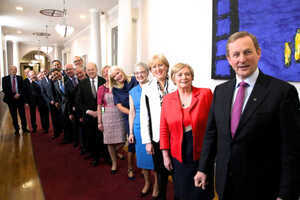
The cabinet at Aras an Uachtaráin on May 6, 2016, following the General Election last year with Katherine Zappone (fourth from right)

Further to reports that Minister for Children and Youth Affairs Katherine Zappone did not inform her cabinet colleagues of the matters concerning Tusla and Sgt Maurice McCabe when it met on Tuesday, to discuss the terms of conditions of the forthcoming commission of investigation into Supt Dave Taylor and Sgt Maurice McCabe’s protected disclosures…

The following statement has been released by a spokesperson for the Minister for Children and Youth Affairs Katherine Zappone…

Minister Zappone has met with Mrs Lorraine McCabe and Sgt Maurice McCabe. She has heard first hand of the devastation caused to them by the false allegations against Sgt Maurice McCabe.

The Minister became aware of the circumstances when Mrs McCabe contacted the office of the Minister for Health on 18 January 2017.

As the matter related to the Department of Children and Youth Affairs, the Private Secretary of DCYA was requested to call Mrs McCabe. The private secretary did this on 18 January.

Minister Zappone met Mrs and Sgt McCabe on Wednesday 25 January. Since then her office has been in regular contact with Mrs and Sgt McCabe and Tusla – which has led to the offer of a public apology.

The Secretary General of the Department of Children and Youth Affairs held a meeting with Senior Tusla Personnel on Friday 27th January. Tusla provided DCYA with a chronology and analysis of the case – which my Department gave to Mrs and Sgt McCabe on Saturday 28th January.

Tusla informed the Secretary General that they have instituted a case review to extrapolate all relevant information in order to provide a more detailed analysis.

Minister Zappone informed relevant Government colleagues during the course of this period. Minister Zappone was always of the view that Tusla would form part of the investigation by the Commission of Inquiry.

It’s also being reported that Ms Zappone is declining to name the “Governement colleagues” with whom she spoke.

Meanwhile…

Yesterday, in the Dáil, Sinn Féin TD Mary Lou McDonald asked Fine Gael Justice Minister and Tánaiste Frances Fitzgerald if she was aware of any contact between the gardaí and any other State agency in respect of Sgt Maurice McCabe…

They had the following exchange…

Screen Shot 2017-02-10 at 15.52.05

In addition, in the Seanad yesterday afternoon, Ms Fitzgerald said the following, as part of her statement on the commission of investigation by Mr Justice Peter Charleton…

I thank Members of this House for agreeing to statements being taken on this important matter in the House today. As the House will be aware I have laid the relevant material before the House to give full effect to the recommendations of Mr Justice O’Neill.

However, before moving to seek approval for the relevant motion I believe it is sensible that we discuss these matters here first. I am already persuaded from discussion which I have had that there may be some improvements which can be made to put beyond doubt that certain matters will come within the remit of the commission. I intend to reflect on what is said here today and make any amendments to the proposed draft order in light of those discussions.

As Mr Justice O’Neill indicated, it is imperative that certain allegations be examined and I believe we should stick as closely as possible to the terms of reference he proposed. After all we appointed him and gave him terms of reference for the initial inquiry. He has considered all the issues and made a series of recommendations which I have laid before the House.

Transcripts via Oireachtas.ie

H/T: Gavan Reilly

Previously: ‘Government Forces Have Said’

Screen Shot 2017-02-10 at 13.52.02

Further to reports that Sgt Maurice McCabe met the Minister for Children and Youth Affairs Katherine Zappone on January 25, 2017

And Tusla chief executive Fred McBride telling Áine Lawlor on RTÉ’s News at One this afternoon that Tusla briefed Ms Zappone’s department about the matters concerning Tusla and Sgt Maurice McCabe “within days of us finding out, or certainly at my level, finding out what had happened here…I can’t get an exact date but within a couple of days”…

And Katie Hannon reporting on Prime Time last night that on January 27, 2017, the chief operations officer of Tusla wrote to the Secretary General of the Department of Children and Youth Affairs acknowledging that ‘mistakes were made in the management of this matter’ and saying that he had ‘instituted a case review internal to Tusla’…

And the terms of reference of a commission of investigation into Supt Dave Taylor and Sgt Maurice McCabe’s protected disclosures being published on Wednesday, February 8, 2017

Sarah Bardon, in The Irish Times, writes:

Ms Zappone met Sgt McCabe last month after receiving a letter from Tusla, the child and family agency, confirming it wrongly sent a file containing false allegations of child sex abuse made against Mr McCabe to gardaí.

Sources said Ms Zappone had not informed Cabinet of the matter when the proposed terms of reference for the commission of inquiry into the handling of garda whistleblowers were discussed this week.

…Neither Ms Zappone or her spokesman have responded to the claims yet.

Zappone urged to clarify handling of false claims against McCabe (Sarah Bardon, The Irish Times)

Earlier: Pasted In Error

Rollingnews