

Yikes.
Stephen Malone writes:
Whoever is working on the Late Late questions maybe needs to put a bit more thought in.



Yikes.
Stephen Malone writes:
Whoever is working on the Late Late questions maybe needs to put a bit more thought in.
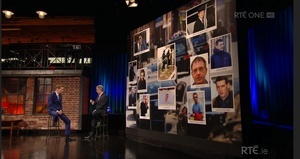
Anyone that votes 4 Sinn Fein are drug dealers,killers, kidnappers & terrorists according to Paul Williams #latelate pic.twitter.com/GGpswDZU14
— Máire Nic an tSaoir (@Mc1988) February 19, 2016
Last night’s Late Late Show..
There you go now.

Tonight.
Awesome Late Late Show Audience Couple.
Expertly done, in fairness.
*blows raspberry*
Thanks Kevin Whitty
Previously: Awesome Audience Persons on broadsheet.ie

There is no escape.
Maria Schweppe, of the London Irish Comedy festival writes:
I’m organising an event in London called The Late Late Toy Show LIVE! on Saturday 28 November in the London Irish Centre [Camden Square, London NW1], which is a screening of The Late Late Toy Show (with support from RTÉ Player International) the night after it airs in Ireland. There’ll be live comedy, craic and Christmas jumpers! Comedians Tara Flynn, Gráinne Maguire and Colum McDonnell will host. Be very grateful for a shout out to let your Irish readers in London know about it.
Book tickets here

Bigger than Garth.
Via RTÉ:
The Late Late Show enjoyed its highest audience of the year so far for Friday night’s country special. An average of 707,400 people tuned in for the show which saw interviews and performances from the biggest stars on the Irish country scene including Daniel O’Donnell, Big Tom (above) and Nathan Carter.
The show attracted an audience share of 52 per cent with over a half of all Irish viewers watching television at that time tuning in to enjoy The Late Late Show in its entirety.
The total audience reached over the course of the show was 1.3 million…
Saloon bar punch-up!
Watch in full here

Neckwear eschewing moneybags Richard Branson during a [precorded] interview to be broadcast tonight on RTÉ One’s Late Late Show with Ryan Tubridy.
Gareth Naughton writes:
…other guests on tonight’s show include:Rapper Professor Green talking about his journey from a troubled upbringing to life amongst the Made in Chelsea set following his marriage to Millie Mackintosh.At Your Service star Francis Brennan giving his guide to happiness. Rory O’Neill, aka Panti Bliss, chatting about the aftermath of the marriage referendum and becoming The Queen of Ireland. Jockeys Robbie McNamara and Brian Toomey will be appearing to discuss the aftermath of their respective falls and their recoveries.
FIGHT!
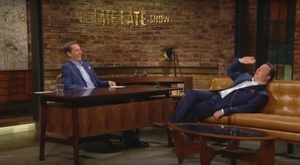
It’s back!
Ann-Louise Foley writes:
The Late Late show is back this Friday at 9.35pm on RTÉ One. And, to get you in the mood, here’s Ryan [Tubridy above with Piers Morgan] and some special friends having a bit of a sing-song. Enjoy!
*burns imaginary telly licence*
The final Late Late Show until September.
Thank you baby Jesus.
It’s a charidee dance special!
RTÉ write:
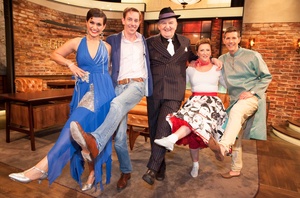
Dermot Bannon will be dancing Bollywood style for Barnardos; Majella O’Donnell will be doing the jive for Arc cancer support; George Hook will be doing the Charleston for the IRFU charitable trust and Maria Walsh will be doing the salsa for Bumbulance.
Also on the show will be a tribute to Bill O’Herlihy featuring ‘the three amigos’ – John Giles, Eamonn Dunphy and Liam Brady – plus many of Bill’s colleagues and friends.
Top from left: Maria Walsh, Ryan Tubridy, George Hook, Majella O’Donnell and Dermot Bannon.
Pic; Tony Kinlan
 Ryan Tubridy and Anti-Austerity Alliance TD Paul Murphy on the Late Late Show on Friday.
Nobody expects the Spanish Inquisition.
You may have caught Paul Murphy’s appearance on the Late Late Show on Friday night?
Whether you think Mr Murphy a silly Marxist loon or hi-viz Robespierre it was (in complete fairness) an unusually hostile, poorly researched and unpleasant piece of political chat show-ing.
But don’t take our word for it.
Grab a tay/soft cushion.
Ryan Tubridy: “My next guest is a man of numbers. He spent three years as a member of the European Parliament, he’s been a member of Dáil Éireann for just four months but in his campaigning history, he’s been arrested five times. Would you welcome please, Paul Murphy, TD.”
Paul Murphy enters
Tubridy: “They’re interesting numbers, aren’t they? When they all add up. But you’re welcome to the program, thanks for joining us.”
Paul Murphy: “Thank you.”
Tubridy: “Before we get into the politics, let’s talk about the personal, because we see a lot of you in the political environment but not in the personal. So, let’s get a little bit of your own background. You’re from what part of Dublin?”
Murphy: “I’m from Goatstown.”
Tubridy: “Yeah. And tell me a little bit about the house you grew up in.”
Murphy: “Yeah, normal enough, middle-class upbringing. One brother. One sister. Did well in school. Went to UCD. Did law in UCD.”
Tubridy: “You did more than law, you came first in your class.”
Murphy: “I did.”
Tubridy: “Which is rather impressive. Was it a political house?”
Murphy: “No, not particularly I’d say. There were political discussions in the sense that, like a lot of families, people have opinions and argue about things, be it politics or culture, or whatever. And so there would have been discussion in my house but not…certainly not linked to any one political party and not a socialist house in particular.”
Tubridy: “Cause you were quite young when your father passed away, isn’t that right? How old were you?”
Murphy: “Eleven.”
Tubridy: “Eleven. And that would have had an impact on you, no doubt?”
Murphy: “Yeah, yeah of course.”
Tubridy: “In what sense?”
Murphy: “Well, you know, I suppose it was hard for my mother, for any mother, any parent, mother or father bringing up their kids on their own. That’s, you know, a difficult situation for someone. And when I think, you know, that creates an environment in a house whereby you’ve one parent one parent and you understand that there’s a pressure on one parent alone. But…yeah.”
Tubridy: “That was that, that’s the world that you lived in. There was talk, you know, reading about you, there was talk of Fine Gael in your family. Is that the case? Is there…”
Murphy: “Not in my immediate family. I mean, it’s like people will say, your family is Fianna Fáil, I mean my…”
Tubridy: “But I’m not a Socialist TD, you know?”
Murphy: “Sure, sure.”
Tubridy: “I suppose that’s the…”
Murphy: “Yeah, but some of my, in the sense that like it doesn’t say anything about your politics but I think some of my dad’s brothers would be Fine Gael, maybe one or two of them. I don’t think it’s some big Fine Gael family. And I was never aware of that actually, prior to becoming an MEP, you know, some people saying, ‘oh, it turns out you’re a Fine Gaeler’ and I’ve betrayed by Blueshirt roots apparently.”
Tubridy: “Of course, of which, of course you don’t… as far as you’re concerned. So what drew you towards socialism and the Socialist Party because, as you say, you were in law in UCD and then you obviously got your interest piqued politically by something, somewhere along the way.”
Murphy: “Yeah, like a fair number of people, I would have become political quite young, as a teenager. In particular when I was 15, 16, what would have been happening around the world? You had big protests against the IMF, against the WTO, against the World Bank, kind of anti-globalisation, anti-capitalist protests and that would have shaked, shaped my political outlook. And like, at the time, what they were about were like, unfair trade practices, it was about unjust debt, it was about austerity in places like Latin America. Some of the things that have now come to Europe then were kind of very present in Latin America and would have been a radicalising factor and then reading things and beginning to describe myself as a Socialist.”
Tubridy: “You felt that this was where your dreams and ideologies lay?”
Murphy: “Yeah, in a sense I felt that, yeah, if I could do things to make this country, this society, our continent, our world a better place, a less unjust place, a place where you don’t have so much poverty, where you don’t have war, where you don’t have just the misery that people, you know what I mean, forget about this country for even one moment, and think about the 2 billion people in the world who survive on less that $2 a day. So they’re the kind of things that drove me to say, ‘let’s try and change this’.”
Tubridy: “So, what age are you?”
Murphy: “31”
Tubridy: “31, because that puts it into a context, in terms of when that was happening and what age you were at the time. You went on, of course then, to work with Joe Higgins probably up until recently the most famous, if not the only Socialist TD in Ireland for a long time.”
Murphy: “Bertie Ahern apparently was a socialist as well.”
Tubridy: “So they so, or so he said. And then you ended up in Europe.”
Murphy: “Yep.”
Tubridy: “With him (Higgins). Tell us a bit about that.”
Murphy: “Yeah, so we, we didn’t go into the European election campaign in 2009, thinking we were going to win. And we won because the crisis had hit, people were being radicalised, moving to the left, and so we won. That was the first MEP seat we had. And so I moved over to Brussels and, whenever Joe [Higgins] got elected to work on setting up our European office, in the European Parliament, to do all of that. And then, in 2011, when Joe was elected back into the Dáil, I took over as MEP.”
Tubridy: “You were co-opted as an MEP. Ok.”
Murphy: “And so that was, I mean that was some experience. Again, a difficult experience, in the sense that, I mean, all of us sudden, you’re in the parliament, you know, debating with all these people who are, you know, establishment figures, etc. But it was a very good time to be an MEP and a very good time as a socialist to have an MEP because there were massive crisis of capitalism within Europe and like massive austerity being waged in Ireland, Greece and Portugal and so, one of the main things we tried to do was say, ‘Ok, let’s have solidarity of working people, right across Europe’. The idea of fighting for a different type of Europe, a Europe not built for the 1%, for the bankers, for the bondholders but for the 99%.”
Tubridy: “So you came out of the European project if you like, you ran for the general election, you didn’t get elected that time. No, sorry, excuse me, sorry you ran for the Europe… and didn’t get elected that time and then, of course, when Brian Hayes [former Fine Gael TD, now MEP] Fine Gael became an MEP, you took the by-election seat. Did you want to be a TD? Did you dream of being a TD? Did you want to walk the corridors of Leinster House all your…”
Murphy: “Never, I still don’t dream of that.”
Tubridy: “So what are you doing there then?”
Murphy: “Well, because I’m a Socialist activist.”
Tubridy: “Right.”
Murphy: “Right. And I think we can fight for fundamental change in society.”
Tubridy: “Right.”
Murphy: “And it’s so happened, events have happened in my life like, going over to work with Joe and then taking over from Joe, because it made sense at that time. And then the by-election happened. Events have happened that have propelled me as a Socialist activist into playing a particular type of role at this stage.”
Tubridy: “Ok.”
Murphy: “Which is being in the Dáil. But it’s not like, I’ve never had any ambition to be a TD or MEP or anything like that but I think, can I play a role in assisting, like the water charges struggle, concretely now in being a TD? Is it a good platform to assist struggles with people? It is. And I think that’s how we can use it.”
Tubridy: “And part of the reason you’re here tonight is you gave, you’ve made quite a name for yourself as part of a very different type of protesting that’s been happening in recent months. We’ll talk about the, obviously, the Joan Burton protest which, of course, became such a talking point in this country. Let’s take a little reminder of that protest and we’ll have a chat about it in a second.’
A clip from RTÉ reporter Sandra Hurley’s report on the Jobstown protest is played. In it, Paul Murphy is seen and heard speaking to the protesters via a bullhorn. From the clip:
Sandra Hurley: “A tense stand-off in Jobstown today as the angry mood against water charges spilled over. The Tánaiste was attending a Higher Education ceremony but, when she left, her car was hemmed in by around 100 protesters. Dozens of garda reinforcements arrived, along with the Garda helicopter and the Public Order Unit. This escalated the tension.”
Paul Murphy: “If they withdraw the Public Order Unit, do we agree to let her go?“
Crowd shouts back ‘yeah’.
Hurley: “Then the unit agreed to step aside in return for protesters agreeing to slowly march in front of the car to let her out. After two and a half hours, some confusion as gardai surrounded the Tánaiste and physically transferred her to another car with some protesters giving chase.”
Tubridy: “Was that a mistake? To do what happened to the Tánaiste that day?”
Murphy: “I don’t think it was a mistake, for me, as a public representative, elected on the basis of opposing water charges, to join in on that protest. That was effectively spontaneously organised by residents the night before and then grew. If I was organising that protest, or if the triple A [Anti-Austerity Alliance] was organising that protest, it would have been a different sort of protest. I mean there’s no question, it was a messy protest. It’s not your ideal situation of how a…”
Tubridy: “Was it ugly?”
Murphy: “I’d say it was messy and I’d say, I mean…”
Tubridy: “Would you say it was ugly?”
Murphy: “Well, I didn’t…I wouldn’t use the word ugly.”
Tubridy: “Would you not?”
Murphy: “I think, afterwards, which was then conflated by Independent newspapers, in particular, afterwards there were ugly scenes. I mean there was a picture that was used again and again of…”
Tubridy: “Can we just talk about that [Jobstown protest]. Don’t mind other newspapers because I’m just gonna deal with what I just saw, and what everyone at home just saw, which was, you know, the Tánaiste, the deputy Prime Minister of the country, trapped in a car for two hours, against her will. Is that acceptable?”
Murphy: “She wasn’t trapped in her car. She was able to leave.”
Tubridy: “She wasn’t going anywhere fast, Paul?”
Murphy: “No, but she left, I mean she moved from one car to the other, right? But the point is…”
Tubridy: “Did I just not, did I just not see you with the bullhorn saying, ‘shall we release her or not?’ If you say such a thing, that suggests that she needs to be released from somewhere, therefore she was not in a voluntary position to move.”
Murphy: “Just this quote and this clip has been used again and again and again, right.”
Tubridy: “Was it made up?”
Murphy: “No but the context of it has been explained again and again and again. And I don’t really believe you don’t know the context because I have explained it so many times. And this is a conscious attempt by the media to demonise anti-water charges so the context…”
Tubridy: “A lot of our viewers may not have seen you on anything, as much as you’d love…”
Murphy: “But you chose to use the clip?”
Tubridy: “We did choose to use the clip.”
Murphy: “But the context, that I’ve explained multiple times, is that the gardaí had explicitly asked me, and if this ever goes to trial, we can find the guard responsible, had asked me to put that question to the crowd. The gardaí wanted to de-escalate the situation and they chose to talk to me.”
Tubridy: “Ok.”
Murphy: “As a public representative and so that’s what I did.”
Tubridy: “Do we need to get into semantics of, about the choice of words, ‘do we want to release that Tánaiste from this?’. Is that…am I missing something here?”
Murphy: “But it’s you that has introduced this particular quote?”
Tubridy: “You said it Paul.”
Murphy: “Sure but I’m explaining that I said..”
Talk over each other
Tubridy: “Are you saying the guards put, forced words into your mouth? That you didn’t want to say that?”
Murphy: “No, the guards asked me to communicate that message to the protesters. I wasn’t fully in charge of everything that was happening at the protest. And I was trying to play a role in having a disciplined protest and to bring the protest to an end at a certain stage. That’s what I was doing and that’s what the clip actually demonstrates.”
Tubridy: “Let’s not get lost on that. Do you think, quickly again, I’m really curious, as a public representative, do you think it’s appropriate that the Tánaiste, who I think it’s fair to say, most parties who would look at that would say, felt intimidated? Regardless of your politics, that it was not a pleasant situation for anyone to be in for two hours. Do you think that that was a mistake?”
Murphy: “No. I’ve said that it’s not a mistake. But I tell you..”
Tubridy: “If it happened tomorrow would you..”
Murphy: “No, let’s..”
Tubridy: “Would you roll with it?”
Murphy: “Let’s take it, let’s put it in its context. Because what the media wants to do is just take these individual incidents, right?, and you can show another clip and you can say, ‘what happened here?'”
Tubridy: “Yeah.”
Murphy: “But the context is, of communities being ravaged because of austerity. The context is of broken promises. If you listen to what was shouted at Joan Burton, overwhelmingly what was shouted was ‘traitor’ because people… Jobstown is a traditionally a Labour Party area, people voted for Labour and then they betrayed them. They cut child benefit, they imposed water charges they’re cutting lone parents [allowance]…and so people are very, very angry.”
Tubridy: “It sounds… I think most right-minded people would understand that anger, Paul to be honest with you but I still am having trouble with you possibly justifying, and people may have trouble with you justifying, the intimidation of a person…”
Murphy: “What am I justifying? No. I’m not justifying any intimidation or anything like that.”
Tubridy: “But you’re condoning it.”
Murphy: “No. What I’m justifying and condoning is a peaceful, sit-down protest behind a car of the deputy prime minister, that has happened multiple times in this country without people having dawn raids without warning, without 23 people arrested at this stage. And I’m condoning and justifying and supporting a slow protest in front of the Tánaiste’s car. There’s been multiple attempts, multiple incidents whereby Taoisigh Charlie Haughey, Bertie Ahern have been stopped in their cars…”
Tubridy: “There just seems…”
Murphy: “Nothing has ever happened like this and it’s not an accident. It’s happening because the establishment is scared. Because they want people to get back in their box because that’s what…it isn’t pure, it isn’t clean, it isn’t…”
Tubridy: “Paul, people aren’t that stupid and I think that, to be honest with you, people felt that this was a different tone to public protest. That it had taken on this very ugly hue that was, that involved this sort of cat-calling, shouting, jeering at people that, you know, may or may not deserve such a thing. Any human being, let alone a politician..”
Murphy: “People don’t deserve? There are people right now locked up, right? For one month and for two months. Five people. And the only reason they’re locked up is for breach of an injunction whereby they’ve gone within 20 metres of a water meter installation. In my opinion that’s much more serious than someone calling Joan Burton a traitor or Joan Burton being held somewhere for two and a half hours. I mean, where Joan Burton was that day, just around the corner there was a couple, whom I later spoke to, who were living in their car, who were homeless.”
Tubridy: “Yes.”
Murphy: “Do you know, that’s what they’ve done in this society and then the media is focused on ‘was she called a traitor here? was she stopped in her car for two hours?’ It misses the picture here which is like the structure of violence, the destruction of communities by their policies.
Tubridy: “Maybe if you had orchestrated things a little better, and in a more civilised manner, you mightn’t have made a martyr of the Tánaiste and we wouldn’t be talking about all this..”
Murphy: “If I had orchestrated, this wouldn’t have happened. I didn’t orchestrate it. That’s the point. Right. So I’m aware this protest is happening. I’m in favour of people protesting but we genuinely did not organise it. We arrive on the scene and what role do I play? I attempt to put a shape on the protest, to put a discipline on the protest, I introduce chance into the protest, in order to have a more effective type of protest.”
Tubridy: “You were arrested anyway, as a result of what happened there. You obviously would have felt that was utterly unjustified. Tell us a little about the morning of your arrest.”
Murphy: “Yeah, it’s a bit of a shocking experience. In the sense that, you know, you’re half awake, five to seven in the morning, you get a ring on the door, you open the door, there’s six gardai at the door and they push their way in and tell you that you’re being arrested, under suspicion of false imprisonment of Joan Burton and her assistant.”
Tubridy: “Right.”
Murphy: “And then I was in the garda station for maybe, for eight and a half hours. I was questioned for four hours.”
Tubridy: “Yeah.”
Murphy: “Again and again, based on media transcripts, and footage from RTÉ, YouTube, etc, etc.”
Tubridy: “Yeah.”
Murphy: “All to try and stand up the idea that, which they’ve been talking to people in the community and questioning people with a view to pinning me, as being responsible for a protest that I didn’t organise and trying to say that I’m responsible for what’s apparently the false imprisonment of Joan Burton. I mean if that’s false imprisonment, well then anyone who participates in any protest and stops, gets in the way of cars, as happens all the time, are guilty of false imprisonment. I mean it’s some stretching of the term and it’s very serious. Because the maximum sentence for false imprisonment is life in prison. And obviously, like I don’t think that’s going to happen…”
Tubridy: “I would be shocked if that was to happen.”
Murphy: “But that’s the kind of threat that hangs over people. And there’s a whole community now in Jobstown, hundreds participated in that protest and people are scared.”
Tubridy: “Do you not get some class of, forgive the choice of words, but thrill out of being arrested. And I say that on the basis that it’s manna from heaven in some ways because suddenly you find yourself as the top of the media tree in terms of whatever programme you’re going on, including this, you get all the attention you need, you bring all the attention to the cause you fight. And chances of you spending any time in prison are slim to none and yet you get all this coverage?”
Murphy: “Firstly, I have no personal interest in media coverage, I really don’t, you know, I don’t find it a pleasant experience to be going on, talking about your childhood, do you know what I mean? That’s not what I want to do.”
Tubridy: “And yet you’re here.”
Murphy: “Two, yeah, because we use media appearances to try to get the political points across, about how we can defeat water charges, though non payment etc.”
Tubridy: “But you say, ‘I don’t like media’ but you’re always in the media; ‘I don’t like politics, yet you’re in Leinster House’. What do you want?”
Murphy: “I’m trying to do the best I can to try and change the society for the better. And I think that I can do that, including by using media appearances. But it’s not that I have any really, I don’t have a personal like for media, being in the media whatsoever. It’s all a platform to get ideas across. And, like, did I like being arrested? No. I had real things to do that day. I’d people to try and assist. I had homeless cases I was trying to assist. I had, you know, work to do that actually could make a difference to my constituents. There was a guy who was trying to contact me, about a particular case and he wrote to his TD, his Fine Gael, he’d traditionally be connected to Fine Gael and he wrote to them saying, you know, he’s outraged because he was meant to talk to me and he couldn’t because I was sitting…you know, so really, I’ve better things to be doing than sitting in a garda station.”
Tubridy: “We need to talk about the Michael D Higgins protest. Let’s call it that for the sake of it. A quick reminder of that too, in terms of the nature and the tenure of the modern protest.”
Tubridy makes a gesture that indicates a clip is set to be played
Murphy: “Why do we need to talk about it?”
Tubridy: “Well we’ll have a look at it and you tell me…”
Murphy: “But it has nothing to do with me…”
Tubridy: “Well I think it’s self explanatory.”
Murphy: “But it’s nothing to do with me.”
Tubridy: “Let’s roll the tape and the people can decide.”
A clip is played from the protest concerning President Michael D Higgins in Finglas last month, in which President Higgins is called a “midget parasite” by jailed protester Derek Byrne. It also shows a garda pushing a female protester twice and another female protester once.
Tubridy: “So, do you approve of that protest?”
Murphy: “No, I condemned it repeatedly, so I don’t know why you want to talk about it because I’ve been in the media repeatedly condemning the protest, right? And so what’s being attempted is to link that protest and the Jobstown protest and to link them somehow to me. I wasn’t there. I don’t approve of it. I didn’t agree with it, I’ve condemned it repeatedly. So, do you know what I mean, if you had Mícheal Martin in here, would you have him on saying, ‘we have to talk about this’?”
Tubridy: “Well when Mícheal Martin comes on, we’ll decide what we ask him at that time but I’ve got you here so I’m going to talk to you about these things. You’re anti-water charges, you’re part of the water protest movement, which is fine. Are all the people that we saw in that tape and the jeering that went on, those people that did that. You are denying them, in public tonight, saying they were wrong, is that what you’re saying?”
Murphy: “Absolutely and it’s not the first time. I’ve said it repeatedly.”
Tubridy: “Yes but I’m just clarifying more than anything else.”
Murphy: “But I don’t see a need to clarify. In the sense that I was all over the media saying it was wrong. What happened again, and the media is a factor here. Does the media have an agenda? You know…Independent newspapers, it’s owned by Denis O’Brien. Denis O’Brien owns GMC Sierra…”
Tubridy: “We’re not here to talk about… why would you talk to me about Denis O’Brien? He’s not here, I…”
Murphy: “But the reason…”
Tubridy: “I work in RTE…”
Murphy: “But the reason we’re talking about this is because of an inaccurate headline in a newspaper which attempted to portray that I supported that, that is, that’s how this became an issue, Ryan..”
Tubridy: “Paul I’m being straight with you here. I have just saw this clip. I was curious to know what you thought of that. I know you’re out and about in the media a lot of the time but a lot of people who watch this programme don’t follow your career with the intensity that maybe some people close to you would do so.”
Murphy: “Or myself because I’m in it like.”
Tubridy: “Right , ok, so that’s just where I, so that particular tape we saw, and the people involved in that, are all, they’re persona non grata as far as you’re concerned?”
Murphy: “What they did there was wrong, it was stupid, you know, it doesn’t assist in any way the anti-water charges movement.”
Tubridy: “Ok.”
Murphy: “That’s clear.”
Tubridy: “Did you have sympathy for the president?”
Murphy: “Yeah, in the sense of when people are, I’ve sympathy for anyone who’s screaming abuse at, I’m sure he’s well able for it, do you know what I mean, I think he’s in the car and he’s gone. But…”
Tubridy: “Do you think he’s a legitimate target?”
Murphy: “I think people have a right to protest any political figure. And I don’t think anybody has actually proposed, you know, banning, making it illegal to protest the President or anybody.”
Tubridy: “But do you think the President… and this got a lot of comment at the time. The President of this country stands a little bit removed from the political system, in the sense of his office and the neutrality of the office and the apolitical nature of it?”
Murphy: “That’s really a formalism, you know? It’s not the reality, I mean if you think of the presidential election, it’s a political election. It’s a political election of a certain type. People talk in a certain way but Michael D Higgins, he stood on a platform of criticising austerity, criticising the impacts of austerity, he has a record of fighting for people, of standing up for human rights so it is a political office and I think people do have the right to protest, they should protest in the correct way and in a peaceful…”
Tubridy: “So if President Higgins was opening a library tomorrow in Galway, you’d say to people, ‘go and protest at that against him’?”
Murphy: “No, no, I wouldn’t…”
Tubridy: “About the water..”
Murphy: “I wouldn’t say that and you can’t draw that inference from what I just said but I said, I wouldn’t right because it’s not much point in protesting against the President. He doesn’t have sufficient power. But if they decided to protest, I’d say, well they’ve a right to do it and I’d say they’ve a right to do it as long as they do it within a peaceful, disciplined way, etc, etc. So you can defend someone’s right to do something without meaning that you advocate it. So I defend the right of people to protest against any political figure.”
Tubridy: “Would you break a court order injunction?”
Murphy: “It would depend on what the court order injunction is. But yeah I would. I mean the injunction that we have at the moment is an injunction, to be clear, it’s an incredible infringement on people’s democratic rights and civil liberties. It says you cannot go within 20 metres of a water meter installation. If necessary I would break that as part of the protest.”
Tubridy: “Ok, so that takes us to yesterday [Thursday] and the people who were incarcerated for coming within the 20 metres of the people trying to put the water machines in. One of whom I believe was the gentleman [Derek Byrne] we heard on that heckle against the President. You support him?”
Murphy: “Well I’ve just criticised him for everything that he said there. I don’t think he should be jailed. Do you think he should be jailed? Do you think he should be in jail for a month?”
Tubridy: “Did you support him in court yesterday?”
Murphy: “Yeah. I don’t think he should be in jail for a month because he stood within 20 metres. So I disagree with what he did there [referring to Finglas incident]..if what he did there was a crime, well then, let there be but no, he should not be…and the other four – a woman and three other men, including a 60-year-old who’s currently out of the country. Should they be in jail because of standing against water meters? They don’t want the imposition of water meters. The only purpose of the water meters is to get the water charges. You have massive opposition in these areas, you’re not talking about protests like that, you’re talking about protests of hundreds of people, effectively protesting.”
Tubridy: “But if it’s 20 metres, to be, proximity, why don’t they protest 21 metres away and avoid having all this waste of, you know, Garda time, legal time, their own time and them not having to spend time doing, in prison, watching, you know…”
Murphy: “Because it’s a question of, what the State is saying and, in my opinion, the media is saying, is that you’ve the right to protest, you’ve the right to march, and a judge said this, you’ve the right to kind of march up and down with your banners and your placards.”
Tubridy: “Yeah.”
Murphy: “But you don’t have the right to effective protest and that’s why people need to be within the 20 metres – to stop water metre installation. Because what GMC Sierra is doing is imposing meters on people who don’t want them and we think people have the right to protest…”
Tubridy: “Do you have any sympathy for the men and women who are putting the meters in?”
Murphy: “I do. I don’t think they should be put in that situation – by their employer or by Irish Water which contracts their employer.”
Tubridy: “And, just looking at the things that you’re anti. And I’m curious to know what you’re pro because you’re anti water charges and anti property tax and you’re anti bin charges and you’re anti bailout and you’re anti college fees and you’re anti austerity. So where’s the pro in the Paul Murphy?”
Murphy: “I’m pro-Socialism. I’m pro taking power in this country out of the hands of the bankers, of the bondholders, of the Denis O’Briens and taking power into the hands of the majority. Right? Which means running society through public investment, through public ownership of our natural resources which are being given away to Shell and Statoil…”
Tubridy: “And if the law doesn’t suit you, break it.”
Murphy: “Well, you asked me what I’m for, so I’m explaining what a Socialist society would look like, it would mean a decent home for everybody, it would mean a decent education, it would mean decent healthcare, it would mean putting people’s needs before profit. That’s what I’m for and all those things that go with it.”
Tubridy: “You must have been so excited when the Greeks elected the government they elected and then you must have been so disappointed to watch the Nine O’Clock News to realise that, despite all their promises, they are having to play ball. I mean they went in saying they were going to tell them, give them the two fingers and now they’ve come out with their hand out.”
Murphy: “Well it’s an ongoing battle. I mean what’s being attempted, it’s incredible. And our government is completely part of it. It’s an incredible blackmail by the European establishment, the Troika, the ECB, etc, demanding that the election results in Greece are annulled. Right the people voted against austerity and saying, ‘you can’t have that, otherwise, we’re going to force you out of the Euro’, that’s what the ECB is saying. So the ECB..”
Tubridy: “The Greek government could sign up to a deal tonight Paul and…”
Murphy: “We don’t know what’s in the deal right. If they’ve signed up to implement any austerity, then that’s a mistake. If they’ve just bought time until Monday and then for later on, well then that’s part of the negotiations but the Syriza election is very, very important, regardless of any mistakes that Syriza may make, because it opens the idea that there is an alternative to austerity. There’s been this mantra for years and years and years, for decades. And now you have a left government elected and it does give people hope.”
Tubridy: “It just feels to me that they were a bit neutered tonight but we’ll talk about that at another time if we can. Quickly, before I say goodbye Paul, thinking about the arrests and the incarcerations in prison yesterday, would you say they’re a help or hindrance to your cause?”
Murphy: “That depends on what response takes place now. People have to respond and say this is just not ok.”
Tubridy: “So what do you propose?”
Murphy: “So tomorrow [Saturday] there’s a major protest, a national protest at 2 o’clock at the Central Bank in Dublin. It will march to Mountjoy Prison. People need to come out now. Anybody who defends the right to protest. I mean we’ve had two weeks of dawn raids in Tallaght, five people jailed, it’s a very, very serious attack that’s going on.”
Tubridy: “Can you guarantee that future marches will be peaceful and less belligerent than the ones we’ve seen of late?”
Murphy: “Well, if you think of all the major protests that have taken place in town, they’ve all been entirely peaceful, entirely disciplined, less trouble than you would have at a GAA match or anything else. So can isolated incidents take place, in small protests or whatever? Certainly it’s possible, I can’t guarantee that won’t happen forever. But I know the vast, vast, vast majority of people, who engage in protest, engage in the right sort of protest. But do engage in effective protest and, in order to engage in effective protest sometimes civil disobedience is necessary. The most important source would be non payment. What will sink Irish Water is the majority of people refusing to pay the water charges. And I think that will happen. And…”
Tubridy: “And what figure? I think the number I have in my head for those who have signed up for Irish Water is 64% – would that be right?”
Murphy: “That’s what they’re claiming.”
Tubridy: “Your notion of a majority…little bit…”
Murphy: “Not at all. Alright that was after…that was after the third deadline. If you remember it was all the propaganda and everything and they said, ‘oh no it’s actually just an administrative deadline, we’ll have a new deadline’. So it’s, they’ve already admitted that that’s a very bad figure for them. But the opinion polls. What matters – registration is important. But what matters really is payment. The opinion polls say 4 in 10 intend to pay, 3 in 10 intend not to pay and the others are in between. And we need to convince those others to join the boycott and as many of the 4 in 10 as well.”
Tubridy: “It’s going to be a fascinating few months ahead. I’ve no doubt about it. But thanks for coming in tonight. Paul Murphy, ladies and gentlemen.”
Watch back here
Meanwhile, after the show, Paul Murphy tweeted:
Afterwards, Ryan showed me a video from ISIS and asked me what I had to say about it. #latelateshow @RTELateLateShow
— Paul Murphy (@paulmurphyAAA) February 20, 2015
Meanwhile…
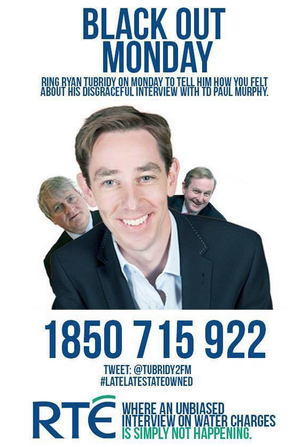
Circulating on ‘social media’ this evening.

@garmacnamee @broadsheet_ie Imagined conversation: “Let’s buy the window from the set of Friends and then just go with it from there.”
— elva carri (@elvacarri) January 9, 2015