
Tag Archives: Maurice McCabe

From top: Sergeant Maurice McCabe; Former Garda Commissioner Martin Callinan and Garda Commissioner Noirin O’Sullivan

On Wednesday.

At the Disclosures Tribunal.

In George’s Hall, Dublin Castle.

Diarmuid McGuinness SC, counsel for the tribunal, read out an opening statement outlining the progress the tribunal is making and an overview of the evidence gathered to date.

Readers will recall how the tribunal is examining claims that a smear campaign was conducted against Sgt Maurice McCabe by former Garda Commissioner Martin Callinan – with the knowledge of Garda Commissioner Nóirín O’Sullivan – as alleged by the former head of the Garda Press Office, Superintendent David Taylor.

Both Mr Callinan and Ms O’Sullivan deny the allegations.

In reading out the opening statement, Diarmuid McGuinness SC explained that Fianna Fáil TD John McGuinness, RTÉ journalist Philip Boucher-Hayes and Comptroller and Auditor General Seamus McCarthy have all told the tribunal about claims former Garda Commissioner Martin Callinan made to them directly about Sgt Maurice McCabe.

He also read out statements made by former Sunday Independent editor Anne Harris, journalist Gemma O’Doherty, and Labour TD Brendan Howlin, about a conversation he had with former Irish Mail on Sunday journalist Alison O’Reilly and a follow-up statement from Ms O’Reilly.

He also explained how the tribunal wrote letters to almost 30 journalists but “with a few exceptions” many of these letters have gone unanswered (more below). Diarmuid McGuinness SC didn’t specify who responded and who didn’t respond.

The Comptroller and Auditor General Seamus McCarthy said he and former Garda Commissioner Martin Callinan met at a meeting of the Public Accounts Committee [PAC] on January 23, 2014. It was at this meeting that Mr Callinan, who sat next to Noirin O’Sullivan, referred to former Garda John Wilson and Sgt Maurice McCabe as “disgusting”.

Mr McCarthy told the tribunal:

Commissioner Callinan referred to Sergeant McCabe by name and made statements to the effect that Sergeant McCabe was not to be trusted, that he had questions to answer, and that there were allegations of sexual offences against him.

In his response, Mr Callinan said:

I did not at any point state that Sergeant McCabe was not to be trusted nor that he had questions to answer. I did not state that there were any allegations of sexual offences against him.

Mr McGuinness told the tribunal a meeting took place between him and former Garda Commissioner Martin Callinan on the 24th of January, 2014 – the day after the PAC meeting – in the carpark of Bewley’s Hotel, Newlands Cross, Co. Dublin. Mr McGuinness told the tribunal:

Mr Callinan asked if I was aware of issues surrounding Mr McCabe’s personal life. I stated that I had heard vague rumours and gossip that Mr McCabe had abused someone and that he was a paedophile but that I had been assured by Mr McCabe that these rumours were lies, that he had heard them before and that they were malicious falsehoods.

Mr Callinan stated to me that the rumours were true, that Mr McCabe had sexually abused someone and that he was not a credible person. Mr Callinan stated that an investigation into Mr McCabe’s activities was underway. Mr Callinan then asked me was I aware that Mr McCabe had sexually abused family members. I was shocked and extremely troubled by what Mr Callinan was telling me because the allegations being made were extreme and the person relaying them to me, as well as the fact that an investigation had commenced, was the Commissioner of An Garda Síochána.

When he left my car, Mr Callinan put his hand on my arm and stated that Mr McCabe was not reliable and could not be trusted and suggested that I had gotten myself and the Public Accounts Committee into a lot of trouble by pursuing the penalty points issue.

In addition,  Deputy McGuinness’s statement to the tribunal states that he kept a handwritten note of the meeting. Part of that note reads:

Callinan
McCabe
Sexual abuse!
Individual + family
Don’t trust him
Story not credible
Investigations ongoing
He’s not credible

In his response, former Garda Commissioner Martin Callinan told the tribunal:

I did not at any time state to Mr McGuinness that Mr McCabe had sexually abused anyone or that he was not a credible person… I never at any stage indicated to Mr McGuinness that Sergeant McCabe had sexually abused family members.

Mr Boucher-Hayes told the tribunal of a conversation he had with Mr Callinan outside an RTE studio on December 17, 2013, as part of Crimecall programme. There had been a disagreement about whether Mr Boucher-Hayes could ask Mr Callinan about the penalty points allegations made by Sgt Maurice McCabe.

Mr Boucher-Hayes said:

He offered me background information on the penalty point story. But the majority of his information related solely to the two whistleblowers, John Wilson and Maurice McCabe, not to the substance of the story. He offered a negative but cursory impression of John Wilson, before speaking at some length on Maurice McCabe’s character. I had not asked any questions to elicit this information.

He told me that McCabe was a troubled individual and that he had a “lot of psychological issues and psychiatric issues”. He claimed that McCabe was motivated by a set of grievances against Garda management and that he was famous with An Garda Síochána for this. He warned me that McCabe was not to be trusted and went onto add that there were other things he could tell me about him “horrific things, the worst kind of thing” but he did not elaborate further.

In his response, Mr Callinan said:

I did not speak “at some length” on Sergeant McCabe’s character as indicated. I did not state that Sergeant McCabe had “a lot of psychological issues and psychiatric issues,” and was “motivated by a set of grievances against Garda management and that he was famous within An Garda Síochána for this.”

I did not indicate to Philip Boucher Hayes that Sergeant McCabe was not to be trusted, nor did I state there were other things I could tell him about “horrific things, the worst kind of thing.” I do not know what Philip Boucher-Hayes is referring to.

In addition, Superintendent Dave Taylor has told the tribunal that, in the company of now Garda Commissioner Noirin O’Sullivan, Garda communications director Andrew McLindon, Assistant Commissioner John O’Mahoney and Fianna Fáil TD John McGuinness that Mr Callinan called Sgt Maurice McCabe a ‘kiddie fiddler’.

This took place after the PAC meeting in January 2014, in which Martin Callinan referred to former Garda John Wilson and Sgt Maurice McCabe as “disgusting”.

Meanwhile…

Superintendent Dave Taylor has provided the tribunal with a waiver of any journalistic privilege and is not claiming privilege over his identification as the source of any information to journalists relating to Sgt Maurice McCabe.

Similar waivers have been signed by Garda Commissioner Noirin O’Sullivan and former Garda Commissioner Martin Callinan.

However…

Diarmuid McGuinness SC notes:

This waiver, and the similar waivers signed by Commissioner Nóirín O’Sullivan and former Commissioner Callinan, have been notified to several journalists. The journalists named by Superintendent Taylor are Paul Williams, Paul Reynolds, Conor Lally, John Mooney, Michael O’Toole, Cormac O’Keefe, John Burke, Daniel McConnell, and Juno McEnroe.

In particular Superintendent Taylor reiterated in his statement to tribunal investigators that Paul Reynolds and Conor Lally would have received negative briefings by him about Sergeant McCabe.

Sir, the tribunal has also identified from telephone data other journalists that Superintendent Taylor contacted during the relevant period.

Arising out of its investigations to date the tribunal has now written to the following journalists: Sarah Bardon, Ali Bracken, Tom Brady, Jennifer Bray, Stephen Breen, John Burke, Paul Connolly, Dyanne Connor, Ken Foy, Fran Greany, Mark Hilliard, Mick McCaffrey, Juno McEnroe, Cathal McMahon, Emma McMenamey, John Mooney, Eavan Murray, Niall O’Connor formerly of the Irish Sun, Niall O’Connor currently of the Irish Independent, Mick O’Toole, Paul Reynolds, Joe Walsh, Debbie McCann, Alison O’Reilly, Paul Williams, and at a later date, Conor Lally, Daniel McConnell and Cormac O’Keefe.

In the first instance, the tribunal wrote to most of these journalists on the 15th of March 2017 and requested statements from anyone who may have information relevant to the terms of reference. Regrettably, many of these letters went unanswered.

Five weeks later on the 21st of April 2017, the tribunal wrote again to these journalists, informing them of the waivers referred to earlier and asking the following series of questions:

1. Can you confirm your mobile phone number and work phone number?
2. Was this number your mobile phone number in the years from July 2012 until Feb 2017?
3. Were you briefed negatively about Sergeant McCabe by anyone? And if so, by whom?
4. Have you any information or evidence about an orchestrated campaign directed by senior officers of the Garda Síochána, to discredit Sergeant Maurice McCabe by spreading rumours about his professional and personal life?
5. Were you contacted by Superintendent David Taylor in relation to Sergeant Maurice McCabe?
6. Were you briefed negatively by Superintendent David Taylor in relation to Sergeant Maurice McCabe?
7. Were you briefed negatively by Superintendent David Taylor in relation to Sergeant Maurice McCabe to the effect that his complaints had no substance?
8. Were you briefed negatively by Superintendent David Taylor in relation to Sgt McCabe to the effect that the Gardaí had fully investigated complaints and had found no substance to his allegations and that he was driven by agendas?
9. Was your attention drawn by Superintendent Taylor to an allegation or suggestion of criminal misconduct made against Sergeant McCabe in any respect?
10. Was your attention drawn by Superintendent Taylor to an allegation that the root cause of Sergeant Maurice McCabe’s agenda was revenge against an Garda Síochána?
11. Were you informed by Superintendent David Taylor that he was instructed/directed by former Commissioner Callinan and /or (then) Deputy Commissioner Nóirín O’Sullivan to contact the media to brief the media negatively against Sgt Maurice McCabe?
12. Are you aware and have you any evidence of any attempt made by former Commissioner Callinan or Commissioner O’Sullivan or any other senior member of an Garda Síochána to discredit Sergeant Maurice McCabe by reference to an allegation of criminal misconduct made against him ?
13. Were you informed by a journalist or any other person of any matters referred to in the questions above?
14. Have you any knowledge, information or evidence relating to any of the matters above? 15. Have you any knowledge, information or evidence relating to any matters within the Terms of Reference of the Tribunal?
16. Have you any records (however made, wherever stored) of any communications from or with Superintendent Taylor or former Commissioner Callinan, Commissioner O’Sullivan or any other senior Gardaí relating to any of the above matters?

With a few exceptions, the journalists have either ignored these letters, or refused to answer these questions, citing journalistic privilege. Many of them nonetheless wish to make generalised academic arguments about the nature of journalistic privilege to the tribunal.

In addition…

Former editor of the Sunday Independent, Anne Harris told the tribunal:

In the years 2013 and 2014, matters raised by whistleblower Sergeant Maurice McCabe, such as the termination by senior gardaí of fixed penalty points, as well as allegations of murder and abductions not properly investigated, came to prominence. From the first instance that the Sunday Independent began to report on these matters, certain journalists came to my office to warn me off Sergeant McCabe.

I was given varying accounts of an alleged case of child sex abuse by him, which was apparently being investigated. This was repeated several times by a very reputable journalist, one who had shown great courage in exposing incidents of corruption and terrorism. I made enquiries and was satisfied that the matter had been investigated by the DPP, and the complaint found to be without grounds.

The Sunday Independent continued to report on Sergeant McCabe’s concerns and the consequent treatment of him. In 2013, the allegation that Sergeant McCabe as a “paedophile” was stated in my office by senior executive from the wider “Group” editorial hierarchy of Independent Newspapers.

I am certain that a whispering smear campaign was being conducted and that the media were being used. The pressure on me was less about publishing the sex abuse allegation – it would have been difficult within the laws of libel – but had the clear purpose of discrediting him, and therefore censoring the issues he was raising.

Labour leader and TD Brendan Howlin also made a statement to the tribunal about a conversation he had with journalist Alison O’Reilly, then of the Irish Mail on Sunday.

Diarmuid McGuinness SC writes:

According to Mr Howlin, Ms O’Reilly informed him that another journalist, Ms Debbie McCann, had told her “that the Commissioner had given information to her claiming serious sexual misconduct on the part of Sergeant McCabe.”

Ms O’Reilly then informed Mr Howlin that Ms McCann described Sergeant McCabe in very derogatory terms following a conversation with Commissioner O’Sullivan and that these matters were being discussed generally in the Mail on Sunday office. Ms O’Reilly also told Mr Howlin that Superintendent Taylor and Commissioner O’Sullivan had both provided this type of information to Ms McCann. Obviously some of what Ms O’Reilly recounted to Mr Howlin was hearsay evidence.

…In response to Mr Howlin’s statement, Ms Alison O’Reilly sent a very helpful and detailed statement to the Tribunal which covers not only her account of her conversation with Mr Howlin, but also her knowledge of events from 2013 until the present as seen from the perspective of the media. This statement is of great assistance to the Tribunal and has opened up a number of avenues of enquiry. Some of the information is hearsay but is nevertheless helpful in identifying journalists who it appears have first-hand knowledge of who may have been behind a campaign to blacken Sergeant McCabe’s good name.

Journalist Gemma O’Doherty told the tribunal that she was:

Well aware of the whispering campaign against Sergeant McCabe and when I was informed about the allegations of child sexual assault against him, I put them to him. He immediately informed me as to what happened and when I did some further investigation into the allegations, I found them to lack credibility entirely.

It was in 2013 that I first became aware that Sergeant McCabe was being associated with an allegation of child sexual assault. Rumours about this were circulating in a number of Dublin newsrooms at the time. It is my understanding that a copy of the garda file concerning the allegations had been provided to Mr Paul Williams (Special Correspondent) by senior gardaí in Garda Headquarters and that was how ‘the word’ got out.

The fact that a Garda investigation file was said to exist and that it contained damaging details concerning Sergeant McCabe, gave the story certain credibility but knowing Sergeant McCabe, I was in no doubt that this was a malicious campaign against him orchestrated by certain people who wanted to silence him and knew they couldn’t.

I spoke to Garda Wilson about the allegations that I had heard concerning Sergeant McCabe. He was aware of them. He said that a number of journalists were on the story but that it was untrue. One such individual was Paul Williams. Paul Williams has significant garda connections which both he and [Independent News and Media] rely upon for exclusive information… It is my understanding that the same firm of solicitors represents Paul Williams, [Independent News and Media] and the woman who was purportedly behind the allegations of sexual abuse concerning Sergeant McCabe…

Rumours circulated that a copy of the garda file had been given to Paul Williams and that it revealed that Sergeant McCabe was under investigation for child sexual abuse… Garda Wilson also informed me that a reporter named Debbie McCann, who worked for the Irish Daily Mail and whose father was a senior garda, was allegedly one of the journalists that was putting the word out that Sergeant McCabe was a child sex abuser. He said that she called him a ‘paedo’.

Readers will recall how Paul Williams, in the Irish Independent, wrote a series of articles in April 2014 concerning the woman – referred to in the tribunal as Ms D – who was at the centre of an allegation made in 2006 against Sgt Maurice McCabe.

This allegation, readers will recall, was investigated and a file was sent to the DPP with the DPP subsequently directing that no prosecution be taken – with the observation that it was doubtful the allegation should constitute a crime at all.

In relation to this…

Diarmuid McGuinness SC writes:

Sir, in early 2014, some journalists sought to contact Ms D, at whose instigation is not yet entirely clear. However, Ms D engaged in contact with a journalist in relation to her initial complaint in 2006. This appears to have been as a result of an inquiry made by her father of her as to whether she’d be prepared to speak to a Mr Paul Williams. He in turn appears to have been nominated to her father by a friend of his, who is a Detective Superintendent in the gardaí.

Meanwhile…

Diarmuid McGuinness SC told the tribunal that of the 15 phones that are of interest to the tribunal – six granted to Garda Commissioner Noirin O’Sullivan; six to former Garda Commissioner Martin Callinan and three to Superintendent Dave Taylor – just four have been located.

Read the opening statement in full here

Then Garda Commissioner Martin Callinan and then Deputy Commissioner Noirin O’Sullivan at the Public Accounts Committee in January 2014 

Earlier today.

Diarmaid McGuinness SC, counsel for the Disclosures Tribunal, began its opening statement at Dublin Castle.

The tribunal, overseen by Supreme Court judge Peter Charleton, is initially examining allegations of a smear campaign by Garda management against Sgt Maurice McCabe.

From the tribunal…

Read the opening statement in full here

Previously: Maurice McCabe on Broadsheet

smaller jpeg faster to load than huge png

Last night.

On TV3’s Tonight with Vincent Browne.

The panelists were: Michelle Murphy, from Social Justice Ireland; policy analyst Dr Rory Hearne; media lawyer Andrea Martin, and political correspondent at The Irish Times Harry McGee.

In the latter half of the show, they discussed the Disclosures Tribunal, following on from Judge Peter Charleton making his opening statement yesterday morning.

The tribunal will investigate allegations of a smear campaign against Sgt Maurice McCabe.

Specifically, Mr Browne raised the subject of journalists and their sources.

Vincent Browne: “There is another issue that arises and it is that a woman made, allegedly made allegations of misconduct against Maurice McCabe which she subsequently withdrew*. And which the DPP found, it couldn’t possibly prosecute on the basis of those allegations. But the name of that person was disclosed to at least two journalists who went off and got exclusives in interviews with this woman. Now that would seem to me that there’s something really insidious involved in that. And who disclosed it? And the journalists then going and interviewing those people. What do you think about that, Harry?”

Harry McGee: “Well, I don’t know if, I mean, what evidence is there that the name was disclosed to journalists?”

Browne: “Well, how else would journalists know otherwise?”

McGee: “Well, I don’t know, you’d have to ask the journalists.”

Browne: “I know but can you think how the journalists would know otherwise?”

McGee: “I can think of many ways in which journalists might know otherwise.”

Browne: “Tell us.”

McGee: “Well, they might have been told my some other people, they might have…”

Browne: “By who? Who’d know?”

McGee: “Well, I don’t know, Vincent.”

Browne: “But who’d know? A priest? A nun? A social worker? A counsellor?…”

McGee: “Well, who do you say? Who would you suggest told the journalist?”

Browne: “I would think that the likelihood is that it was the gardai, members of An Garda Siochana.”

McGee: “I just, I don’t know. I, I…”

Browne: “These are crime journalists that were…”

McGee: “But listen I wasn’t [inaudible] to that particular story, Vincent, you’re asking me to give…”

Browne: “Social workers wouldn’t have much truck with crime journalists…”

McGee: “You’re asking me to answer a question for which I have no, I have no direct knowledge.”

Browne: “Assuming, assuming that it was revealed by gardai – or that the journalists were tipped off by members of An Garda Siochana – this would be pretty insidious, wouldn’t it?”

McGee: “If they were tipped off about the…the identity of…?”

Browne: “Given the name of the person who originally made the complaint.”

McGee: “But there’s no evidence to suggest that at this particular juncture, Vincent, other than supposition. And I, I have no direct influence…”

Browne: “What do you mean there’s no evidence for it? The fact of the matter is: a woman made a claim of abuse. Subsequently, that woman’s name was released to journalists, crime journalists and they went and interviewed that person.”

McGee: “But, you, there is no direct evidence that the identity of the woman was released by gardai. They might have come to identify that woman and find out where that woman was and contact that woman from a separate source. To illicit that information. I think that you should ask…”

Browne: “But is it likely that, is it likely that, given that it was the crime journalists that were given that information – not journalists that are involved in social issues or political journalists or whatever – it’s crime journalists. Isn’t it likely that they got it from the gardai?”

McGee: “Well, there’s a possibility…”

Browne: “But anyway…”

Talk over each other

McGee: “I just can’t…”

Browne: “If that’s so, do you think that’s another dimension of insidiousness with the garda in this whole thing?”

McGee: “Well, I mean, if that were so, yes it would be. But there’s no direct evidence to suggest  that, Vincent.”

Browne: “Ok, in your view, in your view, can journalists validly claim confidentiality with regard to their sources, in respect of texts they may have received, or emails, or whatever, they may have received, concerning phone calls, relating to false information concerning Maurice McCabe?”

McGee: “Well, I think that, what the judge was doing today was he was making a distinction between legal professional privilege where he said that the privilege lay with the client and that of informant privilege where it lay with the informer, as opposed to the recipient of that, which is the journalist in this case. And that’s an important distinction, that he’s making. So, I think that, from what I, he said he [Judge Peter Charleton] hasn’t reached a conclusive decision in relation to this and he’s going to receive submissions on it. But he is making the case that if the informer were to waive his or her privilege, than the privilege wouldn’t attach to the journalist who received it. Now, but, for that to work, the journalist would have to reveal who their source was and the journalist, no journalist, in my experience would reveal who the source was. The second…”

Browne: “But, on what basis?…where information was received, that was entirely false, designed to do terrible damage to a person’s reputation, all in the aim of discrediting that person, in the context of…”

McGee: “But in your own, you said that it was, in your opinion, that journalists actually believed the information that was conveyed to them. So, in this case, I think that the test will be a subjective test because if it were an objective test, if the journalist believed that what was being said to them was a calumny, detraction, was a lie – that would be ludicrous and the journalist would be in dereliction of their duties as journalists. So I think that journalists, who received that information, believed that information to be true…”

Browne: “And they should not disclose and, in your view, they should not disclose the source?”

McGee: “Well, yes, if, I think journalists are quite entitled not to disclose their source.”

Browne: “On what basis do you think that?”

McGee: “On the basis that they gave an undertaking to their source that they wouldn’t compromise that source. They believed that information that was being given to them at the time…”

Browne: “And if it then emerges that that source told them lies, and malicious lies, should the journalist still be bound by the the confidentiality arrangement?”

McGee: “Well, that would be post-hoc and so..”

Browne: “Well, we now know it was lies…”

McGee: “I think that might change the circumstances somewhat, if the informer were to waive their privilege. But the difficulty is that the journalist would then be required to reveal their source.”

Browne: “Yeah.”

McGee: “That would present a difficulty for journalists.”

Later

Andrea Martin: “[If she was a journalist] What I would do is I think that I would disclose my source. If ordered to by the court to do so, if there was no greater good going to be had by staying silent on it. But I think many, many journalists would not agree with that. And it’s a personal decision…”

Michelle Murphy: “I think if you are aware that, or if you become aware that what you have been used as a conduit to spread lies then, I think the journalist, in order to protect their integrity, might do so. If they felt that they were being used by a particular individual….in this exact situation, I think they should. But then there’s other areas where you need whistleblowers, in for example, the HSE…”

Rory Hearne: “I think in this case, yeah, they should. I think that the level of maliciousness, the extent and depth of, you know, it’s just shocking to see the corruption and the way people are treated. Our institutions are, you know, used. People who are supposed to be there to protect us are actually, you know, like the guards, are doing things like this to other guards. Tusla has appeared to be used, it’s just disgusting if you ask me. And I think if you were a journalist, and you realise that these people had done this, you know, used you, to denigrate their colleague, then I think I would say, ‘I’m going to tell who that person is’.”

*Broadsheet understands that what’s been reported thus far has been that the girl made an allegation against Sgt Maurice McCabe in 2006, it was investigated, a file was sent to the DPP – with the recommendation that there was no grounds for a prosecution – and the DPP directed that no prosecution should be taken, with the observation that it was doubtful the allegations should constitute a crime at all.

Watch back in full here

Charleton J 2014

Judge Peter Charleton

Daniel McConnell, in the Irish Examiner, writes:

The public Tribunal of Inquiry into allegations of a smear campaign against Sgt Maurice McCabe is to hold its first hearing on Monday, it has emerged.

…The Irish Examiner understands that Judge Charleton will make an opening address at the commencement of the Tribunal, which will take place in Dublin Castle.

It is understood that once underway, the tribunal will spend up to three months in private preparing for full public hearings to commence.

Judge Charleton is expected to conclude the McCabe body of work between nine months and a year.

Earlier: ‘We Have A Degree Of Confidence’

Pic: Supreme Court

000d930b-8001

2

3

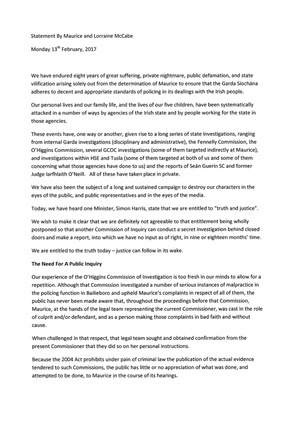
Statement released this afternoon by Lorraine and Maurice McCabe through their solicitors calling for a public inquiry into their treatment by An Garda Síochána and the government.

Earlier: Derek Mooney: Not one Crisis But Two

How Did He Get Here?

Pic By Barry Cronin via RTÉ

‘sup?

More as we get it.

Update:

Oh.

Update:

Oh.

Katherine Zappone didn’t go into ‘vile and wrong’ allegations with Cabinet ‘to protect McCabes’ (irish Examiner)

File photo. The Government yesterday published the details of a Commission of Inquiry into claims that senior gardai mounted a smear campaign against a whistleblower in the force. Yesterday in the Dail under privlege, the Leader of the Labour Party, Brendan Howlin said that new information had come to him regarding a smear campaign against garda whistleblower Maurice McCabe by senior gardai, and called for the Garda Commissioner, Noirin OÕSullivan, to stand aside for the duration of the Inquiry. Prominent whistleblower, Sgt Maurice McCabe has claimed he was targeted in a smear campaign by senior members of the force. He is supported in his claims by the former head of the Garda Press Office, Superintentent David Taylor. End. 30/01/2014. Garda whistleblower at PAC. Serving Garda Sergeant Maurice McCabe arrives at Leinster Hosue this afternoon to appear before the Public Account Committee to discuss penalty points cancellation and alleged corruption. Photo: Laura Hutton/RollingNews.ie

Garda Sergeant Maurice McCabe

Sergeant Maurice McCabe has been attempting to seek accountability in An Garda Síochána for more than 10 years.

His battle has spanned the tenure of four Garda Commissioners, six Ministers for Justice and five Ministers for Health.

Below is a comprehensive timeline of events – covering 2006 to the present day – charting how one man restored his good name, changed a police force forever and brought a government to the brink of collapse.

We will correct any errors.

January 2006: Sgt Maurice McCabe makes a complaint  in relation to an incident where a garda had consumed alcohol before attending the scene of a suicide. This resulted in a sanction being imposed on that colleague.

Noel Conroy is Garda Commissioner at this time. He holds the position from July 2003 until he retires in November 2007.

Michael McDowell, of the Progressive Democrats, is the Minister for Justice at this time; while Mary Harney, also of the Progressive Democrats, is the Minister for Health.

December 2006: The colleague, about whom Sgt McCabe made the complaint, makes a complaint about Sgt McCabe on behalf of the colleague’s daughter. The daughter subsequently makes a statement in which she alleges that, about ten years previously, when she was around six years old, she had been playing hide and seek with Maurice McCabe and his two eldest children at their home. She said when Sgt McCabe found her, he tickled her and pressed up against her in an inappropriate manner.

Supt Noel Cunningham, as the person in charge of the Cavan/Monaghan division, investigates this complaint.

Early 2007: After the allegation is investigated, a file is sent to the DPP with the recommendation that there is no grounds for a prosecution. The DPP directs that no prosecution should be taken – with the observation that it is doubtful the allegations should constitute a crime at all.

April 30, 2007: Taxi driver Mary Lynch is violently assaulted by Jerry McGrath in Virginia, Co. Cavan. McGrath had his zip undone as he bit her, viciously kicked her and pulled out lumps of her hair. He left her with a black eye, bruising down her side and  bruises on her neck, as he held his hands around her neck during the assault. McGrath was released on station bail of €300 the next day, before Mary Lynch gave a statement. McGrath was never questioned about details of her statement. He was charged with assault with no conditions attached to his bail.

June 14, 2007: Brian Lenihan Jnr, of Fianna Fáil, is the new Minister for Justice.

July 9, 2007: A car registered to Deputy Commissioner Martin Callinan – who was appointed to the position in January 2007 – is caught speeding on camera. His Renault Megane was caught going at a speed of 83kph in a 60kph zone. The penalty points in relation to this incident were subsequently quashed.

September 11, 2007: A man made a complaint at Bailieboro Garda station in Co Cavan that his son had been sexually abused by Fr Michael Molloy, of Kill in Cootehill, Co Cavan.

The victim told gardai that one incident of serious sexual assault involving Fr Molloy occurred in March or April 2007, following evening mass, after he had installed or updated antivirus software on a computer in the parochial house, occupied at that time by Fr Molloy. He described the computer, its operating system, and the software he installed to the gardai.

September 14, 2007: Following the complaint, and after obtaining warrants, gardai searched two properties associated with Fr Molloy. They took a number of items, including a personal computer, and brought them to Bailieboro Garda station, where Sgt Maurice McCabe was on duty that day. The items taken from Fr Molloy’s house were placed in the station’s property room. On the same day, Fr Molloy was arrested and interviewed at Bailieboro Garda station.

In a statement given by Garda Pearse O’Shannon, he stated that he found that the name of the software on the seized computer matched that given by the victim.

It subsequently turned out that the warrants, under which the computer and other items were seized, were defective.

October 2007: A file on Mary Lynch’s assault is finally sent to the DPP with a recommendation that the case be dealt with in the district court. Micheal Clifford, of the Irish Examiner, has reported that “the file came back within three weeks, upgrading the charge to Section 3, “assault causing harm” and a robbery charge. The DPP instructed that it should be dealt with by the district court only if a guilty plea was entered on both charges. Otherwise, it should go to trial in the Circuit Court.”

October 9, 2007: McGrath tried to abduct a five-year-old girl from a house which he had broken into, in Dundrum, Co Tipperary. The girl’s father managed to overpower McGrath and hold him until the gardaí arrived. McGrath was charged with assault causing harm, burglary and false imprisonment. He was held in Limerick Prison.

October 18, 2007: McGrath’s Cavan assault case involving Mary Lynch was due for a routine review of bail in Virginia District Court. McGrath’s solicitor was told McGrath didn’t need to attend the two-minute routine hearing. No objection was made at Virginia District Court to renew McGrath’s bail on the Cavan assault charge – even though it was known that McGrath was in custody for assault causing harm, burglary and false imprisonment.

October 30, 2007: An application for bail by McGrath was made in Clonmel Circuit Court on the Tipperary false imprisonment charge. Detective Sergeant John Long objected but the court was not told about the Cavan assault and McGrath was granted bail. Michael Clifford, of the Irish Examiner, has reported: “In a subsequent investigation, Sgt Long said that prior to the bail application, he had checked McGrath’s background on the garda Pulse system. (This would be second nature to any garda investigating a violent incident). On seeing an entry about Cavan, he rang an “unidentified garda” in a “Cavan station” — also unidentified — and was told that the case involved a minor assault over a taxi fare.”

November 2007: Fachtna Murphy is appointed Garda Commissioner.

December 7, 2007: McGrath murders Silvia Roche Kelly in the Clarion Hotel in Limerick.

Continue reading →

Screen Shot 2017-02-10 at 19.38.07

Garda Commissioner Noirin O’Sullivan and Minister for Justice and Tánaiste Frances Fitzgerald

As was confirmed in a statement by the Department of Children and Youth Affairs this afternoon, Minister Zappone became aware in mid-January of an issue affecting Sgt McCabe which related to her Department.

As the statement points out Minister Zappone has taken and is taking a number of steps to deal with this matter.

She informed me in January that she intended to meet with Sgt McCabe. She of course did not inform me about any details in relation to confidential Tusla records.

The Terms of Reference of the proposed Commission put before the Oireachtas by me refer specifically to a complaint of criminal misconduct against Sgt McCabe and whether this allegation was used against him.

I have always been scrupulous to avoid any comment in the Dáil on what was at issue in the criminal complaint against Sgt. McCabe, referred to in the terms of reference.

Had I put into the public domain anything which indicated or implied the nature of the complaint against Sgt McCabe I would be rightly open to criticism.

At the heart of the issues to be examined by the Commission is whether senior Gardaí were involved in a campaign to use information to damage Sgt McCabe.

I agreed to take on board amendments designed to put beyond doubt that the examination of any smear campaign would not be confined.

Just as my colleague Minister Zappone is dealing with the serious matters relating to her area of responsibility, I am proceeding to finalise the terms of reference of the Commission of Investigation arising from Mr Justice O’Neill’s report.

A statement released this evening by Tánaiste and Minister for Justice Frances Fitzgerald.

Any excuse.

Meanwhile…

Meanwhile…

Previously: Whose Line Is It Anyway?

Rollingnews

00162805

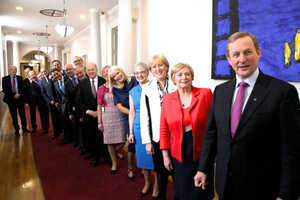
The cabinet at Aras an Uachtaráin on May 6, 2016, following the General Election last year with Katherine Zappone (fourth from right)

Further to reports that Minister for Children and Youth Affairs Katherine Zappone did not inform her cabinet colleagues of the matters concerning Tusla and Sgt Maurice McCabe when it met on Tuesday, to discuss the terms of conditions of the forthcoming commission of investigation into Supt Dave Taylor and Sgt Maurice McCabe’s protected disclosures…

The following statement has been released by a spokesperson for the Minister for Children and Youth Affairs Katherine Zappone…

Minister Zappone has met with Mrs Lorraine McCabe and Sgt Maurice McCabe. She has heard first hand of the devastation caused to them by the false allegations against Sgt Maurice McCabe.

The Minister became aware of the circumstances when Mrs McCabe contacted the office of the Minister for Health on 18 January 2017.

As the matter related to the Department of Children and Youth Affairs, the Private Secretary of DCYA was requested to call Mrs McCabe. The private secretary did this on 18 January.

Minister Zappone met Mrs and Sgt McCabe on Wednesday 25 January. Since then her office has been in regular contact with Mrs and Sgt McCabe and Tusla – which has led to the offer of a public apology.

The Secretary General of the Department of Children and Youth Affairs held a meeting with Senior Tusla Personnel on Friday 27th January. Tusla provided DCYA with a chronology and analysis of the case – which my Department gave to Mrs and Sgt McCabe on Saturday 28th January.

Tusla informed the Secretary General that they have instituted a case review to extrapolate all relevant information in order to provide a more detailed analysis.

Minister Zappone informed relevant Government colleagues during the course of this period. Minister Zappone was always of the view that Tusla would form part of the investigation by the Commission of Inquiry.

It’s also being reported that Ms Zappone is declining to name the “Governement colleagues” with whom she spoke.

Meanwhile…

Yesterday, in the Dáil, Sinn Féin TD Mary Lou McDonald asked Fine Gael Justice Minister and Tánaiste Frances Fitzgerald if she was aware of any contact between the gardaí and any other State agency in respect of Sgt Maurice McCabe…

They had the following exchange…

Screen Shot 2017-02-10 at 15.52.05

In addition, in the Seanad yesterday afternoon, Ms Fitzgerald said the following, as part of her statement on the commission of investigation by Mr Justice Peter Charleton…

I thank Members of this House for agreeing to statements being taken on this important matter in the House today. As the House will be aware I have laid the relevant material before the House to give full effect to the recommendations of Mr Justice O’Neill.

However, before moving to seek approval for the relevant motion I believe it is sensible that we discuss these matters here first. I am already persuaded from discussion which I have had that there may be some improvements which can be made to put beyond doubt that certain matters will come within the remit of the commission. I intend to reflect on what is said here today and make any amendments to the proposed draft order in light of those discussions.

As Mr Justice O’Neill indicated, it is imperative that certain allegations be examined and I believe we should stick as closely as possible to the terms of reference he proposed. After all we appointed him and gave him terms of reference for the initial inquiry. He has considered all the issues and made a series of recommendations which I have laid before the House.

Transcripts via Oireachtas.ie

H/T: Gavan Reilly

Previously: ‘Government Forces Have Said’

wilson

Former Garda whistleblower John Wilson

This morning.

Former Garda John Wilson who – along with Sgt Maurice McCabe – made the public aware of how penalty points were being quashed for certain people in Ireland, was interviewed by Joe Finnegan on Shannonside radio station.

They discussed last night’s Prime Time show and what Sgt Maurice McCabe has been through.

During the interview, Mr Wilson was audibly tearful.

Joe Finnegan: “John, good morning to you.”

John Wilson: “Good morning, Joe.”

Finnegan: “Thank you for taking the call. Already today, I know, you have described this saga if I can call it that, as the worst scandal in the history of our republic.”

Wilson: “Yes, Joe, without doubt. I’ve been away a long time from these issues. But, watching Prime Time last night, I was truly shocked and I see myself as someone who’s not easily shocked. And we have to take into consideration here, that we’re dealing with a human being, a wonderful individual who has, you know, he is a very, very quiet, decent man. And, you know, putting petrol in a diesel car, Joe, is a mistake. But this appalling vista can not be classified as just a mistake. I believe that there are dirty Garda fingerprints all over this scandal and I think that the way Maurice McCabe has being treated, it’s criminal.”

“We’re very short, Joe, in this country, of accountability. We’ve lots of inquiries and commissions of investigations but nobody has ever, as far as I’m concerned, has ever been held accountable and that’s got to change now.”

“When Martin Callinan departed the scene, I called for an outsider to be brought in as commissioner, the day after he left and, of course, that didn’t happen. And we were left with the same tune being played by a different orchestra and I am absolutely, I am gutted, I thought I was beyond shockable but seeing that programme last night and knowing the distress that these false and malicious allegations have done to that man. He’s a very, very quiet, dignified, decent man..”

Finnegan: “All right…”

Talk over each other

Finnegan: “I just want to stop you there because I want to try and humanise this, if I can at all. We all know the details and the shocking, shocking details which were revealed last night. But, you know, every time I see Maurice McCabe on the television, it’s the same for all our listeners this morning, we see a guy with a rucksack, dashing into Leinster House, we see a guy in uniform, running away from a posse of cameras. John, tell me about the Maurice McCabe that you know.”

Wilson: “Well, Joe, I’m not Maurice McCabe’s spokesperson. As a human being, I first met him in 2002 when I was transferred to Clones. And, I won’t go into the full issues, I mean I arrived there under a cloud, again through malicious gossip from Garda management. And I found Maurice to be a decent, professional individual. He treated everybody with respect. If you were the richest man in the town or the poorest man in the town, he had the same time for you. And he treated you with the same respect. He treated everybody with dignity, as he still does.”

“He has two passions in his life, Joe. His family and cars and that’s it. He’s a very, very decent individual. I’m very, very upset, Joe, naturally, but the toll this has taken on the man – and he has remained dignified throughout… you’ve seen it before. He went before the PAC and, as you say, you’ve seen him, he’s the man with the satchel on his back…”

“But these individuals, many of them who should be in jail, have destroyed his life. And they have, I have no doubt, they have reduced his life expectancy. He’s a very, very decent. I cannot…I mean, the Irish public, Joe, and the Garda Commissioner should be proud that a person of his calibre, as a member of our national police force.”

Finnegan: “May I ask John have you been talking to him in the last number of hours?”

Wilson: “No, Joe, I was speaking to him yesterday. I haven’t been speaking to him today. But, as I said, even though I was aware of these serious allegations watching Prime Time last night, I thought I was beyond shockable but I think it’s the most shocking programme that has appeared on Prime Time television in this country, since RTE was established. And that’s saying something. And we’ve been through, and the public are aware of many scandals down through the years. I think, this is, you know what I mean, this is, as far as I’m concerned, I’m cognisant I’m on live radio but there’s been a criminal conspiracy to destroy this man, to destroy a life, his credibility, his reputation. If you haven’t got your reputation and your credibitility, Joe, you’ve got nothing.”

“And to label somebody a paedophile, there’s nothing lower, there’s nothing lower, Joe. And you know, Joe, that when someone is accused of being a paedophile or of child sex abuse, there’s always someone in the corner ‘ah, yeah, ah the report has vindicated him, ah yeah, ah yeah, they all say he’s innocent, but there’s no smoke without fire’.”

“They have destroyed the man. This is unforgivable and somebody has got to go to jail over this, Joe. It’s not good enough having a Commission of Investigation. Somebody has got to end up in prison over this. Or more than one individual. I can assure you. And it is, you know what I mean, criminals know who they are. But I can tell you, Joe, there are lots of criminals in this country wearing uniforms and pretending to be guardians of the peace. And I think it’s time the Irish people started shouting and screaming ‘no more, no more. We want a police service that we can be proud of’.”

Listen back in full here

Earlier: Pasted In Error

Previously: John Wilson on Broadsheet