
Tag Archives: Michael Taft

7881538-3x2-700x467Michael Taft

From top: Hillary Clinton and Donald Trump: Michael Taft

There is a difference between someone who is Trump and someone who is not Trump. The mature response is: support Clinton, oppose Trump.

America-born Michael Taft writes:

I suppose it would be expected of a progressive discussing the US Presidential election to describe Donald Trump negatively: a bigot, a liar, a tax avoider, a sexual predator, a charlatan who connives at arm’s length with the most profoundly anti-American groups (such as the Ku Klux Klan). But what’s the point?

We know all that and more – and we have Donald Trump to thank for that; he’s the one who’s provided the conclusive evidence.

What’s far more interesting is why so many people are voting for him. No doubt, this will become an industry in the future with books, articles, PhDs, earnest documentaries and pop-analysis.

I won’t pretend to have the answer (in any event, there are many answers which provoke even more questions). But I do know many of the people who are voting for him.

I grew up with them, went to school with them, played baseball with them, drank many beers with them. They are good people, caring people. I’m sure if you met them you would enjoy their company; just ordinary folk trying to meet their monthly bills.

But something has snapped. The ties that traditionally bound Americans in a social contact have been cut. These people grew up in the American dream and now they have woken in a place that they weren’t prepared for and weren’t supposed to be in.

The most dismal statistic is that the life-expectancy of whole swathes of the white working class is now falling. Poor health, poor wages, poor life-expectancy. The inclusive ties of community have been replaced by bleak networks despondency and anger.

Of all that was depressing about Trump’s rallies, to me the most depressing were the chants ‘Build the wall! Build the wall!’ Never mind that America became great because it tore down walls, creating a land of many cultures, languages, religions and national origins – a land for, and of, all people. Woody Guthrie said it best:

“This land is your land, this land is my land”

OK, there was always a bit of myth about this; the reality was more fraught, more tense with many injustices. But the mythic parts are important, too – it says something to us about us. And walls are not about us.

People build walls when they are afraid, lack confidence, live in fear, when the social order of cooperation that is so natural to us breaks down. Walls are the ultimate sign of weakness, yet this is the foundation for ‘Making America Great Again’.

Do Trump supporters recognise this weakness? No, not now anyway. That is the tragedy which they don’t deserve.

I know Europeans flinch at Trump’s language but I know the cadences, the syntax, the rhythms; it is a direct language. So much of the oppressive apparatus in America today comes with a ‘corporation-speak’, a ‘bureaucratic-speak’. People know this language and are sick of it.

Trump’s speeches are not written by committee where each sentence is parsed for its impact on this or that focus group. His speech is the speech of ordinary people. Ever read a written transcript of an ordinary conversation – it’s almost unreadable; so much is left to the unspoken word, the unfinished sentence, the wave of the hand, the angle of the head? That’s how Trump speaks. People understand.

But this is the allure and the danger of the demagogue. He or she cannot be neatly categorised on classical ideological graphs. They can act left-wing or right-wing. They can speak a progressive or reactionary language.

The most effective are able to weave these seemingly opposed perspectives into a unitary anti-establishment movement. They identify the elite, mobilise people against that elite and if they are successful, they end up becoming the elite. This is almost the inevitability of a desperate populism led by a persuasive demagogue.

There’s a lot of superficial commentary on the potential voting patterns of the rust-belt or the white working class or the ‘ordinary middle class’ (which means something different in the US than in Europe).

The polling data suggests something much more nuanced and differentiated: by region, by gender, by age, by educational achievement. Three-minute news pieces require neat summations; in many cases they miss the point.

But there’s one point that cannot be missed. Many of the people voting for Trump come from social constituencies that were once part of the greatest and most progressive coalition in the 20th century: the New Deal.

This was the new social contract that emerged out of the wreckage of the Great Depression and lasted for decades.

In the New Deal – which spread over a generation – equality spread as surely as electrification and water supplies, the welfare state was born, pro-labour legislation was implemented, financial interests were subordinated and the productive economy was privileged. Houses and motorways were built, art was created for the public, music classes were funded for schools and civil rights legislation was passed despite fierce opposition.

But the Democratic Party today has moved far from that heritage. Like social democracy and the Left throughout Europe, it proved incapable of fending off neo-liberalism, accommodated itself to capital (how so much different to President Franklin Roosevelt’s Second Bill of Rights), so intellectually debased itself it had no response to the financial crash.

Today, we are living with the results of the collapse of that great coalition and the Democratic Party’s inability to form a new one suited to modern times (though Senator Bernie Sanders gave us an insight into what that new coalition could look like).

How should progressive Americans respond today? Elect Hilary Clinton. Why? Because Hilary Clinton can forge a progressive America? I wish that were the case but I doubt it.

However, this is a defensive battle. Imagine if Trump won the Presidency? It’s not the successes that should worry us. It’s what happens if he fails his supporters. They have built the wall but they are still poor; they have kept out the ‘outsider’ but they still feel afraid. What happens when disillusionment with Trump sets in, when they see through the rhetoric to find another, more fundamental betrayal?

Don’t think they will automatically turn to a progressive and democratic alternative. They might retreat into a long-term apathy. Or worse, they might turn to even more reactionary forces which promise an even truer and more uncompromised politics. If Trump were elected America might spiral into an even more vicious cycle.

That’s why Clinton must win. I’ve come across the trope that, at root, there is no difference between Trump and Clinton. This betrays a profound ignorance of the fundamental issues at stake.

There is a difference between someone who is Trump and someone who is not Trump. The mature response is Senator Bernie Sanders’ response: support Clinton, oppose Trump.

And the mature strategy is Senator Bernie Sander’s strategy: support Clinton, win the White House and immediately start transforming the Democratic Party from the bottom up.

This is a lesson we should learn in Europe. How so much easier to set oneself apart to remain untainted. The real work of democratic mobilisation is so much harder and much more long-term. It is not the instant gratification that can be found in the supermarket aisle or the heated denunciations on social media.

And in America, this democratic mobilisation will need to include Trump supporters – those who are searching for a new social contract. Because they vote Trump today doesn’t mean they have stopped searching.

But it will need to speak directly, honestly. It will need to project a more authentic and liberating Americanism, rooted in a profoundly progressive history.

We must rebuild that coalition, fit for the 21st century. We must start that work now. And the first step is to elect Hilary Clinton today. The next step starts tomorrow.

Michael Taft is Research Officer with Unite the Union. His column appears here every Tuesday. He is author of the political economy blog, Unite’s Notes on the Front. Follow Michael on Twitter: @notesonthefront

maseratiMichael Taft

From top: Aston Martin in South William Street, Dublin 2 last month; Michael Taft

Inequality is growing again and the income of the Irish 1 percent is growing faster than anywhere else in the EU-15.

Michael Taft writes:

The 1 percent serves as an excellent symbol of actually existing capitalism. Examining the inequalities between households gives an insight into the level of solidarity within a country.

Wealth and power is manifested in other systemic ways – namely, the level of financialisation and bargaining power between capital and labour.

Still, a system that produces a 1 percent will be reinforced by that same 1 percent. So let’s take a look at how the 1 percent is doing these days.

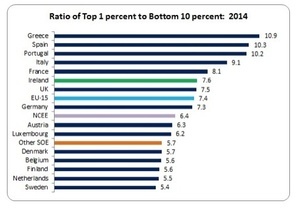
A standard measurement is by ratio.

1

Here we see the ratio of the income of the top 1 percent (see below for a statistical description) to the to the top cut-off point of the first decile.

Though Ireland is not the worst – that is reserved for the poorer Mediterranean countries and France (this might help explain the rise of the National Front) – we’re still in the top half of the table.

We’re slightly ahead of the mean-average of the EU-15, but much higher than our peer groups: Northern and Central European economies (NCEE excluding the Mediterranean countries) and other small open economies (Other SOE).

2

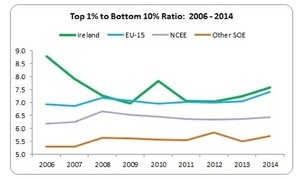
Ireland had very high levels of inequality towards the end of the boom period. The 1 percent took a hit with the crash given their greater reliance on property and speculative activity and this resulted in falling inequality: not because low income groups saw their income rise. It was just that their income fell slower than the 1 percent.

However, we will see below that not all higher income groups suffered.

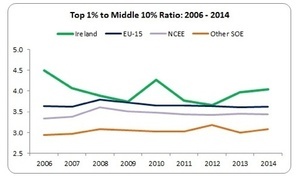
But let’s first look at another measurement, the ratio between the 1 percent and the 5th decile – or that proverbial squeezed middle:

3
We see a similar pattern as with the ratio to the bottom 10 percent – except that since 2012, the gap with the top 1 percent has widened faster. And we see that in this measurement, Ireland has a high level of inequality. In fact, the gap between the top 1 percent and the middle 5th decile in Ireland is higher than any EU-15 country bar France.

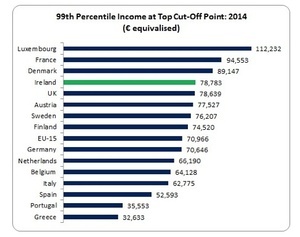
It’s been quite a roller-coaster for the ol’ 1 percent in Ireland. In 2006, they had the highest level of income in the EU-15 bar Luxembourg. But by 2012, they had experienced a fall of 22 percent.

However, though they haven’t climbed back to their dizzying pre-crash levels, in the last two years their income has grown faster than any other EU-15 country with a growth rate of 13 percent compared to an EU-15 average of 3 percent.

4

Even after the big recession hit, the Irish 1 percent still rank high in the EU-15 tables.
But not everyone in the high-income category are the same.

Unfortunately, we don’t have a compositional breakdown of the top 1 percent so we will have to make do with the CSO’s data which provides the top 10 percent.

5

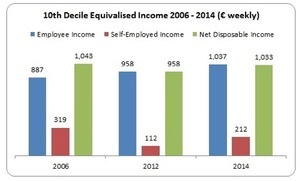
Let’s walk through this table. Between 2006 and 2012 we see that the weekly net income of the top 10 percent fell from €1,043 to €958.

However, employee income continued to increase (and remember, employees in this top 10 percent would include CEOs, senior executives and managers, higher professionals, etc.)

The hit was to those relying on self-employed income which fell by 65 percent. We can assume that a large proportion of this was property-related income. Reduced social transfers and higher tax would have also reduced overall net income.

However, since 2012 net income is rising. Employee income continues to rise and the fall in self-employed income has been reversed; indeed, it doubled in the two years up to 2014. Net income for the top income earners rose by 7.9 percent; for everyone else it rose by less than 4 percent. The gap is widening.

Of course, we can’t automatically assume that the 1 percent had the same rise in income as the overall top 10 percent. It might be higher, lower or the same. But I’m pretty confident – and I’ll give good odds.

Prior to the crash Ireland was highly unequal with the top 1 percent doing better than almost any other 1 percent in Europe. In the recession they took a hit but if the CSO data can be used as a proxy, then this was due mostly to the loss in self-employed income.

This decline has been reversed, inequality is growing again and the income of the Irish 1 percent is growing faster than anywhere else in the EU-15.

Yes, the 1 percent are doing alright.

Michael Taft is Research Officer with Unite the Union. His column appears here every Tuesday. He is author of the political economy blog, Unite’s Notes on the Front. Follow Michael on Twitter: @notesonthefront
NOTE: the tables present household income in ‘equivalised’ terms. This accounts for the size of the household (adults, children). In the Eurostat tables, the income level is based on the top cut-off point. For instance, for the bottom 10 percent, the top cut-off point is that income point in which people rise to the next decile. For the top 1 percent, this is the income at which they enter that top decile.

90431556Michael Taft

From top: Junior Minister Damien English and Minister for Housing, Planning, Community and Local Government Simon Coveney TD launching Pillar 2 of Rebuilding Ireland in September; Michael Taft

Public agencies, not just local authorities, have the land. We have the workers ready to build. and we certainly have the need.

Michael Taft writes:

The recent Saville Report, A Rent Forecasting Model for the Private Rented Sector in Ireland, should be a wake-up call to all policy makers.

Based on the relationship between private sector rents and the vacancy rate (the number of vacancies per 1000 rental units), Dr. John McCarthy estimates that rents will rise over 20 percent over the next two years.

Yes, there is a current rent freeze. But this doesn’t apply to new units coming into the market – and supply is growing, albeit at a slower rate than demand. Nor does it apply when a unit becomes vacant – when the current tenant leaves. And the freeze is only temporary and, unless extended, will be gone in less than two years.

Given that rents in Dublin rose by 10 percent in the last 12 months with rents rising faster outside Dublin (e.g. Cork rents grew by 15 percent), Dr. McCarthy’s prediction is reasonable.

With a one-bedroom apartment averaging €1,300 in Dublin city, we could see this rising close to €1,600 by 2018.

This is not good – for tenants, for the economy or for the Exchequer; the Government’s Housing strategy is premised on placing the majority of those on social housing waiting lists in private accommodation. Rising rent supplements for more people would seem to be in the offing.

Though the Government is set to publish proposals regarding the private rented sector in a few weeks, the early signals are not promising.

First, the Government seems intent on confining direct housing provision for the ‘poor’ only – what’s called residual housing.

Second, in answering a parliamentary question regarding affordable and non-speculative social housing units such as limited equity associations and long-term fixed leasing, Minister Simon Coveney didn’t refer to the public sector.

Rather, he confined his response to Approved Housing Bodies which the the National Economic and Social Council stated were incapable of dealing with the scale of the problem.

Third, the only budgetary measure regarding rent was to give a tax-break to landlords, many of whom have exploited market conditions to drive up rents to already unsustainable levels.

Let’s cut through this morass. While the delivery vehicles and planning logistics can be quite complex, the basic approach is rather simple: build units and rent them. Here are three models that could be developed – in both the best and worst case scenarios.

Cost Rental

Cost rental accommodation is just what it says – rents based on costs, not market-pricing. Take the cost of building/acquiring a unit with interest payments and amortisation, add in maintenance costs, property tax and a small percentage for a sinking fund – and charge rent at that level. Subsequent increases would be confined to a rental-inflation index to create certainty and tenants would have the full range of rights regardless of the law. This is the basic model pursued in other continental European cities. The NESC (in the link above) devoted an entire paper to this model – which could cover not only low-average income earners but those on the waiting list as well, creating a ‘unitary’ model where the distinction between public and private is blurred.

Limited Equity Housing

Even more provocative is the hybrid limited-equity model. In this instance, a person purchases 50 percent of the equity in the house and pays a monthly rent. So for a two-bedroom house costing €205,000 (not counting site costs or infrastructure), the owner/tenant would pay half through a mortgage and pay an additional ‘rent’. The owner/tenant would ‘own’ the house like any other owner but would only have to come up with smaller upfront costs. However, the house or apartment would be non-speculative which means that when the owner/tenant leaves the premises they would only receive their original mortgage which would be inflation-indexed. They could not sell their equity on the open market, nor could they release equity through another mortgage (unless the collateral was on some other asset); they could not automatically pass it on through inheritance or gifts or sub-let it out. In other words, it would be non-speculative housing but one that could be owned for life.

Temporal Ownership Schemes

In this model, a tenant pays an upfront amount to the owner/landlord for the ‘right to own’ a property for a set number of years. Lorcan Sirr has written about this model as it applies in Spain. When the contract ends the property reverts back to the owner – which can be a public, private or cooperative landlord. Temporal owners have all the rights and responsibilities of the property: they can sell the contract or leave it in a will – until the end of the ownership period.
The value to the tenant is certainty of tenure for the period. The value to the landlord is that they have been paid for a certain period (no vacancies, no looking for new tenants, no missed monthly rents, etc.). Further, tenants usually take care of property that they are going to reside in the long-term.Here’s an example: a tenant purchases a 10-year contract for a house/apartment. They get a mortgage for €90,000 and pay it over to the owner/landlord. The monthly mortgage payments would be €870 to €905 per month. This would remain constant throughout the ten years.


The best-case scenario would be if these models could be done ‘off-the-books’; that is, the cost of construction would not be a cost to the Exchequer. This could be done, as in continental European countries, through public housing associations. These would operate commercially at arms-length distance from the central and local government – though local governments could establish these associations by applying for Approved Housing Body status.

Even in this case, the state would still be involved through capital grants and, in the case of temporal ownership, provision of low-cost mortgages.

In the worst-case scenario these models would be on the books. However, this might go no further than the initial once-off capitalisation – the housing associations would still be commercial, albeit not-for-profit, entities. It would also allow for non-market transfers between public agencies (e.g. derelict / vacant land owned by one agency transferred to a housing association).

There is also the possibility of a state Rent Benefit which could be tied to income. This could be paid to all tenants of cost-rental models – whether in the public, private or non-profit sectors.

This would ensure that the Rent Benefit doesn’t inflate the market as it would be paid in regard to rents that are controlled by costs and not subject to market pricing.

In all probability it would be a combination of both. You would start up models, test their capacity and reform them to take them off-the-books. This experimentation would, therefore, entail both tenure and financing models. However, these models would not be a substitute to social housing building but a complement.

The main thing is to start building – and renting, long-term leasing or selling at affordable prices. Public agencies, not just local authorities, have the land. We have the workers ready to build. And we certainly have the need.

Now all we need is a bit of imagination.

Michael Taft is Research Officer with Unite the Union. His column appears here every Tuesday. He is author of the political economy blog, Unite’s Notes on the Front. Follow Michael on Twitter: @notesonthefront
90421711

Michael Taft

From top: Katherine Zappone, Minister for Children and Youth Affairs at the Aishling Nursery in Tallaght last June; Michael Taft

Everyone is trapped in Ireland’s childcare model – providers, workers, parents and, most of all, children.

Michael Taft writes:

The only potentially bright spot in an otherwise dismal budget was the proposals on childcare.The National Women’s Council of Ireland also welcomed the proposals:

‘NWCI has welcomed the announcement of a comprehensive childcare package as part of Budget 2017 as a significant change of direction that has the potential to have a huge positive impact on women’s equality if further funding will be provided.’

Potential seems to be the word. We should all hope that Minister Katherine Zappone’s proposals work. Ireland has one of the highest childcare costs in Europe.

Costs of €1,000 per month or more are not only a burden on households; they are an impediment to people (usually women) from entering the workforce. Anything that can reduce this burden and remove obstacles from work should be welcomed.

But there is a long ways from potential to actual. While much of the debate on the Minister’s proposals has focused on caring in the home I want to look at the potential of both reducing household costs and improving the quality of the services.
At the risk of oversimplification (you can read a little more detail here and here), the Single Affordable Childcare Scheme will amalgamate a number of schemes with two types of payments:

A universal payment for all children between six months and three years – a minimum of €20 per week regardless of household

A means-tested payment with a maximum payment of €259 payment per week, tapering off to a net income household threshold of €47,500.

The payment will be paid directly to the childcare provider or crèche.

Much of the commentary assumes that these payments constitute a reduction in the fees but this is not the case. The Department of Children admits as much:

‘Childcare fees are determined by childcare providers. The Affordable Childcare Scheme will provide a subsidy towards the fee charged by the provider, but the sum that parents will have to pay will then depend on the childcare provider’s own fee policy.’

In other words, the subsidy will be paid to the provider. As to the fees charged, that will be the decision of the provider. The provider could reduce the fees by the entire amount of the subsidy, a partial amount or – at the extreme – not at all.

It would be wrong to put the providers in the hot seat on this one. The problem lies in the loosely regulated market-model of childcare that we operate. A market model means that each individual provider must balance expenditure and revenue to break even.

Any additional cost must be, by and large, passed on to the parents. And loose labour market regulation means that staff are poorly paid in an occupation with few qualifications or career paths. Everyone is trapped in this – providers, workers, parents and, most of all, children.

The Department is hopeful of a ‘pass-on’ to the parents and is hopeful that measures requiring that providers publish their fees will help parents to ‘shop and compare’ (should this have to happen in what should essentially be a public service?).

But there are many legitimate reasons why providers might be unable to pass on the subsidy in whole or substantial part.

During the recession many providers kept fees down knowing that parents couldn’t afford increases. This meant years of pent-up spending pressures (e.g. maintenance, replacement, investment).

It also meant years of depressing wages which has resulted in poor living standards for the worker and high staff turnover for the provider which drives up costs.

Now that there is money in the system, the provider can engage in spending – on building, equipment, service provision and staff.

Let’s go through some numbers based on the Deloitte review of the costs of a childcare facility. The review dates back to 2007 so we’ll treat this as indicative but given that the costs per child at that time were between €215 and €254 per week, the numbers remain relevant for this exercise.

A model childcare facility has overall costs of €553,000. Of this, staff costs make up 67 percent, given the labour-dense nature of this work. Building costs (maintenance, repairs, rent, insurance, etc.) make up another 23 percent with direct costs (food, cleaning, materials, administration, banking) make up the rest – 10 percent. In the model facility, there are 47 children though some would now be catered through the free pre-school years where available.

So now the state will pay approximately €47,000 to the provider in respect of the attending children. However, if staff receives a 10 percent pay increase – in many cases taking them off the minimum wage – this will eat up a substantial portion of the subsidy.

In the Deloitte study, it would take up 80 percent of the subsidy, leaving the provider in a position to reduce fares by €4 per week. Any small increases in building or direct costs (to improve quality) will cancel out the subsidy leaving the parents paying the same fees.

This doesn’t count the cost of professionalising the service with degree-education for childcare workers. The report states:

‘Crucially, there is no reward for obtaining a degree in early childhood education and care and, with the exception of the ECCE (Early Childhood Care and Education) scheme – which requires a minimum of a Level 6 qualification – there is no incentive for existing educators in the field to upskill to higher level qualifications.’

Nor does it consider the issue of supply. Increasing the number of childcare places through new establishments is a costly activity.

Though labour market regulations are lax, there are, fortunately, very high building, health and safety standards making up start-up costs extremely high. It is questionable whether the subsidies will have much impact in this area.

And what about moving to best practice ‘educare’ facilities that exist in Scandinavia and other European countries? Have a read of this and see how far we have to go to reach the highest standards of care, education, accessibility and affordability.

Providers with a high number of low-waged parents will fare better given the high levels of subsidy. They will hopefully be able to provide for better paid and qualified staff, better service quality and reductions in fees.

But for this to become widespread across the sector would be extremely costly and potentially highly inflationary.

‘Keeping childcare costs down will be a challenge when a range of subsidies are introduced next September, the Minister for Children and Youth Affairs, Katherine Zappone, said last week. We may be running in spending just to stand still in affordability.

None of this is the Minister’s fault. She has inherited a market-model system which has been neglected for decades by successive governments.

Ideally, childcare would be categorised as a public service, produced at local level through local authorities combined with a network of highly regulated not-for-profit providers.

The state would absorb the costs but be in a position to control those costs – and set fees not based on cost-recoupment but on affordability.

But realistically this government is not going to go for this. Nonetheless, it might be an interesting exercise for the Minister to draft up a childcare policy based on a public service – to establish a benchmark.

Having established a best-case scenario, then one could construct policies and strategies to move our fragmented market-based model towards that goal.

Minister Zappone deserves support for taking up this issue in a reforming way. Now it’s for all of us who want to see these reforms succeed to point out the fault-lines, traps and means to achieve the goal of a high-quality affordable childcare system.

It won’t be easy. And that’s an under-statement.

Michael Taft is Research Officer with Unite the Union. His column appears here every Tuesday. He is author of the political economy blog, Unite’s Notes on the Front. Follow Michael on Twitter: @notesonthefront
90431811Michael Taft

From top: Michael Noonan presents Budget 2016; Michael Taft

Overall high spending may not tell us much about the efficiency of a public service, but low spending can tell us a lot about why our public services compare so poorly with other countries.

Michael Taft writes:

Budget day and everyone will be looking for the favourite detail (tax cut, pension increase) while the Government attempts to mould the good news angle.

And throughout all this the media will be forced, through time and news cycle constraints, to report headline numbers and instant commentary. Deeper analysis will come later and by then we will all have moved on.

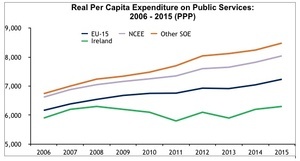
One of my favourite budget details is the general level of expenditure on public services, or government consumption.In the past government ministers have expressed the aspiration to have first class public services – everything from health to education to police and fire services and all the rest.

However, we are so under-funded compared to other countries, it is hard to see how this will be achieved anytime soon.

publicservices

We trail behind the mean averages of EU-15 countries and our two peer groups: Northern and Central European economies, or NCEE (this excludes the poorer Mediterranean countries) and other small open economies (Other SOE – Austria, Belgium, Denmark, Finland and Sweden).

To show how far behind we are, this is how much we would have to increase spending on public services:

To reach the EU-15 average: €4.9 billion

To reach the average of Northern and Central European economies: €9.1 billion

To reach the average of other small open economies: €11.4 billion

A €9 billion increase just to reach average of Northern and Central European economies – that is a big, big number. Even with a government determined to provide the range and quality of public services enjoyed in countries on the continent, it would take a long time to realise that.

So what should we expect today?

We will get a lot of piecemeal announcements (x amount for health, y amount for education and so forth) and a few ‘sweeties’. But you will have to go towards the bottom of the budgetary outlook document, past pages of tables and numbers, to find the expenditure on public services.

But here’s one bottom line: spending on public services would have to increase by €450 million just to keep pace with inflation. Even if spending exceeds that, it may only be enough to keep pace with inflation plus demographic pressures (rising elderly and school-going population).

It will be tight – with tax cuts, increases in social protection (both in rates and increased pensioner numbers) and investment to be financed out of the same relatively small pot.

There is the legitimate complaint that spending levels is no guarantee of quality. Inefficient spending can waste a lot of outlay.

For instance, the Netherlands has experienced a substantial long-term increase in health expenditure due to the extra costs from privatising their health insurance system. This was the model that our last Government sought and failed to introduce, thankfully.

In Ireland, there is a lot of data to suggest we spend more on health than most other EU countries even though we benefit from a much lower elderly demographic (this will change over the next decade).

We spend one percent more than the average of Northern and Central European economies; we should be spending less – though the claim that we over-spend is sometimes greatly exaggerated.

Are there inefficiencies in the health system? Yes. Is it due to the high level of private profit in our public health system?

Our spending on hospital services is low but spending on outpatient services is very high – this might suggest perverse private incentives. Is it because of our geographical density which requires more spending on physical structures and staff than more highly dense countries? Is it due to weak management structures? We need a more sophisticated evidence-based debate on this issue.

One thing is certain – overall high spending may not tell us much about the efficiency of a public service, but low spending can tell us a lot about why our public services compare so poorly with other countries.

While we shouldn’t expect any big increases in public services today given the fiscal constraints and the demand on other expenditure, we should expect that the Government will announce that it intends to close the gap with the European average over the next 5/7/10 years; that is determined to provide the same quality and range of public services that our fellow European citizens enjoy.

Or is that expecting too much?

Michael Taft is Research Officer with Unite the Union. His column appears here every Tuesday. He is author of the political economy blog, Unite’s Notes on the Front. Follow Michael on Twitter: @notesonthefront
shanecoleman

Michael Taft

From top: Shane Colemen in the irish Independent; Michael Taft

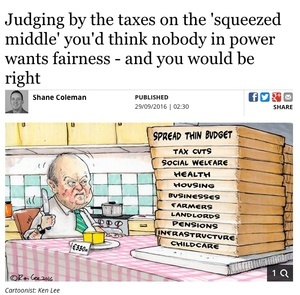
The debate on the burden of the ‘squeezed middle’ is cynical and ill-informed

Michael Taft writes:

Newstalk presenter Shane Coleman asks:

‘So who’s representing those who earn €35,000-€75,000 – the squeezed middle?’

To be fair to Shane, he’s not the only person asking this question nor is he alone in posing this question in those income ranges. But, oh my.

The debate over the ‘squeezed middle’ is one of the more ill-informed and cynical you’ll come across. It is led in many cases by politicians and commentators who make assertions without substantiations, claims without facts; all of which leads to policy proposals that are at variance with equity and economic efficiency.

In many cases the numbers are just made up to rationalise a pre-determined policy preference.

In short, it’s a terrible debate.

The problem starts with the definition of the ‘squeezed middle’. This should be a relatively straight forward statistical issue.

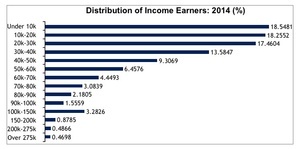
If we are looking at ‘income earners’ (PAYE employees or the self-employed) we can go to the Revenue Commissioners database for a rather crude but revealing headcount.

1

We can see there are a lot of low earners. 54 percent earn less than €30,000. From this we can estimate the median wage (the income level at which 50 percent earn above and 50 percent earn below) to be €27,550. Welcome to the squeezed middle. It’s a long ways off from €75,000.

There are a few problems with these Revenue numbers.First, ‘married couples with both spouses working’ are counted as one tax unit. Therefore, in this category, an income unit of €30,000 could actually mean that each spouse in the household earns €15,000 (or any other variant).
Second, these numbers include pensioners who have taxable income such as an occupational or personal pension, investment and property income. Most pensioners would be at the lower end of the table.

Third, the table includes churn. People who come into the tax net by taking up a job may do so only half-way through the year so the tax unit may refer to six months. Similarly, with people exiting the workforce.

We can try to adjust for some of this by disaggregating couples with two incomes. When this is done, we find the median wage falls to €25,200. We still have, though, the problem with pension income and churn.

A number of commentators prefer to focus on ‘full-time’ workers. I’ve never been convinced of this approach as it excludes so many part-time or near-full time workers.

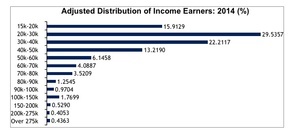
Nonetheless, let’s work this, adjusting for couples with two incomes and excluding all those earning below €15,000. Even doing this we will be including some part-time workers (e.g. someone on €20 per hour working 20 hours a week will be above this €15,000 threshold).

2

Even when excluding all income earners below €15,000 (about 27 percent of all income earners), we still find a significant number earning below €30,000 – over 45 percent.

From this we can estimate the median wage to be €32,050 with 50 percent earning below that amount. The middle is still very low.

So what is the squeezed middle?

The OECD uses a formula to define the broad middle: between one-third below to two-thirds above the average (median) wage.

Using the median wage for all income earners (the first table above) we find the squeezed middle to be between €18,500 and €46,000.

Using the median wage for adjusted income earners above €15,000, the squeezed middle is between €21,500 and €53,500.

This puts the issue of helping the squeezed middle in a new perspective.

We would have to look at things like the minimum wage and living wage, strengthening and extending Joint Labour Committees for all low-paid sectors, increasing social protection programmes such as the Family Income Supplement – in addition to affordable childcare, affordable rents and lower public transportation costs.

Note that most of this doesn’t even get mentioned in the debate over the squeezed middle.
But there is a big, big caveat in all this.

There are a lot of people in society who are not included in the Revenue database because they are not PAYE employees or self-employed: most pensioners, carers (mostly women working in the home), the ill and disabled who can’t work, and those out of work. They should count, too. If they did, the squeezed middle would be a lot, lot less.

For instance, in 2014 the median household income was €40,336. It should be remembered that this includes all income from all people in the household, including social protection income (e.g. Child Benefit, rent supplement, etc.).

And the figure above includes employers’ social insurance (an accounting convention). If you remove that the median household income is closer to €37,700. 50 percent of households earn below that amount.

No, the squeezed middle does not go up to €75,000 or anything like it. If you earn €75,000 you are in the top 10 percent earning bracket. If you earn €50,000 you are in the top 22 percent earning bracket.

This is not to say there are not issues in these above average households. There may be a number of children, high debts from a Celtic Tiger mortgage, etc. But we need to keep a perspective. And to do that is by first getting a robust handle on what we are talking about.

IF we do that, we will have a better chance of getting the policy right.

Michael Taft is Research Officer with Unite the Union. His column appears here every Tuesday. He is author of the political economy blog, Unite’s Notes on the Front. Follow Michael on Twitter: @notesonthefront

90396609Michael Taft

From top: Minister for Finance Michael Noonan delivering his bidget speech last year; Michael Taft

Business in Ireland is too important to be left exclusively to Irish business

Michael Taft writes:

I mentioned previously that the run-up to the budget is my favourite time. We get all manner of sloganeering and mantras. Take this one: a pro-business budget. This usually refers to more tax reliefs, more grant handouts and income tax-cuts to lessen upward wage demands.

Throw in scrapping the odd regulation (always referred to as ‘red tape’) and voila: a pro-business budget.

This isn’t really a pro-business budget – just a string of fiscal gestures that allows the Government to claim it is doing something

. Yes, these are the demands of business organisations but as Sean Lemass pointed out:

‘Nobody nowadays regards the operation of an important industrial undertaking as being the exclusive private concern of its owners . . . The social consequences of fluctuations in the level of business activity are matters of public debate.’

In short, business in Ireland is too important to be left exclusively to Irish business. It is a social activity involving a range of stakeholders. So what would a real pro-business budget look like, one that takes into account social consequences?

In the first instance, it would recognise three principles:

The fortunes of business are inextricably intertwined with the fortunes of society. A prosperous, confident, creative society is likely to create a business sector in its image. If you don’t think so, imagine the opposite: high-levels of poverty, educational inequality, crumbling infrastructure, impoverished public services, etc. What kind of business sector will that produce?

Second, business is not homogenous. Export-focussed firms are not that interested in domestic demand – but they are keenly interested in the demand in other countries. Businesses focussed on the domestic sector, on the other hand, would have an interest in domestic income levels.

Thirdly, businesses need protection from each other. For instance, the original rationale for Joint Labour Committees was not only to protect workers in low-paid sectors; it was also intended to end the situation whereby: ‘ . . . the good employer is undercut by the bad, and the bad employer is undercut by the worst.’

Thus grounded in these principles, here are some ideas for a pro-business budget.

1. Reduce income Inequality: concentration of income at the top of the income pyramid is bad for business. Higher income groups have a higher propensity to save and their spending is more import-dense. If the goal is to induce higher consumer spending, especially if Brexit unsettles confidence, then redistribute to lower income groups.

This would mean no tax cuts for high-income groups (they’re getting pay rises anyway – the CSO shows managers and professionals have seen incomes rise by 7 percent in the last four years compared to losses in other groups). Instead, redirect resources towards raising social protection rates – which spend almost all their income.

2. Increase Investment: essentially, investment ‘buys assets’ that either generate future income or reduce future costs. Investment into advanced broadband can generate new business opportunities; investment in water and waste reduces costs associated with leaks and maintenance; investment into renewables and green energy reduces import and environmental costs. All these come with not only higher business activity (it takes people and materials to produce these assets), but crowds-in additional private investment.

3. Increase Government funded R&D: Ireland is a bottom-dweller in the EU-15 when it comes to support research and design. We would have to increase R&D – in telecommunications, energy, environment, health, transport, etc. – by over 40 percent to reach the average of our peer group, other Northern and Central European economies.

4. Education, Education, Education: this is a key driver, not only in enterprise ability but in reducing inequality. I charted Ireland’s performance on education expenditure here. We would have to increase spending by €1.2 billion to reach other peer group average in Europe.

5. Reduce Living Costs: what is one of the biggest drains on the productive economy (besides debt)? Requiring people to pay market prices for public goods. For instance, health is a public good – yet so many have to purchase it on the private market.

Reducing the costs of childcare, the costs of rents (through public or voluntary cost-rental models), the cost of public transport by having a proper subvention regime – these would reduce unnecessary upward pressure on wages and free up money to spend . . . in the private market. Businesses get a win-win on this.

6. Expand Public Enterprise: business is business – whether it’s public, private, non-profit, capital-owned or labour-owned. So bring together all the public companies and work out a strategy to expand: new start-ups, joint ventures with private companies, expansion, and procurement strategies to facilitate the SME sector.

7. Face Reality: Apple is only the beginning. The momentum in Europe is towards EU-wide initiatives to tackle multi-national avoidance through transparent country-by-country reporting laws, greater transparency in transfer-price fixing, the common corporate consolidated tax base and an EU-wide withdrawal tax. We can either

(a) Hide our head in the sands and hope the world doesn’t notice us,

(b) Line up with the most right-wing forces in Europe (and the richest, tax-avoiding multinationals) to block these initiatives, or

(c) Face up to reality and begin devising a post-Apple foreign direct investment policy. An evidence-based debate is necessary in order to achieve a new consensus. And to achieve that consensus will require the input of all the stakeholders – employees, employers, civil society groups, etc. The Government should announce that it will start this process the day after the budget.

There’s a lot more things we could start doing in Budget 2017 and most of this could not be achieved in one year. But a pro-business budget is one that looks to the long-term, eschewing short-term gesture measures; one that comes with a realisable road-map.

Being ever the optimist, I can’t wait for October 11.

Michael Taft is Research Officer with Unite the Union. His column appears here every Tuesday. He is author of the political economy blog, Unite’s Notes on the Front. Follow Michael on Twitter: @notesonthefront

binsMichael Taft

From top: bin collectionb; Michael Taft

In Ireland, what’s good for Donegal is decided in Dublin.

This must change.

Michael Taft writes:

Whenever one compares Irish government finances with that of other small open economies or Nordic countries, showing that we spend far less on public services, social protection and investment someone invariably comes back with: ‘we can’t trust our government to spend efficiently, or honestly, or at all’.

For those of us who believe in a strong social state, this is a challenge. If people are to accept higher levels of taxation to pay for higher levels of public services, they have to have confidence in state institutions – or at least have confidence those institutions are accountable to them.

So how do the other countries do it?

There is no one answer but the following may be a contributing factor: other European countries are far more decentralised than the Irish state.

The Irish state is one of the most centralised in Europe, fiscally speaking. The central government here spends the highest proportion of total government spending than almost any other EU country. In the EU-15, central government accounts for 54 percent of all government spending; in Ireland it accounts for 95 percent.

Another way of look at this is the amount that local government spending makes up.

Let’s compare ourselves with those high-spending Nordic countries.

1

We can see how decentralised these other high-spending countries are – with Danish local government making up nearly two-thirds of total government spending (interestingly, Denmark is the highest spending state in the EU; the other countries are not far behind).

By contrast, Irish local government is weak, very weak.

So what do these other countries spend their money on through local government?

There are four main areas:

2

On average, in the Nordic countries local governments are the main financial sources for health, education and recreation & leisure. In Ireland, on the other hand, local government plays a much diminished and, in the case of health, a non-existent role.

Even in social protection, Nordic local governments play a prominent role. It should be noted that the category of social protection is not just about cash transfers; it includes in-kind benefits – home-helps to elderly and disabled, transport services, assistance with funeral services for survivors, holiday camps for children, etc.

In short, the Nordic countries are characterised by highly decentralised systems where policies and financing are provided by governmental tiers that are arguably ‘closer to the people’. In Ireland, what’s good for Donegal is decided in Dublin.

Could this decentralised structure imbue more confidence in higher spending regimes? And what implications does it have for Ireland. Well, if the answer to the first is potentially yes, the implications for Ireland are not good.

There are volumes of reports on local government reform going back to the 1940s but local government remains  manager-centred. So what would a reformed local government look like?

It’s too big an issue to go into here but this is just a sampler:

Why do we have four local authorities in Dublin, rather than a Greater Dublin Council? Councillors could be elected along Dail constituencies and would be full-time – part-time councillors don’t have the resources or the time to hold the managerial system to account.

There would be an Assembly with full-time staff and support services with a number of centralised functions devolved to the council level.

Another lower, part-time tier could be established through local area councils (a Swords Council, a Blanchardstown Council, an Inner City Council) with powers devolved through the Assembly.

In the rest of the country, there would need to be an upscaling of city/county councils. We used to have eight regional authorities; recent reforms have reduced to these three. Formerly it was probably too many, now it’s too few.

These are largely toothless but they could be turned into larger full-time professional councils along the lines of a Greater Dublin Council. The current structure could remain but reformed to bring about even more local democracy (a Tralee Council, Letterkenny, Drogheda, Athlone).

But all this is predicated on the willingness of the political culture to engage in a radical decentralisation and, given our historically centralised state, this would be a big task. But it’s one that progressives should investigate.

[Note: it could be argued that Ireland is too small to have a decentralised system. Yet, Iceland and Luxembourg spend more money through local government than we do.]

If people felt that such institutions – being closer to home – were more accountable, then the prospect of developing a strong social state could gain momentum. And there’s another reason.

The Left doesn’t look like taking national power anytime soon with its divisions, fragmentation and low-vote.

However, there are many areas in the country where the Left could form a majority and show that it is capable of governing.

This could set up alternative sources of power and prove useful preparation for hopefully, one day, national hegemony.

It’s not as if others haven’t noticed how weak our local government is. The Council of Europe produced a damning report on Ireland’s excessive centralisation, lack of funding transparency and limited local powers.

Isn’t it about time we noticed, too?

Michael Taft is Research Officer with Unite the Union. His column appears here every Tuesday. He is author of the political economy blog, Unite’s Notes on the Front. Follow Michael on Twitter: @notesonthefront
90428978

Michael Taft

From top: protestor Colm Reddy outside Leinster House during the Dail’s Apple Tax ruling debate last week; Michael Taft

Ireland could be stuck in a reputational and diplomatic damage-zone for years.

Michael Taft writes:

There has been so much written about the Apple tax ruling. Here I look at some of the longer-term implications.

But let’s first nail down some confusions and misunderstandings.

First, the ruling is not an attack on Ireland’s 12.5 percent tax rate. As Peter Brennan of EPS Consulting stated:

‘The Government argues that there is an effort to force Ireland to increase the current rate of corporation tax. Not so . . .There is a huge difference between alleged corporate tax avoidance and the setting of Ireland’s headline rate of corporation tax . . . a ruling from the commission in 1997 clearly indicated that Ireland’s single rate of corporate tax was a general measure under EU state aid rules and was therefore legal and consistent with EU competition policy.’

Second, this is not a tax ruling as such. According to Professor Edward Kleinbard:

‘”The heart of the case is simply that Ireland gave Apple hidden subsidies in exchange for jobs. The only tax connection is that Ireland harnessed its tax system as the instrument to deliver these subsidies. Imagine Dublin promised Apple €220,000 in cash annually for every job located in Ireland.

At 6,000 or so jobs, this totals about €13bn over 10 years. This would clearly equate to an instance of state aid . . . The commission concluded that this is the deal Ireland agreed — but, instead of collecting tax at the Irish 12.5 per cent tax rate and writing cheques to Apple, Ireland forgave substantially all of Apple’s Irish statutory tax liability.”

Nor is it about large nations ganging up on small nations. Before Apple, the largest EU ruling on illegal state aid delivered through the tax system was against France and the French EDF company.

This is about illegal state aids – something that has been part of the EU since the 1951European Coal and Steel Community treaty.

While there have been great memes on social media about what Ireland could do with the €13.5 billion, we shouldn’t get carried away.

While these are legitimate metaphors, Ireland is unlikely to receive this full amount. As Professor James Stewart observes:

“…the commission also note that the amount that may be recovered by Ireland will be much lower if as a result of information “revealed through the commission’s investigation” profits are reallocated to other jurisdictions . . . In addition, the commission note the amount recovered by Ireland would also be reduced if larger sums were reallocated to the US parent to “finance research and development”.

How much could Ireland hope to get? This is speculative at this stage. People who have a much greater grasp of these esoteric international tax rules than me have stated the final figure could be as low as €2 billion but maybe €5 billion. Or maybe more. Or possibly less. Nonetheless, this could be a boon for infrastructural investment.

Nor is it the case that the government is in full control over this ruling.

Apple has announced it will appeal and this process could take years. So instead of a neat situation whereby Ireland would receive €13.5 billion if the Government accepted the ruling, the reality is that we are likely to receive much less and – even if the Government didn’t appeal – we will have to wait years on Apple’s appeal (and may end up with nothing if the appeal is upheld by the European courts).

The Government’s decision to appeal can be partly explained by the fear of two queues forming at their doorstep. The first queue concerns the ruling itself.

As the EU Commission states:

‘The amount of unpaid taxes to be recovered by the Irish authorities would be reduced if other countries were to require Apple to pay more taxes on the profits recorded by Apple Sales International and Apple Operations Europe for this period.’

It is already beginning – with Spain, Austria, Italy and France beginning to investigate what is due to them from the Apple profits. Just what any Government needs – negotiating with other countries, possibly going to court, all that snooping around our tax affairs.

The second queue may form if the EU Commission is investigating other companies potentially benefiting from illegal state aid.

It is being widely reported that the EU Commission is investigating six more cases of Irish deals with multi-national companies. And a Reuters investigation in 2013 showed that at least 74 percent of the 50 biggest U.S. technology companies, including Google and Facebook, use practices similar to Apple’s to reduce their tax bills (these are not all Irish based). So Apple may only be the beginning.

If either or both these queues start forming, Ireland could be stuck in a reputational and diplomatic damage-zone for some years.

The Dáil debate last week was conducted in the dark. TDs did not have access to the 150-page ruling (it will be published after the Government, Apple and the EU Commission agree on redactions for commercially-sensitive information – this could take months).

Therefore, it could not independently assess the ruling nor could it assess the likelihood of a successful Government appeal.

Fortune reports that:

‘Last year, the European Commission published a list of six tax rulings and 59 “measures similar in nature or effect” since 1991, which it had challenged on the basis of state aid rules. It was successful in almost all cases.

The EU Commission has a high success rate in fighting off appeals in the European Court. The Government may know its chances are slim and are undertaking the appeal in an attempt to buy time.

What is the long-term impact of the Apple ruling on Ireland’s low-tax FDI strategy?

Technically, it could be very little. After all, the EU Commission ruling is not about tax policy; it’s about illegal state aid. And the tax provisions through which those subsidies were delivered no longer exist. In this respect, the Apple case is historical.

However, if the state were found to have made special deals with other companies this could give Ireland the image of operating an ad hoc legal and tax framework – one which business and just about everyone else would have little confidence in. That could be quite damaging.

But the biggest challenge for Ireland is that the Apple and related decisions will accelerate moves towards greater European tax cooperation and coordination.

Though hardly mentioned in Ireland, only weeks before the Apple ruling the European Parliament overwhelming passed a resolution containing a number of progressive measures to fight multi-national tax avoidance and evasion (the full text of the resolution can be found here):

EU register of beneficial owners of companies, and a global register of all assets held by individuals, companies and entities, such as trusts and foundations, to which tax authorities would have full access.

A tax havens blacklist with stronger sanctions against non-cooperative tax jurisdictions,
Action against abuse of “patent box” regimes and stricter definitions of what is allowed under transfer-pricing

Tax good governance rules in EU trade agreements

A common consolidated corporate tax base (CCCTB)

An EU-wide withholding tax, to be collected by member states, to ensure that profits made in the EU are taxed at least once before leaving it

Measures like these are necessary to advance corporate accountability and tax justice throughout Europe. However, Ireland continues to resist.

While this resolution found support across the political divide in the European Parliament (514 voted for, 68 against with 125 abstentions) among the Irish MEPs only Nessa Childers supported the measure; the rest opposed or abstained.

One lesson we can draw from the Apple ruling is that the only agency that can break the tax-avoidance/evasion strategies of multi-national capital is a supra-national one; in this instance, the EU. Would a single nation-state (never mind a small one) have been capable of making this ruling and making it stick? Extremely doubtful.

There is a fear that a rational, democratic and accountable corporate tax regime in Europe will undermine Ireland’s ability to incentivise foreign direct investment (FDI).

It is legitimate to ask whether Apple would have sited thousands of jobs here without the ‘tax-deal’. But such questions should not lead us into apologies for global tax avoidance, never mind our participation in it.

In the first instance, the Dáil should assert is role in this process even with the Government appealing.

The Public Accounts Committee or a special committee should hold hearings on the ruling itself, clarify the issues, assess the likelihood of a successful Government appeal and the potential for further cases down the line – in both Ireland throughout Europe.

This is supposed to be the era of ‘new politics’ with a heightened parliamentary role. Well, let’s heighten it.

But these questions should also lead us into a more profound, evidence-based debate on our future in the international marketplace and the policies to incentivise foreign investment.

That debate should start from this simple premise – what is good for FDI is also good for the Irish people: a modern infrastructure, investment in education, a culturally-diverse society, affordable housing costs, comprehensive public transport and accessible cities, strong public services (low-cost, high quality childcare) and social security (health and in-work income supports), transparent governance, recreation and leisure activities, economy-wide employee innovation and participation and so on.

And tax policy? One that supports investment, investment and more investment.

We can do this. Or we can continue to participate in a global race-to-the-bottom; and even worse. We can – just as we did during the speculative-fuelled boom years prior to the crash – continue to close our eyes to the reality around us

And hope the world doesn’t notice us.

Michael Taft is Research Officer with Unite the Union. His column appears here every Tuesday. He is author of the political economy blog, Unite’s Notes on the Front. Follow Michael on Twitter: @notesonthefront
oldmanMichael Taft

From top: Pensioner on the Ha’penny Bridge, Dublin; Michael Taft

The pension debate is overly complex and full of scare mongering.

That ends here.

Michael Taft writes:

Get ready for the big upcoming pension debate. Hopefully it won’t be conducted like the ‘we-are-taxed-too-much’ debate or the ‘Irish-wages-are-too-high’-debate.

Hopefully the pension debate will be evidence-based, without unsubstantiated assertions or slogans masquerading as policy. Let’s keep hope alive by looking at a couple of issues arising out of the report from the Interdepartmental Group on Fuller Working Lives.

For many, pensions are as exciting as a snail race. But believe me, when you get to a certain age it becomes seriously interesting. And with the rising number of elderly, it will become even more prominent in the debate.

The Interdepartmental report focused on the specific dilemma facing people forced to retire at the age of 65 but not being eligible for a pension until they turn 66 (by 2028 the eligibility age will be increased to 68). But the report touches upon wider issues. Let’s look at two of them.

We Can’t Afford Them

We’re going to get a lot of ‘we-can’t-afford-them’ – that is, future pension costs will be fiscally unsustainable due to the rising number of pensioners: .

‘Expenditure on State Pension payments and relevant supplementary payments is estimated to rise from just over €6.5bn in 2015 to around €8.7bn in 2026, assuming no further changes in rates – an increase of 34%.’

While they don’t scare-monger these numbers, others will. But should we be overly-worried about this number?

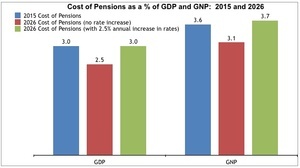
As a proportion of national output (GDP or GNP) these numbers indicate that pensions will actually cost less in the future; at least up to 2026.

1

Using the report’s own numbers, pensions as measured as a proportion of national output will fall between 2015 and 2026 – whether measured by GDP or GNP. In my own calculations,

inserting a 2.5 percent annual increase in weekly pension payments, the cost remains the same. This doesn’t factor in the increased revenue – higher income and indirect tax revenue which will offset a small part of the cost.

Yes, there is a problem with GDP and GNP measurements, but the above measure trends. After 2021 I assume a 4 percent nominal increase in GDP and a 3.5 percent nominal increase in GNP).

This is not to under-estimate the challenges of funding people’s post-retirement income; after 2026 the cost will continue to rise. But it is important to keep these rising costs in perspective.

There’s Going to Be More of Them

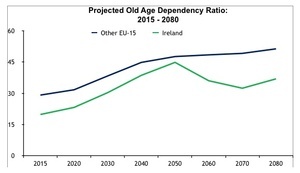
More pensioners, that is. Which brings us to another issue – the age-dependency ratio. It has been pointed out that there will be fewer people at work supporting more people retired – a real social, economic and fiscal challenge.

2

Ireland’s dependency ratio, while staying below the mean average of other EU-15 countries, will nonetheless double over the period to 2050 – to 45 percent. After that the ratio falls to the level that exists in other EU-15 average today – and then rises again.

A couple of things to note about this type of projections. First, it is highly sensitive to small changes in variables such as immigration levels, longevity, fertility, etc.

To show how fragile these projections can be, just remember Ireland in 1989. High emigration, low immigration; who would have imagined that within 10 years everything would be turned upside down. If it’s hard to project demographics over a decade, try attempting it over multiple decades.

Second, age and pension-dependency ratios are also a product of policy. For instance, even under same variables, the above chart is out-of-date. The age range is 65. But Irish policy is to increase the pension age to 68 by 2028. This will improve the dependency ratio under current projections.

Or how about this: the Government pledged to take in 4,000 Syrian refugees yet only 350 have arrived. If we were to have a more pro-active immigration policy, we could improve the dependency ratio.

Why do you think Germany committed to taking so many in? Under current projections, their dependency ratio will rise to a staggering 60 percent, with the population in decline (many EU countries are facing into falling populations).

That’s why what’s called the European ‘immigration crisis’ is actually a ‘social and economic opportunity’.

Again, this doesn’t under-estimate the challenge but hopefully it will point us to positive proposals, rather than an alarmist debate.

Just Outlaw It

The purpose of the inter-governmental report was to address the issue of raising the pension age while people were still required to retire at 65 years. The report calls for a number of interventions, mostly aspirational.

Why not just forbid forced retirement at the age of 65. Retirement should at least become mandatory only when someone is eligible for a state pension.

Or why not go further and just outlaw age-ism. People should be given a range of work-choices – continuing to work past the pension age, reduce working hours, or retire at the pension age. If someone is not considered fit to continue working in a company, it should be treated as a health and safety issue, not an issue of an arbitrary age.

There is no denying the complexity of the issues regarding ageing, pensions, life-time savings and the diminishing number of defined-benefit occupational schemes. We will need an informed debate based on evidence with proposals that are intended to enhance peoples’ life-options and living standards.

One might be pessimistic that this will happen when one considers the how debates over tax, spending cuts, competitiveness, etc. have been, and continue to be, conducted.

But one should live in hope – hopefully for a long, healthy and prosperous life-time.

Michael Taft is Research Officer with Unite the Union. His column appears here every Tuesday. He is author of the political economy blog, Unite’s Notes on the Front. Follow Michael on Twitter: @notesonthefront