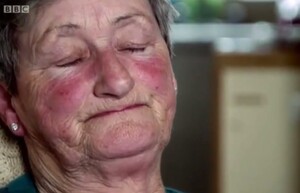
You may have seen Ireland’s Lost Babies, featuring Lily (top) last night…
“I am looking for my half sister who was born at St Peters Hospital Castlepollard Co Westmeath on 29/11/1957 to a Mary Patricia McDowell. She was taken away from the Sacred Heart Convent Castle Pollard for adoption to the USA, The placement agency was The Angel Guardian Home Long Island New York.The was also given the name Mary Patricia when born but was adopted by an American Couple with the surname O’Connell. Anybody with any information please email.” (John Donoher)
“Hi my name is una Stroud from Athlone co westmeath.myself and my family are looking for our sister, she was born on January 28th 1954 or 1955 she was adopted to a couple from America, my mother’s name was Una Dunleavy from Sligo, sadly my mother passed this year on January 29th and we are desperate for help.as it was my mother’s dying wish to find her daughter our sister.” (Una Stroud)
“I am looking for a micky Joe mulligan,or Michael Joseph Mulligan born at castlepollard 1955/6 adopted to an American couple any information would be appreciated” (Totty Maude)
“I am adopted from Ireland. I was born in Castlepollard on June 12, 1951. My birthname was Catherine Mary Flanagan, my mothers name was Margaret Flanagan (formerly Clara) as states on my birth certificate. I was born at a place called Manor House. I was adopted in December of 1951. I am looking for any family which may still be in the area, and looking for information on my parents. I have no information on my father. I was adopted through the ST. Patricks Guild. I need help in looking for for any living relatives. I was adopted by a family from California in the US.” (Cathy Filglas)
“I was adopted from Ireland. I was born in Castlepollard on December 16, 1955. Was adopted from Sacred Heart in Castlepollard. My birth name was Christina Mary Connolly and was adopted on December 22, 1957 to the USA. I now live in New York. If anyone has any info on Connolly who gave birth to a daughter on December 16, 1955, please e-mail me at mauraseanard@yahoo.com…would like to hear from any others adopted from Castlepollard and any info anyone has in tracing their birth parents and possible siblings…” (Mary Jean Connolly)
“My name is Kelly Little now. I was born at Sacred Heart Convent/St. Peter Hospital in Castlepollard on the 4th of April 1962. My mothers name was Josephine Kelly (maiden name). The name on my birth certificate was Grainne Anne Kelly. I was adopted by a couple in Kansas in 1964. Josephine would have been around 22 at the time of my birth. If anyone has any info I would appreciate hearing from you. Please email me at blittle@usd261.com. “ (Kelly Little)
A selection of messages from the Irish Roots website [readable in full here and here] following last night’s BBC Two documentary “Ireland’s Lost Babies” (repeated tonight at 10.15 pm. on RTÉ One and available to watch now on YouTube above), featuring the Sacred Heart Mother and Baby Home, Castlepollard, County Westmeath.
A key player in the Castlepollard adoptions was the local parish priest, Father PJ Regan, who was also chairman of the St Clare’s Adoption Society, run by the Franciscan sisters.
Journalist Mike Milotte, in his book “Banished Babies”, records that over 300 children from Castlepollard and over 130 children from St Clare’s, were adopted by American families during the 1940s, 50s and 60s.
The book also records how subsequent attempts by those children – and their mothers – to make contact – were frustrated by the deliberate provision of incorrect information by both Father Regan and the Sacred Heart nuns.
Sarah Anne Buckley, of the National University of Ireland Galway and David Quinn, of the Iona Institute and the Irish Independent, on Al Jazeera last night
David Quinn, columnist at the Irish Independent, Susan Lohan of Adoption Rights Alliance, and Sarah Anne Buckley, a history lecturer at National University of Ireland Galway appeared on The Stream on Al Jazeera last night – hosted by Malika Bilal – in light of last week’s publication of the Report of the Inter-Departmental Group on Mother and Baby Homes.
During the discussion, David Quinn pointed out that Mother and Baby Homes were not unique to Ireland, told of his bewilderment at the international media’s fascination with Ireland and, indeed, Ireland’s fascination with holding inquiries into its ‘dark chapters’, and also suggested single mothers were treated worse in non-Catholic Sweden than in Ireland.
And on the matter of the few options available to women in Ireland – in regards to contraception – Mr Quinn was at pains to point out that the Pill wasn’t invented until the early 1960s and that “no country in the world had effective contraception”- inferring that Ireland’s Catholic-influenced rules regarding women were really of little or no consequence.
Grab a drink tay.
Malika Bilal: “If it were not for these homes run by the Catholic churches and, in some instances, Protestant Anglican churches, where would these women have turned to? What were the alternatives? Were there alternatives?”
David Quinn: “Well, I mean, I think there’s a danger, some of your listeners may think these homes were in some way, particularly, uniquely an Irish experience. This is to excuse nothing and I mean there was a terrible stigma shown towards single mothers back then. But Mother and Baby Homes didn’t exist only in Ireland. For example, they existed as well in Britain. They existed in a lot of countries because many countries, unfortunately, stigmatised lone parents back then. I mean it’s a focus on Ireland. I don’t quite know why there’s a focus on Ireland to the extent that there is, compared with the same kind of homes in America, in Australia, in Britain. In Sweden, between the 1930s and the 1970s, they had a eugenics programme that swept up many lone parents, treated them as asocial and frequently sterilised them and this carried on until the 1970s. Sometimes they forced these women to have abortions and they had institutions and this was social democratic Sweden where the Catholic church has no influence whatsoever and is also one of the world’s most secular countries. And this is going on between the mid-1930s and the mid-1970s and in social democratic-ruled Sweden…”
Bilal: “But David are you saying that the reason, that the Catholic church is being unfairly singled out?”
Quinn: “Well I think Ireland and the Catholic church have, in fact, been unfairly singled out. I mean it’s interesting that the worldwide media and, indeed, your own organisation now, and I understand why, are reporting on Ireland and the Mother and Baby Homes in Ireland. I mean really to get a proper handle on this, we need to know what was the death rate for infants in Mother and Baby Homes in countries that were socio-economically similar. I mean, for example, if you go back to the 1930s and 1940s, the infant mortality rate in Ireland was 20 times higher than today. It was 20 times higher in Northern Ireland. It was 20 times higher in Scotland. It was about 10 times higher than today in England. The reason is because England was more prosperous at that time than either Ireland, Northern Ireland or Scotland. So a lot of it had to do with background poverty issues…”
Susan Lohan: “But David, David, you haven’t mentioned however…”
Quinn: “The reason the mortality rate was higher again. Sorry. I need to say, I need to say…”
Lohan: “…That these Mother and Baby Homes got State grants to run themselves so not only were they getting a [inaudible] payment but a lot of these Mother and Baby Homes also…”
Quinn: “I want to finish my sentence though. Yeah, can I finish my sentence though? Malika, can I finish my sentence?”
Bilal: “Yes, Susan, let’s let David finish his sentence and then we’ll get right back to you. David?”
Lohan: “Sure.”
Quinn: “Yeah, I mean the reason the…the mortality rate in a Mother And Baby Home was higher again. One reason is because, and we saw this reported in for example the Sunday Independent, once one child got measles in a confined space, in the space of maybe a week or two, ten babies would die, same for things like gastroenteritis. You often had things like TB which would run rampant in these institutions. They were not properly resourced, they were not properly financed. It was a disaster at a time when you had so many deadly infections and highly infectious diseases that could carry children away in these confined spaces. Now these Mother and Baby Homes in fact were absolute death traps for these children and that’s why the death rate was even higher than a rate that was already extremely high.”
Bilal: “David you’ve made that point in a couple of sentences and Susan is shaking her head as you’re speaking. Susan, go ahead.”
Lohan: “Yes, that’s completely wrong. I mean I referenced at the top of the programme, Alice Lister, who was an inspector for the Department of Local Health I think it was. In 1939 she brought to attention of the relevant minister that a child born in the slums now remember the slums in Dublin at this stage were compared readily with those in Calcutta where 10 families may be numbering, 10, 12 to a room were living in these most incredibly cramped and sanitary conditions. Alice Lister, the inspector, the Government inspector pointed out that in homes where people, children and mothers, were supposed to have had a superior diet, a superior sanitary and medical conditions. As I said the, many of these Mother and Baby Homes were situated in large farms, there is absolutely no excuse for the death rate and James Deeney, a former chief medical officer…”
Quinn: “But the cause of death is listed…”
Lohan: “…In his book, in his book said that when he visited Bessborough in 1944 that the matron there was trying to cover up a purulent gastroenteritis type of infection which had led to further complications in the children. He promptly shut the place down. And it was due to a lack of concern for these children and a belief they were disposable.”
Quinn: “Susan, I called them death traps.”
Later
Sarah Anne Buckley: “There is an issue of comparisons to other countries. And there is work being done on this but there were very limited options for women in Ireland. This is a critical point. We had an incredibly high infanticide rate. When your fertility options are that limited, due to legislation that is Catholic influenced, then that will have a bigger knock-on effect. However I do take the point that…”
Quinn: “But Sarah, up to the 1960s, up to the 1960s there was no country with effective contraception and the period we’re looking at here is 1925 to 1961. The Pill was not invented until 1962 or 1963.”
Buckley: “I think that’s the banning of any information. The censorship of any information about a woman’s reproductive system…”
Quinn: “But there was no effective contraception anywhere in the world.”
Buckley: “There was…”
Talk over each other
Quinn: “There was no effective contraception anywhere in the world.”
Buckley: “…I do not agree with you on that point.”
Talk over each other
Quinn: “But of course there wasn’t, the Pill, the Pill was not invented…”
Buckley: “Do you think that the Pill is the only…?”
Bilal: “Both of your points are taken, David and Sarah, I’m going to jump in here and I’m going to go to Susan actually because we started this with the news of the inquiry that’s coming. Susan, what do you think will come out of it?”
Buckley: “Right, well I think the inquiry is being set up to be a whitewash.”
Later, Mr Quinn is asked what he thinks of the upcoming inquiry
Quinn: “Well I mean I actually agree with Susan, I think it has to be a proper, comprehensive inquiry, it has to get to the bottom of it because…I mean Ireland is a country that’s had many inquiries actually into its past, I mean more than most countries I can think of. We’ve had inquiries into our past. I mean it’s a kind of curious aspect of Irish society that we do that. I mean again I’m just of, let’s say, Britain or the United States or any other country I can certainly think of in the English-speaking world where they’re launching a similar number of inquiries into dark chapters of their past. Even undoubtedly all these countries also have dark chapters in their past. And I mean I just find the interest, of the international media in Ireland in particular also, almost fascinating. This is not to say we should not have these inquiries but I just wonder why it is that there’s such focus and attention on Ireland, all the time – not just by ourselves, cause we’re obviously interested in our own past but we seem to be more interested into delving into our own past than other countries and the international media seems to have a similar interest that I can’t quite figure out. But what is noticeable is that the Catholic church is often put, you know, centre stage in these inquiries which is justifiable to the extent that the Catholic church was an extremely dominant institution but again when you see that other countries where the Catholic church was not dominant and had similar problems – either you have these institutions run by other churches or by simply the State. And the State, in a completely secular dominated not church dominated, and again it’s just becomes again curious to me why there is such a singling out of Ireland all the time.”
The Department of Children and Youth Affairs last week published the report of the Inter-Departmental Group on Mother and Baby Homes.
This sets out the conditions against which the Commission of Investigation into matters related to mother and baby homes will operate.
We asked Legal Coffee Drinker what it’s all about and is it worth the paper it’s written on?
Broadsheet: “Legal Coffee Drinker, firstly what’s it all about?”
Legal Coffee Drinker: “It’s a Report which representatives of various government departments were initially asked to compile on the Tuam Babies controversy, the research carried out by local historian Catherine Corless, which disclosed that 796 babies died in the Bon Secours Tuam Mother and Baby Home between 1925 and 1961.
Subsequently, the Dail, in a motion passed on the 11th June last, requested that the Group extend its remit to consider all mother and baby homes, so as to assist – and I quote – “in establishing the truth regarding these institutions and the treatment of those who were in their care”. More specifically, the motion asked the Government, through the Group, to:
(i) identify relevant information and records pertaining to mother and baby homes within the State and
(ii) assist in relation to the scope, format and terms of reference of a Commission of Investigation to inquire into issues relating to these homes.
Broadsheet: “So this is all covered in the Report?”
LCD: “Regrettably not. The Report fails to effectively identify (i) information and records relating to the mother and baby homes discussed. In addition, the assistance it purports to provide in relation (ii) to the scope, format and terms of reference of a Commission of Investigation is somewhat… less than edifying.”
Broadsheet: “What IS in the 37 pages of the Report, then?”
LCD:” It takes some time to find out, due to the fact that whoever prepared the Report forgot to include an index for ease of readers. But here goes. There’s a short introductory chapter, a list of members of the Group and a discussion of the scope of its remit. So far so good – although even these chapters are taken up largely by ‘dog ate my homework’ complaints about not having enough time to do the work required properly.
At this point we should be getting on to the meat of the Report. Sadly, what comes next is a Leaving Cert-style essay on the history of ‘unmarried mothers’ in Ireland, mostly consisting of bits lifted from well-known texts such as “Occasions of Sin: Sex and Society in Modern Ireland”.
The only ‘meat’ so to speak, is in Chapter V of the Report, entitled ‘Mother and Baby Homes’, and it is somewhat lean pickings as far as the information and records requested by the Dail is concerned.
The section in this chapter on the Tuam mother and baby home, being, you will recall, the very institution with which the Group was originally established to deal, contains merely a potted summary of information already in the public domain. As regards the records kept by the Bon Secours sisters in charge of the home, all that we are told is that such records exist and are with the Child and Family Agency. We are not given any idea whatsoever of their content. One would have thought that the figures compiled by Corless, and replicated in the Report, of 1,101 births and 796 deaths in the home between 1925 and 1961 merit at least a paragraph on the nature and content of these records.
However the information given in relation to Tuam is a veritable goldmine compared to that provided in respect of the other mother and baby homes listed. We are told that the records for St Clare’s, Stamullen, are also with the Child and Family Agency (once again, no further information is given). A subsequent section (p12) headed ‘Bethany Home’ appears to be strangely truncated; two sentences only and we are not even told where the records of this home, if any, are kept.
As regards the other mother and baby homes listed in the Report, no information is provided other than their names, their dates of operation and the institution in charge of such. In particular, we are not told whether or not their records are still available, and if so, who holds these records. Given the stated remit of the Group’s task, this omission is so extraordinary that one wonders whether the person responsible for drafting this report, in their enthusiasm for ‘cut and paste’ could inadvertently have ‘cut out’ 100 pages or so. But apparently not, and the result is that we are no wiser, as regards these homes, after reading the Report than before…
Broadsheet: “And does the Report deal with the second request by the Dail, namely to advise on the scope, format and reference of a Commission of Investigation?”
LCD: “It purports to do so in the next chapter [VI: Establishing an Effective Modus Operandi] but fails lamentably. Such suggestions as are made are a master class in stating the obvious: for example, the Group remarks that “establishing an effective approach to the matters to be investigated is essential if the Commission is to provide valuable findings in a manner cognizant of the sensitivities of those involved and the importance of undertaking its work on a timely and cost-effective basis”. Even more helpfully, it goes on to state that “[t]he subject matter of this proposed Commission of Investigation by its nature is likely to encompass a number of diverse elements. The methodologies to be adopted by the Commission must be effective and should be differentiated.” This would be fine if, you know, it was actually followed up by some information about what the Group would regard as ‘an effective approach’ and appropriate ‘methodologies’. It isn’t.
One thread which does run consistently through this Chapter, however, is that of keeping costs down, the Group being at pains to emphasise how important it is “that investigations be conducted in a cost-effective manner since unnecessary expenditure is at the expense of meeting other important demands on the Exchequer, including today’s priorities for the improvement of the welfare of children.”
Broadsheet: “So ‘effective’, for the purposes of the Report, equates with ‘cost effective’?”Continue reading →
Toys and flowers at the Little Angels memorial plot at Bessborough House in
Blackrock, Cork
Yesterday afternoon, the Department of Children and Youth Affairs published its Report of the Inter-Departmental Group on Mother and Baby Homes.
On page 17 of the report it begins to deal with the matter of the 1961, 1971 and 1975 vaccine trials carried out by Burroughs Wellcome – since taken over by GlaxoSmithKline – as seen in the following screengrab:
However, it’s missing something.
Specifically, the final sentence in that paragraph is missing the total number of children which received the vaccines.
The sentence reads:
These vaccines were administered to a total of children in Ireland, one hundred and twenty three of whom were resident in children’s homes in various parts of Ireland.
Odd.
Furthermore, the report states 123 children who received the vaccines were residents of children’s homes across Ireland.
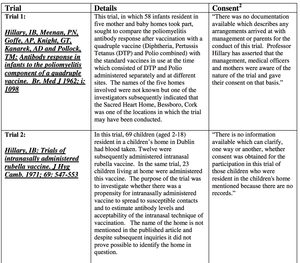
However, the report then includes a table which summarises the findings of a report into the vaccines carried out by the then Chief Medical Officer of the Department of Health, Dr Jim Kiely, in 2000 and the figures in the table don’t add up to 123.
From the report:
According to the figures compiled in the table 180 (58 + 69 + 53) – and not 123 – of the children who received these vaccines, in 1961, 1971 and 1973, were residents in children’s homes.
In addition, the report didn’t include the 1930-1935 trials of a Burroughs Wellcome vaccine for diphtheria carried out on 2000 children in residential institutions. Nor did it mention the 1965 trial of a ‘five-in-one’ vaccine carried out on Philip Delaney at Bessborough Mother and Baby Home, Cork.
Meanwhile, the report also found:
“The Therapeutic Substances Act, 1932 was the statute governing the importation and use of vaccines in these trials. The Chief Medical Officer was unable to locate or identify documentation which would confirm whether or not the legal requirements of this Act were complied with in respect of these three trials.”
And in relation to the matter of consent, it found:
“As the subjects of these trials were children, effective consent to their participation in the trials could only have been given by their parents or guardians. The requirement for such consent to be obtained was clearly understood by researchers and articulated in a number of documents available to the research community at the time.”
A picture taken of the statue depicting Sr Catherine McAuley – who founded the Sisters of Mercy in 1831 – and a ‘penitent’ with a baby outside the International Centre of the Sisters of Mercy on Baggot Street in Dublin this afternoon.
The newly-appointed Justice Minster Frances Fitzgerald spoke to Sean O’Rourke yesterday morning about the special commission of investigation that will examine the high mortality rates at mother and baby homes in Ireland, the burial practices at the sites, secret and illegal adoptions and vaccine trials on children.
Specifically, Ms Fitzgerald was asked about what she did after she was told about these matters by adoption groups last July.
Frances Fitzgerald: “In terms of working out the terms of reference of the commission, I think there’s huge expectations out there. What we want to get is something that is not so vague that it doesn’t satisfy anybody but does give answers. We have to look very carefully at the outcomes we want from this Commission of Investigation.”
Sean O’Rourke: “We’ve had several people texting minister, about your own knowledge and role in this but before we talk about that, let’s just recall what Susan Lohan, of the Adoption Rights Alliance, and she was here with Neil Michael, of the Daily Mail, what she had to say last week.”
Plays clip
Susan Lohan: “I think the Minister for Justice really has to speak out on this and France Fitzgerald knows all too well about the issues because both ourselves, the Adoption Rights Alliance, and other groups have been sending her material since she took office in 2011, so she can not claim ignorance on this issue.”
Neil Michael: “She was handed that report detailing these mass graves, etc, in July, I think it was July 24th last year and she promised she would read the report that night. And we sent her a list of questions, to her private email address, to the Department of Justice and also the the Department of Children and Youth Affairs and we didn’t get a single reply. And the one reply we got, from the Department of Children, completely ignored any question to do with mass graves or high mortality rates.”
O’Rourke: “So that’s Neil Michael, of the Mail, and Susan Lohan, what’s your response minister?”
Fitzgerald: “Well, I’m very glad to respond to that. I certainly had no information in relation to the possibility that there were 800 bodies in any grave. In fact, of course, the details of that, that are emerging. I mean the best witness we have in relation to that grave at the moment is saying that there are probably 20.”
And yet.
A report that the group Adoption Rights Now gave to Ms Fitzgerald, last July, detailed several issues including the matter of Irish babies being sent from mother and baby homes in Ireland to America, England, Germany, Libya, Egypt, the Philippines, India, Australia, South Africa and Venezuela for adoption; vaccination trials at the mother and baby homes; high ‘illegitimate’ infant mortality rates and concerns about burials.
It states:
“If we apply a cautious figure of mortality rates running at an average of less than three times the national average for the total of 100,000 Irish adoptees since 1922, a figure of upwards of 10,000 babies who died above and beyond the deaths which would have occurred naturally would be conservative. We are clearly stating on the record that at least ten thousand babies were neglected to death. We believe the Sisters of the Sacred Heart of Jesus are responsible for at least 2,500 to 3,500 of these deaths and the evidence so far uncovered backs up this truth with incontrovertible facts and a clear pattern of neglecting babies and children to death. These helpless, innocent victims were buried without coffins or ceremony in unmarked or barely marked graves. Many never had a name, a birth certificate, a death certificate or baptism. “
Read the full report that Adoption Rights Now gave Minister Fitzgerald here
Frances Fitzgerald’s interview with Sean O’Rourke here
From top: St Patrick’s Home on the Navan Road in Dublin which was initially known as Pelletstown and a table in Dr Lindsey Earner-Byrne’s book Mother and Child outlining the number of infant deaths in four mother and baby homes in 1933.
To recap.
On Sunday, May 25, Alison O’Reilly in the Irish Mail on Sunday reported that it’s believed 796 babies were buried in a disused septic tank by Bon Secours nuns between 1925 and 1961.
On Saturday, May 31, Neil Michael, in the Irish Daily Mail reported that there may be three other mass graves at three other locations, namely: Sean Ross Abbey in Roscrea, Co Tipperary, where 790 children are believed to be buried; Bessborough, Co Cork, where it’s believed an estimated 2,000 children may have been buried before it closed in 1996 and St Peter’s in Castlepollard in Co. Westmeath, where it’s believed 300 to 500 children died.
Mr Michael also reported that the most common cause of deaths was marasmus – a form of malnutrition.
On Sunday, June 1, Alison O’Reilly, in the Irish Mail on Sunday, reported that there may be a fifth mass grave, containing an unknown number of bodies, on the grounds of the Sisters of Mercy Convent in Loughrea, Co. Galway. She reported that the site was used to bury the children who died in St Brigid’s Industrial School which was there for almost 100 years before it closed in 1967.
But what of Dublin?
Dr Lindsey Earner-Byrne, in chapter 7 of her book Mother and Child: Maternity and Child Welfare in Dublin 1922-1960 wrote:
“Dublin was the destination for many unmarried mothers, and the Department of Local Government and Public Health described the tendency as ‘somewhat remarkable’. Of the 551 illegitimate births registered in the city in 1931, only 335 were found to be ‘chargeable to the city’. Each local authority was responsible for the welfare for the illegitimate children born of women from its area. However, the social shame led many countrywomen to flee to Dublin for anonymity.”
…
“In general, Catholic unmarried mothers from Dublin who remained within the Irish system were either sent to St Patrick’s Home, Pelletstown, to one of the various magdalen asylums in the city or to the Legion of Mary hostel [Regina Coeli] established in 1930. Protestant mothers were received at the Bethany home in Orwell Road, Rathgar; these women were also accepted in Pelletstown, but the preferred option was to send mothers to homes that catered specifically for their religious needs.”
…
“In 1939 the annual inspector’s report noted that the death rates in the various unmarried mother’s homes around the country are undesirably high: Bessboro home, Cork had an infantile death rate of 47 per cent, Shan Ross Abbey, Roscrea had a death rate of 18 per cent, the Manor House, Castlepollard a rate of 7 per cent, and St Patrick’s Home, Pelletstown and the home in Tuam, County Galway had rates of 23 per cent and 15 per cent respectively. By 1943 [Inspector Alice] Lister noted that the rate in Bessboro was a staggering 61 per cent, and Shan Ross Abbey and the Tuam home had rates of 35 per cent, whereas Castlepollard and Pelletstown had shown ‘a satisfactory decrease’.”
…
“In 1945, 156 babies had been admitted to the [Regina Coeli] hostel and 48 had died. In 1946, 85 infants were admitted and 33 died of gastro-enteritis, seven of those having been admitted before January 1946. In September 1946 Dr Murphy recommended that, in order to reduce infant mortality in the institution, visiting medical officers should be appointed, a day and night nurse provided, and an isolation ward established with a separate kitchen and sterilisation unit for infant feeding. Despite regular meetings between [chief medical adviser to the Department of Local Government and Public Health, James] Deeny and the staff of the hostel, it took another year before Frank Duff, the chairman of the Legion of Mary, agreed to the employment of a doctor. In May 1948, in response to the level of infant mortality, Deeny removed the hostel’s exemption from inspection.”