Tag Archives: PAC

angelakerins

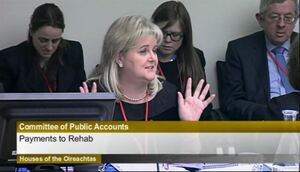
Former CEO of the Rehab Group Angela Kerins at the Public Accounts Committee on February 27, 2014.

Ms Kerins Regrets

MaryLouKerinsLou

UPDATE: 

Angela Kerins: “I have no allowances, I have no hidden, hidden monies anywhere, there’s no…”

Mary Lou McDonald: “What would your expenses run to on average?

Kerins: “I don’t have that with me.”

McDonald: “You don’t have that information with you? It’s just I was alarmed to hear, now I’m sure, I’m confident you’ll tell me that this is not the case but that you were a regular commuter by helicopter to different locations.”

Kerins: “Any time I’ve ever been in one, it hasn’t been, it hasn’t been mine and it’s cost me nothing.”

McDonald: “Ok, well that could make a whole other interesting conversation. Let’s then turn to your commercial because you’ve laid emphasis on this. And can I ask you about one specific commercial venture and you might shed some light on it. Complete Eco Solutions. Rehab had a relationship with this organisation. I checked today. It’s currently described as being involved in the wholesale electrical household appliances and radio and television goods. It is, it has two named directors: Mr Frank Flannery, who we referred to earlier and Mr Joseph McCarthy. I understand that both gentlemen are known to you. Can you identify, obviously Frank Flannery we know…and your bother is Joseph McCarthy. Can you just take us through, Ms Kerins, the relationship between Rehab and Complete Eco Solutions? I understand it relates to the coffin business.”

Kerins: “There was no relationship between those two organisations. A number of years ago, the Rehab Group wanted to get into this business and the..and in piloting and checking to see is that what it wanted to do, they were helped by this organisation, there was no financial benefit to anybody. The organ…that company, who had done some trading in China, agreed to help them. It was a pilot thing and there was no further involvement, it didn’t progress.”

McDonald: “So when did, it what year did Rehab decide to try out this coffin-making enterprise?”

Kerins: “I really, I just can’t remember that. I can’t recall it. It was, it was some years ago.”

McDonald: “Some years ago?”

Kerins: “Deputy I, I actually don’t remember, I’ll have to come back to you with it if you want to know. But I…it must have been…oh dear…would it be four years ago may? I, I…”

McDonald: “Perhaps in the course of this meeting one of your colleagues could check that, back at HQ, I’m sure that’s a matter that could be established quite easily. Complete Eco Solutions set up shop in 2009 so the interesting thing, as I understood the turn of events, is that Rehab initially imported directly materials for the construction of these coffins, directly from China. And that afterwards this Complete Eco Solutions became an intermediary, if you like, like a third party. So in other words, rather than the raw materials coming directly to Rehab that this entity was in the middle, as an agent, I suppose is the…you refute that?”

Kerins: “Oh yeah, the, as I say, I’m not directly involved in this myself, just to make that clear. But this was an initial pilot of a venture and they were helping them with that initial look at it. There was nothing, there was no business prior to that in relation to this activity to the best of my knowledge.”

McDonald: “Are you saying that at no stage and that there exists nowhere, a paper trail to confirm that materials from China came to Rehab via this agent or third party, is that what you’re saying?”

Kerins: “No, no, I’ve misunderstood you. I thought you said that it was coming directly prior to that and then this agen-..this company would…”

McDonald: “That is what I was saying.”

Kerins: “To the best of my knowledge, this, as I say this is not a part of why we’re here today but I’m happy to clarify in so far as I can that these folks were helping the organisation to develop that business but the only involvement was in that pilot stage, that’s to the best of my knowledge, deputy.”

McDonald: “And do you have a means of confirming that, Ms Kerins.”

Kerins: “I will yeah.”

McDonald: “Would it be too ambitious to suggest that you could confirm that also in the course of that meeting.”

Kerins: “Yeah, well let me…”

McDonald: “I’m sure one of your colleagues could step out and text somebody at head office.”

Kerins: “Let’s try to do that.”

McDonald: “Are you uncomfortable with the notion of family members, people close to you, having a commercial relationship with Rehab – given your position, does that put you….?”

Kerins: “I, in relation to this, I would always be uncomfortable…but people and families and people help out, and try to help out the Rehab Group across all of our staff and all of the families.”

McDonald: “I’m referring specifically to a commercial and transactional relationship, not a voluntary effort.”

Kerins: “Yes, to a degree and despite what one might hear, to the degree that I absented myself from any of this decision making and our audit committee and our board had to take oversight of that. It was a short-term activity so…”

McDonald: “How long did it go on for?”

Kerins: “Deputy McDonald, I don’t have any details of that activity with me so we’ll come back to you on it.”

McDonald: “Yeah. And tell me was there any, were any other family members of yours involved in this enterprise, or any other commerical venture?”

Kerins: “My husband was a director of it. But once this activity started, he stood down.”

McDonald: “Ok. And you have no further detail than that?”

Kerins: “No, and there has been no further dealings other than that one.”

McDonald: “So when did it cease? The pilot.”

Kerins: “Again, like I said, we’ll come back to you but it was probably about 2009/2010 but let me come back to you on that, I don’t have…”

McDonald: “But they only became operational in 2009, so, and by the way, are still operational to this day.”

TDCorruptionCallinanPAC

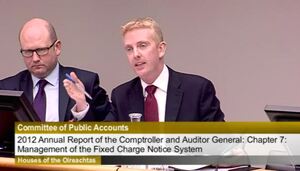
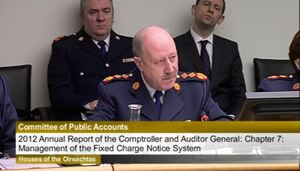
Galway West Labour TD Derek Nolan and Garda Commissioner Martin Callinan in the Public Accounts Committee this morning.

Mr Nolan tried repeatedly to ascertain from the Commissioner what his definition of corruption is in relation to the quashing of penalty points…to no avail.

Derek Nolan: “If a garda cancels penalty points for a friend or for someone they know or a relative, does that come under your definition of corruption?”

Martin Callinan: “I would expect, Deputy, that each individual case would be examined on its merits and, if it’s the case that there’s justification for a cancellation, then that would take place. I don’t expect any member of An Garda Síochána to get involved in doing favours for their friends or for their family, or anybody else. I would expect, I would expect that all of these decisions are made, based on a solid foundation..”

Nolan: “Sure but I’m just, I’m being pedantic because, you’ve referenced the [John O’Mahony] report and you’ve said there was no evidence of criminality or corruption. And what I’m trying to get at is what does corruption mean? Does it mean that if I cancel it for a friend, as a favour, and I got no benefit for it, that it’s not corruption? But if someone paid me to cancel the fine, then it is corruption? I’m trying to find out if this level, if this level of activity, that was maybe informal, doing someone a favour, doing someone a kind of a, if that qualifies in the report as being corruption or not?”

Callinan: “Well, all I can point you towards, deputy, is, with the greatest of respect that I expect that everybody making those decisions made them for the right reasons and they’ve bona fide reasons, that there’s a genuine reason proffered in the first reasons by the person that’s making the petition and that the professional judgement of the officer making the decision is balanced and fair. That’s all I can ask. Now whether your brother, your sister, mother or father shouldn’t really come into it. It’s either it’s right or it’s wrong.”

Nolan: “I understand that, I accept that but this is my point, is that what your internal investigation into the matter took a sample of cancelled notices, of cancelled Fixed Charge Notices, and went through them, I think there was 672, were randomly selected. And the examination found that there wasn’t any evidence to suggest any act of criminality or corruption. So what I’m trying to do is tease out what this statement means. And is it saying that if, does corruption mean I have to take money to do it or does corruption mean that I was, I was doing a favour for a friend? I mean perhaps the person who wrote the report can tell me what that means?”

Callinan: “Well, certainly of course he’s [John O’Mahony] here and that’s the reason he’s here. but corruption, in my view, well it doesn’t appear to be defined in law. One would have the ordinary meaning applied to it, the ordinary meaning that we would understand to be corruption, public officials of course is catered for, so when you’re talking about that type of corruption, you’re talking about perhaps someone that has received money or a favour, or renumeration – all of those things – but that’s as far as I’m concerned where it lies, I can do no more than say to your deputy, in response to your question, that I would expect all of my officers to act fairly and appropriately. And in circumstances where they found there was justification for cancelling ticket that they would do that and otherwise they would reject that and send it forward for summons. It’s…all I can do is provide guidelines and there’s a reasonable expectation that people will follow those guidelines.”

Nolan: “I accept that and I’ve seen the report that’s been updated from the C&AG and the new processes that have been put in place which will make sure this can’t happen again. But I’m trying to…you see this has come to the fore because people are agitated about it. And read it and made an issue out of it and demanded that it went to the public. And the things that they’ve said is that if you know a guard, some guards, and I actually want to preface that, if you knew some guards, you could get off your penalty points. If you were a family friend, if you were someone who worked with someone…And it wasn’t that there was money being exchanged or that was favours being done, it was simply because there was a personal relationship and that liberty was there. I mean we’ve identified that the system in place already was weak and there was very little, a lack of information and the C&AG has expressed his concerns about the system in place. The [Assistant Commissioner John O’Mahony] investigation done took a sample of 672 Fixed Charge Notices and came to the conclusion that there was no evidence of criminality or corruption and I suppose what I’m trying to find out is, is there evidence of this other attitude: of this other possibility, which is that if you knew somebody, that you could get your penalty points cancelled? Or that there was a lax or a disregard for the process?”

Callinan: “Well, deputy, with the greatest of respect, I have read and I’ve seen all of those allegations, the same as you have. And it is the case that I, I’m sorry for repeating myself, it is the case that I expect members of An Garda Síochána, who are in charge of this responsibility, to act fairly and impartially, regardless of who these people are. Of course I’m alive to the allegations, and of course I’m reading these things. But, let’s be clear: I’m not saying the system is weak, you’ve mentioned that a few times. The system itself, there have been weaknesses identified within it but the process, the overall process is quite substantial in terms of success. I can’t, I know the point you’re making, deputy, but…”

Nolan: “But, in fairness Commissioner, I’m asking you about your own report. I’m not asking you about allegations. I’m asking you to comment on what the…”

Callinan: “With the greatest of respect, deputy, I’ve answered you a couple of times on the point and I’ve clearly indicated to you that if you’re suggesting to me that a family member or somebody close to the Superintendent, or the Inspector, can somehow or other influence that person, to look after the ticket, then that’s not the conduct that I would accept as being a valid reason for the cancellation, nor could I ever stand over that. That’s all I’m saying.”

Nolan: “Did the [O’Mahony] investigation that took place uncover such actions, as I’ve outlined?”

Callinan: “Well I think if you look at the report, you’ll see the report lays out the percentage of cases where members of An Garda Síochána, within the band of allegations which is what Mr O’Mahony’s investigation is doing, it’s looking at a set of allegations, 189 different allegations that’s speak to 2,198 separate cancellations, so that’s a very, very targeted exercise and it sets out the number of, the percentage of members of An Garda Síochána who have had tickets cancelled, I think it’s in the region of 8%, of those particular cohort of cancellations, for reasons of being on or off duty.”

Nolan: “The C&AG report of 2000, so 14 years ago,stated that there was a practice of allowing fine notices to be cancelled on the instructions of garda superintendents without recording the reasons and that this may lead to different criteria for cancellations being applied in different areas and they also created the perception that certain kind of fines could be fixed. And that was from the C&AG report in the year 2000. Those concerns are repeated in 2003 and again in 2007. Yet it took allegations, whistleblowing and, you know a serious media storm in 2012 to get updated and in place new investigations into this. Why did it have to get to a national scandal, a national uproar for recommendations that were made 13/14 years ago to be implemented?”

Callinan: “Well, you see you’re talking about a national scandal. Where is the national scandal here?”

Watch here (Committee Room 1)

Previously: The 2.2%

Penalty Point Weirdness

Difficult To Quash

Dear Mr Rae

UPDATE:

Earlier in the meeting, PAC chairman John McGuinness said the names of the gardaí and alleged offenders on documentation contained in the ‘box of evidence’ – given to PAC by a garda whistleblower – have been redacted and therefore compliant with data protection rules.

He said the two garda whistleblowers have been invited to attend next Thursday.

However, in reply to a question from Fine Gael TD Simon Harris, Mr Callinan said he would rather the whistleblowers didn’t come before PAC, saying:

I think in the first instance it goes without saying, I’d have to take legal advice but my personal view, my personal view is that members of An Garda Síochána, who are serving, or retired, should not becoming in to this forum and using this platform to discuss matters of such importance, particularly in the context of criminal and serious allegations that are being made, against their colleagues. I think it would certainly have an adverse affect on the maintenance and discipline and good order in the Garda Síochána and that would be my primary concern.

TV31TV4

[Screengrabs of a report by Ursula Halligan on TV3’s 5.30pm news tonight]

Ms Halligan reported on some of the evidence that the anonymous garda whistleblower will present to the Public Accounts Committee on Thursday, and a statement from him on the matter.

She reported that the garda sergeant will tell PAC that as many as 200 senior gardaí regularly quashed penalty points for family, friends and ‘powerful people’.

He will claim 14 senior gardaí were ‘habitual offenders’, with those 14 alone writing off fines worth €1million, and one of those 14 costing the State €80,000.

Among the examples he will present to PAC, include:

– A sports star who was caught speeding seven times – five in one day – by a Go-Safe van, which would amount to €560 in fines. But the sports star received neither a fine nor a penalty point. Ms Halligan reported that the whistleblower claims the only reason for the star not getting fined was ‘garda discretion’.

– A ticket issued for speeding on October 1, 2012 would have amounted to an €80 was later cancelled because the driver was ‘being tested at an NCT tester’. But when the whistleblower contacted the NCT centre, he was told the car had been NCTed 18 months earlier and was not being tested on the day the ticket was issued.

– In May 2011, a male motorist was caught speeding on a stretch of road in Kildare. The speeding ticket was cancelled by a senior officer, who explained it away by saying there was a query about the speed limits in the area. However, the whistleblower says 14 other motorists caught in the same place, around the same time, on the same day, by the same Go-Safe van, all had to pay their speeding fines.

Garda Commissioner Martin Callinan and the whistleblower will appear before PAC on Thursday, starting at 10am.

Watch the TV3 report in full here

Previously: The Right To Remain Silent

The 2.2%

call

The Irish Independent reports that Garda Commissioner Martin Callinan won’t be “forced to go head-to-head with a garda whistleblower when he is quizzed about penalty points” at a meeting of the Public Accounts Committee on Thursday.

Shane Phelan reports:

“The committee has confirmed that while the whistleblower may be called to give evidence at a future date, there will be no showdown with Mr Callinan this Thursday.”

Meanwhile, a report in the Irish Daily Mail this morning [not online] states that the anonymous garda whistleblower has given PAC a new dossier which apparently details further evidence of widespread termination of penalty points. This dossier is separate to a box of evidence that was handed to PAC in November and prompted a row between PAC and Mr Callinan.

Philip Ryan writes:

“[Public Account Committee chairman] John McGuinness confirmed he had received a 20-page document from the whistleblower. He added that Mr Callinan would be questioned about the dossier and the previous findings of an internal Garda report on the points controversy, and any apparent differences.

“…Mr McGuinness said the whistleblower’s evidence and a report by the Comptroller and Auditor General seemed to ‘contradict’ the findings of an internal Garda report on the points controversy.”

Hmmm.

No face-off for Callinan with garda in penalty points quiz (Irish Independent)

Previously:  Not Seeing Your Points

Mark Stedman/Photocall Ireland

CRCConlon
CRCTD

Fine Gael TD Kieran O’Donnell (above) questioned Brian Conlon (top), former CEO of Central Remedial Clinic this morning at a meeting of the Public Accounts Committee about revelations that Mr Conlon’s predecessor Paul Kiely received a pension package of €700,000 which was paid out of public donations to the charity.

Mr Conlon resigned as CEO in December. Prior to his CEO appointment he had been a member of the CRC board for eight years.

Grab a tay.

And CALL the guards.

Kieran O’Donnell: “You came in as CEO, you’re telling me it’s credible that a CEO of an organisation, which is bringing in about €1.4/€1.5million a year in donations, from ordinary people that are collecting, to provide services for ordinary people, not to be basically giving a divvy-up of the order of €700,000 to Mr [Paul] Kiely. You’re telling me that you had no knowledge of the €450,000 and the €250,000. Do you think it’s credible that the CEO, when you’re looking at the accounts, and you’re collecting €1.4million and literally, sitting in there is €450,000 of a transfer, which was put in as a donation, within the accounts of CRC which, clearly, was designed to misrepresent, at best, and a €250,000, a quarter of a million euro was transferred from peoples, that had been out collecting money for frontline, for service users, you’re telling me that you didn’t spot this? As CEO?”

Brian Conlon: “These adjustments that were going through…”

O’Donnell: “How can you call them adjustments? These, something of €700,000 is not an adjustment. €700,000, which is nearly three-quarters of a million euro is a crazy figure and personally, I’d be asking that Mr Kiely would refund the money to the CRC, to the CRC Friends and Supporters. So I’m asking you the question again. Surely. How often did you do accounts? Did you do monthly management accounts in Friends and Supporters?”

Conlon: “There was one set of accounts, at the end of the year, for Friends and Supporters. There was no management accounts done every month for Friends and Supporters.”

O’Donnell: “But surely you, as CEO, would be looking to see how much money was, of course, the problem is that Friends and Supporters always had, I think, they had a balance. What was the balance in the account, at the end of, when you took over, Mr Conlon?”

Conlon: “The balance in the Friends and Supporters was just over €12million.”

O’Donnell: “And we had the board here, previously, and I would have thought that money would have been put to better use for frontline users, than basically looking at, the question is, it’s about priorities. So obviously the €700,000, in the context of €14million was only a small amount.”

Later

O’Donnell: “Do you think it’s credible that as CEO, when you were looking at Friends and Supporters, and you’d two payments – one of €450,000 and one of €250,000 being put from CRC Friends and Supporters up to CRC, the main company, classified as a donation, it wasn’t a donation, it was effectively, putting the hand in the til of money that was collected by ordinary people up and down the country, to feather the nests of individuals in management in CRC. Now do you think it’s credible that you didn’t know about it, Mr Conlon?”

Conlon: “I did not know that the money was being used to fund Paul Kiely’s pension.”

O’Donnell: “What did you think it was being used for?”

Conlon: “To support…”

O’Donnell: “No, no, no, did you, do you think it’s credible that, as CEO, that when you’d be looking at bank statements or whatever, in terms of CRC, Friends and Supporters, that you would not ask the question, as to what was the €450,000 and €250,000 – where did it go and what was it used for? Do you think it’s credible, as CEO, that you would not ask that question?”

Conlon: “These matters were not…when I joined the CRC first, I had other priorities and my understanding was that Mr Kiely’s pension had been sorted out.”

O’Donnell: “And what did you understand his pension was?”

Conlon: “As he explained that…”

O’Donnell: “€200,000?”

Conlon: “Yes.”

O’Donnell: “So, did you ask where the €450,000 and the €250,000 – that would have come in? Do you have a financial controller in the CRC?”

Conlon: “Yes.”

O’Donnell: “Did the Financial Controller, do you have continuous discussions with the financial controller? Did you have discussions with the financial controller?”

Conlon: “Not about this, no.”

Later

O’Donnell: “I’d ask you to reflect Mr Conlon, on what I’ve asked you is: do you think it’s credible that you were not aware of these payments? Do you think it’s credible?”

Conlon: “Well I’m telling you the truth, I was not aware of these payments going through, absolutely not. I was the new CEO, lots of things were happening, I was finding my feet. I had a serious issue with regards to the appointment of the HSE and I had a serious issue on my hands with CRC Medical Devices.”

O’Donnell: “Side by side with that then, you had CRC Medical Devices, where it was, what was the amount owed from CRC Medical Devices to CRC Friends and Supporters at that particular time? What was the amount owed?”

Conlon: “There was no amount owed because there was no money transferred from Friends of…”

O’Donnell: “There was a loan from Friends and Supporters to CRC Medical.”

Conlon: “There wasn’t, there was an underwriting of a loan. The monies owed were owed to the CRC, they fund it.”

O’Donnell: “So who funded the CRC Medical?”

Conlon: “In the main, the funding came from the CRC.”

O’Donnell: “But you have written in your own notes here, a loan of €550,000, from your presentation today, from the Friends and Supporters of the CRC was approved for the venture.”

Conlon: “The loan was approved but the money was never drawn down. What happened was the working capital exposure over the years was covered by CRC. CRC was owed the money by Friends but that transaction never took place.”

O’Donnell: “But the money that was spent by the CRC Medical, where did that money come from? Where was  the physical, the €550,000?”

Conlon: “That money was never, never transferred to CRC Medical Devices. It was underwritten.”

O’Donnell: “And where did CRC Medical Devices get their money from?”

Conlon: “From the CRC.”

O’Donnell: “And where did the CRC? So, so, what you said there, there was a loan of €550,000 from Friends and Supporters…”

Conlon: “It was approved but never drawn down..”

O’Donnell: “…was approved for the venture but that’s not what your, your presentation does not qualify that. It says…”

Conlon: “But I qualified that for Deputy [Shane] Ross about 15 minutes ago.”

O’Donnell: “So what you’re basically saying is that €550,000 was put down from CRC to CRC Medical, that loan was effectively underwritten by the Friends and Supporters, OK.”

Conlon: “It was working capital support, more so than a loan.”

O’Donnell: “What is now the loss, on the sale of CRC Medical to MMS [Munster Medical Supplies], what’s the eventual, what would be the loss to CRC?”

Conlon: “The maximum loss would be €200,000. I would hope that it would be around €100,000.”

O’Donnell: “But you won’t know that. What’s the potential loss, €200,000?”

Conlon: “€200,000.”

O’Donnell: “Who’ll end up taking that hit?”

Conlon: “The Friends and Supporters.”

O’Donnell: “Ok, so the point I’m trying to make is that between the €200,000 from there, and there’s €700,000 in terms of the divvy-up, the bonanza for Mr Kiely, it’s over €1million of money that was collected by ordinary people, up and down the country. How do you feel about that?”

Conlon: “Well I must stress again that I was not aware of Paul Kiely’s pension arrangements. Those pension arrangements were made by the renumeration committee of the CRC, of which I was not a member and I’d no hand, act nor part to play. In relation to the CRC Medical Devices, I think quite the opposite. I rescued a potential loss of €600,000 by my actions over the last, over the four months or the five months that I was there.”

O’Donnell: “You were on the board for eight years, prior to that date?”

Conlon: “The board of CRC? Yeah.”

O’Donnell: “Yeah. Did the issue in terms of CRC Medical, did that come up for discussion at any time?”

Conlon: “Only more, towards the end, from about April, May onwards.”

O’Donnell: “April, May of what year?”

Conlon: “2013.”

O’Donnell: “So you’re saying to me, this thing was haemoraghing money and it never came up for discussion at the CRC board?”

Conlon: “Only briefly, a number of rescue plans were put in by the management, they didn’t work and it wasn’t really until I got to grips with it, when I was appointed CEO.”

Ex-CRC chief Kiely received €700,000 retirement package (Irish Times)

Watch live here in Committee Room 1

BboG49OCIAAosqgBbwes_zCUAAnfSEAhead of new top-up revelations.

The charity CEO pay grid from The Irish Star Sun with a revised version/response from Total Fundraising.

Tis on.

Meanwhile…

The Chair of the Public Accounts Committee says four more agencies, believed to have breached public pay rules, will be named tomorrow. Fianna Fáil’s John McGuinness says four whistleblowers have come forward to reveal top-up issues – similar to those used at the Central Remedial Clinic.


4 more health agencies in breach of pay rules – PAC Chair (Newstalk)

Pics via RevolutionIRL and Total Fundraising