
Tag Archives: PAC

Screen Shot 2015-07-09 at 11.02.12Screen Shot 2015-07-09 at 11.06.58Screen Shot 2015-07-09 at 11.03.40

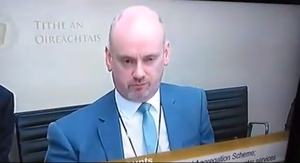
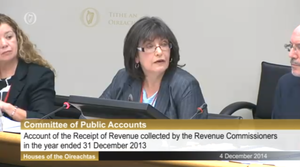
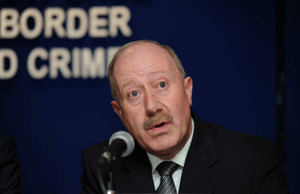
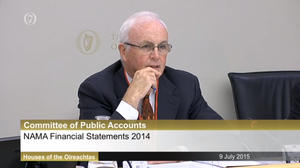
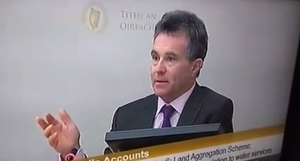
From top: Nama chairman Frank Daly, Nama CEO and Independent TD Shane Ross in the Public Accounts Committee this morning

Nama executives went before the Public Accounts Committee this morning in light of the Northern Ireland portfolio/Project Eagle sale to Cerberus.

You’ll recall how, prior to Cerberus’ purchase, global asset management firm Pimco has claimed it was approached on an unsolicited basis by third parties with a proposal relating to the potential purchase of the Northern Ireland portfolio from Nama.

During the proceedings, Nama told the committee members that Pimco told it about a £15m fee arrangement with £5m earmarked for Frank Cushnahan, a former member of Nama’s Northern Ireland advisory committee.

From the proceedings:

Frank Daly: “I am very firm in my conviction that Mr [Frank] Cushnahan, or Mr [Brian] Rowntree indeed, did not glean any confidential information, or any useful insider information from being a member of that committee…”

Shane Ross: “What did they get €5million for?”

Daly: “I’m not going to speculate on that. But you could ask I mean, what were they paying him €5million for, you’d have to ask Pimco. You would have to ask elsewhere about that.”

Ross:Kind of mind boggling though isn’t it that they’d go ask a guy to act for them and pay him an acquisition fee of €5million, if it’s just an ordinary Joe Soap off the street who didn’t know anything about the portfolio. He had an office as well?”

Daly: “I don’t disagree with your theory but all I can say to you is that from his work with Nama on the Northern Ireland advisory committee, he did not gain any inside knowledge of the portfolio. But remember, right, we’re talking about Northern Ireland and we’re talking about a relatively small business community where there is an awful lot of information out there about debtors, developers, properties, who’s in Nama, who’s not in Nama. It didn’t come from Nama. But it is there.”

Ross: “He had an office in Tughans, didn’t he, Mr Cushnahan?”

Daly: “Well he had, as I understand it, he had the use of an office in Tughans.”

Ross: “Did that worry you?”

Daly:No it didn’t. If we knew then what we know now, a lot of things would worry us but at that time it didn’t worry us, no.”

Ross:But you knew he had an office in Tughans at the time the bidding was going on?”

Daly: “At the time the bidding was going on?”

Ross: “Yeah.”

Daly: “Yes, he had the use of an office, that’s what Tughans have said.”

Ross: “Did that not set alarm bells ringing?”

Daly:There was nothing at that stage, deputy, about any fee payment or any involvement, alleged involvement by Frank Cushnahan in this process. He was gone, he was gone from the Northern Ireland Advisory Committee in November 2013. We first heard, first heard, of any suggestion about his involvement with Pimco in March 2014. He was about 3, 4, 5 months gone.”

Ross: “That was during the bidding process though. The bidding process was under way when you heard about it.”

Daly: “Oh yes, that’s why we threw Pimco out, or sorry, got Pimco to withdraw.”

Ross: “But, and I’m not saying that you acted dishonourably, I’m just saying that that was just another factor that should have made you say this whole thing is flawed, This whole process is flawed. There is something wrong at every turn and there’s something suspicious going on and at that stage I would have thought that you might have been worried about the price you were getting at the end because there was so much going on in the undergrowth and in the background that you didn’t know about.
Let me just ask this question: there was millions sloshing around, there was 15million, one guy getting 5 million; there were all sorts of potential conflicts of interest happening here; there were political sensitivities and you ploughed ahead, ploughed ahead and said, ‘OK, we’ll take the Cerebrus bid’.”

Daly: “We didn’t plough ahead, we went ahead. After consideration, saying, ‘are we still getting  the best price that’s obtainable for this portfolio? Is there still competitive tension? There were still two bidders in there – seven of them had dropped out.
There wasn’t huge interest, by the way, in this portfolio, I must say, you know, and in the nine who came into the process, I think almost any company that would have had the scale to deal with this and the financial backing to actually deliver on it was invited in. Most of them backed out. This was not something that a whole lot of people were interested in.”

Brendan McDonagh: “And also to add to that, deputy, we were very clear at the start, we said to people, to Lazards don’t even think of bidding, or don’t even think of wasting your money bidding on this portfolio. We have a minimum reserve price of 1.3billion [Sterling] because we know the costs of due diligence that firms are going to send on it and we don’t want people wasting their money on a portfolio that they’re not going to pay up for so, at the start of the process in January, 1.3billion, at the need of the process, in April, we achieved 1.3billion sterling. So there was no question that we didn’t get the price that we valued the portfolio at.”

Meanwhile…

Follow the proceedings live here

Follow a live blog by Irish News on the proceedings here

Previously: Project Eagle And The €3.5Billion Haircut
Screen Shot 2015-02-06 at 00.44.27

Screen Shot 2015-02-06 at 00.45.35

From top: Fianna Fáil TD Seán Fleming and Secretary General of the Department of the Environment, John McCarthy, at a Public Accounts Committee meeting yesterday

Senior officials from the Department of Environment, including secretary general of the department, John McCarthy, were before the Public Accounts Committee yesterday.

During the officials’ appearance, the matter of motor tax being used to fund Irish Water was addressed and it was confirmed that €439million of local government funds was paid to Irish Water last year – two-thirds of which came from motor tax.

This year Irish Water is expected to get €399million and next year, €479million.

From yesterday’s meeting…

John McGuinness: “And the resources of the Government fund are used mainly to provide local authorities for their funding for their day-to-day activities and for the upkeep of regional and local roads.”

John McCarthy: “That would have been the case in 2013…yes, yeah.”

McGuinness: “And I’m just saying the shift in that, then in 2014, was the taking of this €439million of subvention to go to Irish Water. Which is incredible.”

Sean Fleming: “Are we right in saying that that local government fund, just to keep the figures in round figures, about €1.5billion went into it, approximately.”

McCarthy: “Yeah.”

Fleming: “Approximately €1billion was motor tax, two-thirds of it. So it’s fair to say two-thirds of the €439billion that went to Irish Water went from motor tax?”

McCarthy: “That was…”

Fleming: “Two-thirds of the funds. So. Right, you can understand, as I said, I missed this, that particular issue, that two-thirds of the money going to Irish Water had actually come from motor tax. Two-thirds of the money from the local government…”

McCarthy: “Which would have formerly been part of the general purpose grant to local authorities as part of their funding of…”

Fleming: “Yeah, you can understand how the people would be… talk about paying for something on, there’s a valid case we pay for the water services through our taxation. Now, we’re going to have to pay for the water services through the bills, the water rates. And you’re actually telling me we’ll also be paying for the water services through our motor tax…”

McGuinness: “The county councils are starved of money to fill the potholes on country roads.”

Fleming: “We’ve three sources of funds now to, paying for Irish…the Irish taxpayer is being asked to pay taxation goes for the water services, as you have it, the central fund. That’s money received from taxation. They’re going to get money from motor tax – two-thirds of that €400 – €250million of that at least – has come from motor tax. And now we’re also saying something, maybe smaller than that, is going to come through the water rates, through the bills they receive from Irish Water. Like people understood, had a problem paying on the double for their water services, having paid their taxes and now paying for water rates. But if they actually knew you’re going to be paid on the treble, because your motor tax is also going to pay for Irish Water. Is it…”

McCarthy: “It’s the operating subvention to Irish Water is, in general terms, it comes out of taxation. The vehicle that is used for it, if you’ll pardon the pun, is the…em.”

Thanks Bewildered Student

Screen Shot 2014-12-04 at 11.01.43

Josephine Feehily, chairman of the Revenue Commissioners

Watch the proceedings live here

Previously: The Regressive Democrats

Screen Shot 2014-11-27 at 11.14.30Screen Shot 2014-11-27 at 11.14.52

Labour TD, Joe Costelloe and Phil Meaney, chairman of the Irish Greyhound Board

Last month, the Comptroller and Auditor General produced a report on the Irish Greyhound Board’s development of Limerick Greyhound Stadium.

The report found the board bought a site for the new stadium in Meelick, on the Limerick/Clare border in April 2005 for €1.02million, while another €935,000 was spent on development, design and project planning on the site.

The C&AG found a consultant’s report – that was prepared before the site was bought – raised concerns about the site’s access to the national road network. The C&AG also found no record that this report was either presented or discussed by the board before they made the purchase.

The plans to build the stadium on the Meelick site were then abandoned because of access issues. The IGB still owns the site and it’s now valued at €150,000, according to the C&AG.

The IGB then bought another site in Greenpark, in June 2008, for €3.4million, or €304,900 per acre, without getting an up-to-date valuation report before the purchase. Additional costs arose because of issues in relation to the filling of the Greenpark site and the use of an adjoining car park.

The C&AG concluded:

“Bord na gCon incurred total expenditure of €21 million in relation to the Limerick stadium project. This contributed to a doubling of Bord na gCon’s borrowing, compared to the average borrowing level in  2006-2008.”

Further to this, Labour TD Joe Costelloe asked the board’s chairman, Phil Meaney, if anyone has been held accountable for the ill-conceived plans.

Joe Costelloe: “There was nobody in charge from a financial point of view.”

Phil Meaney: “Again, I’m not sure whether there was a financial CFO [Chief Financial Officer] in place at the time the decision was made. From memory there was, it was some time after that that we were without a finance director but I accept that every organisation should have a chief financial officer and, as I say, the current board moved quickly to fill that gap. The other point, deputy, I’d like to make is that, following on from what Geraldine [CEO of IGB Geraldine Larkin] has said, as regards, you know, the present board and the previous board, you know, we weren’t involved and I think that’s a point, in that actual decision. But we’re very happy and we recognise our responsibility in dealing with the consequences of that decision, both as a board and as an executive…”

Costelloe: “Ok, so moving on from where we are at the present time but we have to look back as that is what the analysis here, the auditor’s report has given us. And there seems to have been submissions made in relation to the purchase of the original site, the Meelick site, even though it would have been, it should have been obvious to anybody that this was not a satisfactory site. And, as a result, well the site was purchased for €1.75million – there has now been a write-off of €1.6million on side. What was the relationship between the executive and the board on that matter? How was the decision made to purchase a site that was unusable because there was a lack of access and it wasn’t a suitable site and nothing was ever built on it? How could such a big decision be made? And then find out, subsequently, that you could not proceed with it for the purpose intended for the new track, headquarters?”

Meaney: “Well, again, I would say, deputy, through the chair, that it’s 10 years ago now almost, a month short of 10 years since that decision to purchase Meelick was made. The only thing that I can say on it, from the paper trail that exists and from the findings of the C&AG, you know, I accept that it was, it doesn’t seem a good decision but again, it wasn’t a good decision, it was an atrocious decision.”

Costelloe: “I mean, any right-thinking person would not have made the decision where you would buy a site where there was identified, the whole issue of access was identified prior to the purchase of the site. The site was bought, then of course the issue of access, prevented the site from being developed but it was identified in advance. Is it not perverse that such a decision could have been made – to purchase the site from €1.75million knowing that it had no access at the time the purchase took place? I mean this isn’t rocket science. What does the paper trail tell us about it?”

Meaney: “Well, that’s what the paper trail tells us. As I say, it’s 10 years ago, I wasn’t privy to the thinking at that stage…”

Costelloe: “Were any of the previous executive or board? To find out why they made those decisions?”

Meaney: “..and in saying that, from the paper trail that’s available, and from the recommendations of the C&AG, we are happy to accept that it was a decision that shouldn’t have been taken.”

Costelloe: “And has anybody been held responsible for that decision? Has anybody pointed the finger? Anywhere? As to how this could happen? That taxpayers’ money could have been so wilfully thrown around like confetti on something that, from before the purchase took place, was unsustainable? Unusable? Couldn’t have been used for the purpose for which it was bought? Which was to then include a very substantial capital project, capital outlay? The intention was to spend, as happened with the further site, the next site, €19.4million on building a headquarters and new race track. So, there could have been an awful lot of good money going after bad money, from the initial, incredibly negligent decision that was taken.”

Meaney: “During my time no action has been taken.”

Costelloe:And no person has been identified as being culpable in this area? In other words, people can make the most perverse decisions and get away scot-free? Is that the..you know, the new board comes into place and the new board says, ‘that’s the legacy of the previous board or the previous executive and we wash our hands of it and we ride off into the sunset with taxpayers’ money after being wasted.

Meaney: “I accept your point. As I say, certainly, with today’s board and today’s executive, OK, maybe, as a board we have to go back and look at what action, what, if any action should be taken against decisions made by previous boards and previous executives.”

Maybe?

Great.

Watch the proceedings continue here

C&AG Special Report: Development of Limerick Greyhound Stadium

Related: The board has gone to the dogs (Conor Ryan, Irish Examiner, May 8, 2012)

Meanwhile…

Screen Shot 2014-11-27 at 10.58.11

Geraldine Larkin, CEO of the Irish Greyhound Board [Bord na gCon] in the Public Accounts Committee this morning

Breakingnews.ie reports:

“The Public Accounts Committee is today focusing on mismanagement of public money in relation to the purchase of lands for Limerick Greyhound Stadium. A meeting this morning will also look at the knock-on effect of cost overruns on the financial position of Bord na gCon, the commerical state body responsible for the promotion and regulation of the greyhound industry in Ireland. A report by the Comptroller and Auditor General has raised a number of concerns in relation to the Limerick Greyhound Stadium project, which is costing €21m.”

PAC focuses on purchase of lands for Limerick Greyhound Stadium (Breakingnews.ie)

Related: Conflict of interest in greyhound stadium deal (Conor Ryan, Irish Examiner, September 6, 2012)

Watch live here

Screen Shot 2014-11-07 at 11.04.59

Today’s Irish Times

Martin Wall, in the Irish Times, reports:

“A serving civil servant has given an extensive dossier to the Dáil Public Accounts Committee making allegations of substantial tax evasion over an extended period of time involving, among others, senior politicians.
The senior civil servant has also maintained that various ministers over recent years and a number of State agencies failed to fully investigate the allegations.”

“The letter makes allegations regarding one former minister. Allegations are also made in the dossier about a former judge.”

“It is also claimed the evidence in the documentation could “be relevant to the defence of the State and of Mr Michael Lowry and Mr Denis O’Brien in the case being taken by the failed bidders in the 1995 mobile phone licence competition”.”

Hmmmm.

Civil servant claims politicians evaded tax (Irish Times)

Screen Shot 2014-09-25 at 02.34.31

Former Garda Commissioner Martin Callinan, who had penalty points quashed

“The evidence given to the committee, and especially the oral evidence of the Garda Commissioner, highlights the challenge posed to Garda systems, especially when information relating to the cancellation of fixed note charges entered the political system and was raised in Dáil Éireann.”

“The Commissioner described the actions of the two whistle-blowers as disgusting and put a huge degree of emphasis on the need to maintain discipline within the force.”

It appears that the desire to protect the organisation was placed ahead of ensuring that the complaints from the whistle-blower were followed up on and that the Garda Commissioner lost control of the process once the issue appeared in the public domain.”

From a draft report of the Public Accounts Committee (PAC) following its investigation into the penalty point controversy.

The draft report will be discussed by the Public Accounts Committee (PAC) today

Callinan strongly criticised in penalty points report (Irish Times)

Previously: Objection Overruled

Summons Not Right

The Thin Blue Timeline [Updated]

Photocall Ireland

Screen Shot 2014-07-23 at 10.59.18

Former CEO of Rehab Angela Kerins and John McGuire, Director of Fundraising at Rehab, arriving at Leinster House to appear before the Public Accounts Committee in February

The Irish Times reports:

“In her affidavit, [Angela Kerins] said she had a conversation on February 21st with the PAC clerk, Ted McEnery, almost a week before she and other senior Rehab figures appeared before the committee at a seven-hour hearing…

Ms Kerins has also claimed she discussed the forthcoming hearing with the PAC chairman John McGuinness, Fianna Fáil TD for Kilkenny, in the offices of a public relations company the month before her appearance.”

Anyone?

Previously: Attempting Rehabilitation

Kerins says PAC clerk warned her about committee members (Arthur Beesley and Tom Lyons, Irish Times)

kerins-angela-rehab-group

[Former Rehab CEO Angela Kerins]

RTÉ reports:

“The Public Accounts Committee has decided to seek compellability powers for the attendance of former Rehab chief executive Angela Kerins and former board member Frank Flannery in its examination of the spending of public monies. An application to the Dáil Committee on Procedures and Privileges is expected to be made within days.”

PAC seeks to compel attendance by Kerins and Flannery (RTÉ)

Photocall Ireland