Tag Archives: Regina Doherty


Ministers Paschal Donohoe and Regina Doherty; Public Services Card; Section 263, sub section 3 of the Social Welfare and Consolidation Act of 2005

Yesterday, Minister for Employment and Social Protection Regina Doherty went on RTÉ’s Morning Ireland to defend the Government’s position on the Public Services Card, despite findings about the card made by the Data Protection Commissioner Helen Dixon.

During the interview, Ms Doherty repeatedly said the Social Welfare and Consolidation Act of 2005 has allowed the Government to do what it has done in respect of the card and she said that that is the legal advice she’s received from the Attorney General’s Office – advice she will not publish

Ms Doherty  said:

“Where we [the Government and the DPC] have a difference here is in the interpretation of the Social Welfare and Consolidation Act of 2005. My legal advice is incredibly strong, that we have a clear and unambiguous legal basis to do exactly what we intended to do from 2005 and what successive governments have done since…”

She also said:

In the 2005 legislation in sub section 3 of that legislation, it very, very clearly sets out exactly what the anticipated use was for, what the legal right and the responsibility of the data controller is and that’s exactly what we’ve done and so we really believe that we have a very, very strong legal basis to do exactly what we have done…”

However.

This morning.

Ciannan Brennan, in The Irish Examiner, writes:

The minister referred to subsection three of that Act, and 23 words that the department and the DPC disagreed over.

Loose talk aside, there is only one section she could mean — subsection three of section 263 regarding a prospective Public Service Card.

Those words are: “A person shall produce his or her Public Service Card at the request of a specified body for the purposes of a transaction.”

That’s it. You’ll note that nowhere in that sentence are the words “mandatory” or “compulsory” to be found.

Put simply, there is no basis there for the blanket issuance of cards to citizens looking to access State services.”

Much more at stake than a little plastic card (Ciannan Brennan, The Irish Examiner)

Meanwhile…

Solicitor Simon McGarr has also tweeted his thoughts on the matter…

Yesterday: ‘It Would Be In The Circuit Court So It Probably Wouldn’t Be Very Expensive’

Rollingnews

From top: The PSC card; Minister for Employment and Social Protect Regina Doherty

This morning.

Minister for Employment and Social Protect Regina Doherty spoke to Bryan Dobson on RTÉ’s Morning Ireland.

It followed the release of her joint statement with the Minister for Public Expenditure and Reform Paschal Donohoe last night – stating that it would be “inappropriate, and potentially unlawful, to withdraw or modify the use of the Public Services Card or the data processes that underpin it”.

This is despite the Data Protection Commissioner Helen Dixon’s findings on the card following a two-year investigation.

Contrary to the DPC’s report, the Government also said “the processing of personal data related to the PSC does in fact have a strong legal basis, the retention of data is lawful and that the information provided to users does satisfy the requirements of transparency”.

They said they came to this conclusion on foot of advice from the Attorney General’s Office.

Ms Doherty also said the PSC “has not seen any mission creep”.

In this morning’s interview, asked how much a legal challenge to Ms Dixon’s report would cost the State, Ms Doherty said “it would be in the Circuit Court so it probably wouldn’t be very expensive”.

At the outset of the interview, Mr Dobson asked Ms Doherty for her reaction to the DPC report.

Regina Doherty: “So Bryan, first of all, at the outset, I’d like to say that we, in the department and Government, have the highest respect for the office of the Data Protection Commission and the important work that they do.

“But, however, as a minister, I have to take my own responsibilities for Government policy with equal measure of respect and we have taken an awfully long time in the last two and a half weeks to really carefully and methodically consider and reflect on the final report from the commission and we’ve taken both our own legal advice from the Attorney General’s office and external counsel advice.

“And unfortunately, we don’t accept the findings in the report and will challenge them.

“And, to that affect, we wrote to the commission yesterday, seeking at the earliest opportunity, an opportunity to meet with the commission to discuss the findings and to outline exactly what it is that we find is the legal basis and it’s a very strong legal basis, as far back as 1998 when the conception of the idea of cross Government services, across any Government platform was conceived by that Government. But successive Governments since then have changed the legislation to allow and to anticipate the sharing of the data.

“So that Irish citizens can do their business and identify themselves just once and then be able to access services in an efficient manner.”

Bryan Dobson: “But just on a couple of specifics here. Her requirement that you stop processing data in those areas where she [Helen Dixon] says there’s no legal basis for the card, are you going to do that or are you going to continue processing data?”

Doherty: “What we’re going to do is to continue acting on the basis of the legislation as it would have passed in 2005….”

Dobson: “In defiance of her finding?”

Doherty: “In our basis, gives a very clear and legal underpinning of what it is that we’re doing and so at the very early…”

Dobson: “She says you don’t have that legal basis, it’s not there.”

Doherty: “Well, to be respectful, where we have a difference here is in the interpretation of the Social Welfare and Consolidation Act of 2005. My legal advice is incredibly strong, that we have a clear and unambiguous legal basis to do exactly what we intended to do from 2005 and what successive governments have done since and…”

Dobson: “Minister, she spent two years investigating this and her conclusion is that you don’t have the legal basis. She’s the person who’s charged. It’s her responsibility to protect the public interest, to protect all of our privacy and our data. And she says you don’t have the legal right to do this.”

Doherty: “And again, not to labour the point, Bryan, we believe that we do have the legal rights and the legislation to underpin exactly what we’ve anticipated from 2005 and the legislation and that’s why we’d like to sit down with the commission and discuss her concerns and to see if there’s any way we can overcome her concerns that she has with regard to the findings that she’s issued.”

Dobson: “Will you publish your legal advice so we can see what it is?”

Doherty: “I certainly won’t publish the legal advice but what I absolutely intend to publish is the commission’s report and our response to it. But, again, what I would rather do, rather than prejudice a meeting that I would really like to have with the commission, I would wait until the commissioner responds to me at some stage today or tomorrow before publishing. But I have absolutely intentions to publish the report and our response to it.”

Dobson: “Is it likely this will end up in court? Are you prepared to take it to court?”

Doherty: “Depending on where we go from here. At the moment, I don’t have a legal basis to take it because the report wasn’t issued under the legislation, the Data Protection Act…”

Dobson: “But if she takes enforcement proceedings – you’ll fight that? Will you?”

Doherty: “In my letter yesterday, I have given notice that, yes, we would intend to challenge within the courts, yeah.”

Dobson: “So you’re prepared to use public money to confront somebody who’s responsible for defending the public interest?”

Doherty: “I think the way the Oireachtas established the Data Protection Commission was exactly allowing for differences of views and differences of opinion and this certainly is not the first time that a regulator has been challenged by a Government body and I’m probably quite sure it won’t be the last.

“But what I absolutely have a responsibility to do is to make sure that I deliver public services to the people that we serve, that I serve, in the most efficient manner…”

Later

Doherty: “…we really believe that we have a very, very strong legal basis to do exactly what we have done and it would actually be illegal for us to change…”

Dobson: “And you’ll defend that all the way? In terms of legal action, you’d go all the way in defending that?”

Doherty: “I think that’s my role and responsibility…”

Dobson: “What would that cost Minister in legal fees?”

Doherty: “I don’t know but again it would be in the Circuit Court so it probably wouldn’t be very expensive. But what would be absolutely enormously expensive, Bryan, is that if we decided to act illegally and change Government policy and services delivery without having a serious conversation around the difference of opinion of the interoperation of the law.”

Listen back in full here

Rollingnews

Yesterday: Put It On The Card

Identity Crisis

UPDATE:

Elizabeth Farries, Information Rights Programme Manager for the Irish Council for Civil Liberties, also spoke with Mr Dobson this morning.

During her interview, they had this exchange:

Bryan Dobson: “I’m wondering what’s your problem here? Do you have an objection in principle to this kind of card which can be applied across a whole range of Government services, it seems, on the face of it, something that might be very, might be welcomed, improve efficiency and productivity, in the provision of public services. Do you have an objection in principle or is it the way it’s being done?”

Elizabeth Farries: “ICCL and other experts have been opposed to the card from the start. We are opposed to it in principle and we’re opposed to it for good reasons. It’s illegal, the Data Protection Commissioner has said that and we’ve been saying that for years.

“It doesn’t respect privacy rights which are fundamental rights which we should all take extra care of in our technological age.

“And it targets the poor.

“And so crucially now the DPC is saying these same things. There are significant data security risks attached to the card and we have a group of privacy experts from all over the world right now with the international network of civil liberties organisations and they’re dealing with very similar problems in their countries.

“And they’ve seen devastating consequences of cards like this. In India, we have someone from the Human Rights Law Network talking about the Aadhaar card and the massive breach that happened there – they’re exposing important information of a billion people. You’ve got…”

Dobson: “I’m just wondering if the legal safeguards, if the legal foundation was put in place, if the safeguards were put in place, if the transparency, which the data commissioner says isn’t there, if that was put in place. If those safeguards were put in place and people had assurances that their data would be treated properly and be protected, should the card have a future?”

Farries: “There are no legal safeguards, as it stands, to protect from the security risks attached to the card in its current form. It’s absolutely unnecessary to collect very sensitive data, including biometric data used through facial recognition.”

Dobson: “That wasn’t a finding of the data commissioner, I think.”

Farries: “This is certainly our position.”

Dobson: “Yes.”

Farries: “It has been a finding of the data commissioner that it’s unnecessary to collect the huge amount of information without adequately …”

Dobson: “But, biometric data, she didn’t rule on that question.”

Farries: “We understand that she’s going to follow up on that question. Because it’s such an individually important question that it requires and investigation of its own.”

Dobson: “Very good.”

Listen back in full here

Public Services Card; Minister for Employment Affairs and Social Protection Regina Doherty

A week on from the Data Protection Commissioner Helen Dixon announcing that there is no legal basis for anyone to have to present a Public Services Card in respect of any transaction between a person and a public body outside the Department of Employment and Social Protection…

And that the supporting information that millions of card holders had to hand over in order to get their card – such as utility bills, proof of ID, etc – must now be deleted…

And that the Minister for Public Expenditure Paschal Donohoe was informed of Ms Dixon’s report’s findings a year ago

A press release released this lunchtime by the Department for Employment Affairs and Social Protection includes the following comment from Minister Regina Doherty:

“Both myself and my department take very seriously the findings of the Data Protection Commission and the good work it does.

“For that reason it is important that bodies that are subject to findings by the commission give very careful consideration to those findings.

“Such careful consideration is also necessary in order to be fair to the commission and to ensure that when we do speak that the public hears a properly prepared response.

As soon as our consideration of this final report is complete, the department will publish its response along with the report and any other relevant information on its website and I will speak then at greater length on the matter.”

Meanwhile, in the same press release from the department, a spokesperson said:

“The Department is currently reviewing the report together with the Attorney General’s Office and the Department of Public Expenditure and Reform. This process is not yet complete and is expected to take another week or so.

“While the Department understands that some may wish for us to respond sooner, it should be noted that this is a comprehensive report and requires significant attention.

It is not true, as has been reported in some quarters, that the Department has had this report for a year.”

“The Data Protection Commission (DPC) provided a draft investigation report in August of last year at the mid-point of a two year investigation. It came with instructions that it was provided on a strictly confidential basis and was not to be shared with any third parties.

“This draft report contained what it described as preliminary findings and the DPC asked the department to make submissions on these findings. The report also posed a number of additional questions in the form of requests for information.

“These submissions and response to requests for information were sought to assist the DPC in the ongoing investigation and to inform the content of the final report.

“The department together with Department of Public Expenditure and Reform considered the interim report very carefully and sought and received the advice of the Attorney General’s Office.

Based on this consideration, and the advice received, the Department submitted a very detailed response setting out how it believed the SAFE process/PSC was administered in full compliance with all relevant law.

“In this context, in the absence of any determination by the DPC and pending the receipt of the final report, the Department and other specified bodies continued to rely on the PSC and SAFE process.

“The revised and final version of the report was received last Thursday. It contains a significant volume of additional analysis, a number of the findings have been changed and some have been removed.”

Previously: House Of Card

Rollingnews

Meanwhile…

Meath TD and Minister for Employment Affairs and Social Protection Regina Doherty

The resignation of Minister for Social Protection Regina Doherty, on foot of the very expensive Public Services Card debacle, is not “compulsory”, but it is “mandatory” if we are serious about the creation of accountable governance.

Jim O’Sullivan,
Rathedmond,
Sligo.

Public Services Card debacle (The Irish Times letters page)

Previously: House Of Card

Rollingnews

This morning.

Dublin Dental Hospital.

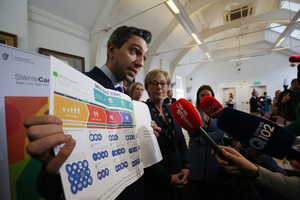
Minister for Health Simon Harris and Minister for Social Protection Regina Doherty launch Smile agus Slainte, the new National Health Policy.

According to figures obtained by Fianna Fáil TD Stephen Donnelly last month from the Health Service Executive, 84,000 children are awaiting check-ups or treatment in the public system.

*covers mouth*

Sam Boal/RollingNews

Stop that.

This afternoon.

Government Buildings, Dublin 2

Minister for Finance and Public Expenditure and Reform, Paschal Donohoe, and Minister for Employment Affairs and Social Protection, Regina Doherty with Minister of State at the Department of Public Expenditure and Reform with special responsibility for the Office of Public Works and Flood Relief, Kevin Boxer Moran (top left) speaking to the media following the publication of the Labour Force Survey (LFS) data by the CSO show “continued momentum” in the labour market.

Leah Farrell/RollingNews

Minister for Employment Affairs and Social Protection Regina Doherty

Last night.

On RTÉ One’s Drivetime.

Philip Boucher-Hayes interviewed the Minister for Employment Affairs and Social Protection Regina Doherty.

They discussed bogus self-employment – where a worker is forced by an employer to declare themselves as self-employed rather than employees and the employer doesn’t have to pay PRSI.

And they spoke about how the deputy secretary of the Department of Social Protection told an Oireachtas committee in November that the department does not prosecute employers hiring people under bogus self-employment conditions.

During the interview Ms Doherty admitted that her department doesn’t prosecute employers for the practice “for a variety of reasons”.

She later told Mr Boucher-Hayes that she disagreed with him when he said it appears employers are being given a “free pass”.

From the interview…

Philip Boucher-Hayes: “The Deputy Secretary of your department appeared before an Oireachtas committee back in November and said that it was departmental policy not to prosecute employers who were engaging people on bogus self-employment terms. Let’s just play it. It’s only 10-seconds long.”

Regina Doherty: “Sure.”

[plays clip]

“We have not been keeping specific stats on bogus self-employment.”

Boucher-Hayes: “The other clip there is Patricia Murphy saying that it is department policy not to prosecute.”

[plays clip]

“The department itself has not taken a criminal prosecution against employers because we have, in fact, used, in our joint operations, the powers available under the tax acts to attach and apply administrative policies and we consider to be, at this time, more effective, and timely.”

Boucher-Hayes: “You’re not prosecuting employers who break the law but you will pursue benefit fraudsters through the courts. This sounds like one law for white collar criminals and another for blue collar criminals?”

Doherty: “No, it’s certainly not. What we do with regard to the scope environment is that if you presented yourself and I use you as an example because we’re talking: If you presented yourself to ask us to do an investigation into your employment status, we would do it.

“If we determined that you were incorrectly categorised, we would go to your employer and say Philip Boucher-Hayes started working for you on the 1st of January, 19-0-flat – you owe us and him and the Revenue Commissioners X amount of money and we would penalise them.”

Boucher-Hayes: “But what about where I work for somebody who has employed 100 or more people on bogus terms and you can prove that and see that they are systematically breaking the law? Why wouldn’t you prosecute them?”

Doherty: “And again, what we do is we bring everybody in line, in the category that they should be paying. We backdate all of the proceeds that the PRSI claims both the employer and the employee should be making to the Revenue Commissioner and to myself and to my own department…”

Boucher-Hayes: “But Regina Doherty, it is a criminal offence to employ people on these terms, why are you not prosecuting them? Why are you giving them a free pass?”

Doherty: “We’re not giving them a free pass. And we conduct thousands, tens of thousands investigations…”

Boucher-Hayes:No you are giving them a free pass because the Deputy Secretary General of the department admitted that there had only been one prosecution, in spite of the fact that this is a criminal law, under the statute books but your policy is: not to enforce it.”

Doherty: “Yeah, I think the main determination and the main ambition from the department is to get people correctly classified – that’s the way the department has always worked. We changed our inspection regime in the last year to actively go out and pro-actively conduct uncalled or unannounced inspections in particular industries which we have never done beforehand. And what we’re doing now today is changing two things this year: we’re going to introduce anti-penalisation legislation to make sure that nobody that is in that status of maybe being coerced into being self-employed should be afraid to take a case…”

Boucher-Hayes: “Ok, that’s great. But up until now, you have been…”

Doherty: “Let me finish, for one second…if you just let me finish for one second…I’m also going to take away the attractiveness of employers using people as contract staff at some point, with legislation, in the next 12 months. So if I can tackle this in a number of ways, ultimately, what I want is: I don’t want to penalise anybody. I don’t want to make employers the bad guy…”

Boucher-Hayes: “What do you mean? Hang on a second. You penalise people who are committing benefit fraud. You prosecute them but you don’t do the same for white collar criminals. Why not?

Doherty: “Well, we actually do.”

Boucher-Hayes: “No, you don’t. You’ve done it on one occasion and that’s the figure of the Deputy Secretary General of the Department.”

Doherty:The reason that we don’t prosecute is that there are a variety of reasons. You’re making the assumption that everybody is put on a self-employment status without the knowledge, without the co-operation, without the consent. There are reasons why people find themselves classified in incorrect classifications and when they come to us we’ll investigate, we find those reasons and we correct and impose fines…”

Boucher-Hayes:You’re not naive to the fact that one of the main reasons is so that employers can duck their PRSI contributions, it’s a money-saving…

Doherty: “Well. That’s exactly what I just told you is that if I can manage to take away the attractiveness – I think that will fix an awful lot of our problems but what I’m more concerned about…”

Boucher-Hayes:You might fix an awful lot of your problems by making an example of the kind of people who are doing it and prosecute them through the courts…”

Doherty: “But what I’m more concerned about…what I’m more concerned about Philip is ensuring that those people who are out there, and we ran a campaign this year to let people know that we even exist, because, to be honest with you, a lot of people were not even aware of the scope, the section within my department on what it does: to let the people know that if they need any assistance or investigation into the classification of their status, from a PRSI perspective, we are here, we will make the investigation and we will make the correction.”

Boucher-Hayes: “Ok.”

Doherty: “And anybody that’s found wanting will be penalised financially. I know you’d probably like to see people hung up by their feet. What I want to do is make sure that we take away the attractiveness...”

Boucher-Hayes:No I think people would like to see everyone being treated equally before the law. That’s the reason that I raised the question because at the moment they’re not being, employers are being given a free pass on this one. Let’s just set that aside…”

Doherty: “I tell you what, let’s just agree to disagree cause I certainly don’t agree with you.”

Boucher-Hayes: “The scope decisions that you have referred to there: People bring their claims and very often, as our investigations established, the scope will find in their favour – that they are indeed bogus self-employed. But when that decision is appealed to the Social Welfare Appeals Office, by the employer, those decisions are routinely overturned our investigations found out.

“Is the system rigged in favour of the employers?”

Doherty: “Again, if I was to give you an example of the amount of people who apply for carers’ allowance that are refused that then have a mechanism to appeal, that are then overturned and found in their favour, would you think that the system is rigged towards people who are getting carers’ allowance or invalid benefits?”

Boucher-Hayes: “We’re talking specifically about bogus self-employment.”

Doherty: “No, no. You’re talking about a culture which you’re trying to assign to the department which is grossly unfair. We have in our department…”

Boucher-Hayes: “I’m not talking about…I’m talking about facts. I don’t know what the culture is. I’m just talking bout the numbers that have exposed themselves – every case that we looked at where the scope decision had gone against an employer was overturned in favour of the employer. The system would appear rigged would it not?

Doherty: “Well, no, it wouldn’t appear. In so far as when anybody makes an application and there’s an adjudication, everybody – whether you’re an employer or an employee, in this particular section – has the ability to appeal it. If they don’t like that decision they have the ability to appeal it again. And if they don’t like that decision they have the ability to take it to the actual courts of this land.

“The cases that you may have looked at might have been one way or the other particularly, but there is no sign or trend in our department with regard to people being categorised one way or the other.

“What there is in our department is an investigation section so that anybody who thinks that they are misclassified from a social insurance perspective to make a complaint and we will investigate.”

“And if they don’t like the outcome of the investigation, they have the opinion, or the ability, to be able to appeal it, appeal it and review it and there is no trend.”

Listen back in full here

Previously: Bogus Self Employment Cheats Us All

Rollingnews

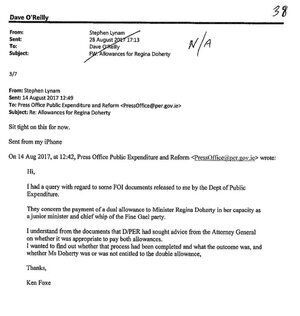
Social Protection Minister Regina Doherty and letters sent in relation to press queries about former Government chief whip Regina Doherty’s €16,000 super junior allowance

Yesterday.

In the Sunday Business Post.

Hugh O’Connell reported on the €16,000 allowance that the Minister for Social Protection Regina Doherty was paid when she was government whip but subsequently told to pay back to the State.

She was paid it as she was one of the three so-called super junior ministers at Cabinet.

But, as readers will recall, legislation only allows for two politicians to receive the sum.

She told The Irish Times last Monday that she was told to pay it back following a report by the Attorney General.

Further to this…

Yesterday Mr O’Connell reported:

It was only confirmed last Monday that Doherty, who is now the Minister for Employment and Social Protection, would be repaying the allowance despite her department being informed this would need to happen at the end of July following a review by the Attorney General.

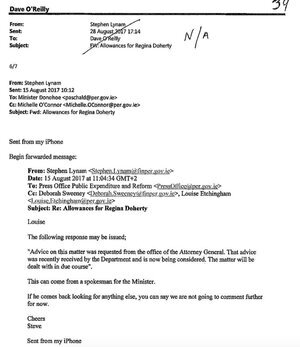
Documents obtained under Freedom of Information show that a letter from the Department of Public Expenditure (DPER) was issued to Regina Doherty’s new department on 26 July last asking officials to make arrangements for the money to be repaid.

…The documents reveal a number of journalists made inquiries to the Department of Public Expenditure’s press office about the allowances situation with officials seeking out Stephen Lynam, Minister for Public Expenditure Paschal Donohoe’s special adviser, for advice on how to proceed.

On August 14, Lynam told the DPER press office to “sit tight on this for now” after being alerted to a journalist’s inquiring if the AG’s review of salary arrangements had concluded and what the outcome was.

The following day, Lynam drafted a response to be issued to the journalist which said the AG’s report had been received, that it was being “considered” and that it would be “dealt with in due course”. Lynam said in the email: “If he [the journalist] comes back looking for anything else, you can say we are not going to comment further for now.”

Further to this…

An email sent to journalist Ken Fox on August 15

In respect of the SBP article, Ken Foxe has tweeted the email above from August 15, saying:

Been in journalism a long time but kind of staggered to have a government department bare face lie to you about Regina Doherty allowance.

Previously: Meanwhile In The Dáil

Ken Foxe

Letters via Hugh O’Connell

Regina O’Doherty

Further to a post last week concerning Tyrone-born, US-based academic Catherine Kelly and Fine Gael TD and Minister for Social Protection Regina Doherty…

Yesterday.

In response to a question from Sinn Féin TD Mary Lou McDonald…

Taoiseach Leo Varadkar told the Dáil…

In respect of the Minister, Deputy Regina Doherty, I had a brief conversation with her about it. I understand that she made a complaint to the Garda with regard to harassment, and the Garda thought it sufficient to caution the individual against whom the complaint was made.

Obviously, if Deputy McDonald has any further questions, she should put them to her directly. This is clearly a private matter. It is not one of public policy.

It is one involving two individuals – one individual who felt that she was being harassed by another. The Garda, based on the evidence it saw, decided to take the action that it did.

Meanwhile…

Michael O’Regan, in The Irish Times, reports:

The Minister made a criminal complaint of harassment under the Non-Fatal Offences Against the Person Act 1997 over online and social-media comments by Ms Kelly relating to the collapse of a company run by Ms Doherty and her husband eight years ago.

… Ms Kelly, whose partner, Jim Cullen, is the head of Friends of Sinn Féin in New York, is considering legal action against the Garda.

She has hired the Irish solicitor Michael Finucane and written to Minister for Justice Charlie Flanagan to allege that she was falsely imprisoned.

Mr Finucane has also asked Pearse Street Garda station for an explanation and written to Dublin Airport, seeking CCTV footage of the incident.

Regina Doherty blogger controversy private, Taoiseach says (The Irish Times)

Full Dail transcript here

Update:

FIGHT!

Minister for Employment Regina Doherty

This morning.

On Today with Sean O’Rourke, presented by Cormac Ó hEadhra.

Fine Gael TD and Minister for Employment and Social Protection Regina Doherty spoke about the story on the front page in today’s Irish Times in which it’s reported that Taoiseach Leo Varadkar will not name and shame “welfare fraudsters”.

And that, under a compromise deal with Fianna Fáil, only people found guilty of defrauding the State of welfare payments in excess of €5,000 will be named in a public register.

From Ms Doherty’s interview with Cormac Ó hEadhra…

Regina Doherty: “Let me be very clear, lest you think that we’re going soft on anybody that’s defrauding the State of money and taking money out of other peoples’ pockets is acceptable. There’s no defrauding of the State that’s acceptable and we will pursue people in the courts that has not changed one jot.

“What has changed here is that a piece of legislation that we were hoping to introduce has been reached a compromise so the piece of legislation can be passed. And the Fianna Fail party, on foot of the proposal to me, to make an amendment so that instead of starting at zero, we will start at six months of somebody defrauding the State even though that person, at five and a half months, three and a half months, whatever length of time that has been taken, the department has saw fit to take a criminal case against somebody, the police has saw fit to take a criminal case against somebody, that will still pursue. The only thing that changed…”

Cormac Ó hEadhra: Where did that €5,000 figure come from? Is it based on any research whatsoever? Or is it something that yourself and Fianna Fail cooked up?

Doherty: “Well, first of all, I take offence at the fact that. Politicians don’t cook things up, Cormac, when we’re putting legislation together for the good of the people….

Later

Doherty: “Can I be very clear? Customer fraud is defined in statute from €1 to whatever it happens to be, some of the recent cases you can see of €60,000, €160,000, €7,000. There is nobody who is defrauding the State in any shape or form or size of money that is acceptable. Because what it does, Cormac, is it takes the capacity of the department and me as the minister remove money from being able to distribute that money to vulnerable people who actually need it. So there is no level of acceptable fraud.”

Meanwhile…

The Meath Chronicle reported last night:

The National Union of Journalists has called on the Minister for Employment and Social Protection, Regina Doherty, to clarify her role in the decision of members of An Garda Síochána to interview a freelance blogger and academic about comments written by the blogger about Ms Doherty.

Acting General Secretary of the NUJ in UK and Ireland, Séamus Dooley, also called on the Garda Commissioner to urgently clarify the circumstances in which Catherine Kelly was approached by Gardai from Pearse Street Garda Station and interviewed about tweets which it is understood referred to Ms Doherty.

NUJ asks Minister Doherty to clarify role in Tweet investigation (Meath Chronicle)

Previously: Chilling

Listen back here