

At the weekend.
Spotted on George’s Quay, Dublin 2.
Previously: TUDious



Ah here.
Thanks Jenny
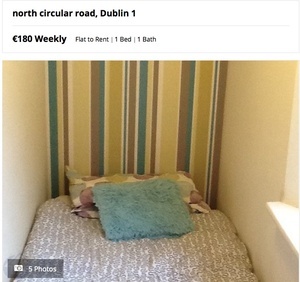
A Daft.ie ad for a one-bed flat on North Circular Road, Dublin, in May
This morning.
On RTÉ Radio One’s Today with Sean O’Rourke, hosted by Keelin Shanley, RTÉ journalist Brian O’Connell spoke to a third-year female student from the west of Ireland who is studying nursing in Trinity College Dublin.
Explaining her struggle to find a place to rent, she said:
“I was fortunate to have a place until May of this year, when I was in the middle of my exams, and my landlord sold the place so I was only given two weeks’ notice. So, in the middle of my exams, I’d to go find new accommodation.”
“Looking for accommodation in Dublin is like selling your soul to the devil. A lot of places are €600-plus a month and, if you’re lucky enough to find a place that’s less than that, it’s not really appropriate for living in.”
“[One place she saw was]… a double room in an apartment and, in the kitchen, the owner of the flat slept on the couch. And you weren’t able to lock your bedroom door because the bathroom was in the bedroom [en suite]… it was €600 a month for that one.“
Meanwhile, on that Rent A Room scheme, which is organised by UCD Students’ Union, TCD Students’ Union and Daft.ie and where homeowners can earn up to €12,000 a year tax free by renting out a room to students, Mr O’Connell said:
“There is an issue that students have been highlighting with me and it was that, if the room is not self-contained, for example, if it’s not a separate bedsit or a converted garage say, then you have very few rights as a tenant. You’re not covered by tenant legislation, if you simply rent a room in someone’s home.
“A tenant can refer to the Small Claims Court if you have an issue but you’re not covered by the PRTB and a lot of students were saying to me that was putting them off because they could be asked to leave at kind of a week’s notice and they’d very little tenancy rights…”
Listen back in full here
Previously: Digs Out
Meanwhile…

https://www.youtube.com/watch?v=C3-IQOqHQqM&feature=youtu.be
To dig.
Or not to dig.
Laura Gaynor writes:
A video on the benefits of ‘digs’ (for both the student and landlord) made for Newstalk…
You dig?

RTÉ One is delighted to announce that the world-renowned entertainment format Dancing with the Stars is to air in the New Year!
— RTE One (@RTEOne) August 3, 2016
Dancing With The Stars will be produced by @ShinawilTV for RTÉ and will air on RTÉ One in early 2017!
— RTE One (@RTEOne) August 3, 2016
“We are delighted to be bringing such a hugely popular format as Dancing with the Stars to RTÉ One…we are confident that Irish audiences will take this home-grown version to their hearts. Family entertainment shows are a cornerstone of what RTÉ One is all about.”
Adrian Lynch, Channel Controller, RTÉ One and RTÉ2.
*Cha-cha-chas over imaginary telly licence*
Thanks Garthicus

RTÉ’s Managing Director of News and Current Affairs, Kevin Bakhurst
RTÉ reports:
RTÉ has confirmed that Kevin Bakhurst, the managing director of the news and current affairs division, is to leave the organisation in October.
He will take up a position as Content Group Director for Ofcom, the communications regulator in the UK.
Mr Bakhurst joined RTÉ four years ago as managing director of the news and current affairs division, and was later appointed Deputy Director-General.
Kevin Bakhurst set to leave RTÉ in October (RTE)
Meanwhile…
Good riddance to Kevin Bakhurst. Chinese government missed out badly here. https://t.co/dIGNyQask4
— Luke 'Ming' Flanagan (@lukeming) August 3, 2016

From top: RTÉ Studios, Montrose, Donnybrook, Dublin 4; Mark Cullinane
How did the public service broadcaster deal with austerity?
Mark Cullinane has completed a PHD on the response by the BBC and RTÉ to the economic crash.
Mark writes:
Academic research on the editorial coverage of and responses to crisis by national public service broadcasters on both sides of the Irish Sea is starting to come in and the emerging picture points to both the BBC and RTÉ as having fallen more or less in lockstep with the right-wing economics of their respective conservative governments.
As part of my own research I analysed a sample of the television and radio broadcast coverage by the Irish public service broadcaster, RTÉ, on some key aspects of what has become known as the Euro debt crisis between 2011 and 2013 – a moment where the future of the single currency seemed to hang in the balance.
The periods analysed encompassed a sequence of momentous and dramatic events in recent European history, including the aborted referendum in Greece on the country’s second bailout package, the subsequent ejection (through EU machinations) of prime ministers in both Greece and Italy and their swift replacement by technocratic administrations, as well as a series of tight elections in both countries in which radical anti-austerity political groupings surged and threatened to seriously disrupt Europe’s austerian masterplan.
My analysis aimed to explore how, when confronted with the travails of other peripheral crisis-hit ‘PIIGS’ nations, RTÉ’s framings of events implicitly and explicitly apportioned blame for economic crisis, legitimised or delegitimised the actions and proposals of different actors, and weighed up journalistically the electoral choices open to Greeks and Italians.
Analysis of the more than 150 separate broadcast items across the sample revealed some consistent features of crisis framings that confirm the general impression of public service broadcasting’s susceptibility to reproducing the preferred narratives of their political masters.
This is illustrated by, for example, the sustained blaming of Prime Ministers George Papandreou and Silvio Berlusconi, in Greece and Italy respectively, as key causes of crises; the horror expressed by journalists at the very prospect of opening up the decision on the second Greek bailout to its population in a referendum; the lending of tacit and explicit support for the anti-democratic statecraft that led to the ousting of both premiers on the basis that they represented threats to the integrity of the Eurozone; and the hailing of their EU-approved temporary technocratic replacements in the form of central banker Lucas Papademos and EU insider Mario Monti, as preconditions of national salvation in both countries.
So elevated was the official sense of emergency at the height of the Euro debt crisis that the studied journalistic performance of disinterestedness, often accentuated in coverage of foreign elections, instead went up a few octaves.
After entirely missing the electoral ascent of Syriza in the first, inconclusive Greek general election of 2012, during the subsequent second campaign its leader Alexis Tsipras was presented as a dangerous populist who had seduced a nihilistic electorate and was leading them to certain ejection from the Eurozone and perhaps even the EU.
Inconclusive election results in both Greece and Italy were assessed mainly in terms of their alignment with the best-laid plans of EU leaders and validated through the ever-present divination of market desires.
The views of those suffering the consequences of their austerian policies, however, remained a distant interest.
Irish viewers were even quietly invited to pull on the green jersey and cheer on the forces of technocratic fiscal responsibility in the face of those who would threaten ‘our’ recovery by causing market instability. So much for the prospects of an inter-PIIGS alliance!
As with the 2012 European fiscal compact treaty, the naturalisation of disciplinary neoliberalism as the new common sense segued seamlessly into a posture of seeing its challengers as quixotic dreamers at best or subversives at worst.
It was little surprise then, that when it emerged in late 2014, the largest Irish anti-austerity movement since the economy crashed – Right2Water – was given short shrift, not just by Ireland’s right-leaning commercial print and broadcast media but by the public broadcaster, too.
The movement, co-ordinated by unions and comprising affiliated political parties and autonomously-organised communities up and down the country, had formed in order to oppose the imposition of another Troika-mandated regressive charge – this time on water usage – as well as the new Irish Water utility which appeared to be established with a clear eye to medium term privatisation.
Both its sheer size – packing the main thoroughfares of towns and cities across the country on a consistent basis – and its broad constituencies of support made it a movement that no government could afford to ignore.
The coalition’s calculation that some concessions on the charging regime would dissipate opposition was proven misplaced as a large and sustained boycott of water bills throughout 2015, combined with a poor showing by the ruling parties in the general election of February 2016 produced a parliamentary arithmetic that swiftly forced the temporary suspension of water charges and imperilling the entire Irish Water project, for now.
For a broadcaster ensconced in its traditional political role as mediator of genteel parliamentarism, the street politics of an increasingly powerful anti-austerity movement were never likely to be warmly received in the circles of metropolitan Irish middle-class liberalism within which RTÉ is culturally immersed.
There are many contributing factors that might be cited to explain the journalistic failures of how the water wars were covered over the last few years.
Middle-class scorn at Right2Water’s subaltern base, for example, continues to play a role that should not be underestimated.
But most instructive of all, I suggest, is the sheer incompatibility of the movement’s very structure, modes of mobilisation and political demands with a broadcasting model whose conception of legitimate politics begins and ends at the gates of parliament, within whose perimeter political journalists resemble mere courtiers in thrall to its local dramas.
Mark Cullinane is a doctoral graduate in sociology from University College Cork. His research focused on the performance of the Irish public service broadcaster in mediating contemporary political and economic crisis.
Read on: Public service austerity broadcasts (OpenDemocracy.co.uk)

RTÉ
Seán McCárthaigh, in The Times (Ireland edition) reports:
RTE has warned that it will remain financially challenged unless there is reform of its public funding model after reporting a loss of €2.8 million last year.
Managers at the national broadcaster, which reported a net surplus of €0.2 million in 2014, have expressed concern at its deteriorating financial position.
RTE blamed last year’s losses on flat income from licence fees combined with the €5 million reduction in state funding in the 2014 budget and exchange rate fluctuations.
It said that cost pressures had caused its finances to slip into the red, despite commercial revenue growth of 4 per cent during 2015, and an emphasis on keeping operating costs under control.
Moya Doherty, the chairwoman, said the resolution of the issues of a national media charge and licence fee evasion would be key to the broadcaster’s funding.
RTE calls for fee reform after €2.8m loss (The Times Ireland edition)

Tonight on RTÉ One at 9.35pm.
Peacekeepers: The Irish in South Lebanon.
Gareth Naughton writes:
Irish peacekeepers have been serving in the Middle East continuously since 1958. In that time, 47 Irish soldiers have paid the ultimate price in the cause of peace while on active service in south Lebanon, an area often beset by conflict and war.
In tonight’s documentary, viewers will hear from Sergeant Michael Merrigan who was serving alongside Private Billy Kedian (22) when he was killed in May 1999 as the Irish outpost where they were stationed came under attack from mortars fired by the South Lebanon Army militia group.
Pte Kedian, from Ballyhaunis in Co Mayo, was killed when a mortar struck directly in camp as the soldiers were making their way to the safety of a bunker, an emergency response known as ‘groundhog’.
RTÉ Investigates reports on how a leading Irish charity deceived its funders. Prime Time, 9.35pm Thursday @RTEOne pic.twitter.com/gv2Z6EsZ6v
— RTÉ (@rte) June 22, 2016
RTÉ reports:
A report by RTÉ Investigates to be broadcast on Prime Time tonight reveals serious mismanagement and deception by Paul Kelly, the founder of Console Suicide Bereavement Counselling Limited.
RTÉ Investigates – Broken Trust – will reveal concerns surrounding the charity’s finances with regards to cash receipting, expense claims and financial accounts.
The report also shows that, when applying for State grants, the charity on several occasions altered accounts to omit the reference to directors’ pay and other benefits.
These amounts totalled over €215,000, according to accounts filed by Console with the Companies Registration Office for the three years 2010 to 2012.
…In documents submitted to funders, the charity also incorrectly claimed that certain people were board members.
One of these was former senator Jillian van Turnhout who told the programme that she was “stunned” that her name had been used and that it is “hugely alarming that any charity would purport that anyone is on the board who is not on their board.”
Serious ‘concerns’ about governance of charity Console (RTE)
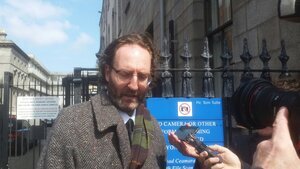
Tom Tuite tweetz:
Comedian David McSavage has been convicted and fined for not paying TV licence arrears after slating RTE’s output.
Yikes.
David McSavage convicted and fined over TV licence arrears (Tom Tuite, Irish Independent)
Previously: RTÉ Needs To Stop Embarrassing Us