Tag Archives: RTE

rtereferendumScreen Shot 2015-04-01 at 21.13.11

Anon writes:

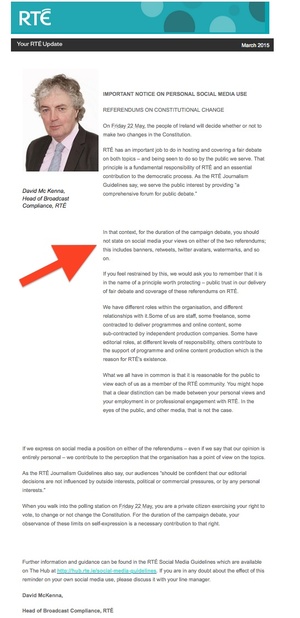
See forwarded email sent to staff of RTÉ (also independent production companies and their personnel and contractors, as well as freelances) regarding the Marriage Referendum and personal support of a Yes vote. Third paragraph is most important/shocking…

And get your hair cut, broadcast compliance guy.

Blummin’ stickies.

Second Captains

Staying in tonight?

Off The Ball Second Captains, returns tonight at 10pm on RTÉ 2 for its fourth season.

Featuring rugby ledges Luke Fitzgerald, Sean Cronin, Nora Stapleton token woman guest, Peter Stringer and Kieran McGeeney.

And debuting tonight will be a new feature, ‘Degrading Irish Superstars Action’. it’s like the Good Wall but even more controversial….

Second Captains

00144943Joe-Duffy_RTE_Feb012009Top: Water meter installation in Dublin earlier this year; Joe Duffy (above)

Yesterday Joe Duffy opened his RTÉ Radio One Liveline show with a caller called ‘Grace’ complaining of dirty tricks by water protestors on her estate.

To some, including the host, Grace’s story was a genuine heart-tugging tale of community infiltration.

But many heard something else entirely.

Joe Duffy: “Grace, what happened yesterday?”

Grace: “The workers for Irish Water came in into our estate, they put the meters in unopposed by the residents, everyone was very friendly with them, some neighbours even offered to, to give them a cup of tea or if they wanted any water, they put the meters in, and when residents came back after being out all day at work they found that the fresh concrete had been interfered with around the meter in some instances people had stood in it and had made a mess of it, so then the workers, I think, called the police, they came and took pictures of the damage and took statements from the residents, but the protesters who came into our estate were uninvited, unwelcome, and were not acting on any residents’ behalf.”

Duffy: “And did anyone see the protestors?”

Grace: “Yes, some were seen the day before, scouting the area, they were in the area at another estate protesting so some of them came up from the other estate to have a good look round, gave the impression that they were going to cause a protest, so the workers were on high alert and there was lots of phoning going on with their supervisors, so they didn’t really go in with the work because they thought that there was going to be trouble, so, the next day, which was yesterday, they got going with the works, and then in the afternoon the protestors came up and did damage.”

Duffy: “Yes, but when you say protestors, how many?”

Grace: “There would have been, maybe, two or three.”

Duffy: “And how do you know they weren’t just vandals?”

Grace: “Because they, you know, were part of a larger group that was close to the estate that I live in, and you know, a couple of them were recognised as being from the larger group because they were seen by my husband who happened to be in the area and he recognised them, and the workers and the police were also aware of them because they had seen them in the previous estates where they had tried to put in the water meters, so, you know, they go from estate to estate, and as soon as the orange barriers go up, the same kind of group of protestors move from one group of houses to the next group of houses so the workers would get to know them.”

Duffy: “Are they carrying placards or banners or chanting or anything?”

Grace:
“No, no.”

Duffy: “So how do you know they’re, just to be fair to them like, how do you know they are water meter protestors, come at it another way, what age group would they be?”

Grace: “Anything from early 20s into 50s, they’re a broad range of people, a lot of them would be residents of other estates, they would have hangers-on but they move from estate to estate they wouldn’t all be residents of that particular estate they just move with the workers, wherever the workers go these protestors go with them.”

Duffy: “And what do they say to the workers if anything?”

Grace: “They are aggressive towards them and I overheard last week in a different estate I happened to be on a walk and I was listening in through the ditch, the language was appalling, the worker was referred to as a something else…”

Duffy: “Desperate.”

Grace: “Yes, appalling, absolutely, I mean for children to overhear their parents using this language it was disgusting, and the workers are only trying to do their job and they’re being abused right left and centre, there’s an aggressive element to these protestors, they’re not wanted, they’re not invited and they’re not welcome, and if the Irish people don’t stand up to them, you know, to this aggression and intimidation, it’s basically, a chance for them to, just come into your estate and show some kind of power.”

Duffy:
“And Grace, did anybody stand up to them yesterday like?”

Grace: “A lady did, a lady did stand up to them and I’d say she, she was kind of shaking afterwards because she got nowhere with them.”

Duffy: “And what did she say?”

Grace: “She said go away, go away from that, you’re not welcome because I don’t want you anywhere near my meter, and they stood in the meter and they damaged it, the fresh concrete that had just been laid…”

Duffy: “The soft concrete, in other words, that wasn’t set.”

Grace: “Yes, and those workers had to come around and now, today and they have to put in fresh concrete into those damaged holes…”

Duffy: “And is there any sign on your estate, Grace, of people opposing water metres?”

Grace:
“Yes there are, there is a sign but it’s a peaceful protest.”

Duffy: “And where’s the sign?”

Grace:
“It’s in the front window, these signs are pretty common you know in other estates in the area but you know it’s not a violent thing, it’s just a piece of paper on a window, it means nothing really at the end of the day because the meter goes in anyway.”

Duffy: “And what do you think of the water charges?”

Grace: “I have no problem paying them to be honest. It’s just another bill that has to be paid, you know, I feel that.”

Duffy: “Well the slogan for tomorrow is that water is a human right?”

Grace: “Yes, but you have to pay for your utilities, you have to pay for electricity, you have to pay for gas, it’s just another utility we’re just lucky that we’ve got away all these years without having to pay for it…”

Duffy: “The argument is, you’re already paying for it through your central taxation income tax and what have you, car tax, whatever?”

Grace: “Yeah but the country Joe can’t run on air we have to start paying for things to get it up and running again and you know it’s not going to be a huge amount of money, you know it’s reasonable enough, I’m not a wealthy person, I’m a law-abiding citizen, I voted the government in and I knew it was on the agenda and I voted them in and it’s happening now and most of my peers and most of the people I live with are all in agreement, it’s just another bill that has to be paid and nobody wants any fighting aggression nobody wants intimidation or workers to be hurt.”

Duffy: “And you say one person in your estate has put a sign in the window saying no to water charges. Given that you’re calling people to stand up would anybody put a sign in the window saying yes to water charges, like you are, supporting…”

Grace: “Yeah, no they wouldn’t do a thing like that because to be honest Joe it doesn’t come into a persons thinking that deeply, people are just getting on with their lives, and they’re just, paying their bills and they’re just accepting the whole thing, workers coming in, they’re just accepting it, they’re not going out of their way to oppose it, it’s, the protestors, what are they opposing, it doesn’t make sense that they go around intimidating people and causing damage, that’s not a good protest.”

Duffy: “Well, the argument would be, Grace, that that’s only a very small minority…”

Grace: “Well Joe, some day I’ll meet you and I’ll bring you to some of the estates where this is all going on its not just a couple of people it’s a group of people and they are vicious. People should stand up to people like that, there’s an aggressive tone coming into these protests and into Irish society generally where people are allowed to push and shove and be aggressive, and it’s not right.”

Duffy: “Yeah but if people are pushing and shoving and being aggressive, there are Gardai there.”

Grace: “The guards, Joe have too much to be doing in their own area to be dealing with everyday crime. They don’t have the resources to be going to every single estate and monitoring it. I mean, one particular estate last week, there were squad cars, there was a van, there was Gardai on bikes, it’s taking up a huge amount of resources monitoring these protests.”

Duffy: “And what do you say to the organisers, I mean the turnout at one stage was 100,000, I know it was smaller the last time but still significant, still very significant.”

Grace: “Well I think the leaders, Richard Boyd Barrett, Paul Murphy they’re educated men and I’m sure they’re people who don’t want violent protests but I think they should speak to the people and re-iterate at all times…”

Duffy: “They do say that, they do say that.”

Grace: “that there should be no intimidation, no violence no interference of property belonging to people, they should not go into an estate…”

Duffy: “And what about your own TDs?”

Grace: “Em, well I haven’t got in contact with any of them yet but these people should not go into estates where they are not welcome. They are not welcome, Joe, we did not invite these people.”

Listen here

(Photocall Ireland/RTÉ)

9037295290372955

90372947

90372954
90372956

90372949

This afternoon.

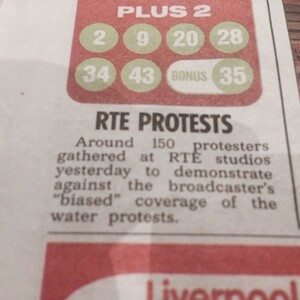
Protestors, including Rita Lawlor and John Martin (second last pic) at the gates of RTÉ studios in Montrose, Donnybrook, Dublin 4 calling for the end of bias in the coverage of the ongoing Irish Water protests, arrests and jailings.

Previously: RTÉ Is Ireland’s Biggest Problem

(Sam Boal/Photocall Ireland)

joins Water protesters outside the gates of RTE for what they claim is unfair coverage of their protests.

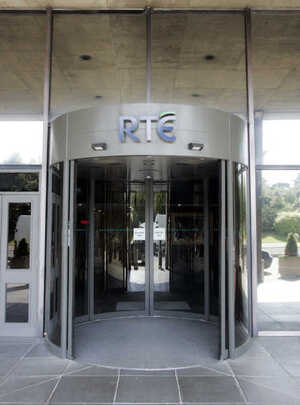
90157355JulienMercille_313ver2RTE Television Centre (top) and Julien Mercille (above)

It’s Monday.

It’s 9.10am.

It’s Mercille on Monday.

Julien Mercille writes:

A fortnight ago a scandal involved Europe’s largest bank, London-based HSBC and its Swiss banking arm, in a large tax evasion scheme.

The charges are that the bank helped its clients hide accounts while providing services to corrupt businessmen and criminals.

Some have called it the biggest banking leak in history. Newspapers immediately gave much attention to the story, but the UK’s Daily Telegraph gave it minimal coverage. Why?

It’s partly because the Telegraph feared that HSBC would stop funding the paper through advertising. Peter Oborne, the Daily Telegraph’s chief Political Commentator, actually resigned in protest because his paper’s editor let commercial advertisers influence the news content and reporting.

HSBC also used to sponsor RTÉ’s Drivetime radio show, which suggests obvious conclusions, but more on that below.

Advertising revenues are crucial to the news industry. They allow newspapers to be sold for a cheaper price, making them more competitive.

This affects news content because corporate advertisers tend not to subsidise television programmes or news stories that seriously question or attack their own business or the political economic system of which they are part, which would be contrary to their interests.

The same goes for corporate or state ownership of the media: owners don’t favour stories that directly challenge government or the corporate sector simply because that’s directly against their interests.

Former Telegraph executives and journalists have confirmed the allegations, saying they were ‘spot on’, and additional claims have been made that:

– HSBC pays about £3.5 million per year to the Telegraph in advertising fees.

– The paper’s commercial department is ‘stronger’ than the editorial one and this has been a ‘dirty little secret for some time’. The Telegraph ‘can’t afford to offend’ some ‘key advertisers’. This means ‘stories being softened, stories being downgraded in terms of placement, headlines softened or stories not run at all’.

– HSBC withdrew advertising from the Telegraph three years ago after negative reporting on the bank.

– Often, ‘If there was a story related to a big Telegraph advertiser and something that was deemed critical was going to appear, subsequently you’d get a call of irritation from someone very senior saying: “We’ve heard that you might be running a story about Tesco… Did you know that they spend X amount with us advertising each year?’

The Irish media faces the same situation. For example, RTÉ gets about €150 million in advertising revenue every year, and in 2008 before the economic crisis that reached €240 million. It’s almost half of its total annual revenues (the other half is made up by the TV licence fees it collects).

Some of its main sponsors are banks, insurance firms and car companies:

-Ulster Bank
-Bank of Ireland
-RaboDirect Bank
-Aviva insurance
-Chill insurance
-Volkswagen
-Volvo
-Mitsubishi Motors
-Land Rover
-Toyota
-Burger King
-Coca-Cola

The full list can be seen here.

A quick look at RTÉ’s website shows how desperate it is for corporate advertising, telling potential advertisers that RTÉ is ready ‘to help you plan the process of getting your message across the largest audience in TV, Radio, Print and Online in the Irish market’ and that advertising on RTÉ ‘is the ideal platform to enhance your tactical plans or long term brand objectives’.

There are telling examples: Bank of Ireland sponsors RTÉ Radio’s The Business show by paying a fee of €160,000 for 12 months.

Ulster Bank sponsors RTÉ’s Drivetime radio programme by giving the show €260,000 for the year. Before that the sponsor was Danske Bank, and before that, HSBC bank. Who really thinks those shows will give us a critical and objective picture of financial issues?

A clear example of the significance of advertising to the Irish media is the large amount of funding from property advertising received during the housing boom years.

The Irish media went even further than benefiting from property advertising money: they became owners of property websites, acquiring a direct stake in the growing housing bubble.

For example, in 2006, Independent News & Media bought PropertyNews.com (along with the PropertyNews monthly newspaper), the largest internet property site in Ireland.

In 2006, the Irish Times bought the property website MyHome.ie for €50 million, along with the website newaddress.ie, which aims to make it easier for home owners to move residences.

Also, most newspapers published weekly supplements for commercial and residential property, ‘glamourising the whole sector’, while ‘glowing editorial pieces about a new housing estate were often miraculously accompanied by a large advertisement plugging the same estate’, in the words of Shane Ross, former Sunday Independent business editor:

‘Unfavorable coverage of developers and auctioneers in other parts of the newspapers was regularly met by implied threats from property interests that advertising could go elsewhere’. Moreover, a reporter working for an Irish news organisation stated that journalists ‘were leaned on by their organisations not to talk down the banks [and the] property market because those organisations have a heavy reliance on property advertising’.

Some people will deny that advertisers and owners influence news content. That’s contrary to all evidence, but think about it this way. We don’t have any problem understanding that a trade union newspaper reflects the trade union’s viewpoint.

Or that a student paper reflects the students’ viewpoint. Or that a television show that would be sponsored by Greenpeace or Amnesty International would promote environmental and human rights issues. Or that a radio station sponsored by the Irish Palestine Solidarity Campaign would highlight views favourable to Palestine.

So why is it so hard to understand that a show sponsored by Ulster Bank or Bank of Ireland will likely present favourable views of bankers? Or that a programme sponsored by private health insurance companies won’t tell you that a private, profit-driven health care system is inefficient, wastes money, and bad for people’s health? Or that a show sponsored by a car company won’t exactly be keen on promoting real alternatives to our car culture?

@JulienMercille is lecturer at UCD and the author of The Political Economy and Media Coverage of the European Economic Crisis: The Case of Ireland. He will provide evidence to the Banking Inquiry on the role of the media during the housing bubble years.

Related: Ireland’s Biggest Problem Is RTÉ Says Max Keiser

(Mark Stedman/Photocall Ireland)


GAAandSkySportsLogoApril2014_large

On April’s Fools day 2014, the Gaelic Athletic Association announced a 3-year broadcasting deal with Sky Sports. The deal involved the sale of exclusive rights to a portion of championship games.

The plan didn’t really come together.

Dr Paul Rouse (School of History and Archives, UCD1) is the author of The Impact of Pay TV on Sport

Dr Rouse writes:

Although the GAA hierarchy has sought to portray the deal with Sky as a success and consider the reaction of people in Britain to be ‘a vindication’, the reality is, at best, much more complex – and one might legitimately arrive at entirely the opposite conclusion. After all, what we now know is:

Viewing figures for showcase GAA games in Ireland collapsed; The supposed new service for Irish emigrants in Britain, not only already existed, but did so in a more extensive way; Irish emigrants wishing to watch Gaelic games in Britain must now pay much more than was previously the case; The part of the deal which allowed the broadcast of matches on TV in Australia no longer exists and there is no plan – in any real sense of that word – for internationalisation.

Idris wept.

Read more: Sports Rights Commercialization Revisited: Sky and the GAA (HistoryHub)

Previously: Sly Sports

Thanks Spaghetti Hoop