
Tag Archives: Stephen Donnelly

Screen Shot 2016-04-26 at 10.44.40

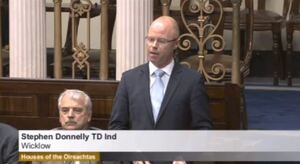
Social Democrats TD Stephen Donnelly

Social Democrats TD Stephen Donnelly spoke to Rachael English on RTÉ One’s Morning Ireland this morning about the matter of Irish Water amid the Government formation talks.

Mr Donnelly said the future of Irish Water should not be solely discussed by Fine Gael and Fianna Fáil negotiators behind closed doors but that it should be discussed among all elected TDs in the Dáil.

At the end of the interview, Mr Donnelly explained that he hasn’t paid his water charges, saying:

“Anyone who’s paying out €160 is essentially being asked to go out into their front garden and set fire to the money”.

Grab a tay.

Rachael English: “It’s 60 days without a Government and the talks are stuck over water charges. The Social Democrats have said that the water issue must be discussed in the Dáil and not confined to a closed room among Fine Gael and Fianna Fáil negotiators. One of its three TDs, Stephen Donnelly, joins us now, good morning.”

Stephen Donnelly: “Good morning.”

English: “You would have had a say had you remained in the process of talking to find a Government.”

Donnelly: “Well we do have a say, we’re a political party elected to the Dáil and that’s where this should be debated. The Greens entered talks in good faith and had to leave, a lot of Independents entered talks in good faith and had to leave, the Social Democrats met both Fine Gael and Fianna Fáil at the start, we had very constructive talks with both parties. And then we said the numbers are such that you two need to go and come to some sort of agreement and that we would then engage. And we were right: those who did engage before that spent a lot of time in there in good faith and they had to leave. We have now reached out to Fianna Fáil, to Fine Gael, to Sinn Féin, to the Greens, in the last week, because the talks are back on and therefore we are very much in the process – we’re not going to go and prop up a Fine Gael minority government, we said during the campaign we wouldn’t do that…”

English: “But you’ve left Fianna Fáil and Fine Gael to it, in terms of making the arrangements for whatever Government needs to be formulated so they have to do an agreement on Irish Water.”

Donnelly: “No they don’t, the Dáil has to have an agreement on Irish Water so, people are really fed up. We’re on day 60…”

English: “But the Dáil did agree on Irish Water, I mean the thing was discussed, it was debated, it was voted on, it was established…”

Donnelly: “It was and then it was a general election and then the majority of TDS elected ran partly on the basis of changing that decision. Let’s not forget: Irish Water was only one of, I think, only two times in the last Dáil term of five years where the Opposition walked out. If you remember Phil Hogan, the minister, then rammed it through, the whole thing through in three hours. And it has been a disaster right from its beginning and continues to be a disaster. And we now have, what it really is, a totally unacceptable situation where we have Fianna Fáil and Fine Gael locked away in a room, potentially about to collapse the 32nd Dáil on the issue of water. What the Social Democrats are saying is, ‘Look, water was one of the key issues of the election. Obviously there are arguably more pressing issues, like homelessness, like people having to wait 25 times longer on public waiting lists than private waiting lists…'”

English: “Murder on the streets…”

Donnelly: “Like murder, right, like the guards are being 20% under resourced and so forth. There are very, very serious issues. We have one in eight children in the country now in daily poverty. The Dáil needs to get about doing its business.”

English: “So is it ridiculous that the 32nd Dáil is being threatened with collapse over an issue which, you can break it down, to €3 a week per household?”

Donnelly: “Well we think it’s outrageous that it is potentially going to be collapsed and so what we are saying to Fianna Fáil and Fine Gael is: there is clearly an impasse. Both parties ran on quite different positions. We actually don’t believe that either position is a tenable position, either Fianna Fáil or Fine Gael’s position but that’s fine. That’s up to them to decide. We’re saying look: clearly this has reached an impasse. The rest of us want to get on with the job we’ve been elected and paid to do – as I’m sure more Fianna Fáil and Fine Gael TDs. Take the issue of Irish Water out of the talks, bring it back to where it belongs – which is in the Dáil – like let’s not forget, about 90 TDs were elected with a very clear mandate: To end domestic water charges. There are about 90 TDs who would vote accordingly. So let’s not collapse the 32nd Dáil on the issue of water, let’s bring it back..”

English: “So how do you change it? Would you change the system of having a national utility called Irish Water, managing the Irish Water project, and having water charges? What would you change?”

Donnelly: “Yes, there’s three things we would do. First of all, we would call for a referendum on public ownership, probably to change Article 10 of the constitution. There is a very real fear of privatisation – probably not in the next few years but in the future. So we would look for a referendum to make sure that could never happen. We would reconstitute Irish Water, you could say end Irish Water, abolish Irish Water but not do what Fianna Fáil is looking to do which, quite frankly, is bonkers – which is send it back to the local authorities – but have a national water board. Because whilst the Government made and unholy mess of Irish Water in the last Dáil, actually the engineers are doing a very good job like they are doing the business that needs to be done on the water system which is great. And the third thing we would do is we would end domestic charges and, partly, and it’s a message people really need to understand, partly because the money that is being raised from domestic charges does nothing other than cover the cost of raising the money. So none of the money that anyone is paying out or not paying out is being used to maintain the system or upgrade the system…”

English: “So all the money to fund water and the repairing of the system should come from the Exchequer, is that what you’re saying?”

Donnelly: “Should continue to come from the Exchequer. Let’s not forget, it costs twice as much in Ireland to provide water as it does in the UK, including northern Ireland where the population density is more or less the same. So what should be done is the engineers should be allowed get on with the job of identifying the leaks, of upgrading the system, that creates very, very significant cost savings. You reinvest those cost savings into upgrading the system. So both from an engineering perspective, from an economic perspective and from a political and democratic perspective, there is a very clear argument that says: end domestic charges, use the savings which are being generated to reinvest and upgrading the system which obviously has to be done…”

Listen back in full here

Sasko Lazarov/Rollingnews

twitter

Thunk.

Grainne Faller at the Insight Centre for Data Analytics writes:

 Researchers from the Insight Centre for Data Analytics have been crunching the Twitter numbers as part of their Insight4Elections data analysis project and they found that Stephen Donnelly, co-leader of the Social Democrats gained a remarkable 1,457 Twitter followers last night, about two thirds more than his closest rival Richard Boyd Barrett of People Before Profit who gained 555.

The deputy leaders’ debate on TV3 inspired less activity overall, but Mary Lou McDonald gained three times as many followers as her closest rival, Labour Deputy Leader Alan Kelly.

Fight!

Insight4Elections is a publicly available web tool where users can “crunch the numbers” for themselves here

Yesterday: Every Manifesto At A Glance

unnamed

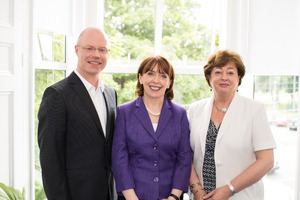
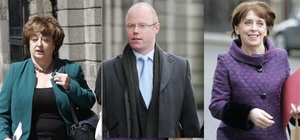
TDs Stephen Donnelly, Róisín Shortall and Catherine Murphy

Anne-Marie McNally writes:

TDs Catherine Murphy, Róisín Shortall, and Stephen Donnelly have agreed to launch an exciting new political venture. Speaking today the three TDs confirmed they have been engaged in ongoing discussions for some time. An event will take place on Wednesday to outline further details.

In a joint statement the three TDs said: “We are excited to be working together to offer a new credible political choice to the Irish electorate.” No further comment will be made until the event on Wednesday.

There you go now.

turnout:zapponemurphy:donnelly:shorthall

From top: Senator Jillian Van Turnout; Senator Katherine Zappone.; TDs from left, Catherine Murphy, Stephen Donnelly and Roisin Shorthall

Via Irish Independent:

The three TDs are linking up with Senators Katherine Zappone and Jillian van Turnhout, who are both the Taoiseach’s nominees in the Seanad.The new centre-left party is likely to be set up by the end of the month.
The party will lean heavily on centre-left economic policy, social justice campaigning and political reform.

Finally.

FIGHT!

Also a name anyone?

New party to be headed by Murphy, Donnelly and Shortall (Niall O’Connor, Independent.ie)

Screen Shot 2015-05-07 at 12.34.24

Last night – before Independent TD for Kildare North Catherine Murphy gave her  contribution to the Dáil debate on the sale of Siteserv – Independent TD for Wicklow and East Carlow Stephen Donnelly and People Before Profit TD for Dun Laoghaire Richard Boyd Barrett also had a few things to say.

Here’s what happened:

Stephen Donnelly: “Public trust in the political system in Ireland has collapsed and tonight’s debate is a perfect example of why that has happened. The only reason an investigation is being conducted into the sale of IBRC assets is because of the work of Deputy Catherine Murphy. The motion before the House concerns who should conduct that investigation but serious questions of political governance must also be investigated. Why did the Minister make no mention of his Department’s concerns in response to numerous parliamentary questions from Deputy Catherine Murphy? Did the Minister inform the Taoiseach, the Economic Management Council or the Cabinet about his Department’s concerns?”

If departmental concerns about this serious issue have been kept secret, what else has been kept secret? What other parliamentary questions have been avoided or fudged by the Minister? If these concerns are worthy of investigation, and they are, why is it only being done now, years after the Department raised its concerns? I will tell the House why. It is because the Minister’s cover-up has failed and he has nowhere left to hide.

Ceann Comhairle Seán Barrett: “The Deputy cannot make an allegation of a cover-up. I ask him to withdraw it.”

Donnelly: “I will withdraw the allegation of a cover-up – heaven forbid.”

Sean Barrett: “We have parliamentary procedure here. The Deputy cannot abuse privilege.”

Donnelly: “The motion before the House condemns the appointment of KPMG to undertake a review of transactions in IBRC as it advised Siteserv during the sale. The Government amendment acknowledges that and states that the sale process was run by Siteserv along with its advisers KPMG Corporate Finance and Davy Corporate Finance and calls on Dáil Éireann to support the review, which KPMG has been directed to conduct. It is extraordinary stuff. In essence, KPMG is being by the Government to investigate itself. This is not a perceived conflict of interest. It is the definition of a conflict of interest. The Government should ask KPMG to step down and appoint a person or organisation who was not involved in the deals under investigation. Should the Government refuse to do so, KPMG should take it upon itself to step back from this situation.”

Richard Boyd Barrett: “The context for this debate is what happened to ordinary citizens in this country in 2012. When some of us on this side of the House screamed in opposition to the vicious cuts imposed, particularly in budget 2012, that hit the most vulnerable people and when many people in this House asked in the same year whether the unsustainable debts of tens of thousands of ordinary mortgage holders who were just trying to keep a roof over the heads could be written down, we were told this could not happen under any circumstances because there would be moral hazard associated with doing it. At the same time that ordinary people were being told that they could not have their debts written down by the banks we had bailed out, those same banks were writing down the debts of companies to the tune of hundreds of millions of euro and to the benefit of some of the richest people in the country, including the richest person in the country. There were three or four different deals from which he benefited to the tune of hundreds of millions of euros in writedowns paid for by the taxpayer.”

“Concerns expressed by the Minister’s Department on foot of questions raised in this House at that time were simply covered up in the sense that the Minister did not bring those concerns to the attention of this House even though his own Department was saying it had concerns. Why has it taken years to drag this out of him instead of a Government that is supposed to be in favour of transparency coming before the Dáil and saying it had big concerns about what was happening with these writedowns? Why did the Minister not do that? This raises suspicions from the word go. When the Minister was finally forced to accept that there was something to look into, he got the insiders to do it. These are the people who were involved in this dubious sale – KPMG. It is unbelievable. He is asking people to investigate themselves. How can he seriously expect that to be a serious investigation?”

“Government Deputies piled into the Oireachtas Committee on Finance, Public Expenditure and Reform today to oppose a motion I put down that stated that the committee should ask some of the key players to come before it to answer questions. The Government does not want that either. Instead, it wants the insiders involved in the deal to investigate themselves. This is a joke and stinks to high heaven.”

Liam Twomey: “That is a lie.”

Sean Barrett: “I am now calling on Deputy…”

Boyd Barrett: “I am not. Government Deputies piled in and then…”

Interruptions

Boyd Barrett: “I ask Deputy Twomey to remain quiet. Deputy Twomey can reply when he is speaking.”

Twomey: “He cannot even tell the truth.”

Paul Murphy: “Is it not unparliamentary to accuse people of lying?”

Later

Twomey: “In respect of the charge made by Deputy Boyd Barrett against the Government, it was explained quite clearly to him and I will not repeat it in the Chamber because the committee was discussing a matter in private session. He knows exactly what the reasons were and that they had nothing to do with Government Deputies piling in.”

Boyd Barrett: “I do not accept the reasons and the Government Deputies did pile in.”

Twomey: “If we use the Chamber to just throw wild accusations around, we will have a very poor quality debate in this House. If I came in and started accusing members of Sinn Féin of being involved in things because they happened to be associated with other things, it would not go down too well either.”

Mary Lou McDonald: “It happens regularly. There is nothing new there. Apparently, it is not a breach of privilege either.”

Twomey: “No, because we have not accused it of anything even though it is always taking exception to something so perhaps I have hit a raw nerve. Opposition Deputies are not clear what they want from this debate. They said today that they are looking for an inquiry to be carried out by the Oireachtas Committee on Finance, Public Expenditure and Reform.”

Boyd Barrett: “I did not say “inquiry”.”

Twomey: “They want an inquiry carried out by the committee over the next number of weeks. We now listen to them saying that they want a full inquiry, which they know will take at least two or three years. They should make up their minds if they are really serious about telling the people of Ireland that they offer credible opposition. What in God’s name do they want to offer them because right now that stands for nothing? It just stands for populist, ranting one-liners that possibly work for them but they certainly do not work when it comes to delivering a proper sense of governance for this country. We can decide that we do not want a rapid inquiry that will deliver by the end of August and that we want an inquiry that will go on for over three or four years, like those we were used to in years gone by, and that would probably report back to some Dáil in the future when we are all long retired.”

Finian McGrath: “That is not what a commission of inquiry is about. It is short and snappy.”

Liam Twomey: “Opposition Deputies need to make up their minds. The way a few parliamentary questions in 2012 are forgotten by the Opposition and the sudden righteous indignation in this Chamber undermines how we should go about our work. If there are serious issues here, we need to have a quick inquiry to look into them and, if necessary, move on to a much deeper inquiry. To stand up here and just throw out accusations against people undermines the entire process. Does Deputy Paul Murphy think that every official in the Department of Finance is a crook?”

Murphy: “No.”

Twomey: “Just the ones who deal with IBRC? It is so easy to throw it out. Opposition Deputies do not know what they want. They do not know what type of inquiry they want. Their accusations are shocking. It is shocking how easily they accuse people and throw their names out with no regard. Deputy Finian McGrath talks about trust in the system. Does he seriously think that trust in the system results from throwing around accusations in the Chamber knowing he is protected by parliamentary privilege?”

McGrath: “I did not throw out any accusations.”

Twomey: “It is really shocking. I have listened to this debate.”

McGrath: “The Deputy is living in cloud cuckoo land.”

Twomey: “Obviously, I am clearly hitting a raw nerve with somebody here and they realise that the quality of the debate is no better than the 24-hour news cycle.”

Transcript via Oireachtas.ie

Last night: Bringing Down The House

donnelly

The money collected will only cover collection?

Of the money?

Yargh.

Independent TD Stephen Donnelly explains:

Last night the Dáil debated Irish Water…there was a lot of understandable emotion on all sides of the House, but I thought it would be useful to bring the stark facts back to the table:
1. The money paid by Irish households will not be used to pay for water…it will be used to pay for the cost of taking the money.
2. Even if the money could be raised for free, the answer is to reduce the operating costs of Irish Water, as is done abroad, and use those savings to upgrade the water infrastructure;
3. Irish Water has been set up in a cloud of incompetence and secrecy – and so I’ve written to the Chair of the Environment Committee requesting a full investigation.
Public services must be high quality, efficient, universally accessible, and paid for progressively…Irish Water is the latest example of an out-of-date political system stuck in the past, and incapable of delivering for the people.

Thanks Barry

donnelly

The Broadcasting (Amendment) Bill 2014, sponsored by Independent TD Stephen Donnelly in the wake of the Pantigate controversy, was debated in the Dail this morning.

The amendment proposes removing the word ‘offence’ from the ‘duties of broadcasters section’ of the Broadcasting Act 2009.

Dismissing the bill Communications Minister Pat Rabbitte said:

“The Deputy proposes this amendment in the full knowledge that a full refurbishment of the 2009 Act is under way. Put simply, the totality of this Bill is the excision of the two words “or offence”. What would happen if colleagues in the House generally started to trawl through statutes based on something they heard over their corn flakes on “What it says in the papers”, resolving to excise two words they do not like and call that proposal a Bill, and defending this legislative ingenuity on the basis of whatever argument is popular at the time?”

He added:

“I am considering an amendment that would require broadcasters to avoid causing undue offence. That seems to be more objective and more in tune with the realities of public debate and the Constitution.”

Prompting the following:

Donnelly:The Minister is known to enjoy words. Perhaps he believes that the more words he uses, the wiser he seems. Perhaps he also believes that legislation is only worthy of his consideration and that of Parliament if it contains lots of words. I accept that his views may not be listened to at Cabinet. The Welfare of Greyhounds Act 2011 was debated day after day in the Dáil, whereas legislation containing more words – for example, successive Finance and Social Welfare Bills – have been guillotined and the House denied the opportunity to debate them. The Cabinet may not agree that the more words it contains, the more worthy is a Bill of debate in the Parliament.”

Rabbitte: “This is a ludicrous argument.”

Donnelly: For all of his words, the Minister almost completely avoided commenting on the content of the Bill.

Rabbitte: What content?

Donnelly: “He referred to defamation and European law. He avoided the content of the Bill, which is extremely surprising in view of the fact that it is so specific and contains so few words.
The Minister may believe the Bill to be beneath him as a result of the fact that it contains so few words. However, the broadcasters do not believe this to be the case. It is for them that the Bills seeks to cater.
One such broadcaster is on record as stating – in the context of the inclusion of the word ‘offence” in the Broadcasting Act – that many of the interest and lobby groups on all sides in various debates now know it is worth complaining to RTE and threatening to go to the Broadcasting Authority of Ireland about offence caused. One such broadcaster is on record as stating – in the context of the inclusion of the word “offence” in the Broadcasting Act – that many of the interest and lobby groups on all sides in various debates now know it is worth complaining to RTE and threatening to go to the Broadcasting Authority of Ireland about offence caused.”
The intention is simply to influence future coverage. Complaints often relate to matters of public debate, including euthanasia, abortion, social welfare, Travellers, gay marriage and surrogacy. I worry that these complaints have a chilling effect.
Editors and producers sometimes avoid items precisely because they are afraid of potential complaints about offence caused. There is a great deal of work in answering these complaints and even a fear that a number of complaints implies to management that one has done something wrong. Producers and researchers who already work under tough and tight conditions will self-edit in the upcoming debates on same-sex marriage to choose items and guests who will not be risky, as it is not worth the fight or hassle. It is not just an issue in the culture wars; it is more widespread.
Each extreme in a debate is trying to exclude the other side and control how RTE covers stories.
The risk is that in giving in to this we will lose fresh, unheard and unique voices. Instead, we will hear again and again from the same tired, tried and tested contributors who have been briefed, rehearsed and sanitised. The Minister may believe the few words in the Bill to be beneath parliamentary debate, but they are the words of broadcasters. The word “offence” is stifling freedom of speech and causing a chilling effect across the country.”

Rabbitte: “The Deputy should not be ridiculous.Continue reading →

stephen donnellybill

“Earlier this year the scandal known as Pantigate erupted. It was kicked off by comments made by Rory O’Neill on the Saturday Night Show. It was escalated by the response of those branded homophobes who consequently threatened RTE with litigation. RTE capitulated and paid over €85,000 to six individuals. Maybe they should and maybe they shouldn’t have paid out, but they did so because of a serious flaw in the current Broadcasting Act.

“Here’s what RTE’s managing director, said in a letter to staff: “Having regard for broadcasting compliance issues, the seriousness of the legal complaints, and the decision by the complainants not to accept RTÉ’s proposed remedies, we decided that a settlement was the most prudent course of action. Senior counsel was consulted and confirmed that the legal position was far from clear.”

“This bill is an attempt to clarify one legislative issue at the heart of the Pantigate episode. That is, the removal the term “offence” from Section 39 of the Broadcasting Act. As legislators, we have a duty to show the LGBT community, and society at large, that free speech is something that the Oireachtas values. Something that we can – and will – protect.

“The existing Act requires broadcasters to not broadcast ‘anything which may reasonably be regarded as causing harm or offence’. This Bill removes the wording ‘or offence’. I do not believe people should be censored for saying offensive things, whether or not that offence is reasonably caused, or not. Determining what might be considered offensive – by anyone in our society – is a pretty hefty obligation to put on our broadcasters. It’s especially difficult when it comes to live broadcasting. TDs know that offence is something some people are determined to take no matter what the topic. Legislation that molly coddles those likey to take offence – regardless of what they’re offered – gags free speech, Harms public debate, and makes uncomfortable truths, invisible truths.

“The Act as it currently stands, and the recent scandal, will undoubtedly cause broadcasters to err on the side of caution.

“As a result, if we don’t make this change, free speech will begin to suffer right away. And litigious bullies can shut down any conversation they deem inconvenient.

“What this bill proposes, therefore, is to remove the reference to offence. Section 39 (1) (d) would therefore read: Every broadcaster shall ensure that “anything which may reasonably be regarded as causing harm or as being likely to promote, or incite to, crime or as tending to undermine the authority of the State, is not broadcast by the broadcaster.”

“We’ve heard in the press the minister is thinking about changing “harm or offence” to “harm or reasonable offence”. Any qualification of the term offence still hamstrings our broadcasters.It is also potentially troublesome in relation to European law.

“Article 11 of the European Charter of Fundamental Rights makes no reference to offence. Article 10 of the European Convention on Human Rights, which deals with freedom of expression, makes no reference to offence. RTE’s statement on respecting diversity is also at odds with the inclusion of ‘Offence’ in the legislation.

“Here’s what the statement says “As Ireland evolves into a more multicultural and ethnically diverse nation it is important that RTÉ reflects these changes. But equally programme-makers must be sensitive to areas of public opinion that are absent from public discourse because of the reticence of some people to express their views”.

“So we’re asking RTE not to broadcast anything that could cause offence, but at the same time to represent minority views, which we don’t often hear – which for whatever reason, may cause offense to some people in our society.

I look forward to seeing what the Minister brings forward, and hope to be able to support his proposals. However, the legislative process takes time. Were the Government to accept THIS Bill, it would almost immediately fix one of the biggest flaws in the legislation, and send a strong signal to broadcasters, minority groups, and those they offend, that Ireland values free speech.”

Independent TD Stephen Donnelly introducing an amendment.to the broadcasting act today.

FIGHT!

Thanks Steve Dempsey

donnellyenglishThis morning Independent TD Stephen Donnelly (left) and Fine Gael TD Damien English (right) spoke on Today with Seán O’Rourke on RTÉ Radio One about the proposed increase in charges for Freedom of Information requests.

Seán O’Rourke: “First of all, Stephen Donnelly, this is something which is coming up at a committee today, it’s being debated and there are amendments. The basic thing is is that there’s a €15 charge for a request but now, if it has several dimensions to it, applied to different departments within a particular institution, it’s €15 per department, is that it?”

Stephen Donnelly: “Per administrative unit check, good morning Seán, thank you for having me on the show. So the context here is important. There are only three countries in the world that charge upfront fees for Freedom of Information. I think we’re all agreed that secrecy in Government is a bad thing and transparency is a good thing. So only us, Israel and Canada currently charge upfront fees for Freedom of Information requests from media, from parliamentarians, from whoever. Canada charges €3.40, Israel charges €4, we currently charge €15, so about four times more than the other two countries. No country in Europe charges anything upfront. What the amendments that are being brought in, and at a very late stage, I’d like to say by Brendan Howlin, brought in on Friday and have caused uproar in the NUJ [National Union of Journalists] and amongst very serious professionals and academics, not sort of people who are used to banging drums and saying ‘this is crazy stuff’. Very, very serious professionals are saying, one of them Gavin Sheridan, for example, who worked on the Anglo Tapes, has said if this gets through, it will be the death of Freedom of Information in Ireland.

So what happens is, let’s say I, as a member of parliament, submit an FOI request to the Department of Finance. First of all I will be charged €15 for submitting a request. Now let’s say the official who gets that has to contact 30 other administrative units, that’s what it says in the amendment. There’s no definition of an administrative unit, it’s reasonable to think that that as a group, headed by a higher executive officer, so it’s entirely possible, let’s say I’m asking something around banking or finance, in other departments, any administrative unit that has to engage, will also charge €15. They will come back to me and say ‘well, actually deputy, the cost is not €15, it’s €450. And if you want to challenge, if they say you can’t have the information, which they’ve done to me in the past on some very important stuff that should be in the public domain, we’re going to charge you an awful lot more. And if you then take your appeal to the Information Commissioner, which, in my case, I have done, you’re going to get charged an awful lot more again. So it’s very, very important for us to understand: Everywhere else on Earth, it’s free or basically free. In Ireland, under the amendments that Brendan Howlin has tabled, and they’re going to go through today, it could cost several thousand euros. So this is very, very serious stuff for the country.”

O’Rourke: “Damien English, I know you’re not on this committee, but at the same time time, you have a view. Do you think the charges are justifiable?

Damien English: “Yeah, that’s unclear. There’s a few things I’d like to say, first of all. It’s very clear that 70% of FOI requests are made by private citizens are there is no charge made for them whatsoever. The other 30% would be kind of media or even TDs, or other peopler asking questions and very often the information is used for commercial reasons – but that 30%, yes there are charges there and the charges will slightly change – If the issue is unrelated. At the moment you have a lot of FOI request that have been put in, and you know there’s a main question, but then there’s an additional unrelated issue that needs to be addressed as well – and that’s where the charge will kick in. We need to be clear here Sean, it’s not free the gather the information – I mean, the average cost of an FOI request last year, of the non-personal information ones, was about 600 Euros – in man hours – that’s a high cost.”

O’Rourke:
“That would be all very fine Damien, if the new government elected in 2011 hadn’t made a pledge to reverse the changes that [former Finance Minister] Charlie McCreevy had brought in, was it 2003, to make the law what it had been before it was undermined. That presumably implied that you were going to remove the charges again completely?”

English: “The base scheme was to restore, to bring back the openness, the transparency, the accountability of public governance because in the ’03 changes made – there were major changes {made} to the actual information you could get, and who you could FOI.”

O’Rourke: “And that all happened, has it?”

English: “It has happened actually, this Bill does two things – it restores all the areas where the information was restricted and it brings in extensions as well – to bring in all public bodies and to all bodies that are basically funded by The State – and so there have been major changes there.”

Listen here

Previously: Jacking Up The Price of Freedom

(Photocall Ireland)

Donn Donnelly2

During Leaders’ Questions this morning Independent TD Stephen Donnelly took issue with the cut in Jobseeker’s Allowance for under 25-year-olds, from €144 to €100, while 25-year-olds will get €144 instead of €188.

Stephen Donnelly: “Taoiseach, with respect, there’s only one group of people here today and yesterday who are insulting the motivation of young people and that is the group of people you were saying you need to cut their social protection to get them to work. Because that is the logic that is being used. Minister Howlin came in here yesterday and said, I quote: ‘I am pleased to announce no reduction in the basic rates of social welfare for the people of working age’. He then announced a reduction in the rates of basic social welfare rates for people under 26. Are people under 26 not of working age? I’m confused. And then the Tánaiste on national radio this morning added insult to injury by saying ‘it’s not a cut’. In double speak, worthy of George Orwell, he explained it wasn’t a cut, the Government was simply ‘extending the lower rate to these people’. Extraordinary stuff. Here’s what Aideen Carbery, the chairperson of Labour Youth said about it: ‘It’s fundamentally unfair. It is our opinion that it will cause people to emigrate. We watched on with a sense of sadness and concern I don’t think that the problem with the unemployment crisis in this country is training. The issue is that there are not enough jobs.’ Labour Youth. Most of our young, unemployed are graduates. They are highly-educated and taking low-paid work to make ends meet. Taoiseach, this cut, not only displays a complete misunderstanding of the unemployment challenge faced by our youth. It’s not just bad economics, it’s discriminatory. This, to me, and I mean this most sincerely, this is an issue of human rights. You would not, and none of us would, I hope,  come in here and say ‘we are cutting basic social protections to non-whites, to women, to Muslims but that’s exactly what you’ve done. You’ve targeted a group of people based on age. So, Taoiseach, my question to you is this:  Do you accept that this cut discriminates based on age? Do you accept that that is not how we should do business in this country? Do you accept that these people are equal citizens in our country? And will you ask Minister Burton to remove this from the Social Protection Bill before it comes before this House? Thank you.”

Watch here

Previously: ‘We’re not cutting their benefits’

Related: Labour Youth condemns cuts in social welfare for young people